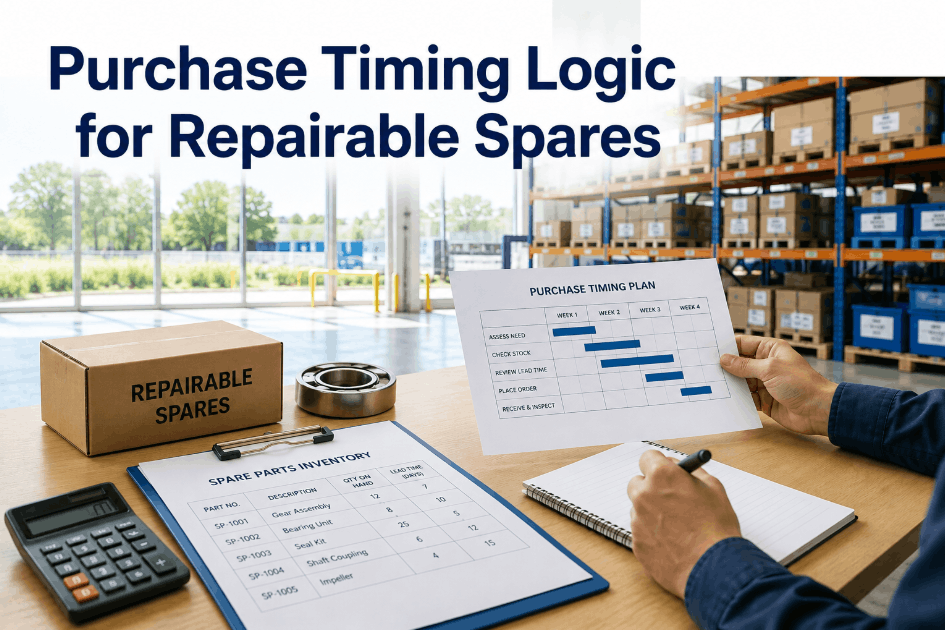
Repairable spares operate under a fundamentally different procurement logic than consumable materials. A replenished consumable arrives from a supplier; a repairable spare may return from an external repair vendor, an in-house workshop, or a third-party exchange pool — each with its own lead time, cost profile, and availability window. When procurement teams apply standard min-max reorder models to repairable spares, they routinely generate both unnecessary purchase orders (for items already in repair return queues) and dangerous stockouts (when repair cycle times extend beyond expected return dates). Purchase timing logic for repairable spares must account for repair turnaround time, in-repair quantity, failure frequency, and criticality class simultaneously — balancing procurement triggers against actual net available stock rather than recorded quantity on hand. Oxmaint's parts and inventory module links repairable spare records to work order history, repair job tracking, and purchase management in one platform — so teams can Sign Up Free and begin applying demand-aware purchase timing logic to their repairable spare population from day one. For plants managing repairable spares across multiple equipment classes and repair vendors, Book a Demo to see how Oxmaint's procurement intelligence handles repairable inventory differently from consumable stock.
Oxmaint tracks repairable spares across procurement, in-repair, and available states — so purchase timing decisions reflect net available stock, not just quantity on hand in the stores bin.
6 Repairable Spare Variables That Must Drive Purchase Timing Decisions
Effective purchase timing logic for repairable spares requires tracking multiple moving variables simultaneously. Oxmaint connects spare part records to asset failure history, repair job status, and vendor lead time data — so procurement teams can Sign Up Free and base purchase triggers on net availability and demand patterns rather than static reorder point thresholds.
Distinguish between quantity on hand in stores and true net available stock — accounting for units currently in external repair, in-house workshop queue, and in-transit from repair vendors before triggering a new purchase order.
Compare average repair turnaround time against mean time between failures for the associated asset — when repair cycles consistently exceed demand intervals, proactive procurement is warranted to prevent coverage gaps.
Apply different reorder trigger levels based on spare criticality class — safety-critical and production-critical spares require higher net stock buffers before purchase is deferred, while non-critical items can tolerate lower availability thresholds.
Track actual vs promised lead times per repair vendor and OEM supplier — when lead time variance is high, purchase timing logic must build in earlier trigger points to absorb delivery unpredictability without creating stockout exposure.
Define the cost point at which repairing a spare becomes less economical than purchasing new — automating the decision boundary so procurement teams are not repeatedly evaluating the same ageing component class without a structured framework.
Align purchase timing windows with scheduled maintenance intervals — procuring or scheduling repair returns ahead of known PM demand periods rather than reacting to consumption events after the planned work order has already stalled.
Repairable Spare Procurement KPIs: What MRO and Maintenance Teams Should Track
Standard inventory KPIs built for consumable materials fail to capture the circular flow of repairable spares. Oxmaint's procurement and inventory analytics layer tracks spare lifecycle stages — available, issued, in-repair, in-transit — giving maintenance and procurement teams the metrics needed to optimise purchase timing decisions and defend capital allocation for critical spare holdings. Teams evaluating CMMS platforms for repairable spare management should Book a Demo to see the full procurement analytics capability before shortlisting.
| KPI | What It Measures | Decision It Supports | Review Frequency | Priority |
|---|---|---|---|---|
| Net Available Stock per Spare | On-hand minus in-repair and committed units | Purchase trigger and deferral decisions | Weekly | Critical |
| Repair Cycle Time per Vendor | Average days from issue to repair return | Lead time buffer and reorder point setting | Monthly | Critical |
| Failure Frequency per Asset Class | Mean time between spare consumption events | Demand interval vs repair cycle comparison | Monthly | Critical |
| Stockout Events for Critical Spares | Work orders stalled by zero net availability | Safety stock and purchase timing adequacy | Weekly | Important |
| Repair vs Replace Cost Ratio | Repair cost as percentage of new unit cost | Economic repair boundary decisions | Quarterly | Important |
| In-Repair Population Size | Units currently with repair vendors or workshop | Unnecessary purchase order prevention | Weekly | Important |
| Vendor Lead Time Variance | Actual vs promised repair/supply lead time | Vendor selection and buffer recalibration | Monthly | Routine |
| Planned Maintenance Demand Forecast | Spare requirements from scheduled PM events | Advance procurement and repair scheduling | Monthly | Routine |
How Plants Activate Repairable Spare Purchase Timing Logic Without a BI Project
The obstacle is rarely awareness of the problem — it is the absence of a platform that tracks repairable spares through every lifecycle stage and connects that data to purchase management automatically. Oxmaint closes this gap with spare records linked to asset history, repair job status captured in work orders, and procurement triggers connected to net availability rather than raw QoH. Maintenance and procurement teams can Sign Up Free and begin applying lifecycle-aware purchase timing logic from the first repair cycle without custom configuration or IT involvement.
- Spare status tracked across available, issued, in-repair, and in-transit stages
- Net available stock calculated automatically excluding units in repair or committed to work orders
- Repair job records linked to spare part entries with expected return dates
- Purchase triggers evaluated against net availability — not raw quantity on hand
- Vendor lead time history accumulated per supplier for buffer recalibration
- Role-based access: technicians log usage, procurement sees live net stock and purchase analytics
- Ordering spares already in repair? Net stock visibility prevents duplicate purchase orders
- No repair cycle data? Repair job records accumulate actuals per vendor automatically
- Criticality-blind reorder models? Configurable thresholds by spare criticality class
- Multi-vendor complexity? Lead time variance tracked per supplier across all repair categories
- Repair vs replace ambiguity? Cost ratio tracking triggers economic review at defined thresholds
- Audit readiness? Every procurement trigger and spare movement is timestamped and attributed
Repairable Spare Procurement Optimisation: Investment vs Savings Model
Per-user pricing with no infrastructure overhead and no custom development fees. Repairable spare lifecycle analytics and purchase timing intelligence go live within the first 30 days of deployment.
Without net stock visibility, procurement teams routinely order spares already in the repair return pipeline — generating unnecessary purchase commitments that inflate inventory value without adding net availability.
When repair cycle times exceed demand intervals without a purchase buffer, work orders for critical assets stall — generating downtime costs that far exceed the capital investment in a well-timed spare procurement programme.
Plants that implement net-availability-based purchase triggers report 20–35% reductions in unnecessary spare purchase orders by eliminating procurement decisions made against raw QoH rather than actual net stock.
Repair-cycle-aware purchase timing ensures critical spares are procured before net availability drops to stockout risk levels — reducing maintenance delays and unplanned downtime events caused by spare procurement gaps.
Accumulated repair cost and cycle time data enables data-backed vendor selection and repair vs replace decisions — replacing subjective judgement with economic analysis that finance teams can independently validate.
Why Maintenance Teams Choose Oxmaint for Repairable Spare Purchase Timing
Oxmaint is not a standalone procurement system — it is a maintenance execution platform with repairable spare lifecycle tracking, work order history, and purchase management integrated into a single workflow. Purchase timing intelligence is generated from actual maintenance operations, not assembled from disconnected repair logs and procurement exports. Teams can Book a Demo to see how repairable spare procurement logic integrates with work order execution and vendor management in one operational view.
Oxmaint tracks each repairable spare across available, in-repair, in-transit, and committed states — giving procurement teams net availability data rather than misleading raw QoH figures for purchase timing decisions.
Repair jobs are logged inside Oxmaint's work order module with expected return dates and vendor attribution — connecting repair pipeline data directly to net stock calculations without manual tracking spreadsheets.
Net available stock, repair cycle time per vendor, failure frequency by asset class, and in-repair population size available without custom reporting configuration or BI tool licensing.
Configure different reorder thresholds by spare criticality class — ensuring safety-critical and production-critical spares carry adequate net stock buffers while non-critical items are managed at lower holding levels.
Actual repair and supply lead times are accumulated per vendor in Oxmaint — enabling procurement teams to recalibrate purchase timing buffers as lead time performance data builds across the repair programme.
Every purchase trigger, repair job, and stock movement is timestamped and user-attributed — supporting capital spares justification, insurance valuation, and maintenance budget reviews without manual data assembly.
Oxmaint tracks every repairable spare through its full lifecycle — giving maintenance and procurement teams net stock visibility, repair cycle analytics, and criticality-weighted purchase timing without spreadsheet management.
Purchase Timing Logic for Repairable Spares — Questions MRO Teams Ask
Oxmaint subtracts units currently in external repair, in-house workshop queue, and committed to open work orders from the recorded quantity on hand — providing a net availability figure that reflects true procurement need rather than raw stock position.
Yes. Because Oxmaint tracks in-repair population against net stock thresholds, purchase triggers are evaluated against actual availability — spares with sufficient units in the repair return queue will not generate unnecessary procurement alerts.
Actual repair turnaround times are accumulated per vendor in Oxmaint's records — allowing procurement teams to set vendor-specific lead time buffers and recalibrate purchase timing thresholds as performance data builds over successive repair cycles.
Yes. Oxmaint supports criticality classification per spare — enabling different net stock thresholds and purchase trigger points for safety-critical, production-critical, and non-critical spare categories within the same inventory system.
Oxmaint accumulates repair cost history per spare unit — giving maintenance and procurement teams the data needed to evaluate whether continued repair investment remains economical against the cost of new procurement at defined review thresholds.
Most teams see live net stock visibility and repair pipeline data within 30–45 days once work orders begin logging spare usage and repair jobs. Meaningful purchase timing benchmarks typically emerge within the first two full repair cycles.
Oxmaint gives maintenance and procurement teams repairable spare lifecycle tracking, repair-cycle-aware purchase timing, and criticality-weighted availability analytics — no spreadsheets, no duplicate orders, no stockout surprises.