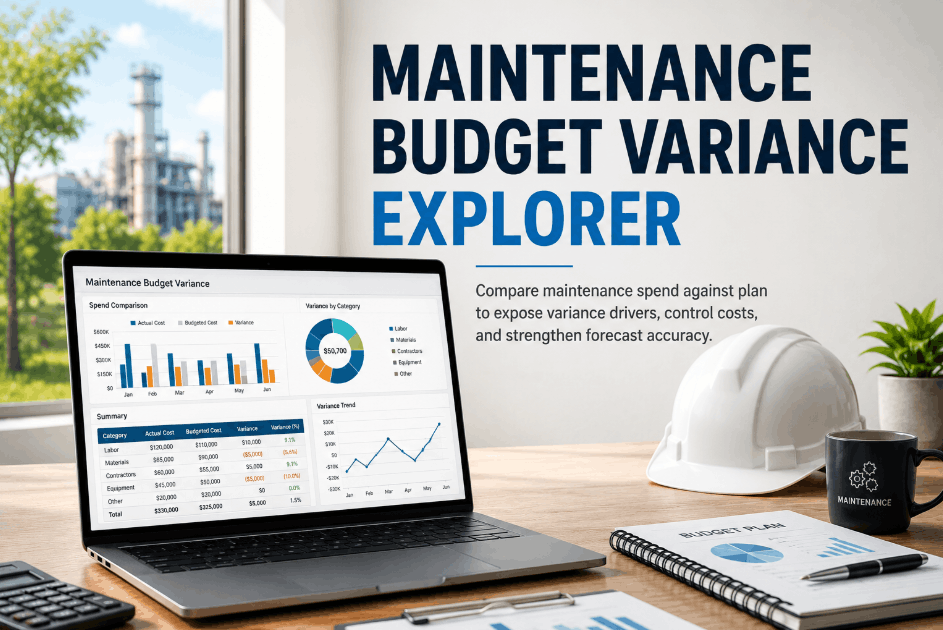
Maintenance budget variance analysis is how maintenance managers determine whether spending deviations from plan represent unavoidable operational reality or controllable cost discipline failures — yet most facilities lack the work order cost structure to distinguish between the two with confidence. When maintenance spend cannot be compared against budget at the asset, cost center, or work type level, variance drivers remain opaque, forecast accuracy deteriorates each period, and budget conversations default to reactive justification rather than proactive cost governance. Maintenance teams using Sign Up Free on OxMaint can track labor, parts, and contractor costs against work orders, compare actual spend to planned maintenance budgets, and generate the variance reporting that finance, operations, and plant management require to evaluate maintenance cost performance with confidence.
Why Maintenance Budget Variance Requires Work Order-Level Cost Tracking
Budget variance analysis that operates only at the department or cost center level cannot identify which work types, assets, or cost categories are driving overspend — making corrective action impossible to target. When labor hours, parts costs, and contractor invoices are captured at the work order level in OxMaint and compared against the planned maintenance budget, variance explorers can drill from total spend deviation to specific cost driver within minutes rather than weeks of manual reconciliation. Book a Demo to see how OxMaint's work order cost structure provides the granularity your maintenance budget variance analysis requires to expose root causes, not just totals.
Five Maintenance Budget Variance Driver Categories
Not all maintenance budget variance represents uncontrolled overspend — and separating avoidable from unavoidable variance is the first task of a useful budget explorer. OxMaint's work order cost data enables variance categorization by driver type, allowing maintenance managers to report justified variance with evidence and target controllable variance with corrective action. Sign Up Free to configure OxMaint's work order cost fields and variance reporting for your maintenance budget management program.
Reactive Corrective Work Volume Above Plan
Corrective work order volume that exceeds planned allowance represents the most common and highest-value maintenance budget variance driver. OxMaint's corrective vs. planned work order ratio reporting identifies which asset classes and failure modes are generating the most unplanned spend — pointing directly to PM compliance gaps or asset condition problems requiring investment.
Parts and Materials Cost Escalation
Parts cost variance against budget plan is driven by emergency procurement premiums, substitution cost differentials, and consumption volumes above planned rates. OxMaint's parts issuance records by work order type allow variance explorers to separate emergency-purchase premium cost from underlying consumption volume variance — targeting the right corrective lever.
Contractor Scope and Rate Variance
Contractor spend variance results from scope creep on maintenance work orders, rate changes, or unplanned contractor engagement for emergency response. OxMaint contractor work order records with budget attachment allow post-period variance analysis that separates approved scope additions from unauthorized spend growth.
PM Labor Hours Above Standard Time Estimates
When PM execution takes longer than the standard hours budgeted, labor cost variance accumulates across high-frequency PMs without a single identifiable work order trigger. OxMaint's actual vs. standard hours reporting on PM work orders identifies which task types and asset categories are consistently over-running planned labor estimates.
Budget Forecast Errors from Prior Period Under-Capture
Maintenance budgets built on incomplete prior-period data systematically underestimate actual cost by omitting informal labor charges, undocumented parts pulls, and unassigned contractor invoices. OxMaint's closed work order cost completeness tracking flags gaps in cost capture before they propagate into next-cycle budget inaccuracy.
Maintenance Budget Variance by Cost Category and Work Type
Variance analysis at the cost category and work type level reveals patterns that aggregate reporting obscures — enabling maintenance managers to address overspend at its source rather than applying uniform budget reductions that harm PM compliance and increase future corrective costs. Book a Demo to see how OxMaint's cost reporting segments maintenance spend by work type, asset class, and cost category for structured budget variance exploration.
| Cost Category | Common Variance Direction | Primary Variance Driver | Controllability | OxMaint Tracking Method |
|---|---|---|---|---|
| Corrective Labor | Over budget | Reactive work volume, PM compliance gaps | Partially controllable | Corrective vs. planned work order labor hours report |
| PM Labor | Under or over budget | Compliance rate, standard hour accuracy | Highly controllable | PM compliance rate + actual vs. standard hours tracking |
| Spare Parts and Materials | Over budget | Emergency procurement, consumption variance | Partially controllable | Parts issuance by work order type + purchase order linkage |
| Contractor Spend | Over budget | Scope creep, emergency engagement, rate changes | Controllable with work order discipline | Contractor work order budgets + variance flag reporting |
| Project and Overhaul Costs | Over or under budget | Scope changes, scheduling shifts | Controllable at planning stage | Project work order cost tracking against approved budget |
Four Outcomes of a Structured Maintenance Budget Variance Program
Maintenance budget variance exploration that produces structured, actionable outputs delivers four categories of financial and operational value — each of which justifies the discipline investment required to build work order cost capture and variance reporting in OxMaint. Sign Up Free to begin tracking maintenance spend against budget in OxMaint and build the variance history that improves forecast discipline and cost control across your facility's maintenance program.
Building a Maintenance Budget Variance Explorer with OxMaint
Attach Budget Estimates to All Planned Work Orders
Configure OxMaint PM and project work orders with planned labor hours, estimated parts cost, and contractor budget values before execution begins. Budget attachment at the work order level is the prerequisite for any planned vs. actual variance calculation that produces actionable output.
Capture Actual Costs on Every Closed Work Order
Require technicians and supervisors to record actual labor hours and parts used on all work orders before closing in OxMaint. Complete actual cost capture on every closed work order — planned and corrective — is the data completeness requirement that makes variance analysis meaningful rather than partial.
Segment Variance Reports by Work Type and Asset Class
Run OxMaint variance reports filtered by corrective vs. preventive work type, by asset criticality class, and by cost category — separating the variance signals that require different corrective responses from the total spend deviation that aggregate reporting cannot decompose.
Identify Top Variance Contributors by Asset and Failure Mode
OxMaint's work order cost data filtered by asset and failure code identifies which specific assets and failure modes are generating the largest positive variances — enabling targeted investigation and corrective investment that addresses variance at its operational source rather than its financial symptom.
Feed Variance History into Next-Cycle Budget Planning
Extract OxMaint's prior-period variance data by cost category and work type as the input to next-cycle maintenance budget construction. Variance-informed budgets systematically close the forecast accuracy gap that causes maintenance finance reporting to repeat the same deviations period after period.
Frequently Asked Questions: Maintenance Budget Variance Explorer
What is maintenance budget variance analysis?
Maintenance budget variance analysis compares actual maintenance spend against planned budget by work type, cost category, and asset class — identifying the drivers of deviation so managers can separate justified from controllable overspend and target corrective action precisely.
Why does maintenance variance analysis require work order-level cost data?
Department-level variance reporting cannot identify which assets or work types are driving overspend. Work order-level cost capture in OxMaint enables drill-down from total variance to specific cost drivers — making corrective action targetable rather than anecdotal.
How does OxMaint support maintenance budget variance exploration?
OxMaint captures planned and actual costs on every work order, segments variance by work type and asset class, identifies top variance contributors, and generates the reporting that maintenance managers use for budget governance and next-cycle forecast improvement.
What is the most common maintenance budget variance driver?
Unplanned corrective work volume above plan is the most common and highest-value driver in most facilities. It typically traces to PM compliance gaps or asset condition deterioration — both of which OxMaint records can identify and support corrective action programs to address.
How does variance history improve future budget forecast accuracy?
Prior-period variance data from OxMaint work order records shows which cost categories and work types consistently over- or under-run plan — allowing budget planners to incorporate actual performance patterns into next-cycle estimates rather than repeating assumptions that have already proven inaccurate.
![maintenance-cost-tracking-template-for-plant-managers-[free-excel-2026]](./manage-post-2k26/uploads/maintenance-cost-tracking-template-for-plant-managers-[free-excel-2026].png)


