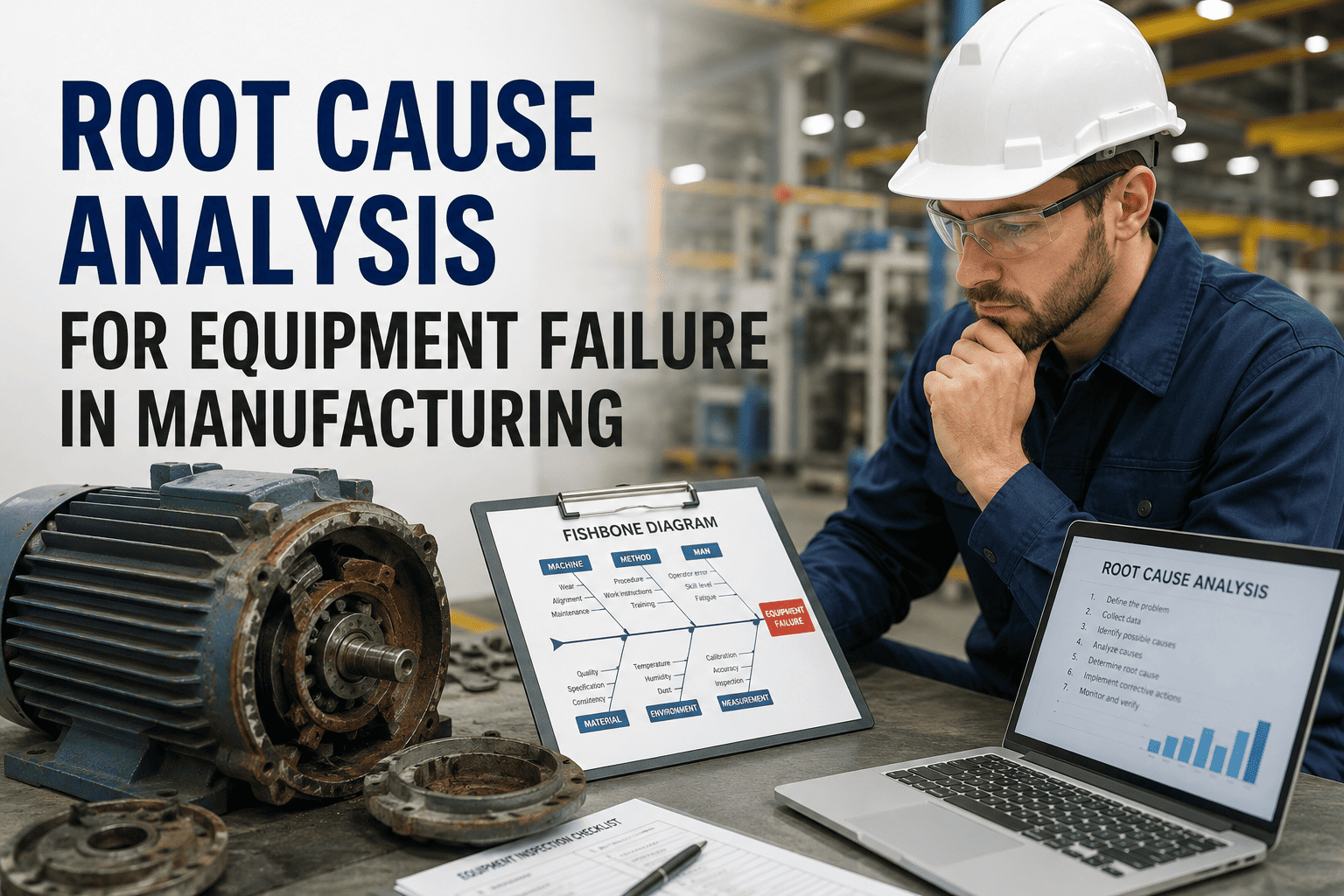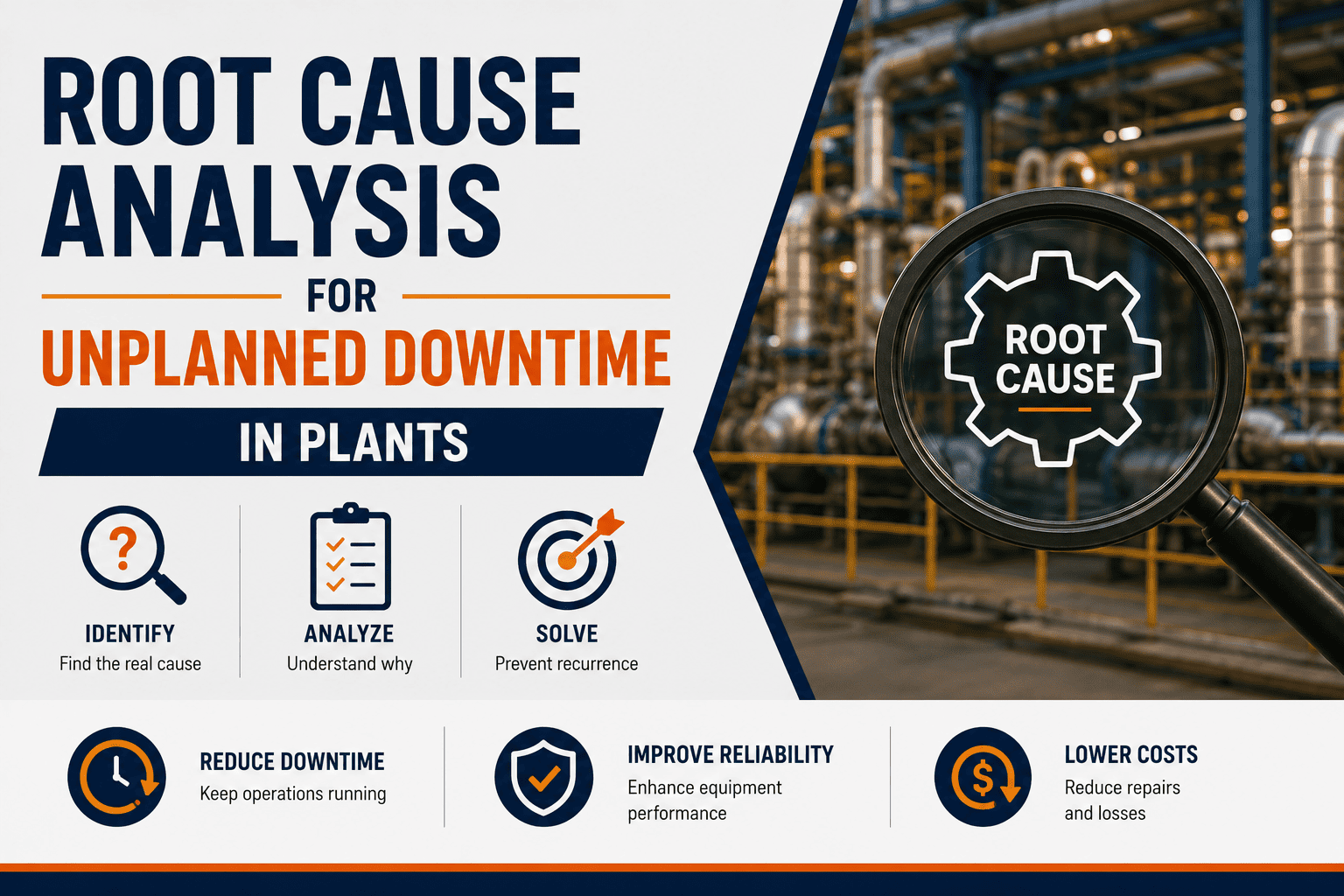
Unplanned downtime root cause analysis is the difference between a plant that fixes the same equipment failure three times a quarter and one that eliminates it permanently. When a critical asset goes down, the immediate repair is only the first step — a structured root cause analysis (RCA) for manufacturing downtime ensures you trace every recurring breakdown to its mechanical, operational, or systemic origin so it never repeats. Plants that skip RCA typically spend 40% more on reactive labor and replacement parts year over year, while those that log RCA findings in their CMMS cut chronic failures by up to 70%. OxMaint's AI-powered CMMS turns every downtime investigation into a permanent fix — you can Start Free Trial today or book a demo to see how digital work orders and predictive analytics close the loop on recurring failures.
DOWNTIME INVESTIGATION GUIDE
Are you repairing the same equipment failure — again?
Reactive maintenance burns $50 billion annually across U.S. manufacturers. A structured downtime RCA method replaces repeated fixes with permanent solutions — turning every unplanned breakdown into a documented, data-driven corrective action inside your CMMS.
THE TRUE COST OF INACTION
What unplanned downtime actually costs your plant
Most maintenance teams underestimate the cost of a single hour of downtime by 50-60% because they only count labor and the replacement part. A complete downtime analysis includes lost production, scrap, expedited shipping, overtime, and the cascading risk of secondary failures on degraded equipment.
STEP-BY-STEP METHOD
How to run a downtime RCA — from 5 Whys to fishbone analysis
A repeatable RCA method for plants follows a disciplined sequence: stabilize the asset, gather evidence, select the right analytical tool, validate the root cause, and assign a permanent corrective action — all logged inside your CMMS so the learning is never lost.
Stabilize & Preserve Evidence
Before the investigation begins, secure the asset in a safe state and preserve sensor logs, alarm histories, and failed components. Photograph the failure mode, bag the fractured part, and freeze the last 72 hours of SCADA data. Roughly 60% of RCAs stall because the scene is cleaned before the team arrives.
Form a Cross-Functional Team
Pull the reliability engineer, the operator who was on shift, and the maintenance technician who executed the repair. Downtime investigations that include the operator resolve 45% faster because they capture process upsets (speed changes, material swaps) that maintenance alone never sees.
Select the Right RCA Tool
Use the 5 Whys for straightforward, single-cause failures (a seized bearing due to missed lubrication). Deploy fishbone analysis (Ishikawa) when multiple contributing factors across Man, Machine, Method, Material, Measurement, and Environment are suspected. Apply Fault Tree Analysis (FTA) for complex, redundant systems where safety interlocks or PLC logic are involved.
Validate the True Root Cause
Before assigning a fix, prove the cause. If lubrication starvation is suspected, confirm the auto-luber reservoir was empty and the line pressure dropped below spec. Validation prevents the most expensive RCA mistake — fixing a symptom while the real failure root cause quietly persists for another 90 days.
Log Corrective Action in the CMMS
Every RCA must end with a corrective work order, an updated PM checklist, or a parts-modification request — linked to the original breakdown. If the finding is not in the CMMS, the next technician will repeat the same temporary repair. OxMaint closes this loop automatically.
Monitor MTBF & Verify the Fix
Track Mean Time Between Failures for 90-180 days post-correction. If MTBF does not improve, reopen the RCA. This final step is what separates downtime prevention from downtime postponement.
RCA METHOD COMPARISON
Which RCA tool fits your equipment failure analysis?
Choosing the wrong RCA framework wastes hours. Use this reference to match the failure pattern to the right analytical method so your team spends time solving, not debating process.
| RCA Method | Best For | Time Required | Output |
|---|---|---|---|
| 5 Whys | Simple, single-path mechanical failures (e.g., bearing seizure from missed grease) | 15–30 min | One validated root cause + corrective work order |
| Fishbone (Ishikawa) | Chronic failures with suspected human, process, and material factors | 1–2 hours | Ranked list of contributing factors across 6 categories |
| Fault Tree Analysis | Complex, redundant systems with safety interlocks, PLC logic, or multiple sensors | 3–6 hours | Boolean logic diagram showing all paths to the top failure event |
| FMEA Review | Recurring failures on critical assets where a PM strategy redesign is needed | 4–8 hours | Updated RPN scores and a revised preventive maintenance plan |
WORKED EXAMPLE
Downtime RCA in action: the 5 Whys done right
A 180-asset food packaging plant was losing $42,000 a year replacing the same conveyor drive motor every 90 days. Each replacement cost $1,800 in parts and 4 hours of line downtime. A structured 5 Whys downtime investigation revealed the real problem — and it was not the motor.
PLATFORM INTEGRATION
How OxMaint closes the loop on recurring equipment failures
A downtime RCA is only as good as the system that enforces the corrective action. OxMaint's AI-powered CMMS captures the failure data, recommends the RCA framework, and tracks every corrective work order to closure — so the learning compounds instead of evaporating.
Digital Failure Code Logging
Every unplanned work order prompts the technician to select an ISO 14224 failure mode and damage code before closure. This standardized tagging makes downtime analysis searchable across thousands of assets and highlights chronic failure patterns in weeks, not years.
Built-In RCA Templates
Trigger a 5 Whys, Fishbone, or FTA template directly from any breakdown work order. The completed RCA auto-links to the asset history and the original failure event, eliminating disconnected spreadsheets and lost email threads.
Predictive Failure Alerts
OxMaint's AI monitors vibration, temperature, and pressure sensor data to flag degradation before a breakdown occurs — giving your team the window to perform a planned RCA instead of a midnight emergency repair. Plants using OxMaint predictive maintenance cut unplanned downtime 30-50%.
Corrective Action Tracking
Every RCA outcome generates a linked corrective work order or PM update with a due date and an owner. Dashboards flag overdue actions in red, ensuring that the permanent fix is actually executed — not just written on a whiteboard.
STOP THE REPEAT CYCLE
See OxMaint on your assets — book a 30-min demo
Watch how maintenance teams turn every breakdown into a permanent corrective action, cut unplanned downtime 30-50%, and eliminate paper work orders in their first 30 days.
FREQUENTLY ASKED QUESTIONS
Root cause analysis for unplanned downtime — FAQs
What is the best root cause analysis method for manufacturing downtime?
For most unplanned downtime events, the 5 Whys method is the fastest and most effective starting point — it takes 15-30 minutes and works for 80% of single-cause mechanical failures. For chronic failures involving multiple factors (operator, material, environment), escalate to a fishbone analysis. For complex systems with safety interlocks or PLC logic, use Fault Tree Analysis. The best method is always the one your team will actually execute and log inside their CMMS.
How do I stop recurring equipment failures in my plant?
Recurring failures persist because the corrective action is never tracked to closure. To break the cycle, mandate a documented RCA for every critical-asset breakdown, link the findings to a corrective work order in your CMMS with a named owner and due date, and monitor MTBF for 90 days. If MTBF does not improve, reopen the RCA. You can Start Free Trial on OxMaint to automate this entire tracking loop.
Who should be on an RCA team for a major equipment breakdown?
A strong RCA team includes the maintenance technician who performed the repair, the operator who was running the line when the failure occurred, and a reliability engineer or maintenance manager to facilitate. Including the operator is critical — they often hold the missing context about process upsets, material changes, or unusual sounds that preceded the failure. Keep the group to 3-5 people to stay efficient.
How long should a downtime investigation take?
A standard 5 Whys investigation should take 15-30 minutes and can be completed during or immediately after the repair. A fishbone analysis for a chronic failure typically requires 1-2 hours in a focused meeting. A full Fault Tree Analysis for a complex, high-risk system may take 3-6 hours spread across a week. The goal is not speed — it is a validated root cause and a corrective action logged before the next shift.
How does a CMMS support downtime RCA and prevention?
A CMMS like OxMaint supports RCA by standardizing failure-code logging on every work order, storing completed RCA templates directly on the asset history record, auto-generating corrective work orders with due dates, and providing analytics dashboards that flag assets with declining MTBF. To see how this works on your asset register, Book a Demo and we will walk you through a live downtime-to-corrective-action workflow in 30 minutes.
YOUR NEXT STEP
Turn your next breakdown into your last one
Join the maintenance and reliability teams using OxMaint to cut unplanned downtime 30-50%, eliminate paper work orders, and make recurring failures a thing of the past.
Free 14-day trial · No credit card