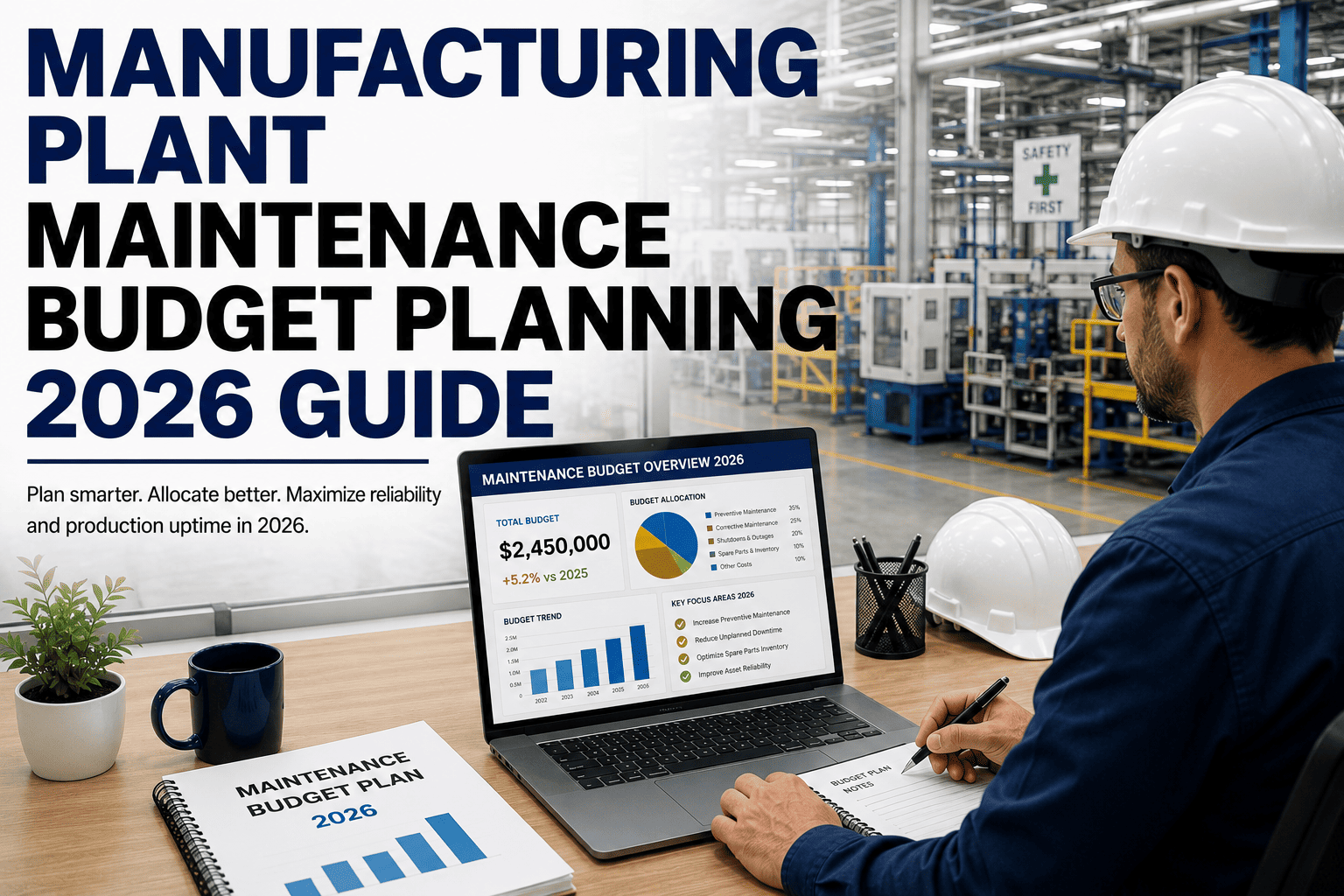
US manufacturers spend over $100 billion annually on equipment maintenance — yet most maintenance budgets are built by adding an inflation percentage to last year's spend rather than anchoring to actual asset value, failure history, and strategic reliability targets. That approach systematically over-funds reactive repair and under-funds reliability improvement, keeping maintenance cost ratios 40–60% higher than world-class benchmarks. OxMaint's analytics and reporting dashboard gives manufacturing finance and maintenance leaders the cost attribution data, RAV-based benchmarking, and ROI modeling to build maintenance budgets that reduce total spend while improving asset availability. Book a free OxMaint demo to see how data-driven budget construction works in your facility.
Maintenance Budgeting · Cost Benchmarks · RAV Metrics · OxMaint Analytics
Maintenance Budgeting in Manufacturing: Cost Benchmarks, RAV Metrics & ROI Optimization
A maintenance budget built on gut instinct or last year's numbers is not a budget — it is a blank check for reactive maintenance. The facilities that consistently spend less on maintenance and experience less downtime build budgets around one foundational metric: Maintenance Cost as a Percentage of Replacement Asset Value (MC/RAV). Everything else follows from that anchor.
World-Class Target
1–2%
MC/RAV — achieved through predictive and condition-based maintenance
Well-Managed Program
2–3%
MC/RAV — strong planned maintenance ratio, limited reactive spend
Acceptable Range
3–5%
MC/RAV — reactive work significant; improvement opportunities visible
Needs Intervention
5%+
MC/RAV — reactive-dominant program; budget at risk of spiraling further
The Core Metric
What Is MC/RAV and Why Every Maintenance Budget Should Start Here
Replacement Asset Value (RAV) is the current cost to replace your entire asset base with new, identical equipment at today's prices — not book value, not depreciated value, not insured value. MC/RAV expresses annual maintenance spend as a percentage of that figure, creating a size-independent benchmark that works across facilities, industries, and years.
Why Not Just Track Total Spend?
A $2 million maintenance budget is neither large nor small without context. Against a $20 million RAV it represents 10% — a serious problem. Against a $200 million RAV it represents 1% — excellent efficiency. Total spend numbers are meaningless without the asset value denominator that RAV provides.
Why Not Just Track Cost Per Unit?
Cost per unit produced is a useful secondary metric but is distorted by production volume swings. A facility running at 60% capacity will show worse maintenance cost per unit than the same facility at full capacity — even with identical maintenance performance. RAV removes production volume from the equation entirely.
Why Not Just Watch the Budget Line?
Budget line compliance tells you nothing about whether you are spending efficiently or on the right activities. A facility that comes in under budget by deferring critical PMs has improved the budget number while worsening its future cost position. MC/RAV reveals the actual program quality behind the spend figure.
Cost Anatomy
Where Does Your Maintenance Budget Actually Go?
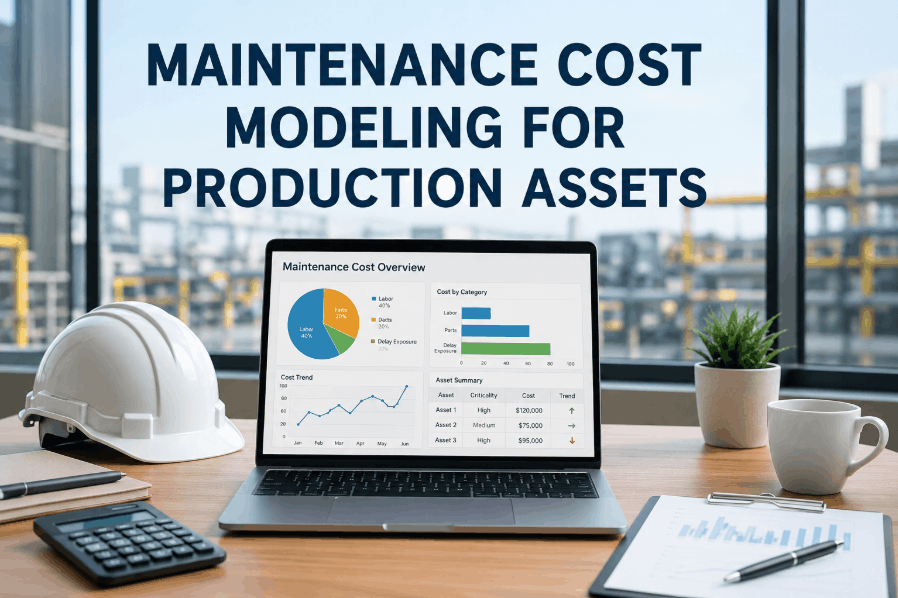
Understanding the cost structure of your maintenance program is the prerequisite to optimizing it. Most manufacturing facilities have four direct cost categories and one indirect cost category that dwarfs all the others combined.
Typical Maintenance Cost Distribution — Manufacturing Plant
Labor (internal technicians)
30–40%
Spare parts and materials
25–35%
Contracted services
15–25%
Tools, technology, overhead
5–10%
Production downtime losses (indirect — often unreported)
Exceeds all direct costs
The largest maintenance cost is rarely in the maintenance budget — it lives in production's revenue loss line
The Hidden Cost Problem
Unplanned downtime costs Fortune Global 500 companies 11% of annual turnover. For a $100M revenue manufacturer, that is $11M in losses — most of it caused by maintenance failures that were not in anyone's budget line. When maintenance budgets exclude downtime consequence costs, they systematically understate the ROI of reliability investment and make it harder to justify spending on prevention.
$260K+
Average cost of a single unplanned industrial breakdown when downtime losses are included
Do you know your current MC/RAV ratio — and how it compares to your industry benchmark?
OxMaint's analytics dashboard calculates MC/RAV automatically from your work order and asset data, tracking it monthly against your facility-specific benchmark target. No manual spreadsheet required.
The Cost of Reactive Maintenance
Why Reactive-Dominant Programs Always Cost More — The Budget Math
The single most impactful lever in maintenance budgeting is the planned versus reactive work ratio. Reactive maintenance is not just a reliability problem — it is a financial multiplier that inflates every cost category simultaneously.
Emergency labor (overtime/call-out premium)
+25–50%
Expedited parts (next-day freight vs standard)
+30–80%
Secondary damage from run-to-failure
2–5× repair cost
Production downtime during diagnosis
Hours unplanned
Contractor premium (unscheduled visit)
+40–100%
Total cost vs same job as planned maintenance
3–5× higher per event
Standard labor during regular shift hours
Base rate
Parts ordered on standard lead time
Catalog price
Controlled scope — no secondary damage
Contained cost
Production window scheduled in advance
Minimal loss
Contractor scheduled at negotiated rate
Standard rate
Total cost vs reactive for same repair scope
Baseline cost
20–28%
Reduction in total maintenance spend achievable by moving from bottom-quartile to top-quartile planned maintenance ratio — without changing headcount or equipment
88–92%
Planned maintenance ratio at world-class manufacturing facilities. Industry average is 40–60% — leaving substantial budget recovery on the table
Budget KPI Framework
The Six Financial Metrics Every Maintenance Budget Should Track
These are not theoretical measures — they are the operational financial metrics that maintenance managers and plant finance teams track quarterly to prove budget efficiency, justify investment, and identify where spend is going to waste.
MC/RAV Ratio
World-class: <2%
Good: 2–3%
Average: 3–5%
Poor: >5%
Primary budget anchor metric. Normalizes spend against asset base for cross-facility and year-on-year comparison. Track quarterly; set annual improvement target of 0.3–0.5% reduction.
Planned vs Reactive Ratio
World-class: >88% planned
Good: 70–88% planned
Average: 50–70% planned
Poor: <50% planned
Strongest predictor of total maintenance cost. Every 10-point shift toward planned work reduces total program cost by 5–8% as emergency premiums, expedited parts, and secondary damage are eliminated.
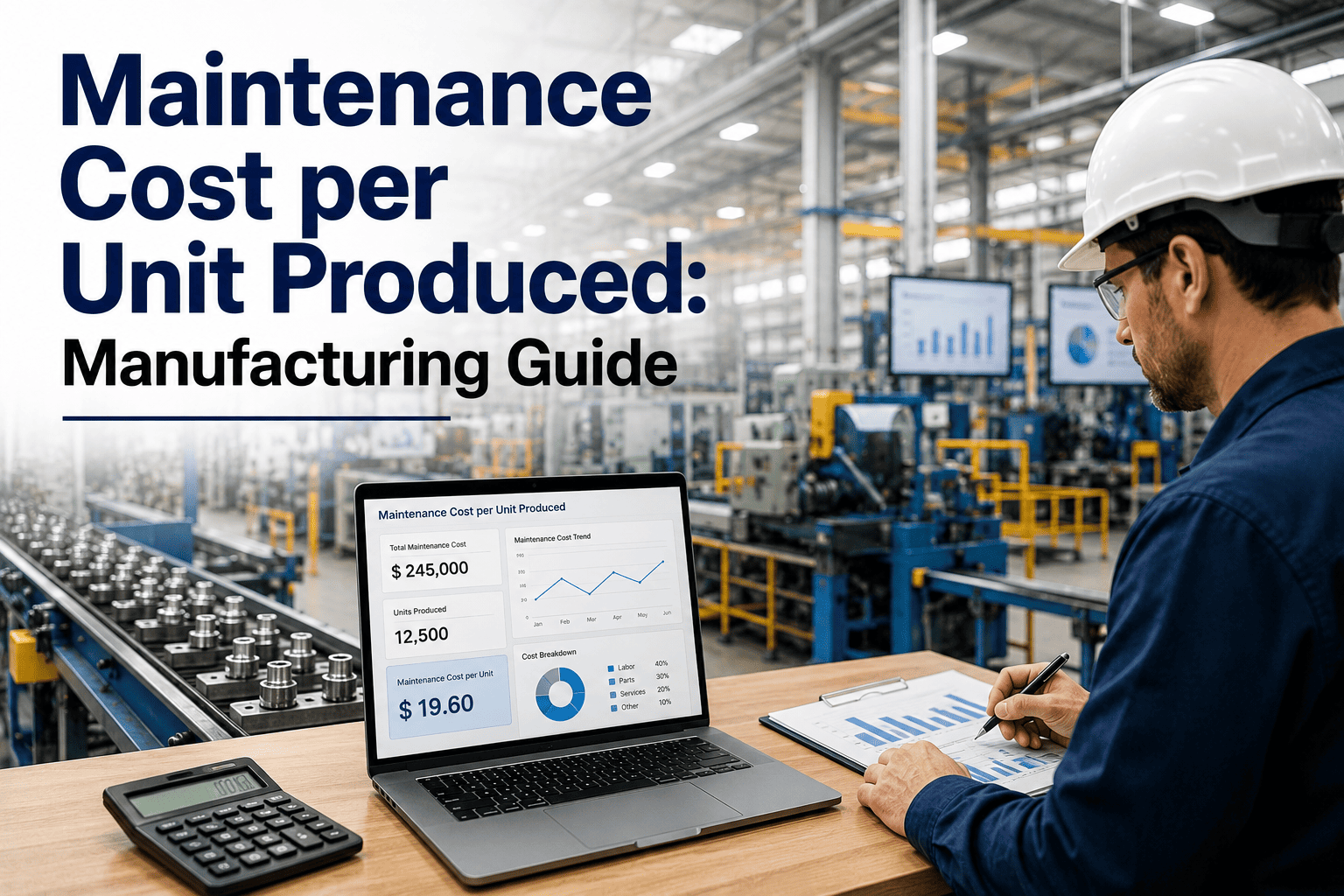
Maintenance Cost Per Unit Produced
Benchmark: industry-specific; track trend
Target: decrease YoY
Watch: rising trend vs flat production
Flag: rising despite stable volume
Links maintenance cost directly to production output. Useful for operations finance reporting and connecting maintenance investment to per-unit manufacturing economics. Best used alongside OEE tracking.
MRO Inventory as % of RAV
World-class: <0.5%
Good: 0.5–1%
Average: 1–2%
Excess: >2%
Excess MRO inventory ties up working capital without improving reliability. World-class facilities manage inventory to demand patterns; excess stock often signals poor work order planning and reactive purchasing habits.
PM Compliance Rate
World-class: >95%
Good: 85–95%
Developing: 70–85%
At risk: <70%
Low PM compliance is the earliest leading indicator of a future reactive maintenance cost spike. When PMs are skipped, the failures they prevent accumulate in the backlog and erupt as emergency repairs — typically 8–12 weeks later.
Emergency Work Order Rate
World-class: <10% of total WOs
Good: 10–15%
Watch: 15–25%
Crisis: >25%
Emergency work orders carry cost premiums across every line item. Tracking this rate weekly — not monthly — gives early warning of reliability deterioration before it impacts the budget line. OxMaint flags this in real time on the dashboard.
Industry Benchmarks
MC/RAV Benchmarks by Industry: Where Does Your Plant Stand?
RAV benchmarks vary significantly by industry because of differences in equipment complexity, operating environment, asset criticality, and maintenance intensity. Use this reference to set your facility-specific target rather than applying the generic 2–3% figure without industry context.
| Industry |
Typical MC/RAV Range |
World-Class Target |
Primary Cost Driver |
Budget Focus Area |
| General Manufacturing |
2–5% |
2–2.5% |
Reactive repair premium on rotating equipment |
Planned maintenance ratio improvement |
| Food & Beverage Processing |
2–5% |
Below 2.5% |
Sanitation compliance and hygienic equipment requirements |
PM compliance and sanitation scheduling integration |
| Steel & Heavy Metals |
3–6% |
2–3% |
High capital equipment wear in harsh environments |
Condition monitoring reducing unplanned shutdowns |
| Chemical & Process |
2–4% |
Below 2% |
Corrosion, high-pressure containment, safety compliance |
Inspection regime and regulatory compliance cost |
| Automotive Assembly |
1.5–3.5% |
Below 1.5% |
High-volume line stoppage cost during unplanned downtime |
TPM and autonomous maintenance to reduce maintenance labor |
| Power Generation |
2–5% |
Below 2.5% |
Outage duration and replacement power cost during downtime |
Outage planning optimization and parallel task scheduling |
ROI Modeling
How to Build the Business Case for Maintenance Budget Investment
The ROI of maintenance investment is consistently underestimated because downtime costs are rarely attributed to maintenance in financial reporting. Building a complete ROI model requires three steps: baseline costs, intervention costs, and quantified avoided losses.
Step 1
Establish True Baseline Cost
Calculate total maintenance cost including production downtime losses — not just direct maintenance spend. For most facilities, including downtime consequences increases the apparent cost of reactive maintenance by 3–5×. This reframing is essential: it makes the ROI of preventive investment obvious rather than marginal.
True Cost = Direct Spend + (Downtime Hours × Production Revenue per Hour)
Step 2
Model the Intervention Cost
Define the specific investment: CMMS implementation, condition monitoring sensors, planned maintenance expansion, or reliability engineering resources. Assign a realistic one-time implementation cost and an ongoing annual operational cost. Use OxMaint's 18-month typical ROI payback benchmark to set expectations with finance leadership.
Investment = Implementation Cost + (Annual Operating Cost × Payback Period)
Step 3
Quantify Avoided Losses
Model the financial impact of specific improvement targets: a 10-point shift in planned maintenance ratio, a 20% reduction in emergency work orders, a 0.5% MC/RAV improvement. Each of these has a calculable dollar value against your actual revenue and asset base. Use OxMaint's reporting dashboard to track actual versus modeled improvement in real time.
Annual Saving = (Reactive Events Reduced × Avg Reactive Premium) + (Downtime Hours Recovered × Revenue/Hour)
Worked Example — Mid-Size Manufacturer
Current MC/RAV
4.5% = $900K/yr
Target MC/RAV
2.5% = $500K/yr
Annual Budget Recovery
$400,000
A 2-point MC/RAV improvement on a $20M asset base recovers $400,000 annually — typically 2–4× the cost of the CMMS and reliability program investment that achieves it.
Common Questions
What Manufacturing Finance and Maintenance Teams Ask About Maintenance Budgeting
How do I calculate RAV for our plant if we don't have a formal asset register?
Start with your accounting department's total asset value for production equipment — not book value, but replacement cost if available. A practical shortcut is to request current-price quotes from vendors for your major equipment categories and extrapolate across asset classes. Once you have a working RAV estimate,
OxMaint's asset management module allows you to build a formal asset register progressively — starting with your highest-value equipment and expanding over time. Even a rough RAV estimate produces more useful budget guidance than no benchmark at all, and accuracy improves as the asset register develops.
Our MC/RAV is above 5% — where should we focus first to reduce it?
The fastest return comes from reducing emergency work order rate and shifting the planned versus reactive ratio — these two levers address the cost premium problem directly. Analyze your last 12 months of work orders to identify which assets generated the most reactive events: typically 20% of assets generate 80% of emergency maintenance cost. Focusing reliability investment on those specific assets produces disproportionate budget improvement.
Book a demo with OxMaint to see how the analytics dashboard surfaces these high-cost assets automatically and prioritizes them for PM schedule development or condition monitoring deployment.
How does OxMaint help track maintenance budget performance in real time?
OxMaint's analytics and reporting dashboard automatically calculates MC/RAV, planned versus reactive ratio, PM compliance, emergency work order rate, and cost per asset from live work order data — no manual extraction required. Budget actuals update as work orders are closed, giving finance and maintenance leadership a real-time view of cost trajectory versus plan.
Start a free OxMaint account to begin tracking these metrics immediately — the dashboard populates from your first work orders, with historical data importable from existing CMMS or spreadsheet records to establish your baseline benchmark.
Should maintenance be budgeted as CapEx or OpEx, and how does that affect the investment case?
Day-to-day maintenance labor, parts, and contractor services are operational expenditure (OpEx) and flow through the P&L. Capital replacement of end-of-life assets that cannot be maintained cost-effectively is CapEx. The RAV metric helps resolve the repair-versus-replace decision: when annual maintenance cost on a specific asset consistently exceeds 15–20% of its individual replacement value, the economic case for capital replacement typically outperforms continued maintenance OpEx.
Speak with our team about how OxMaint's per-asset cost tracking surfaces these repair-versus-replace trigger points automatically, before the decision becomes reactive rather than planned.
Analytics & Reporting · RAV Benchmarking · Maintenance Cost Optimization
Your Maintenance Budget Deserves the Same Rigour as Every Other Line on Your P&L.
OxMaint's analytics dashboard gives manufacturing teams the MC/RAV tracking, cost attribution, and ROI reporting to build maintenance budgets that reduce total spend and prove the financial value of reliability investment — in a language finance leadership actually understands.