Planning and scheduling are not the same maintenance function, and confusing them is why so many plants run jam-packed schedules yet still miss their compliance targets. The distinction is clean once you see it: planning answers what needs doing, how, and with which materials — the preparation that happens days or weeks ahead. Scheduling answers when the job runs and who does it — the assignment that happens for the current week. One removes obstacles before the technician arrives; the other decides the order of play once the obstacles are gone. When the two collapse into a single overworked "planner/scheduler," that person spends all day fighting today's fires and never has time to prepare next week's work, so the plant stays stuck in reactive mode permanently. The cost shows up in one number: in a typical factory a technician spends only 25 to 35% of the day actually turning wrenches. The rest is walking to the parts room, hunting for a manual, waiting for a machine to free up, and looking for a tool — and that waste is a planning and scheduling failure, not the technician's fault. This guide separates the two functions, the two roles, and the metrics that prove they are working. Start a free Oxmaint trial and build job plans your scheduler can drop straight into a week, or book a demo to see the planned backlog and weekly schedule as separate views.
Manufacturing · Work Management · Planning & Scheduling
Maintenance Planning vs Scheduling: Manufacturing Guide
The difference between maintenance planning and scheduling — planner versus scheduler roles, job plan creation, the ideal planner-to-technician ratio, and how top plants split the two for higher wrench time.
-
25–35%
of a technician's day is actual wrench time
-
1 : 20–25
ideal planner-to-technician ratio
-
1–2 wks
how far ahead a planner works the backlog
-
90%+
world-class schedule compliance target
Two Functions, Four Questions
What Each Function Actually Answers
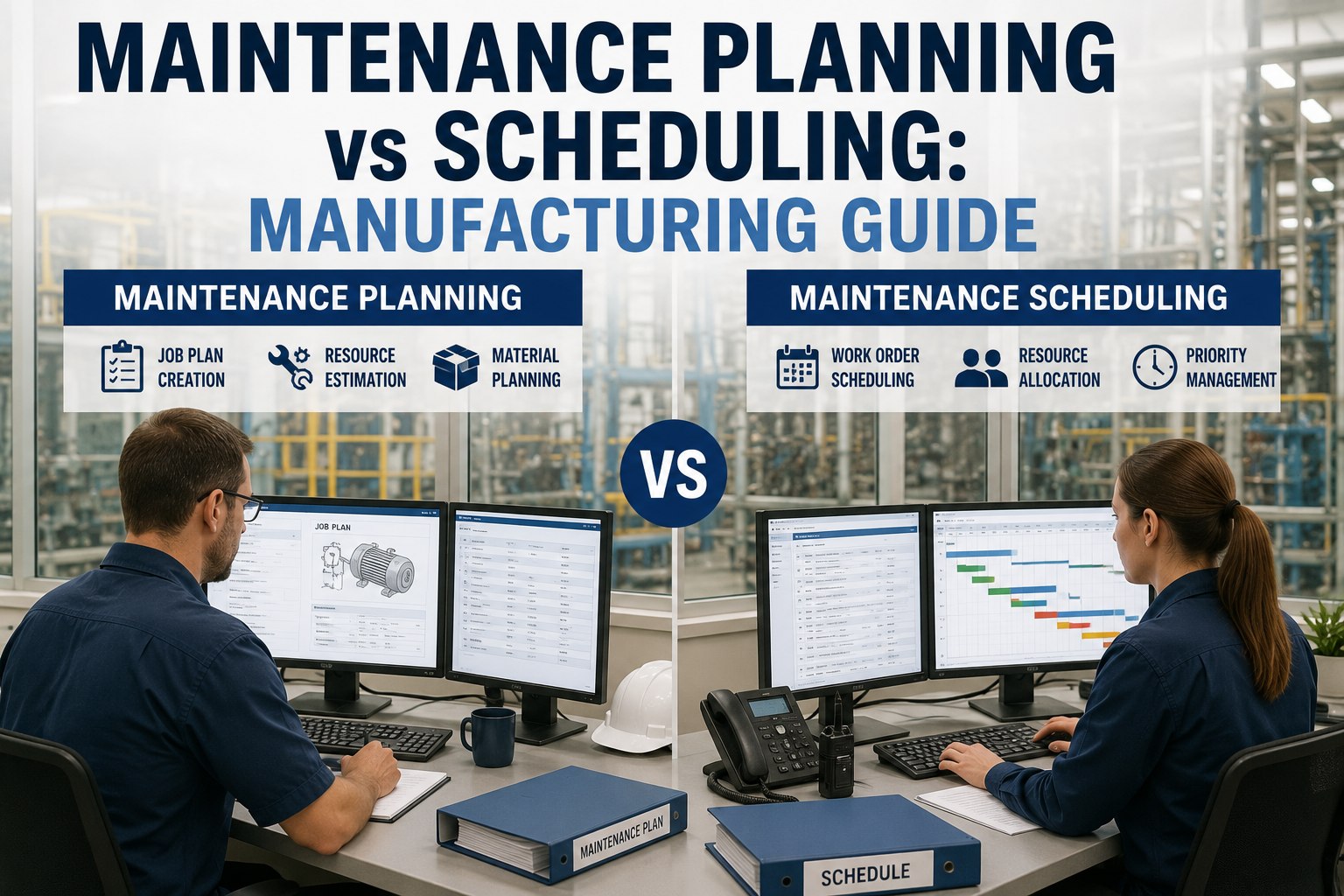
The cleanest way to hold the distinction: planning owns two questions, scheduling owns two others. Planning is preparation and happens ahead of time; scheduling is coordination and happens for the week at hand.
-
Planning — Preparation
What · How · Materials
The planner converts a work request into a complete, executable job plan — every task, part, tool, and safety requirement identified before the order reaches a technician. Labor is estimated, parts are kitted and staged, permits attached. The goal is that when the technician arrives, they start working immediately.
-
Scheduling — Coordination
When · Who
The scheduler takes ready-to-go job plans and decides when each runs and who performs it, balancing technician availability, skills, and equipment downtime windows with production. A scheduled job has a defined start and end, with all resources assigned and coordinated to minimize total cost.
The order is one-directional: all preparation is completed upfront so scheduling can proceed without friction. When planning is skipped or rushed, scheduling becomes guesswork. Book a demo to see a planned backlog feed the weekly schedule.
The Same Job, Two Ways
One Motor Replacement, With and Without a Plan
Nothing shows the difference faster than watching an identical job run both ways. This is a motor swap — the same failure, the same technician, two completely different days.
-
Unplanned
- Tech walks to the machine, sees the motor is bad
- Walks to the parts room — motor is out of stock
- Orders the motor, waits two days
- Motor arrives, walks back to the machine
- Realizes a lift is needed, goes to find one
4 hours of walking, 1 hour of work
-
Planned & scheduled
- Planner sees the request, orders the motor
- Reserves the lift, prints the SOP and permit
- Job sits in backlog until parts arrive
- Scheduler assigns it for Tuesday at 9:00 AM
- Tech arrives — motor and lift are already there
Start immediately, finish in one visit
The waste in the first column is not the technician's fault — it is the absence of planning, and it is the most expensive way to run a department. Sign up for Oxmaint to build parts and permits into the job plan.
Two Roles, Kept Separate
Why the Planner Must Not Become the Scheduler
The functions map to two roles, and the single most common failure is letting them merge. A planner pulled into scheduling this week's work stops preparing next week's — and the planned backlog dries up.
-
1
The planner works ahead
Separated from the execution crew, the planner works 1–2 weeks out: building job plans, verifying and kitting parts, maintaining SOPs and equipment history, and owning the ready-to-schedule backlog. -
2
The scheduler works the week
Often the supervisor who knows each technician's skill, the scheduler sequences the ready backlog into a daily and weekly plan, coordinating with production for downtime windows. -
3
The schedule is communicated ahead
Best practice is handing tomorrow's schedule to the trades at end of day. Worst practice is posting work orders and letting technicians self-select what to do next. -
4
Feedback closes the loop
Technicians report missing parts or tools and as-found conditions; the planner refines future job plans from it. Planning and scheduling become a continuous improvement loop, not a handoff.
Even a one-person show should separate the time — schedule and fight fires in the morning, plan next week in the afternoon — or reactive mode never ends. Book a demo to see planner and scheduler views kept distinct.
The Numbers That Prove It Works
Metrics, Ratios, and Healthy Targets
Planning and scheduling maturity is measurable. These are the benchmarks that tell you whether the split is functioning — and where it is breaking down.
| Metric | Target | What It Tells You |
|---|---|---|
| Wrench time | 55%+ (from 25–35%) | How much of the day is real work |
| Schedule compliance | 90%+ world-class | Planning quality and scheduling both |
| Planned maintenance % | 80%+ | Share of work that is planned, not reactive |
| Planner-to-tech ratio | 1 : 20–25 | Enough planning capacity to stay ahead |
| Work order backlog | 2–4 weeks | Healthy queue without a bottleneck |
Two warning signs live in the job-plan estimates: consistently high completion times mean plans are unrealistic; wildly varying times mean they are unbalanced. Reactive plants often start below 50% schedule compliance and climb as planning matures. Sign up for Oxmaint to track wrench time and schedule compliance.
Oxmaint for Planning & Scheduling
How Oxmaint Splits the Two Functions
-
Job Plan Builder
What, How, Materials
Convert a request into a complete job plan — tasks, labor estimate, parts, tools, and safety permits — in the desktop view, so the technician can start the moment they arrive. Well-crafted job plans are the single biggest driver of wrench-time gains.
-
Ready Backlog
Waiting-on-Parts, Then Ready
Hold planned jobs in a status-tracked backlog — marked waiting on parts, then flipped to ready when they arrive — so the scheduler only ever pulls from work that is genuinely executable.
-
Weekly Schedule
When and Who
Assign ready jobs to qualified technicians across the week against availability and downtime windows, keeping the scheduling view separate from the planning view so neither role bleeds into the other.
-
Parts Staging
Kitted Before Start
Link spare parts from inventory to the job and reserve them ahead, since parts availability at job start is the leading cause of delay — pre-staging removes it entirely.
-
Plan Library
Reusable by Asset
Maintain equipment-specific job plans, manuals, failure history, and as-found/as-left records in one place, so the next job on the same asset is planned faster and repeat failures are caught.
-
P&S Metrics
Wrench Time to Compliance
Track wrench time, schedule compliance, planned-maintenance percentage, and backlog age, so the split's payoff is visible and the warning signs in plan estimates surface early.
Frequently Asked
Planning vs Scheduling Questions
What is the difference between planning and scheduling?
Planning is preparation: it answers what work needs doing, how, and with which parts, tools, and permits, and it happens days or weeks ahead of execution. Scheduling is coordination: it answers when each planned job runs and who performs it, and it happens for the current week. The planner removes every obstacle before the technician arrives; the scheduler sequences that ready work against technician availability and production downtime. All preparation is completed upfront so scheduling proceeds without friction — when planning is skipped, scheduling becomes guesswork. Book a demo to see planning and scheduling as distinct steps.
What is the ideal planner-to-technician ratio?
Industry best practice is one dedicated planner for every 20 to 25 field technicians. That ratio lets planners work 1–2 weeks ahead of execution and maintain a healthy planned backlog without becoming a bottleneck in the work order pipeline. Crucially, the planner should be separated from the execution crew — a planner who gets pulled into daily firefighting stops preparing future work, and the backlog of ready jobs collapses, pushing the plant back into reactive mode.
What is wrench time and why does it matter?
Wrench time is the share of a technician's day spent actually working on equipment rather than walking to the parts room, searching for manuals, waiting for a machine to free up, or hunting for tools. In a typical factory it is only 25 to 35%, and world-class programmes target 55%+. The gap is almost entirely a planning and scheduling problem, not a technician-effort problem — well-crafted job plans that stage parts and tools ahead of time are the single greatest driver of wrench-time improvement. Sign up for Oxmaint to see wrench-time drivers in one place.
Can one person do both planning and scheduling?
It is not ideal, but if it is unavoidable, separate the time rather than the person doing both at once. The classic trap is a combined "planner/scheduler" who spends all day reacting to today's emergencies and never finds time to prepare next week's work, leaving the team stuck in reactive mode permanently. The practical fix is to schedule and fight fires in the morning and plan next week in the afternoon — a firm time boundary that protects the preparation work from being eaten by the current day's chaos. Book a demo to protect planning time from firefighting.
Prepare · Sequence · Separate · Measure
A Full Schedule Is Not the Same as a Productive One
Every technician who arrives to find the part out of stock, every planner pulled into today's fire instead of next week's prep, and every work order handed over with a "go figure it out" is wrench time lost to a function that was never separated from the other. Oxmaint gives manufacturing teams one platform to build complete job plans, hold a ready-to-schedule backlog, assign the week against real availability, stage parts before start, and track wrench time and schedule compliance — so planning prepares the work and scheduling runs it, and the two never collapse into the same overloaded seat.