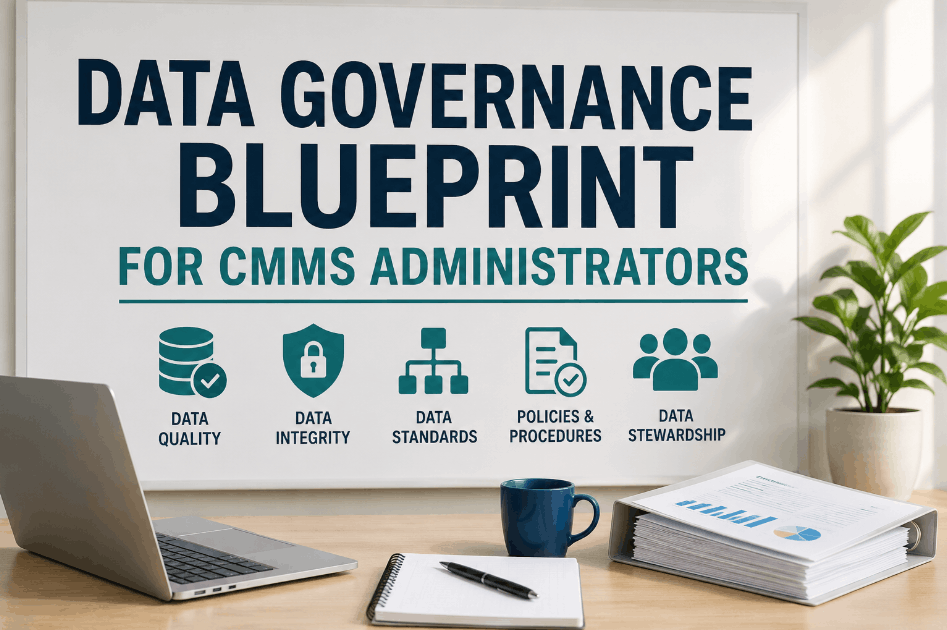
Manufacturing maintenance data governance is the discipline of defining who owns, validates, and standardizes every asset record, failure code, and work-order entry inside your CMMS — because without it, reliability analytics deliver noise instead of insight. Plants that enforce clear CMMS data standards, structured failure-code taxonomies, and spare-parts naming rules routinely cut unplanned downtime 20–40% and recover thousands of labor hours previously lost to hunting for bad information. This guide lays out a practical plant data governance framework — from master-data ownership to CMMS data cleanup — and shows how OxMaint automates data-quality enforcement so your maintenance team can act on trustworthy analytics. Ready to replace spreadsheet chaos with governed, audit-ready maintenance data? Start Free Trial and see the difference on day one.
Is bad CMMS data silently draining your plant's reliability?
Manufacturers lose an estimated $50B annually to unplanned downtime — and the root cause is rarely the assets. It is the broken, inconsistent, and ungoverned maintenance data flowing through the CMMS that hides failure patterns, misroutes work orders, and stalls predictive analytics for years.
Why manufacturing plants need maintenance data governance
ISO 55000-certified plants treat maintenance data as a strategic asset, not a clerical byproduct. Yet most facilities still operate without formal CMMS data governance — no naming conventions, no failure-code ownership, and no validation rules — which is why 60–70% of reliability analytics projects fail to produce actionable insight.
The five pillars of CMMS data governance for manufacturing
A workable manufacturing data management framework rests on five pillars. Each pillar assigns clear ownership, defines enforceable standards, and closes the feedback loop so data quality improves continuously rather than decaying after go-live.
Data ownership and stewardship
Assign a named maintenance data steward — usually a reliability engineer or CMMS administrator — accountable for master-data accuracy. Without an owner, asset records drift: duplicate pumps appear, locations go missing, and criticality ratings go stale within months.
Asset naming standards
Define a structured asset-naming convention (e.g., Plant-Area-Function-Sequence) and enforce it at CMMS entry. ISO 14224-aligned naming lets reliability teams aggregate failure data across identical pumps, motors, and compressors instead of treating each asset as unique.
Failure-code taxonomy
Replace free-text "problem" fields with a hierarchical failure-code taxonomy: Problem → Cause → Remedy. Plants that deploy structured failure coding see 40% faster root-cause analysis and unlock the clean datasets that predictive maintenance models depend on.
Spare-parts naming rules
Govern spare-parts inventory with standardized descriptions, manufacturer part numbers, and criticality flags. Duplicate or vaguely named SKOs ("Pump Seal — Old") inflate inventory 15–30% and cause emergency purchases when a critical spare can't be found in the CMMS.
Data-quality validation rules
Enforce mandatory fields, drop-down selections, and format checks at the work-order entry point — not after the fact. CMMS data quality rules prevent technicians from closing work orders without a failure code, labor hours, or parts consumed, keeping analytics trustworthy.
How to run a CMMS data cleanup without stalling reliability analytics
A CMMS data cleanup does not have to be a multi-year project that freezes reporting. A focused 90-day sprint — backed by automated data-quality tooling — can recover enough trustworthy records to restart reliability analytics and feed predictive models.
Audit and baseline data quality
Export the full asset register, work-order history, and spare-parts list. Score each record for completeness, duplicates, and naming-convention compliance. A typical 180-asset plant discovers 40–60% of records need correction before analytics can be trusted.
Standardize and deduplicate
Apply the asset-naming standard, merge duplicate equipment records, and remap spare-parts to a single SKU convention. Deploy the failure-code taxonomy and reclassify the last 12 months of work orders so historical trends become comparable.
Enforce rules and relaunch analytics
Activate mandatory-field validation, launch clean PM compliance and MTBF dashboards, and brief the maintenance team on the new data-entry standards. Reliability analytics go live on a governed dataset — no more garbage-in, garbage-out.
A 180-asset food-processing plant spending $42K/yr on emergency parts and losing 6 hours/week to work-order confusion ran a 90-day CMMS data cleanup. By deduplicating 73 spare-parts records, enforcing a 4-tier failure-code taxonomy, and activating mandatory-field validation, the plant cut unplanned downtime 22%, reduced emergency parts spend by $11K, and recovered 180 labor hours per quarter — all before adding any new sensors or predictive models.
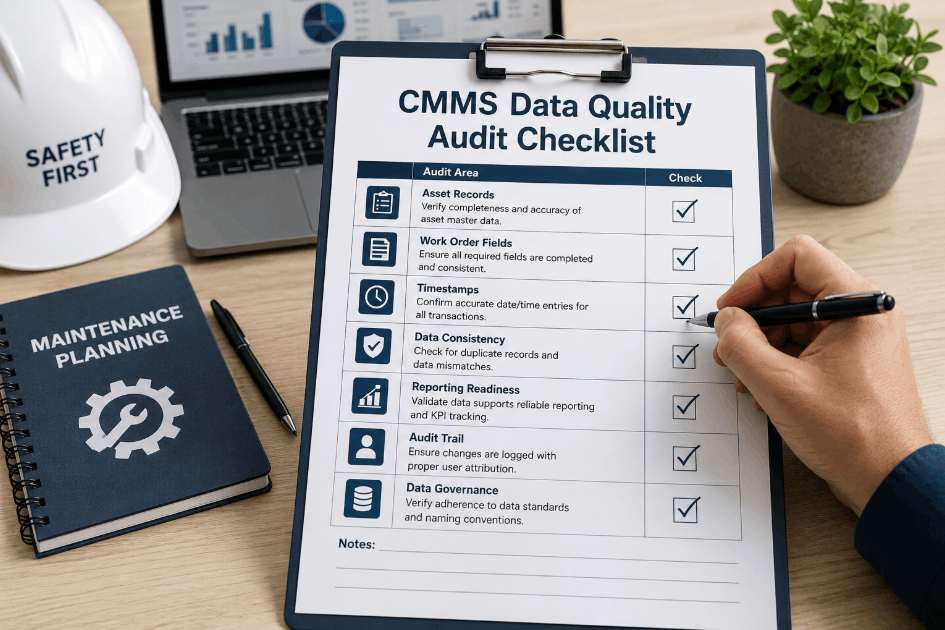
Manufacturing maintenance data quality checklist
Use this checklist to benchmark your plant's CMMS data governance maturity. Each item maps to a concrete standard that reliability teams can audit in a single afternoon — and that OxMaint enforces automatically once activated.
| Data Domain | Common Quality Issue | Governance Fix | Impact on Reliability |
|---|---|---|---|
| Asset register | Duplicate or missing equipment records | Unique ID convention + deduplication | Accurate asset counts and PM coverage |
| Work orders | Free-text problem descriptions, no failure code | Mandatory Problem → Cause → Remedy | Enables root-cause and bad-actor analysis |
| Spare parts | Vague descriptions, duplicate SKUs | Standardized naming + manufacturer PN | Cuts inventory 15–30%, faster kitting |
| Labor entries | Missing or rounded labor hours | Validation rule on work-order close | Reliable cost-to-maint and capacity planning |
| Asset hierarchy | Flat structure, no parent-child links | Functional location hierarchy build-out | Correct downtime attribution and roll-ups |
See how governed maintenance data transforms your downtime numbers
Book a 30-minute demo and we'll run your actual asset register through OxMaint's data-quality engine — live, on the call.
How OxMaint enforces maintenance data governance automatically
OxMaint bakes CMMS data governance into the daily workflow — validation rules fire at work-order entry, the AI engine flags duplicate assets and parts, and reliability dashboards draw only from governed, audit-ready data. No separate spreadsheet cleanup. No waiting 12 months for trustworthy analytics.
AI-powered data validation
OxMaint enforces mandatory failure codes, labor hours, and parts on every closed work order — and flags non-compliant entries in real time. Outcome: 95%+ work-order data completeness within the first 90 days.
Standardized asset & parts registry
Built-in naming-convention templates and duplicate-detection keep your asset register and spare-parts inventory clean from day one. Outcome: 15–30% inventory reduction and faster, error-free kitting.
Structured failure-code taxonomy
A configurable Problem → Cause → Remedy hierarchy — aligned to ISO 14224 — replaces free-text fields and unlocks comparable failure data across every asset. Outcome: 40% faster root-cause analysis.
Trustworthy reliability analytics
OxMaint's dashboards and predictive models draw only from governed data, delivering accurate MTBF, PM compliance, and OEE — and predicting failures before they happen. Outcome: 20–40% less unplanned downtime.
Within one quarter of switching to OxMaint, our work-order data completeness jumped from 61% to 94%. For the first time, our reliability meetings are driven by numbers we actually trust — not guesses from a spreadsheet.
Manufacturing maintenance data governance FAQ
What is maintenance data governance in manufacturing?
Maintenance data governance is the framework of ownership, standards, and validation rules that keep CMMS data — asset records, failure codes, work orders, and spare-parts inventory — accurate, consistent, and usable for reliability analytics. In manufacturing, it means assigning a data steward, enforcing naming conventions, and requiring structured failure coding so that MTBF, PM compliance, and predictive models run on trustworthy inputs rather than free-text guesses.
Why does CMMS data quality matter for plant reliability?
CMMS data quality directly determines whether reliability analytics produce insight or noise. Bad data — duplicate assets, missing failure codes, vague parts descriptions — hides failure patterns, misroutes preventive maintenance, and makes predictive models unreliable. Plants with governed data typically see 20–40% less unplanned downtime because they can identify bad actors, optimize PM intervals, and plan corrective work with confidence.
How do you create a failure-code taxonomy for a CMMS?
Start with a three-tier hierarchy — Problem (what was observed), Cause (why it happened), and Remedy (what fixed it) — and keep each level to 15–25 codes maximum so technicians can select quickly. Align the codes to ISO 14224 where possible, make the fields mandatory at work-order close, and review the taxonomy quarterly to retire unused codes and add new failure modes. OxMaint ships with a pre-built, configurable taxonomy so you can deploy it in days, not months — book a demo to see it on your assets.
How long does a CMMS data cleanup take?
A focused CMMS data cleanup for a mid-sized plant (150–500 assets) typically takes 60–90 days: one month to audit and baseline, one month to standardize and deduplicate, and one month to enforce validation rules and relaunch analytics. With an AI-powered platform like OxMaint, duplicate detection and automated validation compress the timeline further — many plants see trustworthy dashboards live within the first month. The key is to scope tightly and enforce rules at entry rather than relying on periodic manual scrubbing.
Who should own CMMS data governance in a plant?
A named maintenance data steward — usually a reliability engineer, CMMS administrator, or maintenance planner — should own day-to-day data governance, with executive sponsorship from the plant or reliability manager. The steward is accountable for master-data accuracy, naming-convention compliance, failure-code taxonomy health, and monthly data-quality reviews. Ownership must be explicit; plants that leave data governance to "everyone" end up with no one accountable and data quality that decays within a quarter.
Turn governed maintenance data into measurable uptime
Join the manufacturing plants using OxMaint to enforce CMMS data standards, eliminate paper work orders, and predict failures before they happen — all on a governed, audit-ready dataset.
Free 14-day trial · No credit card