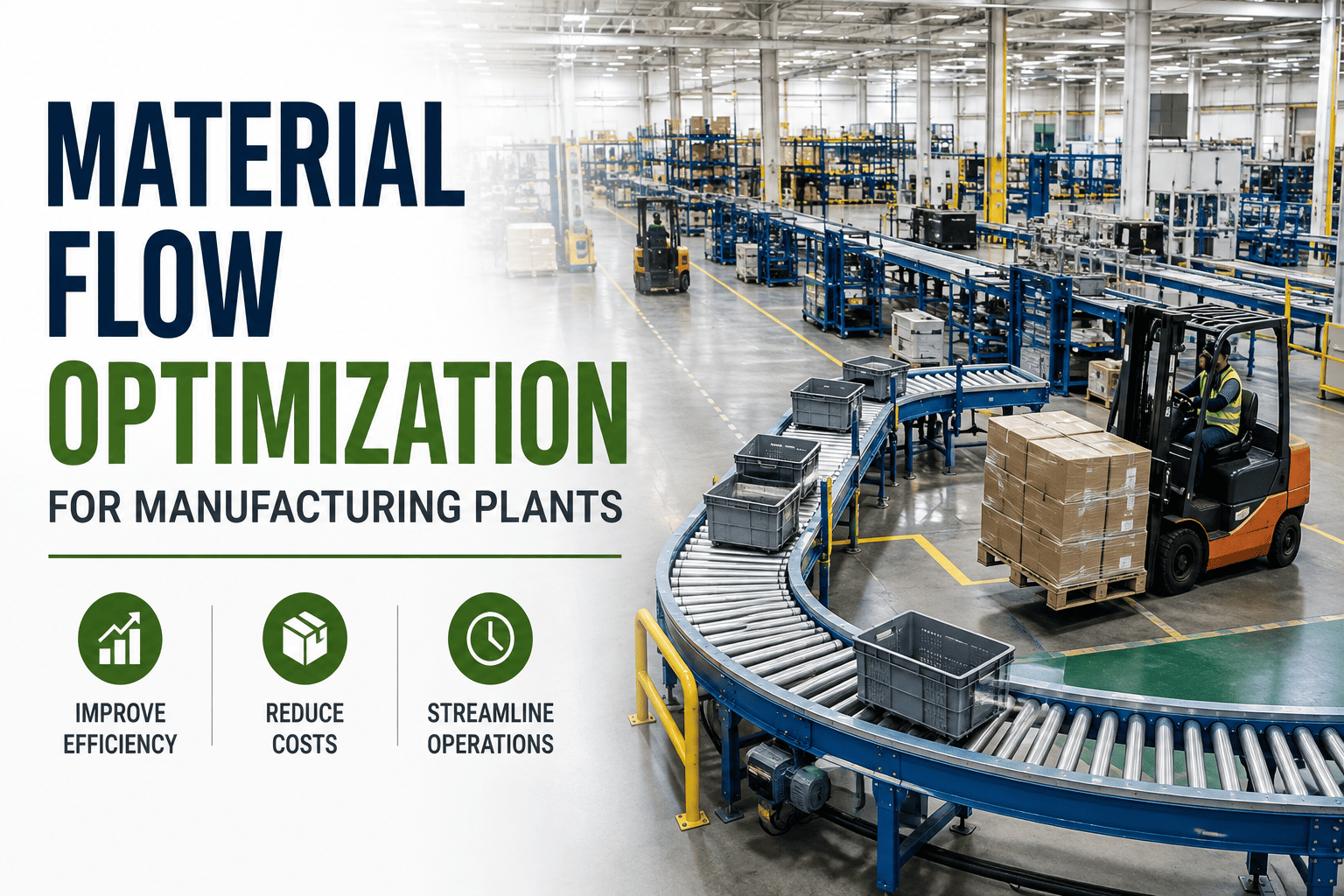
Material flow optimization is the process of analyzing, redesigning, and continuously improving how parts and raw materials move through a manufacturing plant — and most facilities leak 15–25% of their labor time to inefficient routes, bottlenecked staging areas, and poor material handling. When production flow optimization is neglected, every unit absorbs unnecessary handling cost, cycle times stretch, and throughput stalls. This guide breaks down a proven material flow analysis method for industrial engineers — from spaghetti diagrams and value stream mapping to kanban design — so you can optimize material flow without halting operations. You can map and digitize these redesigned flows quickly when you Start Free Trial with OxMaint to align your maintenance, inventory, and production data in one platform.
Is Poor Material Flow Costing You 15–25% of Your Labor Time?
Most manufacturing plants lose a quarter of their productive hours to parts traveling too far, in the wrong order, or arriving at the wrong moment. Plant material flow inefficiency silently inflates handling costs on every single unit — and traditional reactive maintenance systems cannot fix it. By applying structured material flow analysis, industrial engineers are cutting waste, increasing throughput, and recovering thousands of lost labor hours.
Why Manufacturing Material Handling Drives Up Unit Costs
In a typical 180-asset plant spending roughly $42,000 annually on material handling labor, up to $10,500 is lost to unnecessary travel, re-handling, and idle staging. Material handling efficiency is not just about moving things faster — it is about moving them the shortest distance, in the right sequence, exactly when needed.
Share of operator time spent searching for parts, walking between zones, or waiting on delayed material movement.
Parts touched more than necessary cost up to 2.5x more in handling labor and risk damage during each transfer point.
Disorganized factory material flow can throttle maximum plant throughput by up to 30% during high-demand shifts.
How to Optimize Material Flow: A 4-Phase Plant Floor Method
Effective material flow design requires a data-driven approach. Industrial engineers use this 4-phase sequence to map current states, identify bottlenecks, and implement optimized routing without shutting down the plant to move racks.
Spaghetti Diagram Mapping
Trace the actual path of a single part from receiving to final assembly. Most plants discover parts travel 3–5x farther than necessary. Highlight backtracking and cross-traffic to visualize material movement manufacturing waste immediately.
Value Stream Mapping (VSM)
Document the flow of materials and information. Identify non-value-added steps, push-versus-pull triggers, and delays between work centers. A clean VSM reveals exactly where production flow optimization breaks down.
Kanban & Pull System Design
Replace complex MRP-driven push scheduling with visual kanban signals. Right-size inventory buffers at point-of-use to ensure parts arrive exactly when needed, minimizing staging area congestion and improving material flow efficiency.
Cellular Layout Redesign
Reorganize equipment into U-shaped or cellular layouts without halting production. Move high-frequency parts to point-of-use racks and re-route forklift traffic to eliminate intersecting flows, maximizing plant flow optimization.
Calculating the Payback of Plant Flow Optimization
Material flow analysis is a capital-justifiable project. Use this formula to quantify the annual savings of optimizing factory material flow against the cost of facility downtime and handling labor.
Subtract the cost of layout changes, racking, and software to calculate net first-year payback.
| Flow Optimization Scenario | Hours Saved / Shift | Annual Labor Savings | Throughput Gain |
|---|---|---|---|
| Spaghetti Diagram Re-route (Single Line) | 1.5 hrs | $54,000 | +8% |
| Kanban Pull System Implementation | 2.5 hrs | $90,000 | +14% |
| Cellular Layout Redesign (Full Plant) | 4.0 hrs | $144,000 | +22% |
| Digital Material Flow Tracking (OxMaint) | 3.5 hrs | $126,000 | +18% |
*Savings based on a 180-asset plant running 3 shifts, 300 days/year, at a $40/hr loaded labor rate. Integrating a CMMS provides continuous tracking to sustain these gains.
See OxMaint on Your Assets — Book a 30-Min Demo
Discover how AI-driven work orders, spare-parts inventory, and predictive maintenance align perfectly with your redesigned material flow to eliminate downtime.
How OxMaint Sustains Material Handling Efficiency
Redesigning physical flow is only half the battle — sustaining it requires digital alignment of your maintenance, inventory, and asset data. OxMaint is an AI-powered CMMS and EAM platform that ensures your optimized material flow stays optimized.
Spare-Parts Inventory Sync
Map point-of-use kanbans directly to OxMaint inventory thresholds. Automated reordering prevents stockouts and overstocking, ensuring material flow design is supported by real-time spare-parts tracking.
Outcome: Cuts parts search time by 40%Preventive Maintenance Scheduling
Keep conveyors, AGVs, and material handling equipment running at peak capacity. OxMaint automates PM triggers based on meter readings or time, preventing the unplanned breakdowns that derail factory material flow.
Outcome: Reduces unplanned downtime 30–50%Asset & Equipment Tracking
Gain instant visibility into the health and location of pumps, motors, and handling assets across the plant floor. QR-coded asset tagging bridges your physical flow to your digital maintenance records.
Outcome: Eliminates paper work orders entirelyMaintenance Analytics
Leverage AI-driven analytics to see which machines cause the most material flow bottlenecks. Use MTBF and OEE dashboards to prioritize layout and flow improvements where they impact throughput the most.
Outcome: Predicts failures before they happenA 180-Asset Plant Recovers $84K in Lost Labor
"We mapped our spaghetti diagram and realized forklifts were crossing paths 40 times a shift. After redesigning the cellular layout and syncing our kanbans with OxMaint's inventory module, we cut material travel time by 35% and recovered $84,000 in lost labor in the first year. The AI predictive maintenance also kept our conveyor systems running flawlessly during peak loads."
Material Flow Optimization Frequently Asked Questions
What is material flow optimization in manufacturing?
Material flow optimization is the systematic process of analyzing and redesigning how raw materials, parts, and work-in-progress move through a manufacturing plant. The goal is to minimize travel distance, reduce handling touches, and synchronize delivery with actual production demand using tools like value stream mapping and kanban pull systems.
How do you perform a material flow analysis?
You perform a material flow analysis by creating a spaghetti diagram to trace current part routes, conducting a value stream map to identify value-added versus non-value-added steps, measuring distances and cycle times, and then redesigning the layout to implement point-of-use staging and pull-based replenishment. You can digitize and track these new flows using a CMMS like OxMaint — Book a Demo to see how.
How much can plant material flow efficiency improve throughput?
Optimizing plant material flow can improve throughput by 15–30%. By reducing unnecessary travel, eliminating staging bottlenecks, and preventing equipment downtime through predictive maintenance, plants typically recover 15–25% of lost labor time and significantly increase their overall equipment effectiveness (OEE).
Can you redesign factory material flow without shutting down the plant?
Yes. Redesigning factory material flow without halting production requires a phased approach: map the current state, implement point-of-use kanbans for high-volume parts first, and gradually shift equipment during scheduled maintenance windows. Using OxMaint to schedule these moves during planned downtime ensures zero disruption to active production lines.
Why is material handling optimization important for maintenance teams?
Material handling optimization is critical for maintenance teams because poor spare-parts flow directly causes downtime. If technicians cannot locate parts or if material handling equipment breaks down unexpectedly, production stalls. Integrating flow optimization with an AI-powered CMMS ensures spare parts are always staged at point-of-use and handling equipment receives predictive maintenance before failure.
Ready to Eliminate Material Flow Waste?
Join the maintenance and reliability teams using OxMaint to align inventory, predict equipment failures, and sustain peak production flow. Start your free trial or book a personalized demo today.
Free 14-day trial · No credit card required