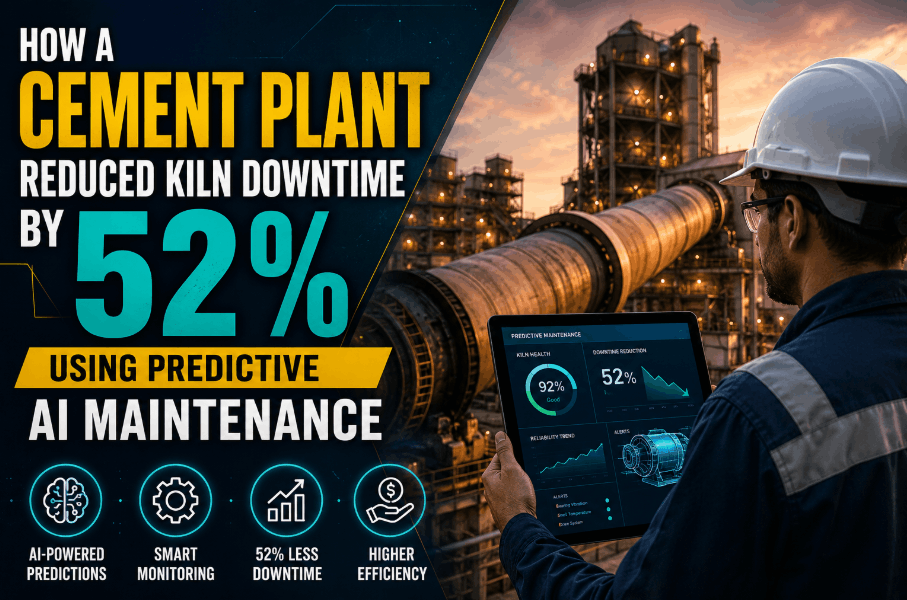
Predictive Maintenance for Cement Plants Using AI

By Oxmaint on December 17, 2025

predictive-maintenance-cement-plants-ai

Somewhere in your plant right now, a bearing is failing. Not catastrophically—not yet. But deep within its metal housing, microscopic cracks are spreading, temperatures are rising fractionally, and vibration patterns are shifting in ways invisible to the human eye. In 6 weeks, it will seize. Production will stop. You will lose $300,000 per day while waiting for parts that should have been ordered last month.

This isn't fear-mongering—it's physics. Every piece of rotating equipment follows a predictable degradation curve. The question isn't whether failures will happen, but whether you'll see them coming. AI-powered predictive maintenance gives cement plants the ability to detect these failures 4-8 weeks in advance, transforming emergency shutdowns into scheduled repairs and turning maintenance from a cost center into a competitive weapon.

The Maintenance Transformation
Without AI Prediction
Failures discovered when equipment stops
Emergency repairs at premium costs
Parts expedited overnight
3-7 days unplanned downtime
Cascading quality problems
Typical Impact $900K+ per event
With AI Prediction
Failures detected 4-8 weeks early
Planned repairs during scheduled stops
Parts ordered with normal lead times
Zero unplanned production loss
Consistent product quality
Typical Savings $600K+ annually

Your Equipment Is Already Talking—Are You Listening?

Every motor, bearing, gearbox, and pump in your plant generates continuous data streams: vibration frequencies, temperature gradients, current draws andoil particle counts. This data contains early warning signals that predict failures weeks before they occur. The challenge is that humans cannot process this volume of information or detect the subtle pattern changes that indicate emerging problems.

What AI Hears That You Can't
Healthy
Normal Vibration Pattern
Consistent amplitude, stable frequency
Early Warning
Bearing Wear Detected
Subtle harmonic changes, 6 weeks to failure
Critical
Imminent Failure
Severe degradation, days remaining

AI predictive maintenance platforms analyze millions of data points continuously, comparing current patterns against known failure signatures and your equipment's historical baseline. When deviations emerge—often invisible to routine inspections—the system alerts your team with specific diagnoses and recommended actions. For maintenance heads ready to hear what their equipment is saying, connecting with condition monitoring specialists is the first step.

The Equipment That Breaks Your Plant

Not all equipment failures are equal. Some cause minor inconveniences; others halt entire production lines for days. AI monitoring prioritizes assets based on criticality, failure probabilityand business impact—ensuring you catch the failures that matter most.

Failure Risk & Impact Matrix

Rotary Kiln System
Bearings, girth gear, drive motor, support rollers
3-7 days downtime
$900K+ per failure

Vertical Roller Mill
Gearbox, hydraulic system, roller assemblies
24-56 hrs downtime
$500K per failure

ID/PH Fans
Impeller, bearings, motor, couplings
4-10 hrs downtime
$150K per failure

Conveyor Systems
Belt, pulleys, idlers, drive motors
2-8 hrs downtime
$80K per failure
Critical High Medium Moderate

Results That Justify the Investment

The business case for AI predictive maintenance isn't based on projections—it's documented across hundreds of cement plant implementations worldwide. The U.S. Department of Energy confirms predictive maintenance saves 8-12% over preventive approaches and up to 40% over reactive maintenance.

Documented Industry Results
70%
Reduction in Unplanned Breakdowns
40%
Cost Savings vs Reactive Maintenance
25%
Increase in Overall Productivity
91%
Plants Report Reduced Downtime
Industry Leaders Already Using AI Predictive Maintenance
Holcim
100+ plants
1,200 critical assets monitored with 3,000+ sensors across global operations
Titan America
New OEE Records
Achieved higher equipment effectiveness while improving energy efficiency
Global White Cement
$500K Saved
Single gearbox failure prevented through early AI detection

These results aren't limited to industry giants. The same AI technology scales to plants of any size, with implementation timelines measured in weeks rather than months. Reliability engineers evaluating options should schedule a technical demonstration to see how prediction works on equipment similar to theirs.

What Would You Do With 6 Weeks Warning?
See exactly how AI detects bearing wear, gearbox degradation, and motor faults before they become emergencies. Live demo on real cement plant equipment.

Expert Perspective

"Unplanned downtime is minimized, and repairs are made at early stages, prior to failure, reducing cost and the need for total replacement. The machine learning through correlations and interactions of operational data continuously updates and improves the AI system and the plant maintenance plan alike."
82%
of plants experience unplanned downtime every 3 years
95%
prediction confidence achievable with mature AI systems
28.5%
CAGR for AI in cement industry through 2026

Implementation: Faster Than You Think

Modern predictive maintenance doesn't require replacing your control systems or installing complex infrastructure. Wireless sensors attach to existing equipment during normal operations—no shutdowns required. Cloud-based AI begins learning your equipment's patterns immediately, with actionable predictions typically available within 60 days. For plants ready to start, requesting an asset assessment identifies the highest-priority monitoring points.

From Decision to Predictions in 8 Weeks
Week 1-2
Assessment

Week 3-4
Install

Week 5-8
Train AI

Ongoing
Predict
Your Next Failure Is Already Developing
The only question is whether you'll detect it in time. Book a demo to see how AI transforms maintenance from reactive firefighting to proactive optimization.

Conclusion

Every cement plant experiences equipment degradation. The physics of rotating machinery under extreme conditions guarantees it. The only variable is whether you discover problems through catastrophic failure or through early detection that enables planned response. AI-powered predictive maintenance has moved from emerging technology to proven practice, with documented results showing 70% fewer breakdowns, 40% cost savings, and ROI achieved often within a single prevented failure.

The leaders in cement manufacturing have already made this transition. Holcim monitors 1,200+ assets across 100 plants. Titan America has achieved new OEE records. Plants worldwide are preventing six-figure failures through early AI detection. For maintenance heads and reliability engineers still operating on reactive or calendar-based schedules, scheduling a demonstration reveals what predictive capability looks like for your specific equipment.
Frequently Asked Questions

How much does unplanned downtime cost cement plants?
Unplanned downtime costs approximately $300,000 per day for a typical 1 MTPA cement plant, with critical equipment failures potentially exceeding $100,000 per hour. A single kiln bearing failure requiring 3-7 days of repair can cost $900,000 or more when including lost production, emergency labor, expedited parts, and downstream quality issues.
How far in advance can AI predict equipment failures?
AI systems typically detect developing failures 4-8 weeks before breakdown, depending on failure mode and monitoring technology. Vibration analysis identifies bearing wear patterns weeks in advance. Thermal imaging catches overheating days to weeks early. Advanced systems achieve 95% confidence intervals for remaining useful life predictions, enabling precise maintenance scheduling.
What equipment should be monitored first?
Priority goes to single-point-of-failure assets with highest downtime costs: rotary kiln systems (bearings, drives, support rollers), vertical roller mills (gearboxes, hydraulics), main ID/PH fans, and cement mill drives. These represent the highest-impact monitoring opportunities. Most implementations start with 10-20 critical points, then expand based on demonstrated value.
What ROI can plants expect?
Documented results show 70% reduction in unplanned breakdowns, 25% productivity increase, and 40% cost savings versus reactive maintenance. Individual prevented failures often justify the entire system cost—a single gearbox failure prevention saved one plant $500,000. Most implementations achieve positive ROI within 6-12 months or after the first prevented major failure.
How quickly can predictive maintenance be implemented?
Typical deployment requires 6-8 weeks from project start to live predictions. Modern wireless sensors install during normal operations without production shutdowns. AI models begin learning patterns immediately, with actionable alerts typically available within 60 days. The technology layers on existing infrastructure—no control system replacement required.

Share This Story, Choose Your Platform!