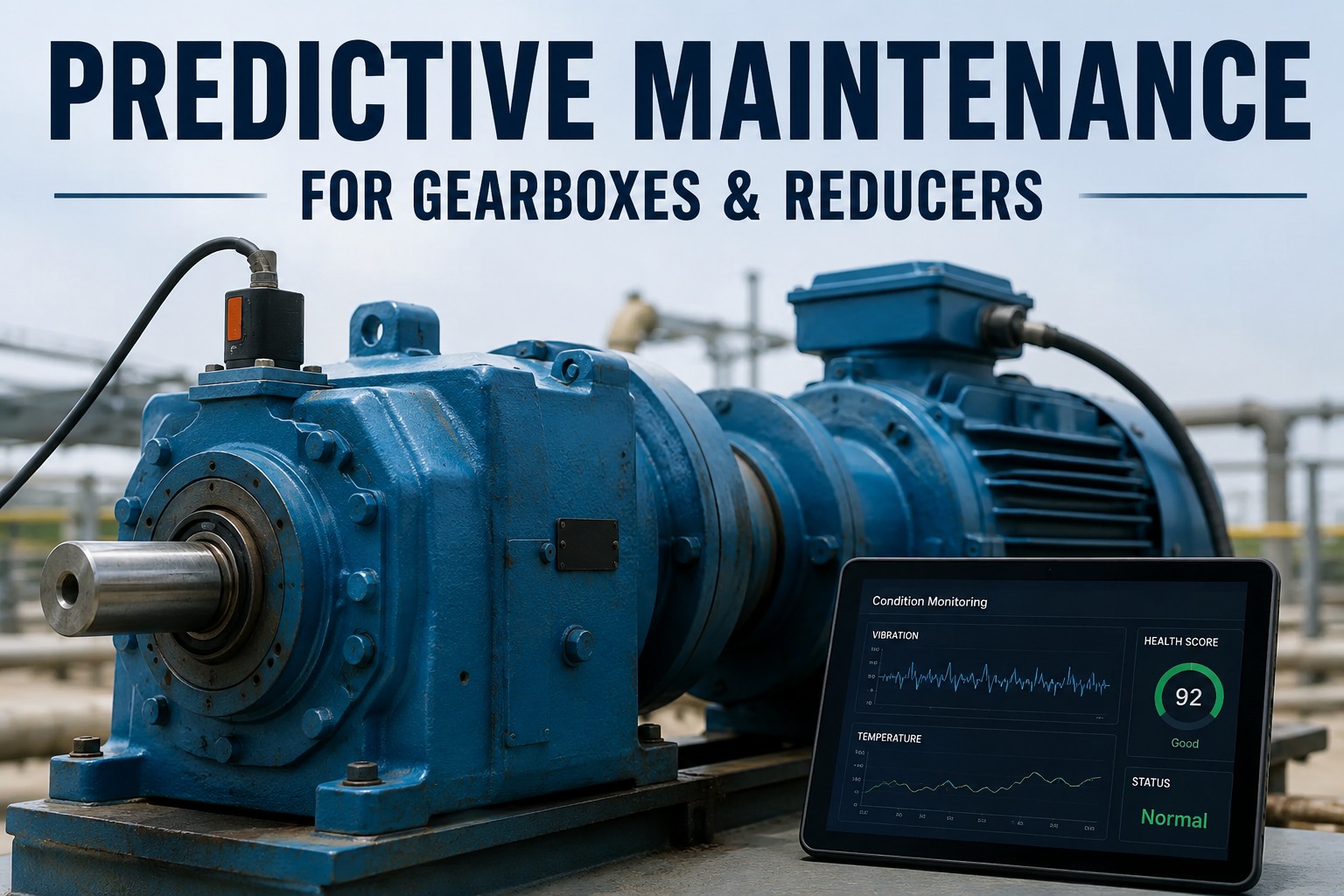
A gearbox rarely dies without warning — it broadcasts its decline for weeks across three separate channels, and most maintenance programs are only listening to one, or none. Gear-tooth pitting elevates specific vibration frequencies weeks before any metal shows up in the oil. Bearing spalling throws distinct defect signatures — BPFI, BPFO, BSF — into the vibration spectrum long before anything is audible over production noise. Contaminated lubricant loses its protective film 4 to 12 weeks before accelerated wear turns critical. Catch those signals and a bearing swap during a planned outage costs a fraction of the $20K–$80K rebuild that follows a run-to-failure, before you count the lost production. Miss them and spalled material circulates through the oil system, cascading damage across every other bearing and gear surface. This guide covers predictive maintenance for gearboxes and reducers the way it actually works in 2026 — the failure modes that dominate, the four monitoring techniques and what each detects, how multi-modal AI fuses them into a single call, and how a CMMS turns a sensor reading into a staged work order. Book a live predictive-maintenance demo against your own gearbox fleet.
A Failing Gearbox Warns You for Weeks
Vibration, oil, and heat each carry the signal early — the trick is listening to all three at once.
34%
Of gearbox failures come from gear-tooth damage — the single largest mode
4–12 wk
Lead time oil analysis gives before wear turns critical
$20–80K
Cost of a run-to-failure rebuild — before lost production
25–30%
Maintenance-cost reduction predictive programs deliver over time-based
Where Gearboxes Actually Fail
Predictive maintenance starts with knowing what you're watching for. A handful of failure modes account for the overwhelming majority of gearbox and reducer downtime — and they cascade into each other, which is why early detection on any one of them prevents secondary damage across the rest.
34%
Gear-Tooth Damage
Micro-pitting under marginal lubrication progresses to surface spalling and eventually tooth fracture. Shows as gear-mesh frequency harmonics and sidebands in vibration, plus gear-shaped iron debris in oil.
28%
Bearing Faults
Inner/outer race fatigue, rolling-element spalling, and cage wear generate distinct defect frequencies — BPFI, BPFO, BSF — visible in vibration weeks before any audible symptom.
18%
Lubrication Degradation
The most preventable category, directly readable in oil. Contamination, viscosity loss, or additive depletion thins the protective film — water above 0.1% even drives hydrogen embrittlement in bearing steel.
Root
Misalignment & Overload
Angular or parallel misalignment and undersizing load teeth unevenly and push heat and vibration into bearings — often the root cause that sets tooth, bearing, and lubrication failures in motion.
The Four Predictive Techniques · What Each One Hears
No single technique sees everything. Each monitors a different physical signal, catches a different failure mode earliest, and covers a blind spot the others have. A real program layers them — and the strongest programs fuse them.
Vibration Analysis
The EKG of the gearbox
Accelerometers on the bearing housing nearest the gear mesh capture acceleration, converted to a frequency spectrum by FFT. Gear-mesh sidebands reveal tooth wear; BPFI/BPFO/BSF frequencies isolate bearing defects. The most powerful, most widely used technique for rotating faults.
Oil Analysis
Earliest warning for wear
Sampling the sump for particle count, viscosity, water content, and elemental wear metals. Often detects wear before vibration does — 4 to 12 weeks of lead — and reads lubrication health directly, so it both finds faults and optimizes oil-change intervals.
Thermography
The fast screening tool
Infrared imaging reveals localized hot spots 10–20°C above surrounding housing temperature from friction, poor lubrication, or misalignment. Excellent for a quick inspection route — a hot spot flags the asset for deeper vibration or oil investigation.
Acoustic Emission
The earliest, most sensitive
Listens for the high-frequency stress waves generated at the very earliest stages of material failure — especially valuable on slow-speed gearboxes below 100 RPM, where low vibration energy makes conventional analysis difficult.
Map Your Gearbox PdM Program in 30 Minutes
Working session with our reliability team — bring your gearbox and reducer fleet. We'll match failure modes to monitoring techniques, set sensor placement and thresholds, and show how OxMaint turns each reading into an auto-generated work order with parts staged.
Why Multi-Modal Beats Any Single Signal
The traditional approach treats monthly vibration, quarterly oil, and annual thermography as three separate reports. Each is valid but incomplete — and the gap between them is where failures slip through. Fusing the signals is what turns detection into prediction.
Each Signal Leads at a Different Stage
Gear-tooth pitting elevates vibration for weeks before debris reaches the oil; bearing spalling can show a thermal gradient before it's audible. Timing differs by mode — so one stream alone always lags on something.
AI Fuses Them Into One Call
Multi-modal sensor fusion cross-references vibration, oil, and thermal trends to classify the fault and confirm it — cutting the false alarms that come from reading any single stream in isolation.
RUL Turns It Into a Schedule
A remaining-useful-life estimate converts "a fault exists" into "you have X weeks" — enough runway to procure parts at planned pricing and fix during a scheduled outage, not an emergency.
The P-F Interval · Why Early Detection Pays
Every gearbox failure travels a path from first detectable symptom (P) to functional failure (F). The whole return on predictive maintenance comes from acting inside that window — and the earlier you detect, the cheaper and safer the fix.
EARLY
Incipient — Oil & AE Detect First
Micro-pitting begins, lubricant additives deplete, stress waves emerge. Cheapest intervention: an oil change, a filter upgrade, an alignment correction. No secondary damage yet.
DEVELOPING
Progressing — Vibration & Heat Confirm
Ferrous particles appear in oil, vibration climbs at fault frequencies, temperature rises — still no audible abnormality. Plan a bearing or gear swap for the next scheduled outage: $20K–$80K, controlled.
CRITICAL
Functional Failure — Cascade Begins
Spalled material circulates through the oil system, damaging other bearings and gear surfaces. Emergency repair, emergency parts premiums of 30–80%, and unplanned production loss. The outcome PdM exists to prevent.
How OxMaint Runs Gearbox Predictive Maintenance
OxMaint is an AI-native CMMS and RCM platform that turns condition data into action — IoT and vibration sensor integration, auto-generated PM tasks, continuous FMEA and criticality analysis, SAP and Maximo overlay, and cloud reliability reporting that replaces spreadsheet RCM, from one dashboard on desktop or mobile.
Integrate
IoT & Vibration Sensors
Ingest vibration, oil, and thermal data against each gearbox — accelerometer feeds and lab results in one asset record, the foundation for trending and fusion.
Detect
Threshold & Fault Alerts
A gear-mesh sideband, a rising particle count, or a thermal hot spot that breaches its limit fires an alert tied to the specific predicted failure mode.
Trigger
Auto-Generated Work Orders
An alert converts to a prioritized work order with the right bearing, seal, or filter and the procedure staged — mobile-first for the technician in the field.
Analyze
Continuous FMEA & Criticality
Live failure-mode libraries and criticality scoring focus predictive effort on the gearboxes whose failure hurts most — no flat calendar, no spreadsheet RCM.
Overlay
SAP & Maximo Support
Sit over existing SAP PM or IBM Maximo as the reliability execution layer — no rip-and-replace, one view across a single plant or a global network.
Report
Cloud Reliability Reporting
Dashboards on downtime cut, asset life extended, MRO cost, and OEE — audit-ready reliability data leadership can act on, not a stack of spreadsheets.
Catch the Fault Weeks Before the Rebuild
Cut unplanned downtime, extend critical asset life, lower MRO cost, and hit your OEE targets. See how OxMaint fuses vibration, oil, and thermal data into staged work orders across your gearbox fleet. Free forever plan available.
Frequently Asked Questions
What is predictive maintenance for gearboxes and reducers?
It's a condition-based strategy that continuously monitors the actual health of a gearbox — through vibration, oil, thermal, and acoustic signals — to detect developing faults weeks before they cause failure, so repairs happen on a planned schedule instead of after a breakdown. Rather than replacing components on a fixed calendar (which either wastes 30–50% of remaining life or acts too late), predictive maintenance reads the machine's real condition and prescribes action only when the data shows a fault developing. For gearboxes and reducers, it targets the dominant failure modes — gear-tooth damage, bearing faults, and lubrication degradation — inside their detectable window.
Book a demo to see it on your fleet.
Which monitoring techniques work best for gearboxes?
Four techniques, used together. Vibration analysis is the most powerful for mechanical faults — accelerometers on the bearing housing capture gear-mesh frequencies and bearing defect signatures (BPFI, BPFO, BSF) via FFT. Oil analysis often detects wear earliest, reading particle count, viscosity, water content, and wear metals from a sump sample, and doubles as a lubrication-health check. Thermography is a fast screening tool that flags hot spots 10–20°C above normal for deeper follow-up. Acoustic emission is the most sensitive to the earliest material failure and especially valuable on slow-speed gearboxes where vibration energy is low. Each catches a different mode earliest, which is why layering them beats relying on any one.
Why combine vibration, oil, and thermal instead of just one?
Because each signal leads at a different stage of failure and has blind spots the others cover. Gear-tooth pitting can elevate vibration at specific mesh frequencies for weeks before any debris appears in oil analysis; bearing spalling may produce a localized thermal gradient before it's audible. Reading each stream in isolation means always lagging on something and generating false alarms. Multi-modal sensor fusion cross-references all three to classify and confirm the fault, and a remaining-useful-life estimate converts that into a timeline — enough runway to order parts at planned pricing and repair during a scheduled outage rather than an emergency. It's the difference between detection and true prediction.
What does predictive maintenance save on gearboxes?
Predictive programs typically reduce overall gearbox maintenance cost by 25–30% versus time-based maintenance, largely by eliminating unnecessary parts replacements and preventing the secondary damage that turns a single bearing fault into a full rebuild. Catching a fault early means a controlled repair instead of a $20K–$80K emergency rebuild plus lost production, and avoids the 30–80% premiums that come with emergency parts orders. Spare-parts inventory typically drops 20–35% within 18–24 months, because enough warning lets you procure long-lead items on detection rather than pre-stocking them speculatively.
Sign up free to start capturing that.
How does OxMaint support gearbox predictive maintenance?
OxMaint is an AI-native CMMS and RCM platform that ingests IoT, vibration, oil, and thermal data against each gearbox, fires fault and threshold alerts tied to specific failure modes, and auto-generates prioritized work orders with the right parts and procedures staged. It runs continuous FMEA and criticality analysis to focus effort on the gearboxes that matter most, overlays existing SAP PM and IBM Maximo so there's no rip-and-replace, and delivers cloud reliability reporting on downtime, asset life, MRO cost, and OEE — replacing spreadsheet RCM. Whether you run one plant or a global network, it works from a single dashboard on desktop or mobile. A free forever plan and live demos are available.