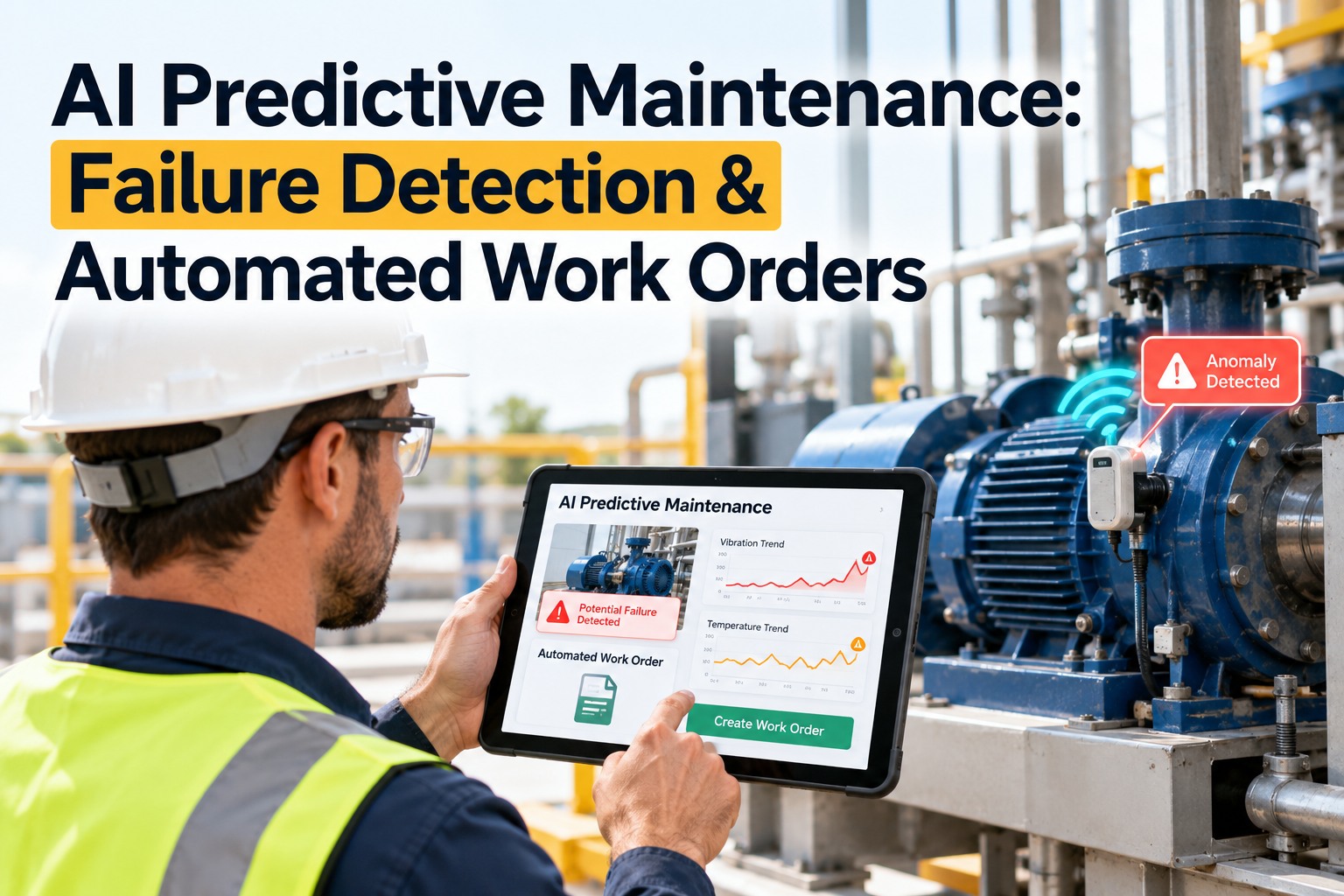
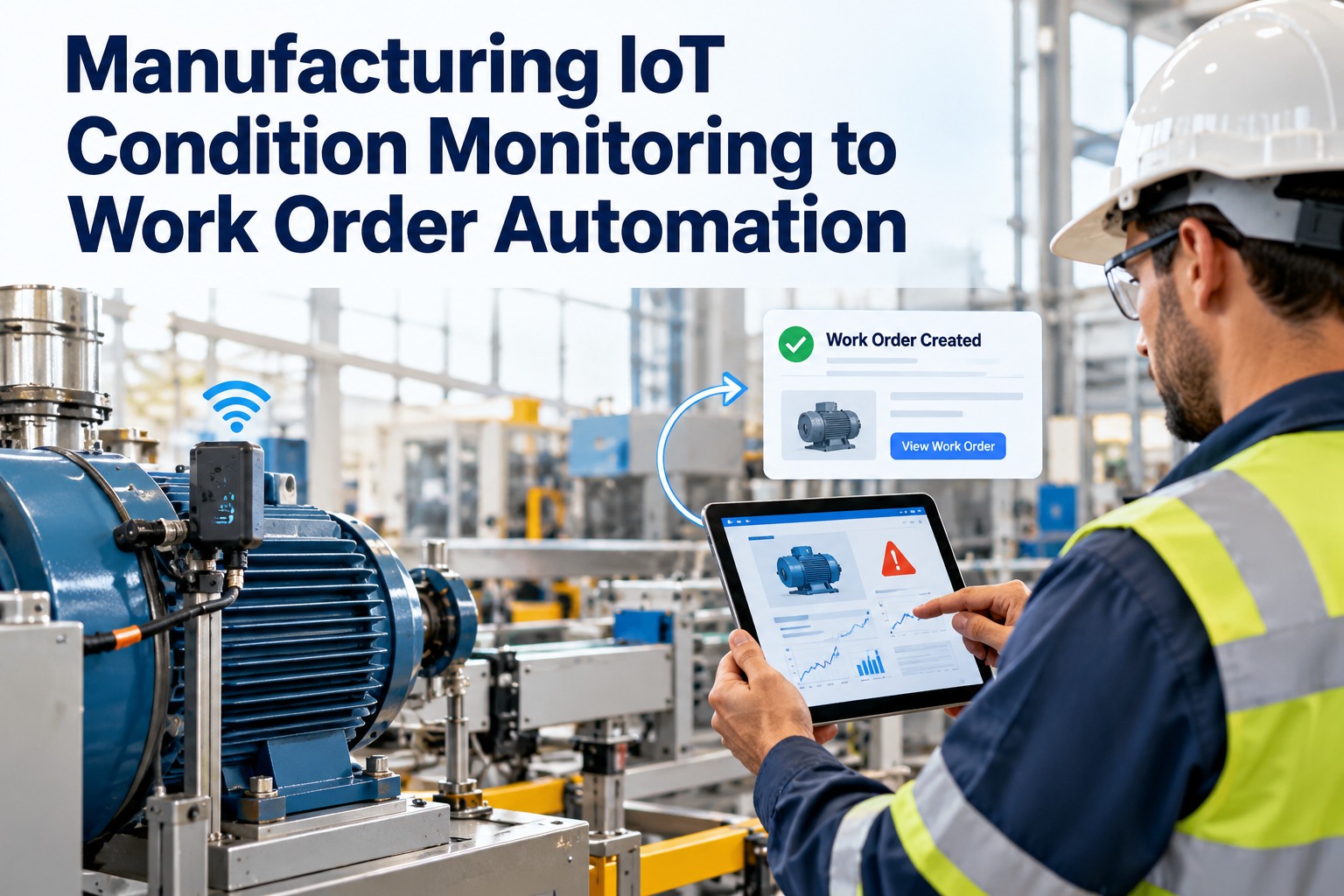
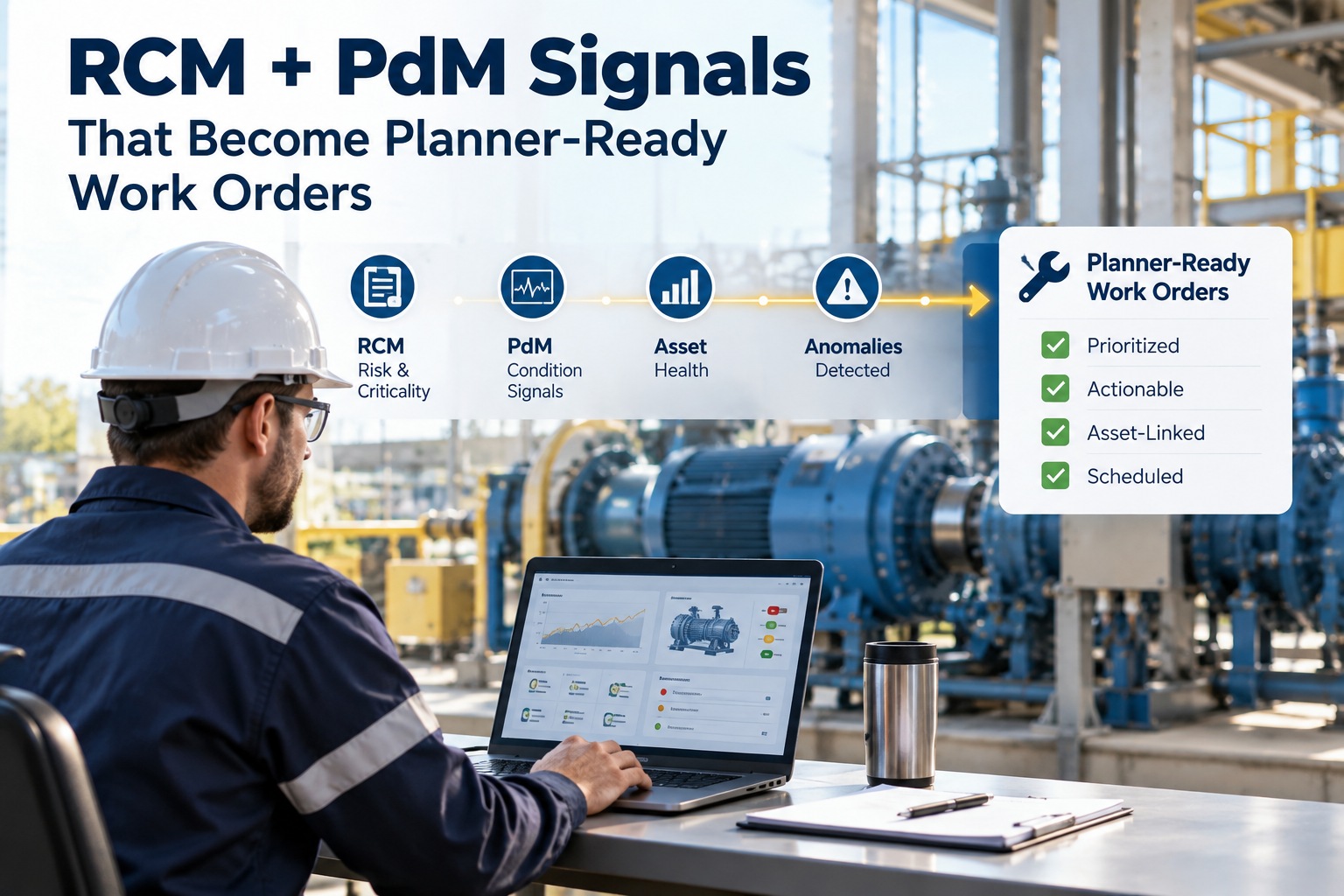
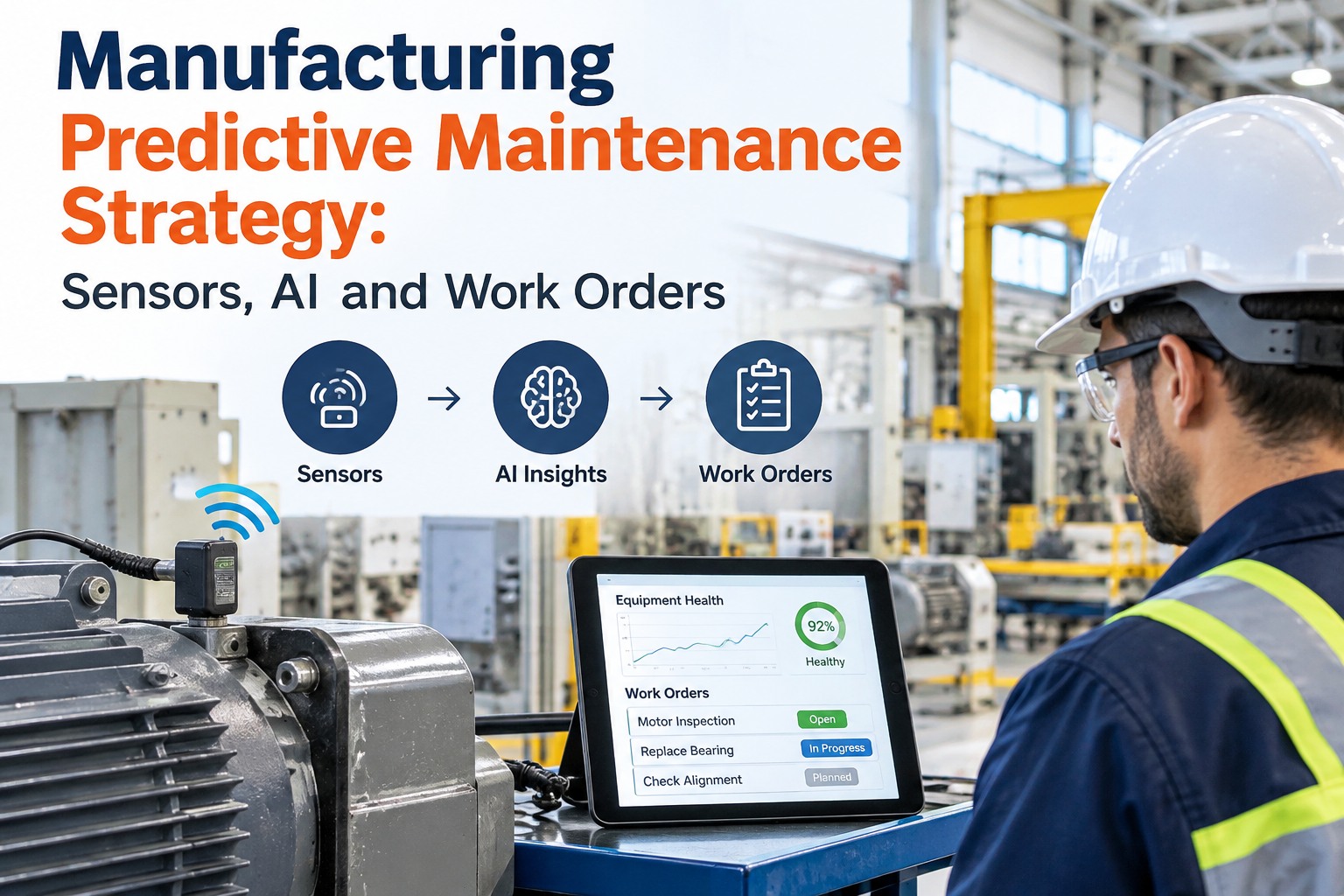
Reactive maintenance fixes the pump after it fails. Preventive maintenance services it on a calendar — whether it needed it or not. Predictive maintenance does something neither can: it catches the failure while it's still just a signal, days or weeks before the breakdown, and schedules the fix for exactly the right moment. The difference is a window called the P-F interval, and AI is what reads it. OXMAINT AI is the AI-powered maintenance management software that detects the developing failure and raises the work order automatically — or book a demo of predictive maintenance in OXMAINT AI.
AI PREDICTIVE MAINTENANCE · FAILURE DETECTION · AUTOMATED WORK ORDERS · 2026
AI Predictive Maintenance: Failure Detection & Automated Work Orders
A failure announces itself long before it stops the machine — in a vibration, a temperature, a current draw. OXMAINT AI is the AI-powered CMMS that reads those signals, detects the developing failure early in the P-F window, predicts how much life is left, and raises a prioritised work order with the fix already scoped. Less unplanned downtime, maintenance timed to need, and the technician told what to do.
1 · Detect
2 · Predict
3 · Prioritise
4 · Work order
P→F
the window between a detectable signal and functional failure — PdM lives here
4
maintenance maturity levels — reactive, preventive, condition-based, predictive
5
condition techniques — vibration, thermal, oil, ultrasound, motor current
0
surprises that were truly unpredictable — most had an early signal
The Maintenance Maturity Ladder
Every maintenance program sits somewhere on a ladder, and AI predictive maintenance is the top rung. Each step up trades reacting to failure for anticipating it — start free and move up the maturity ladder in OXMAINT AI.
01
Reactive
Run to failure, fix after it breaks. Cheapest to plan, costliest when it stops the line.
02
Preventive
Service on a fixed calendar or run-hours. Better, but you over-maintain healthy assets and still miss random failures.
03
Condition-Based
Act on a measured condition crossing a threshold. Maintenance by need, not by date — but still waiting for a limit.
04
Predictive (AI)
AI reads the signal trend, predicts when failure will arrive, and schedules the fix inside the P-F window — before the threshold, before the breakdown.
The P-F Curve: Catch It Early in the Window
A failure is detectable long before it's functional. The gap between the two — the P-F interval — is the whole opportunity, and different techniques catch the failure at different points along it. The earlier you detect, the longer you have to plan.
P
Potential failure — first detectable signal
1Ultrasoundearliest
2Vibrationearly
3Thermal / IRmid
4Oil debrismid
5Audible noiselate
6Hot to touchtoo late
F
Functional failure — asset stops performing
The interval from P to F is your planning window — AI watches the earliest signals so you catch failure near P, not near F
Detect at ultrasound or vibration and you have weeks; wait until it's hot to the touch and you have minutes. AI predictive maintenance lives at the early end of this curve — schedule a walkthrough of the detection window in OXMAINT AI.
What the Signals Tell You
AI PdM doesn't rely on one sensor — it reads several, each catching a different failure mode. Together they cover far more than any single check.
Vibration
Bearing wear, imbalance, misalignment, looseness — the workhorse of rotating-equipment PdM.
Thermal / Infrared
Hot spots in electrical connections, bearings and insulation before they fail.
Oil Analysis
Wear metals, contamination and degraded lubricant — the health of what's inside.
Ultrasound
Early bearing faults, leaks and electrical discharge — often the first thing to show.
Motor Current
Electrical signature analysis for rotor, winding and load faults without a probe on the machine.
Process Data
Pressure, flow, temperature and run-hours from the control system, trended for drift.
From Signal to Automated Work Order
Detection is only half of it. The other half — the part that actually prevents the failure — is turning the prediction into a scheduled, guided job. This is the loop OXMAINT AI runs end to end.
1
Sense
Sensor and process data stream in.
2
Detect
AI flags the anomaly against the baseline.
3
Predict
Estimates remaining life and time to failure.
4
Prioritise
Ranks by severity and asset criticality.
5
Raise WO
Auto work order with the likely cause and task.
6
Guide & Close
Technician guided, repair done, loop learns.
How OXMAINT AI Runs Predictive Maintenance
OXMAINT AI is the AI-powered maintenance management software that carries the prediction all the way to the closed work order — detection, prioritisation and technician guidance on one platform. Put your first assets on it when you start free and build your PdM program in OXMAINT AI.
AI Failure Detection
Sensor and process signals read against each asset's baseline, flagging the anomaly early in the P-F window.
Remaining-Life Prediction
An estimate of time to failure, so the fix is scheduled for the right moment — not too early, not too late.
Alert → Work Order
A qualifying prediction raises a ranked work order automatically, with the likely cause and task attached.
Criticality Prioritisation
Predictions ranked by asset criticality and severity, so the most important failure is worked first.
Technician Guidance
The work order carries the probable cause, the task steps and the history, so the fix is faster and surer.
Reliability Analytics
Failures and predictions trended across the fleet so the recurring bad actor is engineered out, not just fixed.
The Failure Was Never a Surprise to the Data.
Almost every unplanned breakdown had a signal days or weeks earlier — a rising vibration, a warming bearing — that nobody was watching. OXMAINT AI watches, predicts, and raises the work order while there's still time to plan it, so the surprise never happens.
EXPERT REVIEW
Written for reliability, maintenance and operations teams. OXMAINT AI is a maintenance management platform with predictive capability — it detects anomalies, estimates remaining life and automates work orders, but predictions are probabilistic and depend on data quality, sensor coverage and a sound failure-mode understanding. It supports, and does not replace, a reliability engineer's judgement or an established condition-monitoring program. The P-F curve and condition-monitoring techniques described here are standard reliability references.
Frequently Asked Questions
How is predictive different from preventive maintenance?
Preventive maintenance services an asset on a fixed schedule whether it needs it or not; predictive maintenance reads the asset's actual condition and acts only when the data shows a failure developing. One is timed by the calendar, the other by the equipment itself.
Start free and compare the two in OXMAINT AI.
What is the P-F interval?
The window between the potential failure point (P), where a developing fault first becomes detectable, and the functional failure point (F), where the asset stops performing. That interval is your time to plan and act — and detecting early in it is the entire goal of predictive maintenance.
Book a demo of the detection window in OXMAINT AI.
Which condition-monitoring techniques does PdM use?
Commonly vibration (rotating equipment), thermal/infrared (electrical and bearings), oil analysis (wear and contamination), ultrasound (early bearing faults and leaks), and motor current signature analysis — plus process data trended from the control system. Each catches a different failure mode.
Start free and connect your signals in OXMAINT AI.
How does a prediction become a work order?
Do we need sensors on everything to start?
No. Start with the critical assets where a failure hurts most and the signals are strongest, using existing process data and targeted condition monitoring, then expand. Predictive maintenance is built up asset by asset, not switched on all at once.
Start free and begin with your critical assets in OXMAINT AI.
Fix It When the Data Says, Not When It Breaks.
Run predictive maintenance on OXMAINT AI: AI reading your condition signals, catching the failure early in the P-F window, predicting the time to failure, and raising a prioritised, guided work order automatically — so maintenance is timed to need and the breakdown never gets the chance.