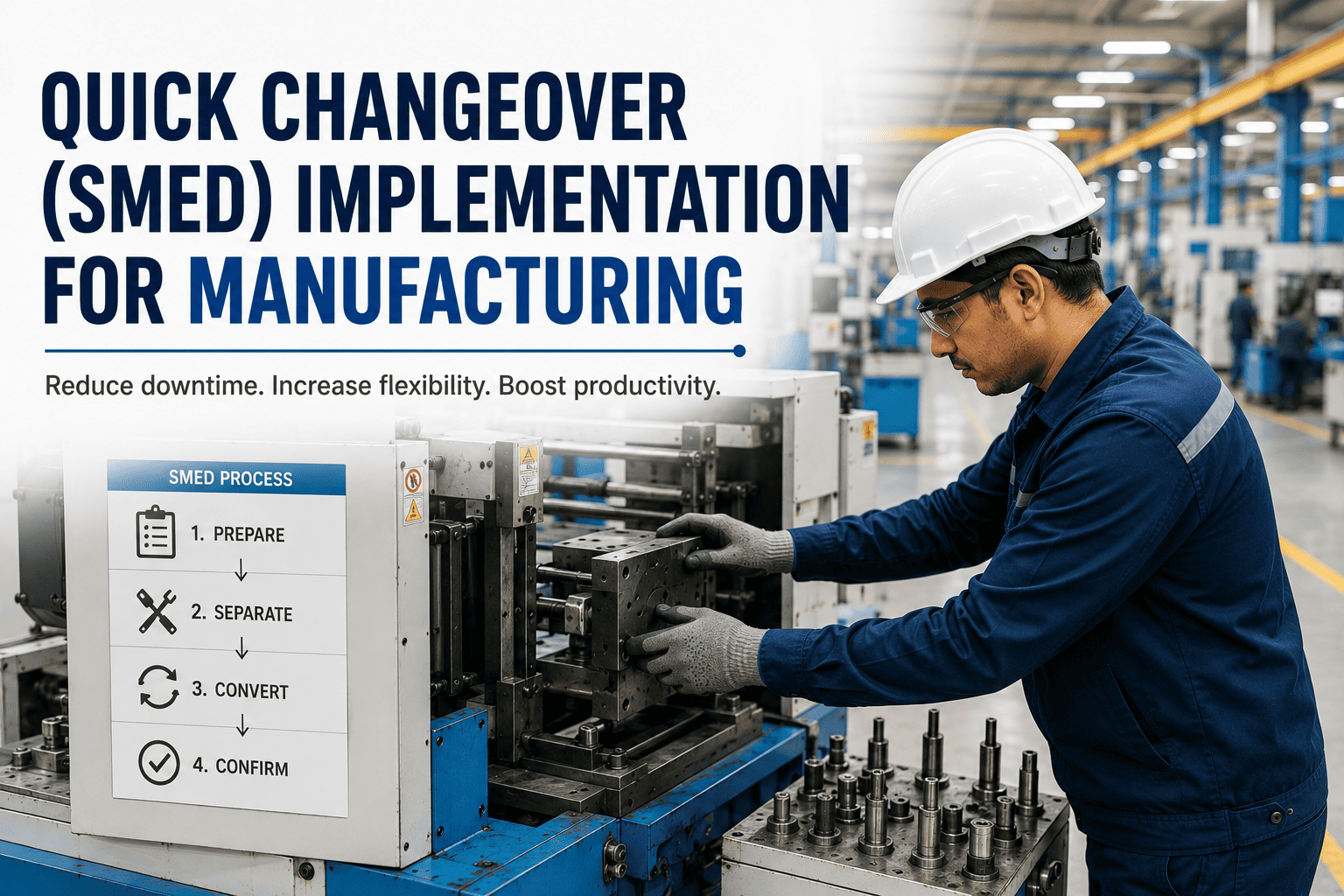
Single-Minute Exchange of Die, or SMED, is the single fastest way most manufacturing plants can unlock 20–40% more press capacity without buying a new line — yet most still treat changeover as a fixed cost rather than a controllable variable. Done right, a disciplined SMED program cuts changeover time by 60–90% in 8–12 weeks and pays for itself in the first quarter through recovered production hours, lower inventory buffers, and shorter lead times. This guide walks through the four implementation stages — measure, separate, convert, and streamline — with worked kaizen examples and a CMMS-linked standard that holds the gains. Ready to stop losing shifts to setups? Start Free Trial and digitize the whole workflow.
SMED IMPLEMENTATION GUIDE · 2026
What if every changeover on your floor took under 10 minutes?
SMED is the lean discipline that converts hours-long die, mold, and format changes into repeatable sub-ten-minute events — recovering thousands of machine-hours per year with zero capex. Most plants reach a 60–90% reduction inside a single kaizen cycle.
THE COST OF INACTION
Why changeover is the highest-leverage loss on your floor
A single 90-minute press changeover running 5 times per week eats 390 productive hours per year — the equivalent of one full shift of capacity lost every week. SMED targets that loss directly.
A 180-asset injection molding plant running 12 presses with an average 2-hour mold change was losing roughly 14,400 machine-hours per year to setup alone. After a 10-week SMED rollout that converted 70% of internal elements to external, average changeover dropped to 26 minutes — recovering 9,100 hours and $1.9M in contribution margin without a single new machine purchased.
THE FOUR SMED STAGES
A step-by-step path from hours to single-digit minutes
SMED is not a workshop — it is a sequence. Skip a stage and the gains evaporate within a quarter. Here is the proven four-stage flow Shigeo Shingo formalized, updated for CMMS-linked execution.
Film and time-stamp the current changeover
Record two consecutive changeovers end-to-end with a time-lapse camera and a second-by-second element log. Capture operator walk patterns, tool searches, waits, and adjustments. The baseline must be brutal and honest — most plants discover their "45-minute" changeover actually averages 78 minutes.
Split internal elements from external
Tag every element as Internal (machine stopped) or External (machine still running). Pre-heating dies, staging tools, preparing material batches, and pre-setting fasteners should all be External — yet on most floors they happen while the press sits idle, burning the most expensive minutes on the asset.
Move internal elements to external
This is the highest-impact stage. Pre-stage carts, pre-heat molds to operating temperature off-line, pre-set die heights on shadow boards, and run parallel preparation stations. Each converted element removes a full minute from the stopped-clock window and compounds across every changeover thereafter.
Eliminate adjustments and standardize
Replace bolts with quick-clamps and one-turn fasteners, use locating pins instead of manual alignment, and lock settings with pre-set notches. Then codify the new sequence in a standardized setup sheet attached to a CMMS changeover work order — so the improvement survives operator turnover and shift changes.
THE SMED MATH
How recovered minutes turn into recovered margin
The business case for SMED is arithmetic, not opinion. Below is the formula most plant managers use to size the opportunity before committing to a kaizen event.
Changeover Savings Formula
Recovered Hours = (Current COT − Target COT) × Weekly Changeovers × 52
Annual Savings = Recovered Hours × Contribution Margin per Machine-Hour
Worked example: a stamping line running 5 changeovers/week at 95 minutes each, targeting 20 minutes post-SMED, at $730/hour contribution.
(95 − 20) × 5 × 52 = 19,500 minutes → 325 recovered hours → $237,250 / year from one line.
| Changeover Metric | Before SMED | After SMED | Delta |
|---|---|---|---|
| Average changeover time | 95 min | 20 min | −79% |
| Internal elements (stopped machine) | 74 min | 16 min | −78% |
| Adjustments after first shot | 22 min | 3 min | −86% |
| Tool search time per changeover | 9 min | 0.5 min | −94% |
| Recovered machine-hours / year | — | 325 h | +$237K |
STAGE 03 DEEP DIVE
Conversion checklist: internal elements to eliminate
Stage 3 is where 70% of the time savings live. Use this checklist on every changeover event to force internal elements into external preparation.
Pre-Stage Tools & Fixtures
- Tools staged on shadow cart 30 min before stop
- All fasteners pre-loosened to finger-tight
- Consumables (lube, tape, shims) pre-counted
Pre-Heat & Pre-Set
- Mold/die pre-heated to operating temperature
- Die height pre-set on off-line bench
- Material staged and verified at line side
Parallel Operations
- Two operators assigned, roles pre-defined
- Old die removed while new die is staged
- Cleanup runs in parallel, not in sequence
Eliminate Adjustments
- Bolts replaced with one-turn quick clamps
- Locating pins eliminate manual alignment
- Settings locked to pre-set notches, no dial-in
STAGE 04 — LOCK THE GAINS
The CMMS-linked changeover work order
The most common reason SMED gains erode within six months is that the new standard lives on paper in a binder. Embedding the setup sheet inside a CMMS changeover work order makes it executable, measurable, and auditable on every shift.
Baseline & film
Video two changeovers, build the element-level time log, and calculate the baseline OEE impact. Assign the changeover event type in CMMS.
Separate & tag
Tag every element Internal or External in the CMMS setup sheet. Build the staging cart and shadow board. Train operators on the new prep sequence.
Convert & streamline
Run the kaizen week: convert elements, install quick-clamps, pre-set dies off-line. Target sub-20-minute changeover on the pilot line.
Standardize & audit
Publish the standardized setup sheet as a CMMS changeover work order template. Audit weekly for 4 weeks, then monthly. Roll out to lines 2–N.
READY TO MEASURE?
Turn your next changeover into a CMMS-tracked work order
Oxmaint gives you standardized setup sheets, element-level timing, and audit-ready changeover history — all linked to asset OEE. Start measuring today and watch the minutes fall.
FREQUENTLY ASKED
SMED implementation — straight answers
How long does a full SMED implementation take?
A disciplined SMED rollout on a single pilot line runs 8–12 weeks from first video recording to a locked, audited standard. The kaizen week itself is 5 days, but the surrounding measurement, training, quick-clamp fabrication, and CMMS standardization drive the full timeline. Multi-line rollouts typically add 3–4 weeks per line once the template is proven. Start Free Trial to template the whole process.
What is the difference between internal and external elements?
Internal elements are tasks performed while the machine is stopped — die removal, bolt loosening, alignment, first-shot validation. External elements are tasks that can be done while the machine is still running the previous job — tool staging, pre-heating, material prep, and pre-setting. The core SMED move is converting as many internal elements as possible to external so the stopped-clock window shrinks.
How much can we realistically reduce changeover time by?
Most plants achieve 60–90% reduction on the pilot line when they execute all four stages. A 90-minute changeover typically lands between 15 and 30 minutes after conversion and streamlining. Lines already under 20 minutes see smaller absolute gains but still benefit from standardization and auditability through the CMMS work order.
Do we need to buy new equipment to do SMED?
No — that is the point. SMED is a process and fixturing discipline, not a capex program. Most gains come from converting internal elements to external and eliminating adjustments using quick-clamps, locating pins, and pre-set notches. Typical hardware spend is $2,000–$8,000 per line for carts, clamps, and shadow boards, with payback in under 90 days. Book a Demo to scope your lines.
How does CMMS keep SMED gains from eroding?
A CMMS changeover work order embeds the standardized setup sheet, assigns roles, captures actual element times against the standard, and creates an audit trail. When the new sequence is a work order — not a paper sheet — supervisors can spot drift in week two, not quarter two. Monthly changeover-time reports flag any line trending back toward its old baseline so corrective action is immediate.
START YOUR SMED JOURNEY
Recover 300+ machine-hours per line, per year
Oxmaint ties standardized setup sheets, changeover work orders, and OEE tracking into one platform — so your SMED gains are measured, audited, and permanent.
Free 14-day trial · No credit card