Every manufacturing plant battles the same invisible enemy — downtime. A single hour of unplanned equipment failure can drain anywhere from $39,000 to over $1 million from your bottom line, depending on plant size and product value. Yet the majority of factories still rely on spreadsheets, paper logs, and reactive firefighting to manage their most expensive operational problem. The difference between world-class manufacturers and everyone else comes down to one thing: a structured, data-driven approach to identifying, measuring, and systematically eliminating the root causes of production stoppages. This guide delivers the exact framework maintenance leaders and plant managers use to slash unplanned downtime, improve Overall Equipment Effectiveness, and build maintenance programs that pay for themselves within months. If your facility is still stuck in reactive mode, schedule a free demo to see how Oxmaint tracks and eliminates your top downtime causes.
How Unplanned Equipment Failures Drain Your Production Budget
Most plant managers know downtime is expensive, but few have quantified just how deeply it bleeds across the entire operation. The direct cost of a stopped machine is only the tip of the iceberg — the real damage shows up in overtime labor, scrapped materials, expedited shipping, missed contracts, and eroded customer trust. Understanding these cascading costs is what turns downtime reduction from a nice-to-have into an urgent strategic priority.
$260K
Average hourly cost of unplanned manufacturing downtime across mid-to-large facilities
23%
Of total manufacturing costs attributed to poor maintenance practices and reactive repairs
82%
Of unplanned failures are preventable with structured condition monitoring and PM programs
The Downtime Cost Cascade — What One Hour of Failure Actually Costs
Layer 1
Direct Production Loss
Output stops immediately. Every unit you do not produce during the stoppage is revenue that never materializes. For high-volume lines, this alone reaches six figures per hour.
Layer 2
Emergency Labor & Parts
Overtime call-ins, premium-priced expedited parts, and contractor fees multiply the repair bill by 3-5x compared to the same job done during a planned window.
Layer 3
Downstream Disruption
Idle operators across connected processes, backed-up WIP inventory, quality holds on restarted batches, and missed shipping windows that trigger contractual penalties.
Layer 4
Hidden Long-Term Damage
Customer trust erodes with every late delivery. Repeated failures shorten asset lifespan. Constant firefighting burns out your best technicians and drives turnover.
Stop Guessing What Downtime Costs You
Oxmaint automatically tracks every stoppage, calculates real costs, and shows you exactly where to focus your improvement efforts first.
Planned Maintenance vs. Emergency Repairs: The Hidden Cost Gap
The distinction between planned and unplanned downtime is the single most important concept in maintenance strategy. Planned downtime is an investment — you schedule it, control it, and minimize its impact. Unplanned downtime is a tax on poor preparation, and it costs five to fifteen times more per incident than the same work done proactively. Shifting your ratio toward planned work is the fastest lever for reducing total maintenance spend.
Planned & Controlled
Scheduled Maintenance Downtime
✓ Preventive maintenance at optimal intervals
✓ Calibration and equipment upgrades
✓ Product changeovers with SMED preparation
✓ Operator training and safety audits
✓ Scheduled during off-peak production windows
Predictable
Budget-friendly, scheduled in advance, resources pre-staged
Unexpected & Disruptive
Unplanned Breakdown Downtime
⚠ Equipment failures and mechanical breakdowns
⚠ Electrical faults and control system crashes
⚠ Material jams and quality-triggered holds
⚠ Operator errors from insufficient training
⚠ Supply chain disruptions halting production
5-15x Costlier
Emergency labor, expedited parts, cascade delays, lost output
Building a Data-Driven Downtime Tracking System
You cannot reduce what you do not measure with precision. The foundation of every successful downtime reduction program is a tracking system that captures not just when machines stop, but why they stop, how long each event lasts, and which root causes recur most frequently. Manual logs and tribal knowledge are not enough — you need standardized categories, automated capture, and a CMMS that turns raw stoppage data into actionable Pareto charts your team can act on weekly. Sign up for Oxmaint to start capturing every downtime event automatically from day one.
1
Standardize Downtime Categories
Define a clear taxonomy — mechanical failure, electrical fault, material shortage, changeover, operator error, quality hold, utility outage. Every operator and technician must log events using the same categories so your data is consistent and comparable across shifts, lines, and facilities.
2
Automate Data Capture Where Possible
Manual entry introduces delays and inconsistencies. Connect your CMMS to PLCs, SCADA systems, or IoT sensors to capture machine state changes automatically. Even simple solutions like barcode-triggered work orders dramatically improve data accuracy and response times.
3
Run Weekly Pareto Analysis
Sort your downtime data by frequency and duration to identify the vital few causes that drive the majority of losses. The classic 80/20 rule applies — a small number of failure modes typically account for most of your downtime hours. Focus improvement efforts on these first for maximum ROI.
4
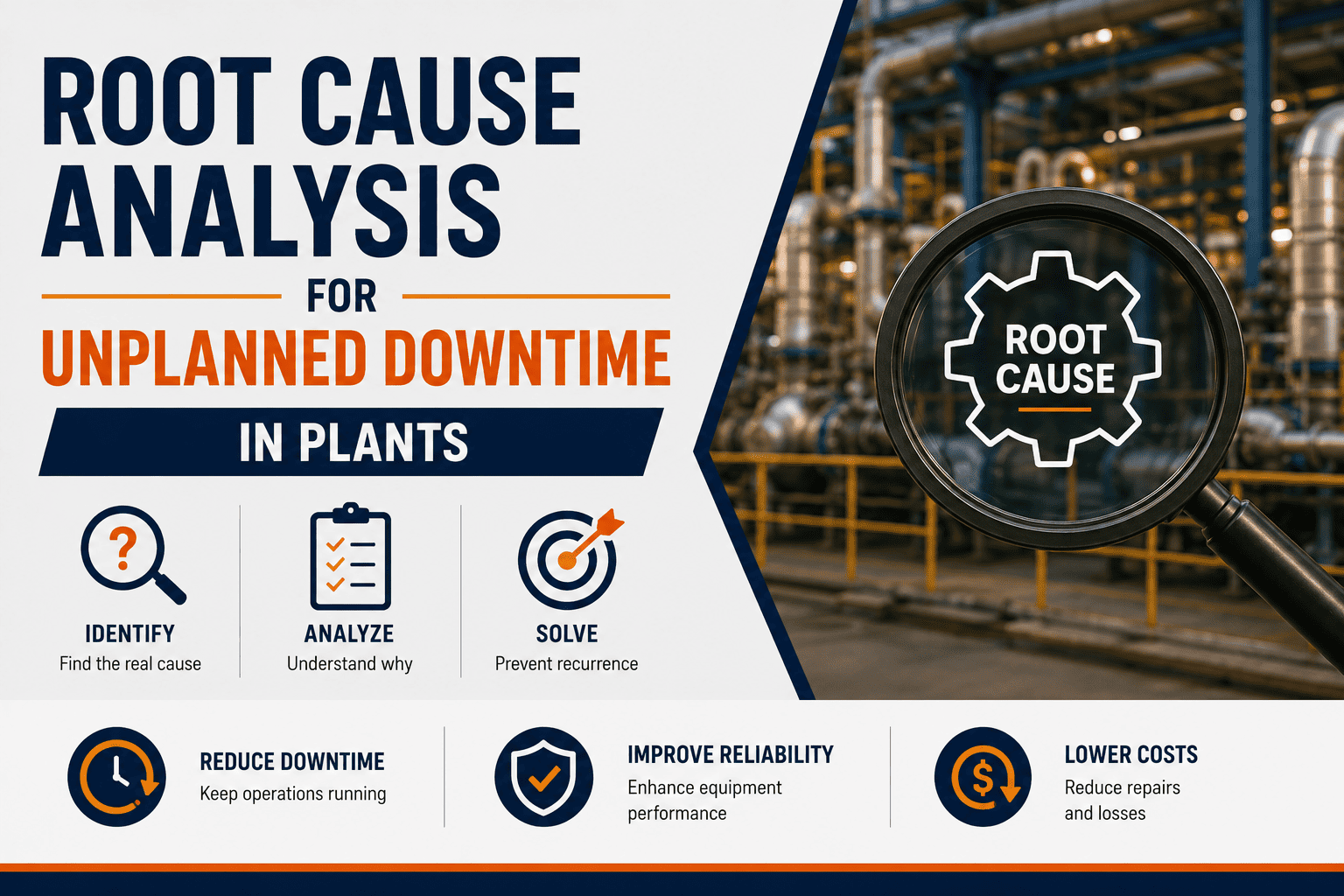
Conduct Root Cause Analysis on Every Major Event
For every significant unplanned stop, use structured methods like the 5 Whys or Fishbone diagrams to peel back symptoms and reach the true underlying cause. Document findings and corrective actions in your CMMS so the knowledge stays with the organization, not just in one technician's head.
The OEE Formula: Measuring What Matters on the Shop Floor
Overall Equipment Effectiveness is widely considered the gold standard KPI for manufacturing productivity because it combines three critical dimensions — Availability, Performance, and Quality — into a single score that reveals exactly where your losses are hiding. World-class facilities target 85% or higher, yet the average manufacturer operates closer to 60%, which means there is massive untapped capacity sitting inside your existing equipment.
Availability
Percentage of scheduled time the equipment is actually running. Losses come from breakdowns, changeovers, and startup delays.
Improve it: Predictive maintenance, SMED for changeovers, spare parts optimization
Performance
How close the machine runs to its theoretical maximum speed. Losses include micro-stoppages, slow cycles, and reduced speed events.
Improve it: Cycle time analysis, bottleneck identification, line balancing
Quality
Ratio of good units produced to total units. Losses come from scrap, rework, and defects caused by equipment or process issues.
Improve it: SPC implementation, instrument calibration, defect RCA
0.88 x 0.92 x 0.97 =
78.5% OEE
Gap to world-class (85%): 6.5 percentage points of hidden capacity
Proactive Maintenance Strategies That Cut Breakdowns by Half
Shifting from reactive to proactive maintenance is the highest-impact move a manufacturing facility can make to reduce unplanned downtime. Research consistently shows that plants adopting structured preventive and predictive maintenance programs achieve a 30-50% reduction in equipment failures. The key is not choosing one approach over another — it is using the right strategy for each asset based on its criticality, failure mode, and monitoring feasibility.
Foundation
Preventive Maintenance (PM)
Time-based or usage-based scheduled tasks — inspections, lubrication, filter changes, belt replacements. Best for non-critical assets with simple, well-understood failure patterns. The backbone of any reliability program.
Best for: Standard equipment, HVAC, conveyors, auxiliary systems
Intermediate
Condition-Based Maintenance (CBM)
Triggered by real-time indicators like vibration levels, oil analysis, thermal imaging, or pressure readings. Maintenance happens when the equipment actually needs it — not before or after. Reduces both over-maintenance waste and surprise failures.
Best for: Rotating equipment, motors, pumps, compressors
Advanced
Predictive Maintenance (PdM)
Uses IoT sensor data combined with machine learning analytics to forecast when a failure will likely occur. Provides the longest lead time for planning repairs, ordering parts, and scheduling work during optimal production windows.
Best for: High-value, high-risk production-critical assets
Build Your Proactive Maintenance Program with Oxmaint
From automated PM scheduling to condition-based triggers and mobile work orders, Oxmaint gives your team the tools to move from reactive firefighting to planned reliability.
Critical KPIs Every Plant Manager Should Monitor Weekly
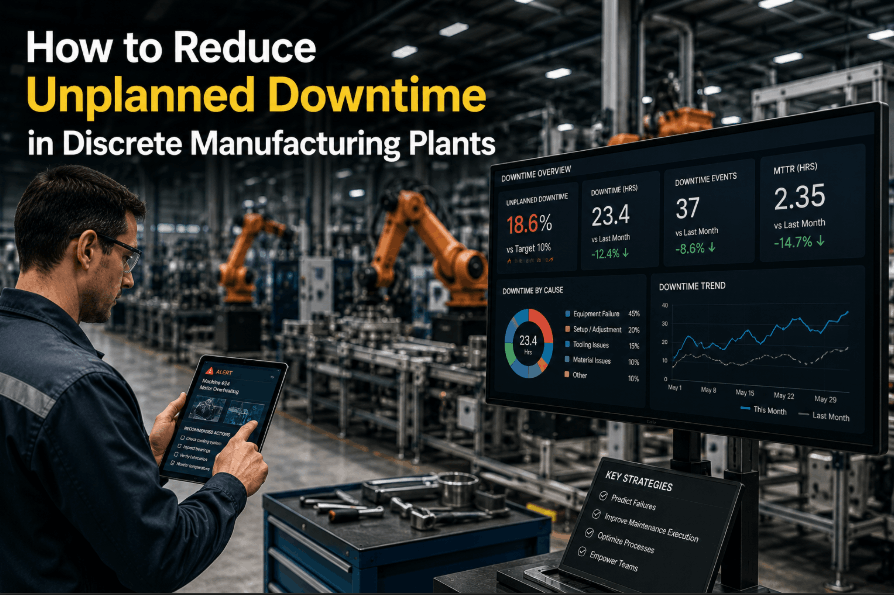
KPIs are the bridge between shop floor activity and strategic decision-making. Without the right metrics, your team is flying blind — reacting to problems instead of anticipating them. These six KPIs form an interconnected system where improvement in one area often drives gains across the board. Tracking them consistently through a centralized KPI dashboard — explore how top plants track manufacturing metrics — turns complex operational data into clear, actionable priorities.
Availability x Performance x Quality
The comprehensive top-level metric. Tells you what percentage of scheduled production time is truly productive. Every other KPI below feeds into this number.
Total Operating Time / Number of Failures
Mean Time Between Failures measures reliability. If MTBF is increasing, your proactive maintenance strategy is working and equipment health is improving.
Total Repair Time / Number of Repairs
Mean Time to Repair measures response speed. Shorter MTTR means your team diagnoses and fixes problems faster, minimizing the impact of each failure event.
PM Compliance
Target: 90%+
Completed PMs / Scheduled PMs x 100
Execution discipline metric. A PM plan only works if it is followed consistently. Low compliance rates directly correlate with higher unplanned failure rates.
Planned Work Ratio
Target: 80%+
Planned Work Orders / Total Work Orders
Organizational maturity indicator. A ratio above 80% signals a proactive maintenance culture; below 50% means your team is trapped in reactive mode.
First Pass Yield
Target: 95%+
Good Units / Total Units x 100
Directly feeds the Quality component of OEE. Low FPY often points to equipment calibration issues or process instability that maintenance can address.
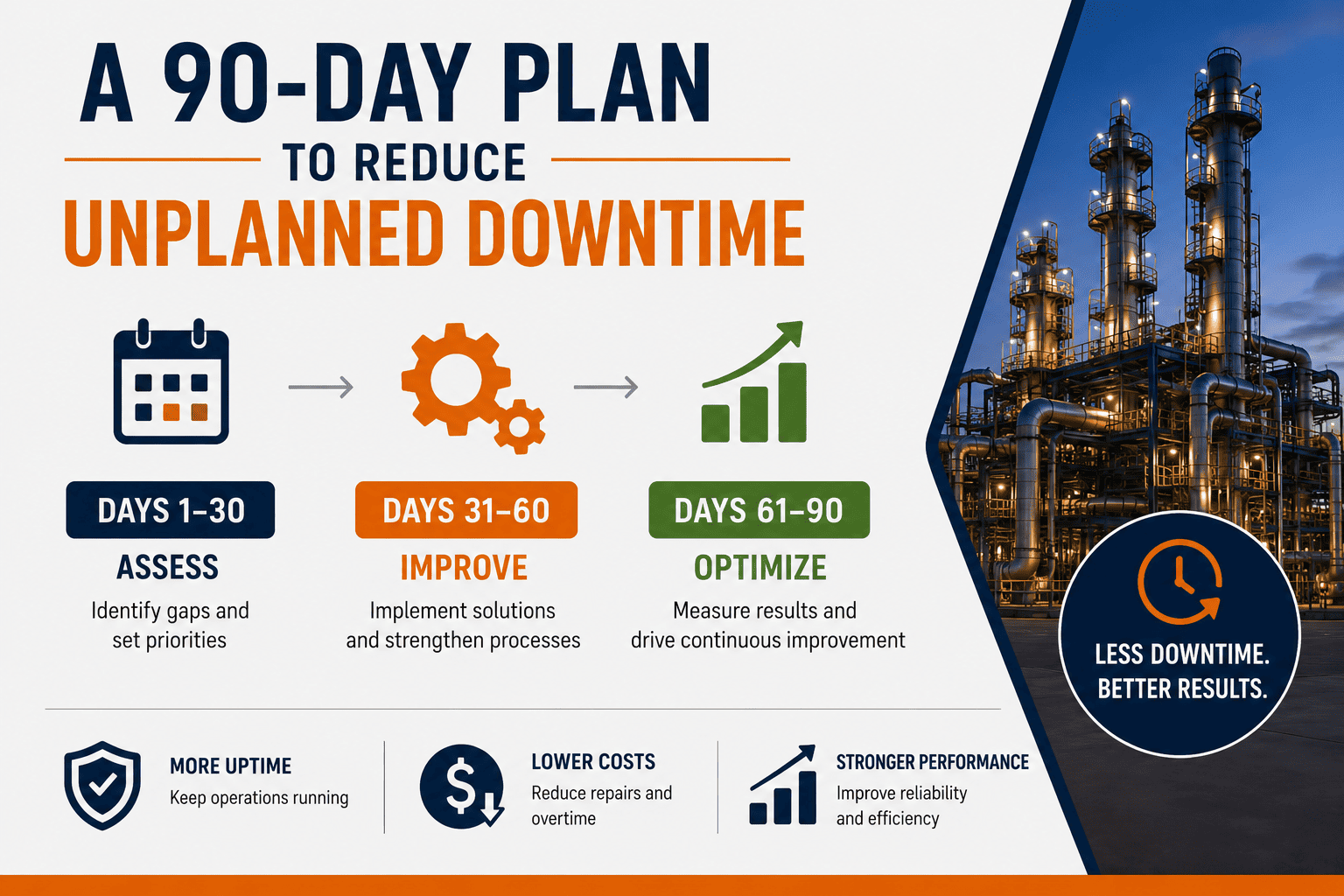
From Reactive to Predictive: A 90-Day Transformation Roadmap
Transforming your maintenance culture does not require a multi-year overhaul. A focused 90-day roadmap can deliver measurable quick wins while building the foundation for long-term reliability excellence. The phased approach below has been validated across hundreds of industrial facilities moving from reactive firefighting to structured proactive programs.
Days 1 — 30
Foundation & Quick Wins
Deploy CMMS and import asset registry
Standardize downtime tracking categories
Activate PM schedules for top 20 critical assets
Run first Pareto analysis on historical downtime data
Days 31 — 60
Optimization & Expansion
Extend PM coverage to all production-critical assets
Implement mobile work orders for field technicians
Begin condition-based monitoring on high-value equipment
Establish weekly KPI review meetings across maintenance and production
Days 61 — 90
Maturity & Measurement
Launch OEE tracking and dashboard reporting
Formalize Root Cause Analysis process for all major events
Benchmark KPIs against first 30-day baseline
Set 12-month improvement targets based on data
Why Leading Manufacturers Choose CMMS Over Spreadsheets
Spreadsheets break the moment your maintenance operation scales beyond a handful of assets. Work orders get lost, PM tasks get missed, asset history lives in someone's memory instead of a searchable database, and there is no way to calculate KPIs in real-time. A modern CMMS like Oxmaint solves all of these problems while delivering capabilities that spreadsheets simply cannot replicate.
Work Order Management
✗ Manual creation, easy to lose
✓ Automated, mobile, real-time tracking
PM Scheduling
✗ Calendar reminders, often missed
✓ Auto-generated based on time, usage, or condition
Downtime Tracking
✗ Inconsistent manual logs
✓ Standardized categories with auto-reporting
KPI Dashboards
✗ Hours of manual calculation
✓ Real-time OEE, MTBF, MTTR, PM compliance
Asset History
✗ Scattered files, tribal knowledge
✓ Complete searchable digital record
Spare Parts Inventory
✗ Manual counts, stockouts common
✓ Min/max levels, auto reorder alerts
Your Equipment Has More to Give. Oxmaint Helps You Unlock It.
Every percentage point of OEE improvement translates directly to increased output without adding machines, shifts, or headcount. Oxmaint gives your maintenance team the visibility, automation, and analytics to systematically close the gap between where you are today and world-class performance. Join the facilities that have already made the shift from reactive to proactive.
Frequently Asked Questions
What are the biggest causes of unplanned downtime in manufacturing?
The most common causes are equipment mechanical failures, electrical faults, material shortages or jams, operator errors, and control system issues. Research shows that the majority of these are preventable through structured preventive maintenance, operator training, and condition monitoring programs. The first step is tracking every stoppage consistently so you can identify which failure modes drive the most hours of lost production at your specific facility.
Sign up for Oxmaint and start logging every equipment stoppage with automated root cause tracking.
How is OEE calculated and what is a good score?
OEE is calculated by multiplying three factors: Availability (actual runtime divided by scheduled time), Performance (actual output speed versus ideal speed), and Quality (good units versus total units produced). A score of 85% or above is generally considered world-class, while many manufacturers operate between 55-65%. Even a small improvement of one percentage point can translate to hundreds of thousands of dollars in additional annual output from existing equipment.
How quickly does a CMMS deliver measurable ROI?
Most manufacturing facilities report measurable improvements within the first 30-90 days of CMMS deployment. Quick wins come from eliminating missed PM tasks, reducing time technicians spend searching for asset information, and having consistent data to drive targeted improvements. Full return on investment typically arrives within 6-12 months as the compounding effect of fewer breakdowns, lower emergency repair costs, and improved OEE accumulates.
Book a demo to see projected ROI numbers based on your facility size and current downtime levels.
What is the difference between preventive, predictive, and condition-based maintenance?
Preventive maintenance follows a fixed schedule based on time or usage — for example, changing oil every 500 hours regardless of condition. Condition-based maintenance is triggered by real-time measurements like vibration, temperature, or oil analysis that indicate degradation. Predictive maintenance takes this further by using sensor data and machine learning to forecast when a failure will likely occur, giving you maximum lead time to plan the repair. The best maintenance programs combine all three approaches, matching the strategy to each asset's criticality and failure characteristics.
Which maintenance KPIs should we track first?
Start with OEE as your top-level diagnostic metric, then track its three components (Availability, Performance, Quality) individually. Add MTBF and MTTR to measure reliability and response speed, PM Compliance Rate to measure execution discipline, and the Planned vs. Unplanned work order ratio to track your shift toward proactive maintenance. These six KPIs give you a comprehensive view of maintenance performance and its direct impact on production. Oxmaint calculates all of these automatically from your work order and asset data.


.png)

