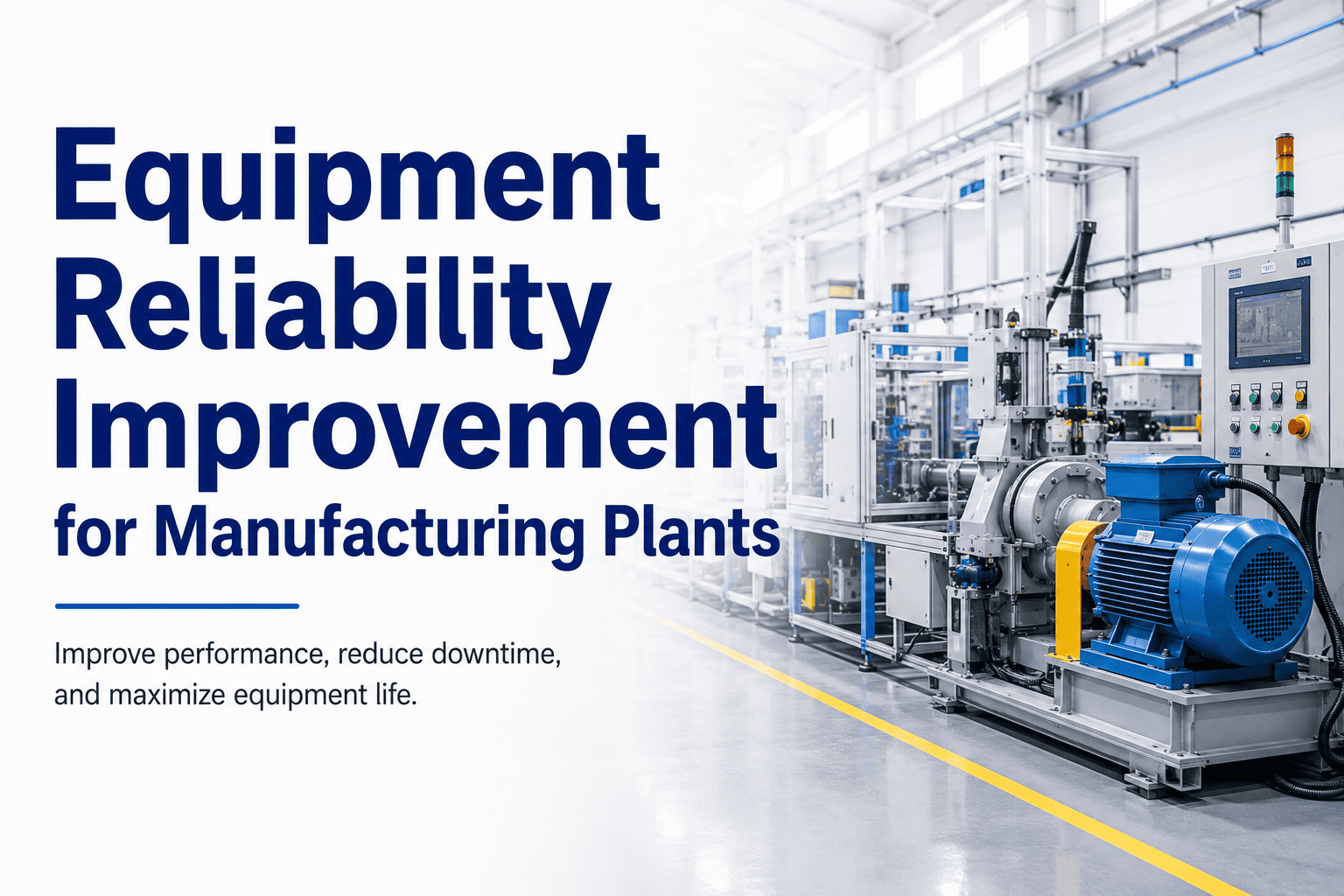
Reduce Manufacturing Plant Downtime by 50% in 2026
By oxmaint on February 6, 2026
Every silent machine on your production floor is burning money — roughly $260,000 per hour according to recent industry data. Manufacturing plants across the globe are losing an average of 27 hours each month to unplanned equipment failures, adding up to a staggering $50 billion annually in the United States alone. But the most forward-thinking plants are rewriting this story. By combining smart maintenance strategies with modern CMMS technology, they are slashing unplanned downtime by 50% or more — and the path to get there is more accessible than most plant managers realize. Schedule a free consultation to discover how Oxmaint helps manufacturing teams take control of their uptime.
What Downtime Really Costs Your Plant
Most plant managers know downtime is expensive. What many underestimate is the compounding nature of those costs — lost production is just the tip of the iceberg. Emergency repairs run three times higher than planned maintenance. Wasted raw materials, missed shipments, overtime labor, customer penalties, and even workplace safety incidents all pile onto the real cost of every unplanned stoppage.
$260K
Cost Per Hour
Average across manufacturing sectors
800
Hours Lost Yearly
Per average manufacturing plant
42%
Equipment Failure
Leading cause of unplanned stops
70%
Lack Awareness
Of when equipment needs servicing
Here is the hard truth
Every 1% reduction in unplanned downtime can save a specialized manufacturing plant $2 million annually. A 50% reduction does not just improve productivity — it fundamentally changes your cost structure, delivery reliability, and competitive position. The question is not whether you can afford to invest in downtime reduction — it is whether you can afford not to. Sign up for Oxmaint to start tracking and eliminating your costliest downtime drivers today.
Where Your Downtime Actually Comes From
Effective downtime reduction starts with an honest diagnosis. Surveys of over 600 manufacturing leaders reveal that downtime is not a single problem — it is a cluster of interconnected failures across equipment, processes, and people. The breakdown below shows where the biggest opportunities for improvement really are.
Anatomy of Manufacturing Downtime
Equipment Failure & Sensor Faults35%
Delayed or Improper Maintenance25%
Human Error & Training Gaps19%
Supply Chain & Parts Delays11%
Changeover & Scheduling Issues10%
The 50% Reduction Playbook
Cutting downtime in half requires more than buying software — it demands a strategic shift in how your plant thinks about maintenance. The most successful facilities combine technology with cultural change, moving from a "fix it when it breaks" mentality to a data-driven proactive approach. Here is the playbook that leading manufacturers are following right now.
1
Shift from Reactive to Predictive Maintenance
Stop waiting for breakdowns. IoT sensors monitoring vibration, temperature, and performance feed real-time data into your CMMS, enabling AI-powered predictions that catch failures weeks before they happen. Plants implementing predictive maintenance report 25% fewer breakdowns and 40% lower spare parts consumption. The key is starting small — pilot predictive monitoring on your five most failure-prone assets and expand from there.
25% fewer breakdowns with predictive maintenance
2
Centralize Everything in a CMMS
Spreadsheets, whiteboards, and paper logs are invisible enemies of uptime. A modern CMMS like Oxmaint centralizes work orders, asset histories, failure codes, parts inventory, and technician assignments in one platform — accessible from any device on the shop floor. Research shows that CMMS implementation alone reduces downtime by an average of 20%, and digitizing maintenance workflows improves technician wrench time by 35%. Sign up for Oxmaint to replace scattered systems with a single source of maintenance truth.
20% average downtime reduction with CMMS adoption
3
Master Root Cause Analysis
Fixing the same problem twice is not maintenance — it is waste. Every unplanned stoppage should trigger a formal root cause analysis logged in your CMMS. Use Pareto charts to identify the 20% of issues causing 80% of your downtime. Track failure codes consistently so patterns emerge over time. Plants that formalize RCA workflows eliminate 60% of recurring failures within 12 months.
60% reduction in recurring failures through RCA
4
Empower Operators as First Responders
Your machine operators are your earliest warning system. Train them to recognize early failure signs — unusual sounds, vibrations, or performance changes — and give them mobile tools to submit maintenance requests instantly. Autonomous maintenance programs where operators handle basic inspections and lubrication can prevent 15-20% of equipment failures that would otherwise require specialist intervention.
15-20% fewer failures with operator-led autonomous maintenance
5
Build a Smart Spare Parts Strategy
Waiting for critical parts is one of the most frustrating and avoidable sources of extended downtime. Use your CMMS to track consumption rates, set automatic reorder triggers, and maintain emergency kits for high-risk equipment. Pair this with vendor management integration so procurement happens seamlessly. Book a demo to see how Oxmaint automates inventory management alongside your maintenance workflows.
50% faster mean time to repair with optimized parts inventory
Ready to build your downtime reduction plan? See how Oxmaint brings predictive scheduling, mobile work orders, and real-time asset tracking together in one platform.
You cannot improve what you do not measure. These are the essential metrics that world-class manufacturing plants track through their CMMS to drive continuous uptime improvement. If your team is not monitoring all of these today, you are flying blind on your downtime reduction journey.
MTBF
Mean Time Between Failures
Measures average operating time between breakdowns. Higher is better. World-class target is 200+ hours for critical equipment.
MTTR
Mean Time to Repair
Average time from failure detection to equipment restart. Lower is better. Target under 2 hours for critical assets.
OEE
Overall Equipment Effectiveness
Combines availability, performance, and quality into one score. World-class plants achieve 85%+ OEE. Most average 60%.
PMP
Planned Maintenance Percentage
Ratio of planned vs. unplanned work. Best-in-class plants keep PMP above 85%, meaning only 15% of work is reactive.
Schedule Compliance
PM Tasks Completed On Time
Percentage of preventive maintenance tasks completed as scheduled. Target 90%+ to prevent the PM backlog that causes breakdowns.
Downtime Cost
Total Cost Per Stoppage Event
Full cost including lost production, labor, parts, penalties, and waste. Track per-event to prioritize highest-impact improvements.
Your 90-Day Transformation Roadmap
Reaching 50% less downtime is not an overnight achievement, but the timeline is far shorter than most expect. This phased roadmap delivers measurable quick wins in the first month while building toward sustainable, long-term uptime improvement across your entire operation.
Days 1-30
Foundation
Deploy CMMS, audit top 10 failure-prone assets, establish OEE baselines, digitize work order submission, and configure automated PM schedules for critical equipment.
Expected Impact: 15-20% downtime reduction from immediate PM automation
Days 31-60
Acceleration
Launch mobile work orders for technicians, implement root cause analysis workflows, set up spare parts min/max alerts, and begin condition-based monitoring on priority assets.
Activate predictive maintenance triggers, expand CMMS across all production assets, train operators on autonomous maintenance basics, and establish continuous improvement reviews.
Want a customized roadmap for your plant? Our maintenance specialists will assess your current setup and build a 90-day plan tailored to your equipment, team, and goals.
How Different Industries Are Winning the Uptime Battle
Downtime challenges vary dramatically across manufacturing sectors. Automotive plants deal with complex robotic assembly lines, food processors face sanitation-driven stoppages, and heavy industry battles extreme-environment equipment wear. The table below maps sector-specific challenges to the CMMS capabilities that deliver the fastest results.
Sector-Specific Downtime Solutions
Sector
Biggest Downtime Trigger
Avg. Monthly Lost Hours
Highest-Impact CMMS Feature
Automotive
Robotic cell failures, line stoppages
29 hours
Predictive maintenance with IoT integration
Food & Beverage
Sanitation delays, packaging jams
25 hours
Compliance checklists and SOP management
Metals & Mining
Crusher and conveyor wear
23 hours
Mobile work orders for remote sites
Pharmaceuticals
Calibration drift, validation gaps
20 hours
Audit trails and regulatory documentation
Plastics & Packaging
Extruder and hydraulic failures
18 hours
Asset lifecycle tracking and failure analysis
Chemical Processing
Corrosion, seal failures, shutdowns
22 hours
Condition-based monitoring and safety workflows
Unplanned downtime is the curse of the industrial sector. When expensive production lines fall silent, organizations stop earning and those investments start costing rather than making money. The companies that shift from reactive to proactive maintenance will gain a lasting competitive edge.
— Senseye True Cost of Downtime Report
Your Machines Should Be Running, Not Waiting
Oxmaint gives your maintenance team everything they need to predict failures before they happen, automate work order scheduling, track every asset in real time, and turn downtime data into actionable improvement plans — all from one platform accessible on any device. Join the manufacturers who have cut their unplanned stoppages in half.
How fast will we see results after deploying a CMMS?
Most plants see measurable downtime reduction within 30 days. Automated preventive maintenance scheduling and mobile work orders deliver quick wins immediately, while predictive capabilities and root cause tracking compound results over the following 60-90 days. Schedule a consultation to discuss realistic timelines for your specific operation.
What is the difference between preventive and predictive maintenance?
Preventive maintenance follows fixed time or usage schedules — like changing oil every 500 hours regardless of condition. Predictive maintenance uses real-time sensor data to determine when maintenance is actually needed based on equipment health. Predictive is more cost-effective because it prevents both over-maintaining healthy equipment and missing early signs of failure on degrading assets.
Can Oxmaint work with our existing older equipment?
Absolutely. Oxmaint works with equipment of any age. Older machines can be retrofitted with affordable IoT sensors for condition monitoring, or your team can use mobile devices to log manual inspections and readings. The platform adapts to your current infrastructure while enabling future upgrades. Sign up for free to see how the platform handles mixed-age equipment environments.
What size plant benefits most from a CMMS?
Any plant experiencing more than 10 hours of unplanned downtime per month will see significant ROI from a CMMS. Facilities with 50+ production assets see the most dramatic improvements, but even smaller operations using spreadsheets or paper-based maintenance report immediate gains in response times and failure prevention after switching to digital workflows.
How does Oxmaint compare to spreadsheet-based maintenance tracking?
Spreadsheets cannot send automated alerts, trigger work orders based on equipment conditions, track real-time technician availability, manage parts inventory, or generate OEE dashboards. Oxmaint replaces all of that scattered manual effort with one connected platform that gives your team instant visibility and automated workflows — which is why CMMS adoption alone reduces downtime by 20% on average. Book a demo to see the difference firsthand.