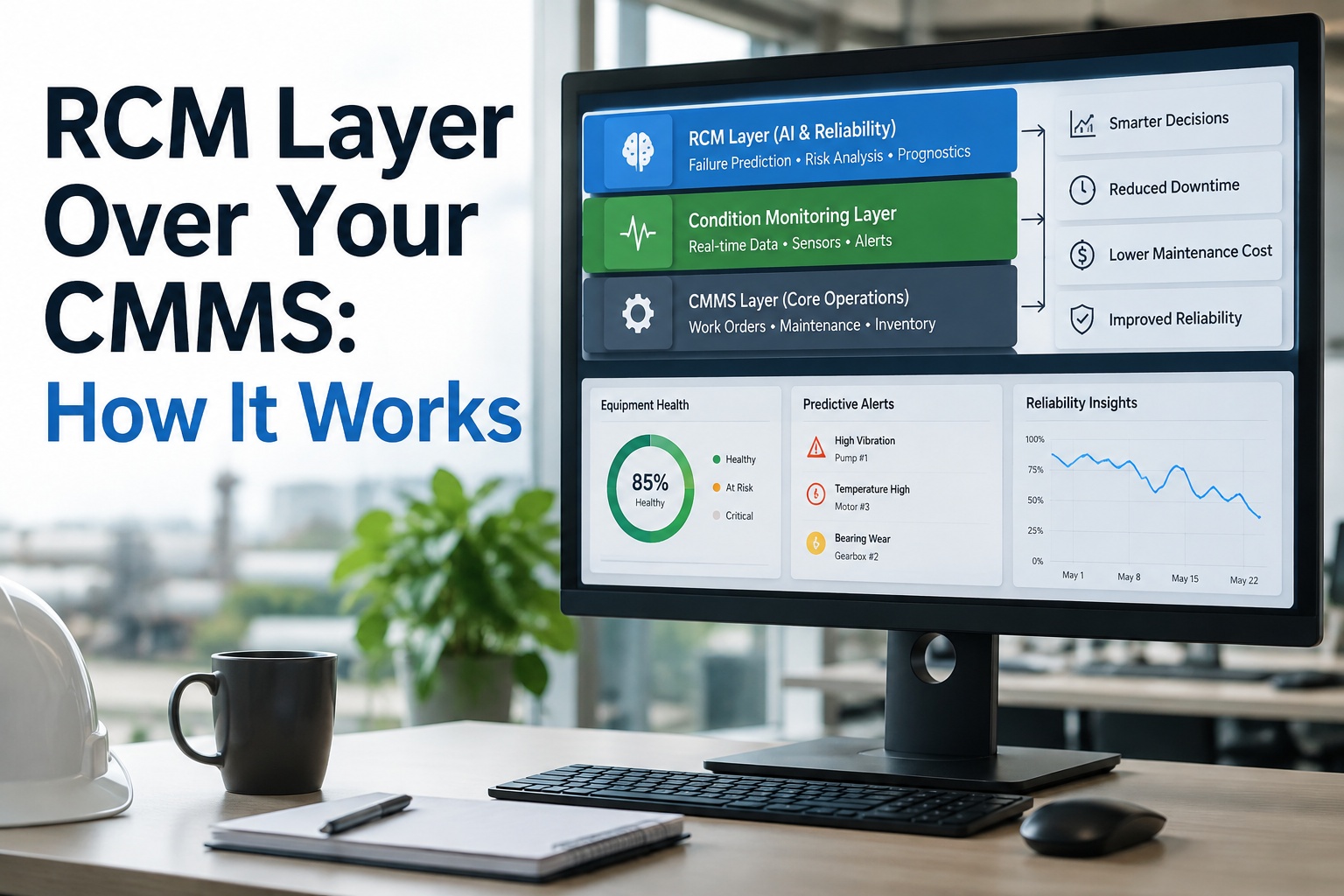
Every mid-to-large manufacturer already has a system of record — SAP PM, IBM Maximo, Infor EAM, Oracle EAM — and the last thing the reliability team needs is to rip it out. That's not just a political fight; it's a five-year, seven-figure project with a good chance of failing on go-live. The real move in 2026 is different: keep SAP or Maximo as the enterprise system of record and add a purpose-built RCM layer on top. Asset records, work orders, financial postings — those stay where they are. The reliability layer handles what the legacy EAM was never built for: continuous FMEA linked to live assets, JA1011 decision logic, condition-monitoring ingest, predictive anomaly detection, mobile execution on the plant floor, and the analytics that turn RCM from a consulting deliverable into an operating rhythm. This guide walks the architecture — how the layer connects, what data flows in which direction, and why the additive pattern is displacing rip-and-replace across manufacturing. Book a free demo to see the overlay live against a Maximo or SAP PM sandbox.
40%
Of maintenance data goes unrecorded or is entered incorrectly when technicians work through a desktop EAM interface designed for planners
90%+
Technician adoption rate typically achieved within weeks when the mobile execution layer is added on top of SAP or Maximo
<4wk
Time to real-time bidirectional sync on a pilot production line for a modern additive integration
Zero
Changes to SAP ABAP code, Basis transports, or Maximo customizations required for the overlay pattern
The Overlay Architecture · Three Zones, Not One Replacement
The additive pattern splits the maintenance stack into three architectural zones. Each system stays in its lane. SAP or Maximo remains authoritative for master data and financials. The RCM layer owns the analysis and predictive logic. The mobile execution surface handles the plant-floor work. Bidirectional sync ties them together. This is the architecture manufacturers are moving to in 2026 because it delivers modern reliability without touching the ERP that runs the business.
ZONE 1 · System of Record
SAP PM · IBM Maximo · Infor EAM · Oracle EAM
Owns: Asset master · Cost centers · Financial postings · Purchase requisitions · Enterprise reporting · Compliance archive
Master data down · Completions, costs, and RCM tasks up
ZONE 2 · RCM Overlay
OxMaint · Cloud-Native AI-First RCM Layer
Owns: FMEA analysis · JA1011 decision logic · Criticality & Pareto · P-F interval scheduling · Predictive anomaly detection · Reliability KPI dashboards
Predictive alerts, threshold-crossed WOs, technician tasks down · Confirmations, readings, photos up
ZONE 3 · Execution Surface
Mobile Apps · IoT Sensors · Condition Monitoring · QR Asset Tags
Owns: Technician mobile capture · Vibration/thermal/current streams · Photo evidence · Offline sync · Real-time floor-level work
The Six Bidirectional Data Flows
The overlay works because six specific data flows keep the three zones synchronized in near-real-time. Each flow is a defined channel with a canonical direction, a triggering event, and a conflict-resolution rule. Get all six right and the overlay is operationally invisible. Get any wrong and you produce either duplicate or stale data — the classic failure mode of half-built integrations.
Data Object
Direction
Trigger
Conflict Rule
Asset master & hierarchy
EAM → OxMaint
Nightly + on-change delta
SAP / Maximo wins
RCM-derived PM tasks
OxMaint → EAM
On task-selection approval
OxMaint wins for reliability logic
Work order execution & completion
Bidirectional
Real-time on status change
Last-touch with audit log
Predictive/condition-based WO fires
OxMaint → EAM
Sensor threshold crossed
OxMaint originates, EAM records
Parts consumption & labor
OxMaint → EAM
Technician close-out on mobile
EAM validates against inventory
Financial cost settlements
EAM → OxMaint
On settlement run
EAM authoritative
The API Surface · How the Layers Actually Talk
Modern SAP-CMMS overlays don't touch ABAP code or require Basis transports. They connect through the standard interface layer using out-of-the-box APIs — the same pattern Maximo, Infor, and Oracle EAM all expose. The four interfaces below cover 95% of real-world overlay integrations.
API 1
OData V4 / REST
SAP S/4HANA OData · Maximo REST · modern JSON payloads
Real-time work order and asset sync · low latency · preferred for cloud-to-cloud connections
API 2
BAPI / RFC Function Modules
SAP standard business object APIs · secure, transactional
Master data replication · financial postings · bulk operations · widely supported by SAP ECC 6.0 and above
API 3
IDoc Messaging
Asynchronous document exchange · file or middleware based
Batch synchronization · legacy landscape compatibility · queue-based for high-volume flows
API 4
MQTT / IoT Streaming
Sensor telemetry ingress · publish/subscribe protocol
Condition-monitoring streams · vibration, thermal, current · sub-second latency for predictive triggers
Review Your EAM Landscape With Our Integration Team
30-minute working session — we'll walk your SAP PM, Maximo, or Infor EAM configuration through the overlay architecture and show which API surface fits your landscape. Zero ABAP required, zero Basis transport.
Why Additive Beats Rip-and-Replace — Every Time
Enterprise EAM replacement projects have a well-documented failure rate. The additive overlay avoids the failure modes entirely by not asking anyone to migrate off the system that already runs finance and procurement. Below is the operational comparison every reliability director should walk their CFO through before a budget conversation.
Rip-and-Replace EAM Migration
The traditional path
18–36 month project · seven-figure budget
Full re-implementation of finance, procurement, HR integrations
Data migration risk on 10+ years of asset history
Business disruption during cutover
Change management across every department that touches maintenance
Board-level exposure if the go-live slips
Additive RCM Overlay
The 2026 default
Pilot live in 2–4 weeks · cloud subscription cost
No changes to SAP / Maximo core configuration
All existing asset history preserved in place
Zero business disruption — parallel operation from day one
Change management scoped to reliability & maintenance only
Reversible — kill the layer, EAM keeps running
Phased Rollout · What the First 90 Days Actually Look Like
The additive pattern rolls out in three phases. Each phase produces working software and measurable results. There is no big-bang cutover, no parallel-run testing period, no data migration weekend. The plant keeps running SAP or Maximo throughout; OxMaint layers on incrementally.
Weeks 1–4
Phase 1 · Foundation Sync
Audit existing EAM configuration · asset hierarchy · cost centers · maintenance plans
Configure bidirectional sync for equipment, materials, and PMs on one production line
Validate round-trip: 50 test work orders sync clean in both directions
KPI baseline captured for comparison
Weeks 5–8
Phase 2 · Pilot Live
Mobile app deployed to pilot line technicians · QR asset tags applied
First FMEA analysis run on top 20 critical assets in pilot scope
Predictive tasks generated, pushed back into SAP or Maximo as work orders
First measurable wins: 90%+ technician adoption, duplicate-entry rate down 20–30%
Weeks 9–13
Phase 3 · Scale & Sensors
Roll out to remaining production lines in waves
Activate IoT / condition-monitoring integrations · MQTT streams live
Reliability dashboards live for planners and plant management
First condition-based WO fires before threshold would have been reached manually
What OxMaint Owns vs What Your EAM Owns
The clearest way to understand the overlay is to draw a bright line: which system owns which capability. The tables below settle that question definitively — no ambiguity, no duplication.
EAM (SAP PM / Maximo) Owns
Asset master data · equipment records · functional locations
Cost center structure · financial postings · settlement runs
Purchase requisitions · vendor management · procurement
Bill of materials · parts inventory · warehouse management
Enterprise-wide compliance archive · regulatory reporting
Cross-plant financial rollup · consolidation for corporate
OxMaint Overlay Owns
FMEA worksheets · failure modes linked to assets · RPN scoring
JA1011 seven-question decision logic · task type selection
P-F interval calculation · predictive task scheduling
IoT / condition-monitoring ingest · threshold-based triggers
Mobile technician execution · photo evidence · offline sync
Live reliability KPI dashboards · MTBF / MTTR / OEE / PM comp
Expert Perspective · Why the Overlay Wins in Real Deployments
The rip-and-replace conversation is over in most manufacturing organizations we work with in 2026. Nobody has the appetite for an 18-month EAM migration to solve a reliability problem — because reliability is not an EAM problem. SAP PM and Maximo were built to run finance and procurement around maintenance work. They were never built to run FMEA, or to ingest live vibration data, or to fire a predictive work order when a bearing starts trending three weeks before failure. Trying to force the EAM to do those things creates custom ABAP objects that break at every S/4 upgrade. The additive overlay pattern is what modern reliability teams actually want: SAP or Maximo keeps running exactly as they are, the corporate CFO's spreadsheets don't change, procurement keeps posting POs the way it has for a decade — and reliability engineers get a purpose-built platform for the analytical and predictive work the EAM was never architected for. Every optimized task flows back into the EAM as a real work order. Every completion posts costs to the right cost center. The audit trail is complete. Nothing broke. That's why this pattern is displacing the traditional replacement conversation faster than most vendors realized was going to happen.
EAM Was Built for Planners
Desktop interface, transactional focus, no mobile heritage. Adding an execution layer solves the technician-adoption gap without touching the ERP.
Reliability Is Not an EAM Problem
FMEA, decision logic, condition monitoring, predictive triggers — none of it was in the EAM's original design brief. Purpose-built layer wins.
Reversible Beats Irreversible
If the overlay underperforms, kill the subscription — EAM keeps running. That optionality is what makes CFOs approve the project.
How OxMaint Delivers the Overlay in Production
OxMaint is architected for the overlay pattern from day one — not as a bolt-on to a standalone CMMS. The connector library, the sync engine, the conflict-resolution rules, the reliability data model — all designed to sit on top of an existing EAM without asking anyone to migrate off it.
Connectors
Pre-Built EAM Adapters
SAP PM, IBM Maximo, Infor EAM, Oracle EAM connectors ready to configure · OData V4, BAPI, RFC, IDoc supported
Sync
Bidirectional Sync Engine
Real-time or scheduled sync per object · field-level mapping · conflict-resolution rules per data class
FMEA
Reliability Data Model
FMEA linked to asset records synced from EAM · RPN scoring · JA1011 logic native · task selection auto-pushed back
IoT
Sensor Streaming Ingest
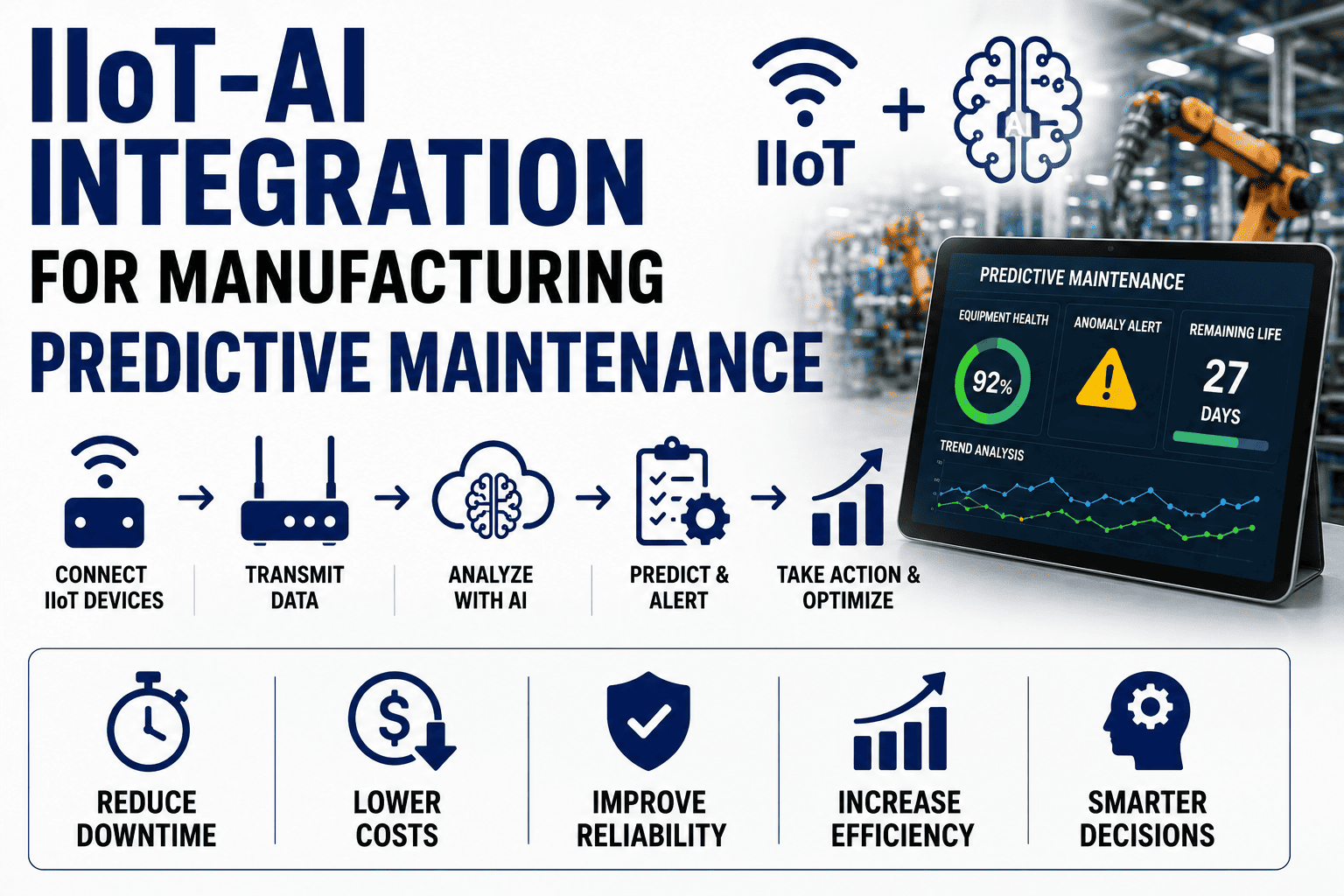
MQTT and REST ingress for vibration, thermal, current, pressure · threshold rules auto-fire predictive WOs into EAM
Mobile
Plant-Floor Execution Surface
Technician app pulls WOs from EAM · pass/fail capture · photo evidence · offline sync · confirmations push back real-time
KPIs
Live Reliability Dashboards
MTBF, MTTR, OEE, PM compliance, planned-to-reactive ratio — live from operational data, no monthly SAP report waiting cycle
Keep Your EAM · Add Real Reliability
The additive overlay is production-ready in weeks, not years. See how OxMaint layers on top of SAP PM, Maximo, or Infor EAM to deliver predictive, RCM-driven maintenance without touching the system your CFO signed off on. Free forever plan available to trial the workflow.
Frequently Asked Questions
Do we have to replace SAP PM or IBM Maximo to add the RCM layer?
No — and that's the entire point of the overlay pattern. SAP PM or IBM Maximo stays as the enterprise system of record for asset masters, financials, and procurement. OxMaint layers on top and handles what the EAM was never built for: continuous FMEA, JA1011 decision logic, condition-monitoring ingest, mobile execution, and live reliability KPIs. The optimized preventive and predictive tasks push back into your EAM as real work orders, and completions, parts consumption, and labor sync back up. Nothing about SAP or Maximo changes.
Does the integration require ABAP development or Basis transports?
No. Modern SAP-CMMS overlays connect through the standard interface layer — OData V4, BAPIs, RFC-enabled function modules, or IDocs — none of which require custom ABAP code or Basis transport changes. Your SAP Basis team retains full access control. The same pattern applies to Maximo (REST APIs), Infor EAM, and Oracle EAM. This is why the additive approach can go from kickoff to a running pilot in 2–4 weeks rather than the 18-month cycle a rip-and-replace project would demand.
Book a free demo to walk your landscape.
Which data flows in which direction between OxMaint and our EAM?
Master data flows down from the EAM to OxMaint — asset hierarchy, cost centers, maintenance plans. Execution and reliability data flow back up from OxMaint to the EAM — RCM-derived task selections, work order completions, technician confirmations, parts consumption, labor hours, and photo evidence. Predictive and condition-based work orders originate in OxMaint from sensor thresholds and get pushed into the EAM as work orders for cost tracking. Financial cost settlements flow back down from EAM to OxMaint for reliability KPI attribution.
What if our reliability engineers want to keep FMEA in a separate tool like RCM++ or Windchill?
OxMaint can ingest FMEA data from external tools via CSV or API, or reliability engineers can continue using specialized tools and push the resulting task selections into OxMaint for scheduling and execution. But most teams that adopt the overlay ultimately consolidate FMEA inside OxMaint because the analysis stops being a static document and becomes a living record — every failure mode linked to the actual asset, every predicted MTBF compared against observed MTBF each month, task intervals auto-recommending adjustment. That living-analysis model is hard to reproduce when FMEA lives in a separate silo.
Sign up free to test the integrated FMEA model.
Is the overlay pattern reversible if it doesn't work for us?
Yes — that's the operational advantage of the additive approach. Because OxMaint sits on top of the EAM without modifying its core configuration, cancelling the overlay is simply cancelling the OxMaint subscription. SAP or Maximo keeps running exactly as it did before, with all asset records, work order history, and financial postings intact. This reversibility is what makes the additive pattern approvable at the CFO level — it isn't a bet-the-farm decision, it's an incremental improvement that can be tested, scaled, or unwound without disrupting the ERP.
How does OxMaint handle ISO 55000 asset management compliance?
OxMaint produces the reliability program documentation ISO 55000 requires — asset criticality register, failure-mode analysis, task justification, KPI performance evidence, corrective action closure — all with immutable timestamps and audit-ready export by filter. The overlay pattern preserves the EAM's authoritative role in asset lifecycle and financial records, while OxMaint owns the reliability program evidence layer. Together they cover the ISO 55000 documentation surface without redundant record-keeping. The free forever plan is available to test the compliance workflow.
Book a free demo to review ISO 55000 evidence.


-for-manufacturing-plants-a-2026-guide.png)