Centrifugal pumps are the most common rotating equipment in any plant — and their failures are remarkably predictable. Across industry reliability data, bearing failures cause roughly 45% and mechanical seals another 30% of all centrifugal pump breakdowns, and both announce themselves weeks in advance through vibration, temperature, and oil-wear signals. That predictability is exactly what reliability-centered maintenance exploits. RCM doesn't ask you to service every pump identically; it asks which failure modes matter, whether each gives warning, and what task catches it before functional failure. This guide walks the full RCM strategy for centrifugal pumps — criticality ranking, failure-mode routing, the P-F interval that sets your intervals, and the condition monitoring that makes it work — plus how an AI-native CMMS keeps the whole thing living. Try OxMaint free or schedule a live demo.
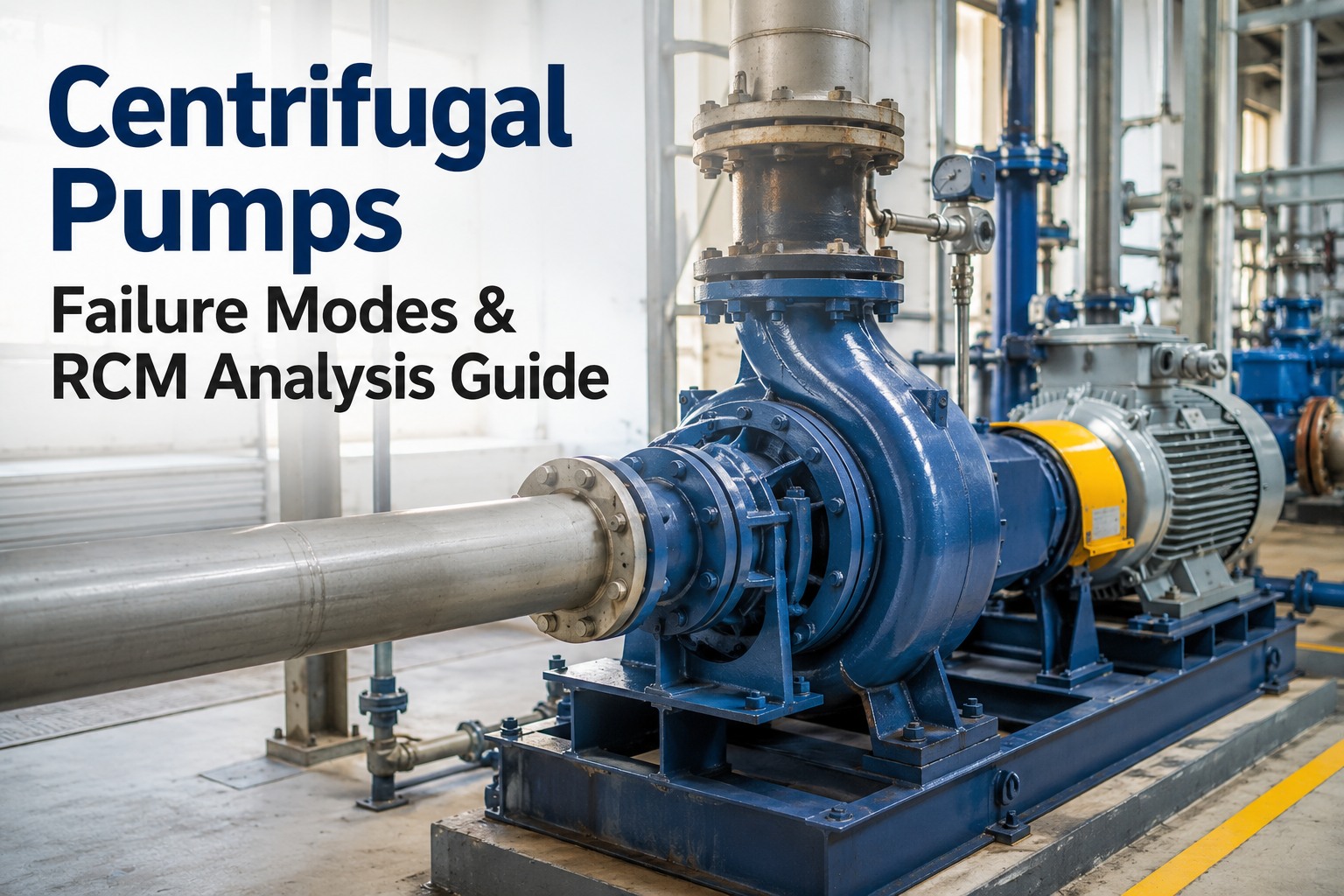
Reliability-Centered Maintenance · Centrifugal Pumps
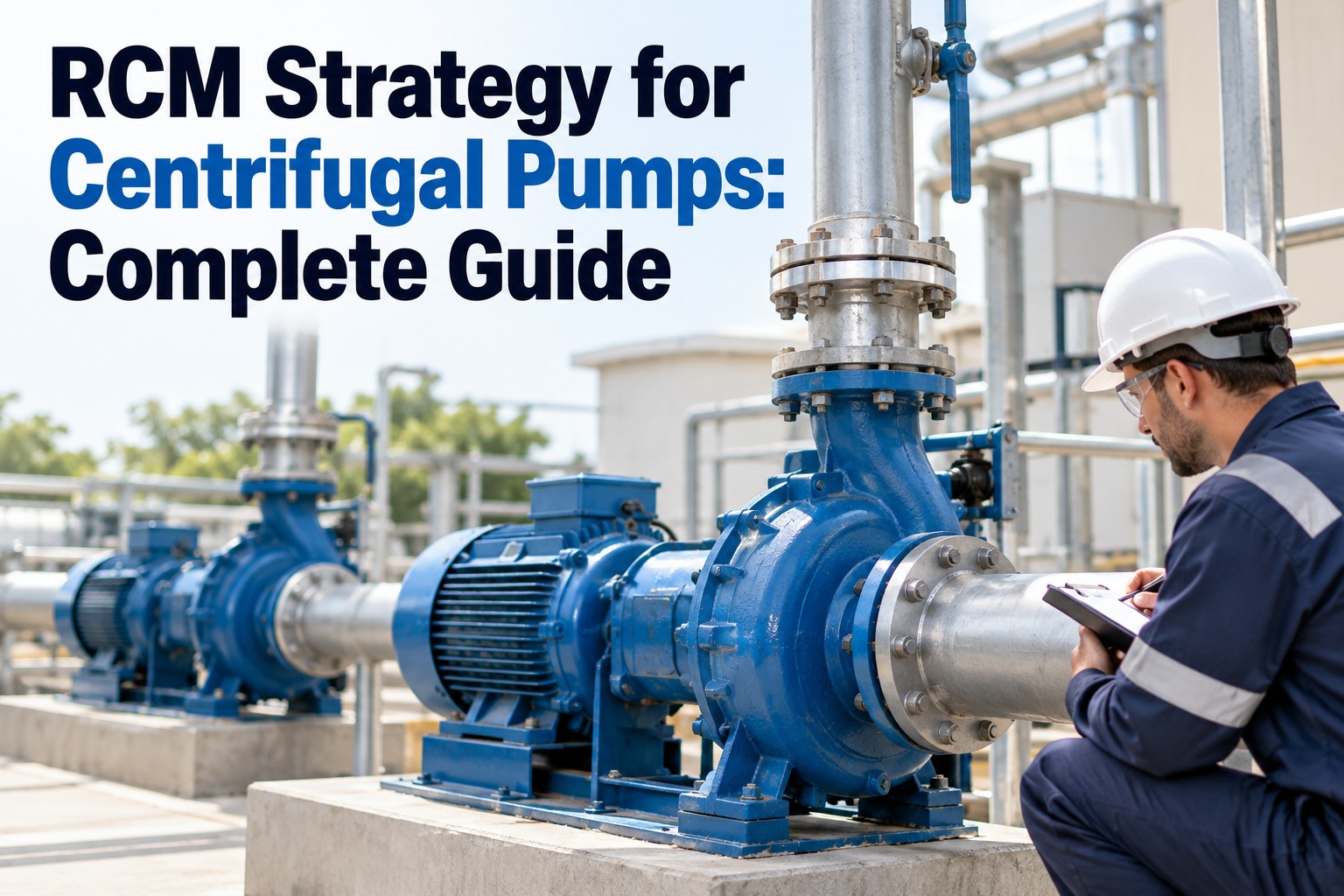
RCM Strategy for Centrifugal Pumps: Complete Guide
Bearings and seals cause three of every four pump failures — and both are catchable weeks early. This is how to build a reliability strategy that listens to the right signal at the right stage.
45% bearing failures
30% mechanical seal failures
24→48mo MTBF gain from BEP operation
80% of faults show in vibration
Why RCM Fits Pumps So Well
A centrifugal pump is almost the ideal RCM candidate, because most of its failures are induced — by installation, lubrication, or how it's run — rather than by bad components. Running far from the best efficiency point, poor alignment, a starved suction: these create the very failure modes a generic PM calendar never addresses. RCM starts from function and consequence instead of from the manual, which is why it consistently extends pump life while spending less. The headline example: keeping a pump operating within 80–110% of its rated flow can push mean time between failures from a typical 24 months to over 48 — a reliability gain no amount of extra greasing delivers.
The Failure Modes You're Actually Fighting
RCM analysis on a pump converges on two failure families — mechanical and hydraulic. Naming them precisely is the whole point: each has a different warning signal and a different defense.
Mechanical Failure Modes
Bearing failure
~45% of failures · vibration + temperature + oil wear
Mechanical seal failure
~30% of failures · leakage + seal-chamber temperature
Shaft seizure / misalignment
vibration signature · 1× and 2× running speed
Hydraulic Failure Modes
Cavitation
broadband vibration >5 kHz · erodes impeller fast
Recirculation / off-BEP
running outside 70–120% of rated flow
Pressure pulsation / thrust
discharge-pressure drift · piping vibration
The P-F Interval Sets Everything
The single idea that makes an RCM pump program work is the P-F interval: the window between the point a failure becomes detectable (P) and the point it becomes functional failure (F). Your monitoring task has to run more frequently than this window, or you'll miss it. Different signals see the failure at different stages — which is why the best programs layer them, from earliest warning to last-chance confirmation.
P · detectable
F · functional failure
Earliest
Ultrasonic / acoustic
First-stage bearing wear, incipient cavitation
Early
Oil analysis
Wear metals weeks to months out (ISO 4406 19/16)
Mid
Vibration
Bearings, imbalance, misalignment (ISO 10816-7)
Late
Thermal / process
Fastest confirmation · NPSH margin, pressure drift
Turn Every Monitoring Reading Into a Work Order — Free Forever
Collecting vibration and oil data means nothing if nothing triggers an action. OxMaint links condition thresholds straight to work orders, so a bearing trending toward failure opens a job the technician actually sees — with the failure mode, the P-F window, and the task already attached. No card, no time limit.
Routing Each Failure to a Strategy
The core output of RCM isn't a report — it's a maintenance decision for every failure mode, routed through a logic tree by whether the failure gives warning and what its consequence is. A single pump usually ends up with all four strategies at once: condition monitoring on bearings, time-based service on seals, and run-to-failure on a drain plug.
Does it give warning?
→ On-condition monitoring
Bearings, cavitation, seal wear — measurable degradation caught inside the P-F window.
Wears predictably?
→ Scheduled restoration/replacement
Mechanical seals, lubrication, wear rings — serviced at a set life before failure.
Hidden failure?
→ Failure-finding task
Standby-pump auto-start, check valves — tested because normal running hides the fault.
Cheap & non-critical?
→ Run-to-failure
Drain fittings, minor seeps — a deliberate, justified choice, not neglect.
The Inspection Cadence That Follows
Once failure modes are routed, the intervals fall out naturally — tiered by how fast each mode develops, with continuous monitoring reserved for the most critical pumps.
Daily
Operator rounds — leaks, noise, levels, suction/discharge pressures
Monthly
Technician PM — vibration vs ISO 20816 zones, thermography, seal checks
Annual / Outage
Alignment verification, internal clearances, performance testing
Continuous
Critical pumps — always-on vibration + process monitoring with alert thresholds
How OxMaint Runs Your Pump RCM Program
Continuous FMEA, live criticality, condition monitoring, digital work orders, asset-health tracking, and reliability KPI reporting on one cloud-based AI-native platform — so the strategy runs everywhere your team does, from utility rooms to remote sites, with mobile apps, offline mode, QR tags, IoT, and SAP/Maximo overlay.
01
Live Criticality & FMEA
Rank pumps by consequence and hold failure modes per asset — the analysis stays with the equipment, updated as it runs.
02
Condition Triggers → WO
Vibration, temperature, and oil thresholds open work orders automatically — the reading routes to the technician, not a dashboard.
03
IoT & Predictive Data
Real-time sensor streams tracked against P-F windows so degradation is caught at the earliest useful stage.
04
Mobile + Offline + QR
Scan a pump's QR tag for full history; close work orders offline at remote sites — synced when back online.
05
Asset-Health Tracking
Every pump's condition, MTBF, and work history in one record across moves and refits — the reliability memory.
06
Reliability KPI Reporting
Dashboards for engineers, planners, and multi-site groups — audit-ready, with SAP PM and Maximo overlay.
Give Every Pump a Living Reliability Strategy
Free forever plan — no card, no time limit. Rank criticality, route every failure mode, trigger work orders from condition data, and report reliability KPIs your whole group can act on. Or schedule 30 minutes and we'll map your centrifugal pump RCM program onto the platform end to end.
Frequently Asked Questions
What are the most common centrifugal pump failure modes?
Bearing failures lead at roughly 45% of all pump failures, mechanical seal failures follow at about 30%, and the rest split across cavitation, recirculation from off-BEP operation, misalignment, and shaft issues. Most are induced by installation, lubrication, or operating practice — not component quality — which is exactly why an RCM approach that targets causes beats reactive component swapping.
What is the P-F interval and why does it set my PM frequency?
The P-F interval is the time between when a failure first becomes detectable (P) and when it becomes functional failure (F). Any monitoring task must run more often than that window or it misses the failure. Since different signals detect degradation at different stages — ultrasonic earliest, then oil, vibration, and thermal — layering them extends your total warning time.
Book a demo to see it tracked per pump.
Which condition monitoring methods should a pump program use?
Vibration, thermal, and process monitoring are the minimum working combination. Adding ultrasonic and oil analysis significantly extends lead time on the top failure modes — ultrasonic catches incipient cavitation and stage-1 bearing wear, oil analysis flags wear metals weeks out, and motor current signature analysis catches impeller and dry-running faults. The key is that readings must trigger an action, not just accumulate.
How does running near BEP improve reliability?
Operating within 80–110% of rated flow keeps hydraulics stable and can extend MTBF from a typical 24 months to over 48. Running far below the best efficiency point causes recirculation, pressure pulsation, and thrust that attack seals and bearings. Off-BEP operation is a failure mode your RCM analysis should flag as an operating fix, not just a maintenance one.
Why run pump RCM in a CMMS instead of a spreadsheet?
Because a spreadsheet can't trigger anything. An AI-native CMMS links FMEA findings directly to asset records, condition-monitoring thresholds, and work order templates — so an RCM decision becomes a daily maintenance action that's tracked and refined. Failure modes stay with the asset, condition data opens work orders automatically, and reliability KPIs stay audit-ready across every site.
Try OxMaint free to make the switch.