CNC machines fail in patterns that RCM was built to attack. Field-data FMECA studies of CNC turning centers consistently identify the same critical subsystems — spindle, linear axis, turret, hydraulic and lubrication circuits — with the spindle bearing, spindle belt, drawbar, tool holder, and coolant/hydraulic hoses topping the low-reliability list. Yet 68% of manufacturing plants still run reactive on their CNCs, waiting for the spindle to seize or the ballscrew to lock up before intervening, and then paying $15K-$60K per unplanned event plus lost machining hours. A properly implemented RCM strategy — SAE JA1011 seven questions, FMEA-driven failure mode identification, criticality ranking, RCM decision tree for task selection — cuts unplanned downtime 30-50% and maintenance cost 25% within 18 months on studied CNC deployments. This guide covers RCM for CNC machines the way a reliability-mature manufacturer runs it: criticality ranking of the sub-systems, the seven questions applied to CNC failure modes, the decision tree for task selection, PM interval optimization, and how OxMaint CMMS replaces spreadsheet RCM with a live workflow. Start free or book a demo to see RCM decision logic applied to your CNC fleet.
Manufacturing · CNC Machines · RCM Strategy · CMMS 2026
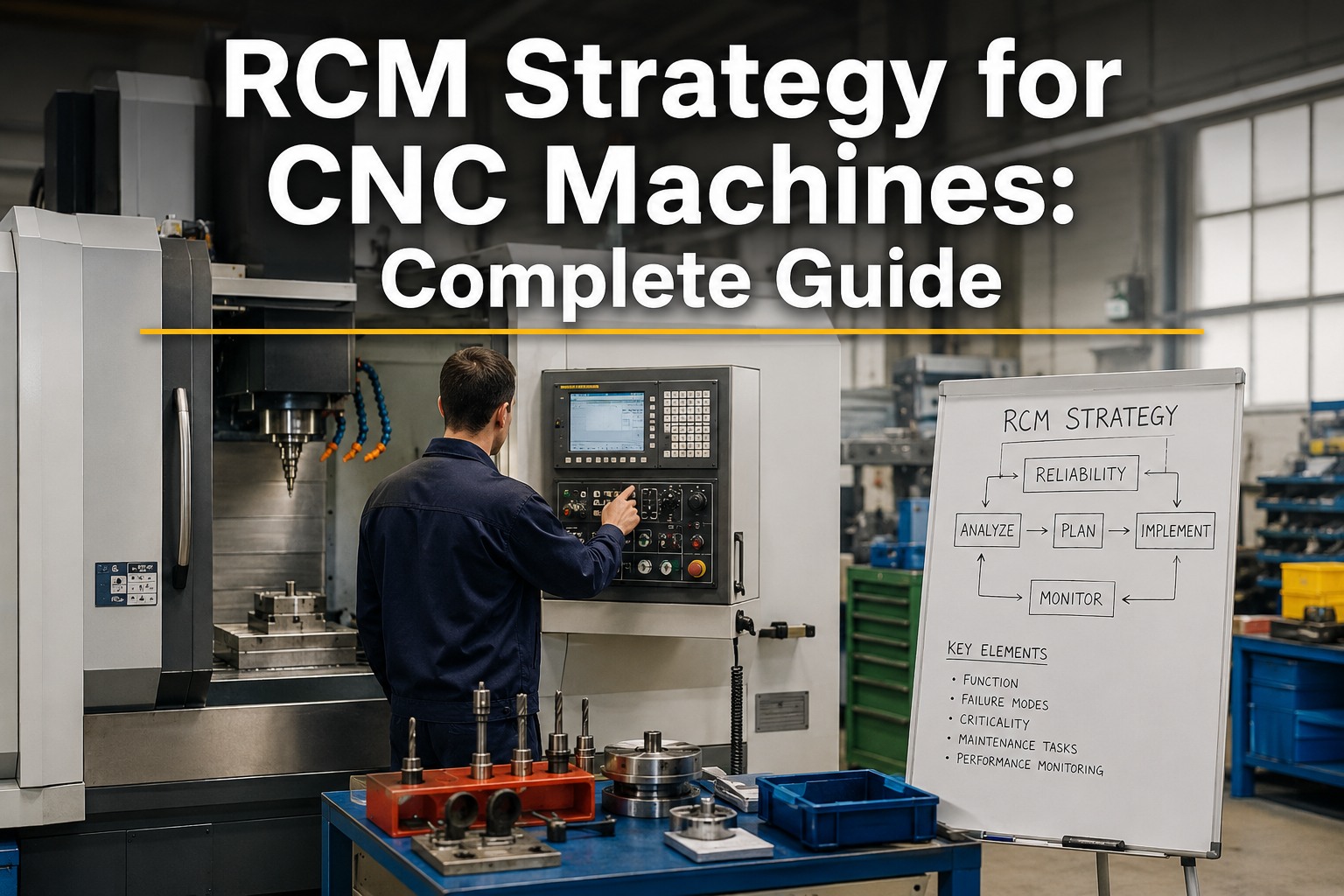
RCM Strategy for CNC Machines: Complete Guide
Build a proven RCM strategy for CNC machines: criticality ranking, task selection, PM intervals, and AI overlay with OxMaint. From spindle FMEA through ballscrew condition monitoring to run-to-failure justification — the full reliability workflow.
7 Questions
SAE JA1011 framework every true RCM program must answer
30-50%
Unplanned downtime reduction from mature RCM programs
25%
Maintenance cost reduction within first 18 months
14 Subsystems
Typical CNC turning centre subsystem count per FMEA studies
The 7 RCM Questions Applied to CNC Machines (SAE JA1011)
A program only qualifies as RCM under international standard SAE JA1011 if it systematically answers seven questions about every asset. Skip any one and the technical integrity of the whole program is compromised. Below is how each question lands on a CNC machining centre. Sign up free and OxMaint's manufacturing library ships with a CNC-specific RCM template — the seven questions become guided fields in the FMEA workflow, so your first CNC asset gets a compliant RCM record within your first workspace session.
Q1
What are the functions and performance standards?
e.g., "Machine parts to ±0.005mm tolerance at 8,000 RPM spindle speed, 30% cycle-time headroom." Without measurable performance, "failure" cannot be objectively defined.
Q2
In what ways can it fail to fulfill those functions?
Functional failures — spindle won't reach RPM, tolerance drifts, cycle time extends, coolant flow drops below spec. Not just breakdowns — degraded performance counts too.
Q3
What causes each failure? (Failure modes)
Root causes — bearing wear, belt slip, hydraulic contamination, encoder drift, ballscrew backlash, coolant nozzle blockage. This is where FMEA does the work.
Q4
What happens when each failure occurs?
Effects — machine crash, scrap batch, spindle seizure, secondary damage to workpiece and tooling. Document physical effects, not just downtime hours.
Q5
In what way does each failure matter? (Consequence)
Classify into: Safety/Environmental, Operational (production impact), Non-Operational (economic only), or Hidden. Consequence determines maintenance spend priority.
Q6
What proactive task can prevent or predict each failure?
Condition monitoring (vibration on spindle), scheduled restoration (hydraulic oil change), scheduled discard (coolant filter), failure-finding (safety circuit test).
Q7
What if no proactive task exists? (Default action)
Run-to-failure (economic-only consequences), redesign (safety consequences with no viable task), or accept the risk with justification. Run-to-failure is a valid RCM outcome.
CNC Subsystem Criticality — Where the Failures Actually Land
Field-data FMECA studies of CNC turning centers consistently identify the same set of critical subsystems, ranked by combined failure frequency and effect severity. The spindle system tops the list on almost every study, followed by the axis drives, turret, and hydraulic/lubrication circuits. Below is the criticality ranking that shapes where your RCM effort earns the biggest return. Book a 30-minute demo and an OxMaint reliability specialist will walk your specific CNC fleet's failure history against this criticality ranking — you'll leave with a prioritised RCM rollout order before you commit to a trial.
#1
SPINDLE SYSTEM
Bearings · Belt · Drawbar · Motor
Highest failure impact — spindle seizure = $15K-$60K + machining downtime
#2
LINEAR AXIS DRIVES
Ballscrews · Linear guides · Servo motors · Encoders
Backlash and positioning error precede failure — condition monitoring high yield
#3
TURRET / TOOL CHANGER
Turret indexing · ATC arm · Tool holders
High failure frequency, moderate severity — scheduled restoration wins here
#4
HYDRAULIC & LUBRICATION
Pump · Hoses · Solenoid valves · Filters
Hoses & solenoids are the "low-reliability" items — scheduled discard fits best
#5
COOLANT SYSTEM
Pump · Filters · Nozzles · Chip conveyor
Frequent nuisance failures, low individual severity — run-to-failure often justified
#6
CNC CONTROL & ELECTRICAL
Drives · PSU · Fans · Battery backup
Hidden failures dominate — failure-finding tasks (battery test, fan check) essential
The RCM Decision Tree — Choosing the Right Task for Each Failure Mode
Every failure mode identified in FMEA gets routed through the RCM decision tree to determine the technically appropriate and economically justified maintenance task. There are only five valid outputs — pick the wrong one and you're either wasting PM labour or accepting risk you shouldn't. Below is how the tree maps for CNC failure modes. Sign up free and OxMaint's RCM decision logic is built into the FMEA workflow — every failure mode you log routes through the tree automatically, producing a technically defensible task assignment with full audit trail.
FAILURE MODE INPUT
e.g., "Spindle bearing wear leads to progressive vibration increase, then seizure"
↓
CONDITION MONITORING
When: measurable degradation curve exists (P-F interval)
CNC example: Spindle vibration, ballscrew backlash, oil analysis
SCHEDULED RESTORATION
When: known age-related wear pattern, restoration returns to as-new
CNC example: Turret indexing gearbox rebuild, hydraulic oil change
SCHEDULED DISCARD
When: component has clear useful-life limit, replacement is cheaper than monitoring
CNC example: Coolant filter, hydraulic hose, timing belt
FAILURE-FINDING
When: hidden failure mode (fault only shows up under demand)
CNC example: Emergency-stop circuit test, battery backup verify
RUN-TO-FAILURE
When: consequence is economic only + PM cost > failure cost
CNC example: Coolant nozzle blockage, minor sensor failures
Every Spreadsheet RCM Program Dies the Same Way.
The FMEA workbook gets built, everyone celebrates, and six months later nobody can find the current version. Tasks that were rigorously justified go stale, decisions that were consequence-classified get overridden by whoever schedules PMs. OxMaint keeps RCM live — FMEA linked to work orders, criticality visible on every dashboard, and decisions updated with every closed WO.
PM Interval Optimization — Beyond OEM Calendar Schedules
OEM-recommended calendar intervals are a starting point, not the answer. They're set conservatively for the worst-case customer, and they assume no visibility into actual operating condition. RCM-driven interval optimization typically extends genuine PM intervals 20-40% while tightening others where wear is faster than assumed. Below is the optimization discipline that separates spreadsheet RCM from live RCM. Book a scoping call — an OxMaint reliability engineer will identify the top 5 PM intervals on your CNC fleet with the biggest optimization opportunity, before you commit to a trial workspace.
01
Operating-Hour Basis, Not Calendar Basis
Ballscrew relube on hours-run, not months. A single-shift CNC and a 24/7 CNC on the same calendar interval get very different actual service.
02
Condition-Based Trigger Where Possible
Coolant change on TRAMP-oil or particulate threshold, not calendar. Oil analysis + vibration data drive the interval, not the wall calendar.
03
Failure-Data Feedback Loop
If component X fails 60% of the way through the PM cycle, tighten. If it never shows wear at renewal, loosen. Six-month interval reviews based on closed WO data.
04
Product-Mix Adjustment
CNC running abrasive materials wears tooling and coolant filters faster. RCM intervals adjust to actual production mix, not nameplate assumptions.
Spreadsheet RCM vs. OxMaint Live RCM Loop
Most manufacturers have "done RCM" — meaning an FMEA workbook sits on a shared drive from a 2019 consulting engagement. Live RCM is different. Here's what changes when the FMEA, criticality, and decision-tree logic live inside OxMaint. Start free — no credit card, unlimited users, and the manufacturing library ships with CNC RCM templates so your first FMEA lives in the workflow, not a workbook.
Manufacturers that put RCM into a live CMMS see the 30-50% downtime and 25% cost reductions the mature-program studies promise. Start your free forever workspace to build your first CNC FMEA this week, or book a demo to see live RCM in action on a similar fleet before you commit.
"
We ran 34 CNC turning centres and machining centres, and our "RCM program" was a 2020 Excel workbook that nobody had touched in three years. The PM cycles were straight OEM, the criticality analysis was a memory, and we were losing an average 6 unplanned CNC events per quarter — most of them spindle or ballscrew. Rebuilding the FMEA inside OxMaint took us 90 days across the fleet. First year post-rollout, unplanned CNC events fell to 2 per quarter, spindle-related emergencies dropped to zero, and we extended 18 PM intervals with defensible failure-data justification. Maintenance cost per CNC dropped about 22%, and the RCM record is now something we could actually put in front of an auditor.
Reliability Engineering Manager · Tier-1 Automotive Supplier · 34 CNC Fleet · Midwest US
Frequently Asked Questions
What is RCM and how does it apply to CNC machines?
RCM (Reliability Centered Maintenance) is a systematic methodology defined by SAE JA1011 that identifies the most technically appropriate and economically justified maintenance task for every failure mode on an asset. For CNC machines, it starts with an FMEA of the ~14 typical subsystems (spindle, axes, turret, hydraulics, coolant, control), classifies each failure mode by consequence, and routes through the RCM decision tree to assign condition monitoring, scheduled restoration, scheduled discard, failure-finding, or run-to-failure. The outcome is a defensible PM program tuned to real risk.
Which CNC subsystems are the most critical for RCM?
Published FMECA studies consistently rank spindle system first (bearings, belt, drawbar, motor), followed by linear axis drives (ballscrews, guides, servos, encoders), turret/tool changer, hydraulic and lubrication systems, coolant system, and CNC control/electrical. The spindle typically accounts for the largest single failure-impact contribution.
Sign up free to load these subsystems as pre-configured criticality templates.
Is run-to-failure ever the correct RCM outcome for a CNC machine?
Yes — for failure modes where the consequence is purely economic AND the cost of PM exceeds the cost of failure. On CNC machines this often applies to coolant nozzle blockages, some sensor failures, and low-impact hydraulic seals. Run-to-failure is a valid, documented RCM decision — not neglect. What matters is that the decision is justified and recorded, not just quietly adopted because "we stopped PM'ing it."
How long does RCM implementation take for a CNC fleet?
A typical 20-50 CNC fleet reaches full RCM coverage in 60-120 days with a live CMMS-based approach — assuming failure history data is available for FMEA. Spreadsheet-based RCM programs often take 6-12 months and produce documents that go stale within the year. OxMaint's CNC templates accelerate the initial FMEA by pre-populating standard subsystems and common failure modes, leaving only site-specific customization to complete.
Can OxMaint integrate with our existing SAP or Maximo system?
Yes. OxMaint supports overlay with SAP PM and IBM Maximo — SAP/Maximo can remain the system of record for asset master data and financial reporting while OxMaint runs the mobile-first RCM execution, FMEA workflow, and condition monitoring layer. No rip-and-replace, no CAPEX request.
Book a demo to see the SAP/Maximo overlay workflow.
Does OxMaint support IoT and vibration sensor data for condition monitoring?
Yes. Vibration sensor data on spindles, ballscrew position feedback, hydraulic pressure telemetry, and other IoT feeds integrate via API or industrial protocols. RCM decisions that route to condition monitoring get an automated trigger — vibration crossing threshold or oil analysis exceeding limits generates a work order automatically, tied to the specific failure mode in the FMEA.
Is a credit card or CAPEX approval required to start?
No. OxMaint's free forever plan requires no credit card, no CAPEX request, and no consulting engagement — you can
sign up in under 2 minutes and start building your first CNC FMEA the same shift. Manufacturing plant asset templates including CNC turning and machining centres ship pre-built.
Move Your RCM Program Out of the Spreadsheet, Into the Workflow.
OxMaint links FMEA to work orders, criticality to every dashboard, RCM decisions to defensible task assignments, and interval optimization to actual failure data. From spindle to solenoid, every CNC failure mode gets the technically right response. Start free — no credit card, unlimited users, forever. Or book a demo for a fleet-specific RCM rollout walkthrough.