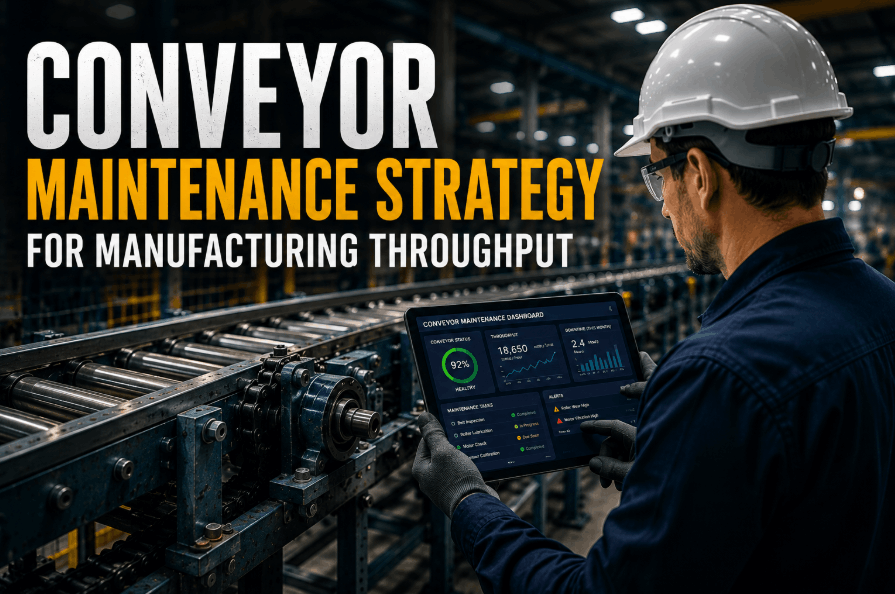
Conveyor systems are the circulatory system of manufacturing, distribution, and mining operations — and when they stop, the entire process stops with them. Aberdeen Group data pegs average unplanned downtime at $260,000 per hour across industries, and a single conveyor belt failure event runs $50,000-$250,000 with idler bearing emergency events adding $10,000-$50,000 in secondary damage on top. But the failures are not random. Bearing wear announces itself 4-8 weeks ahead in vibration signatures, belt tension drift shows weeks before slippage, and motor current drift precedes mechanical seizure by 2-4 weeks — every dominant conveyor failure mode has a detectable P-F interval that traditional calendar-based PM does not exploit. Reliability-Centered Maintenance (RCM) is the framework that closes that gap: identify every critical failure mode per conveyor asset, quantify consequence, and route each mode to the right maintenance strategy — run-to-failure for low-consequence rollers, time-based PM for lubrication, condition-based monitoring for bearings and belts, or redesign where no suitable task fits. Reliability engineers report 30-50% reductions in unplanned conveyor downtime and MTBF extensions up to 60% after structured RCM deployment. Below is the working guide — the 6-step RCM implementation methodology, the conveyor failure mode taxonomy with detection windows, the four-strategy routing decision per mode, and the CMMS architecture that turns RCM output into scheduled work. Start free or book a demo.
Manufacturing · Distribution · Mining · SAE JA1011 · 2026
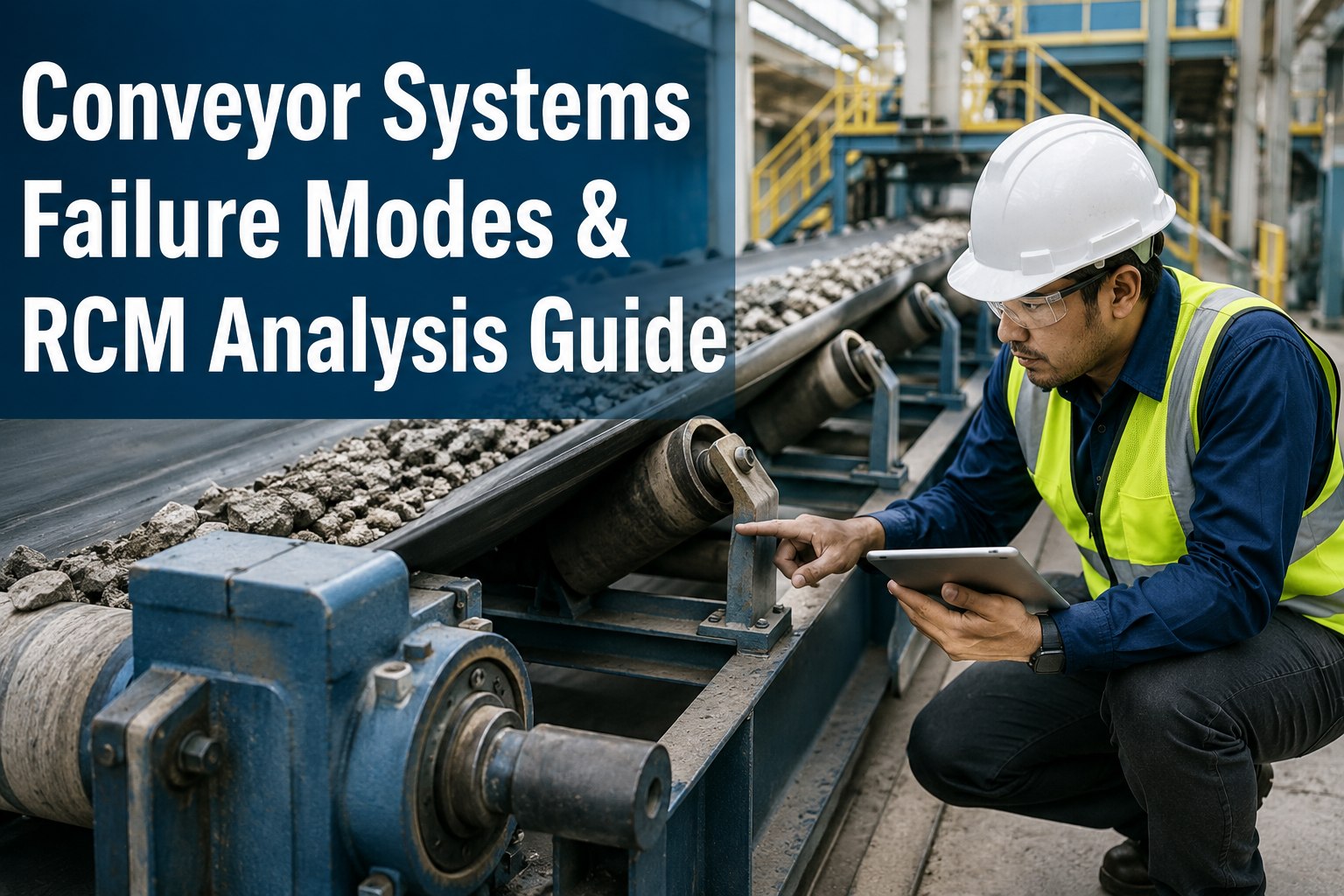
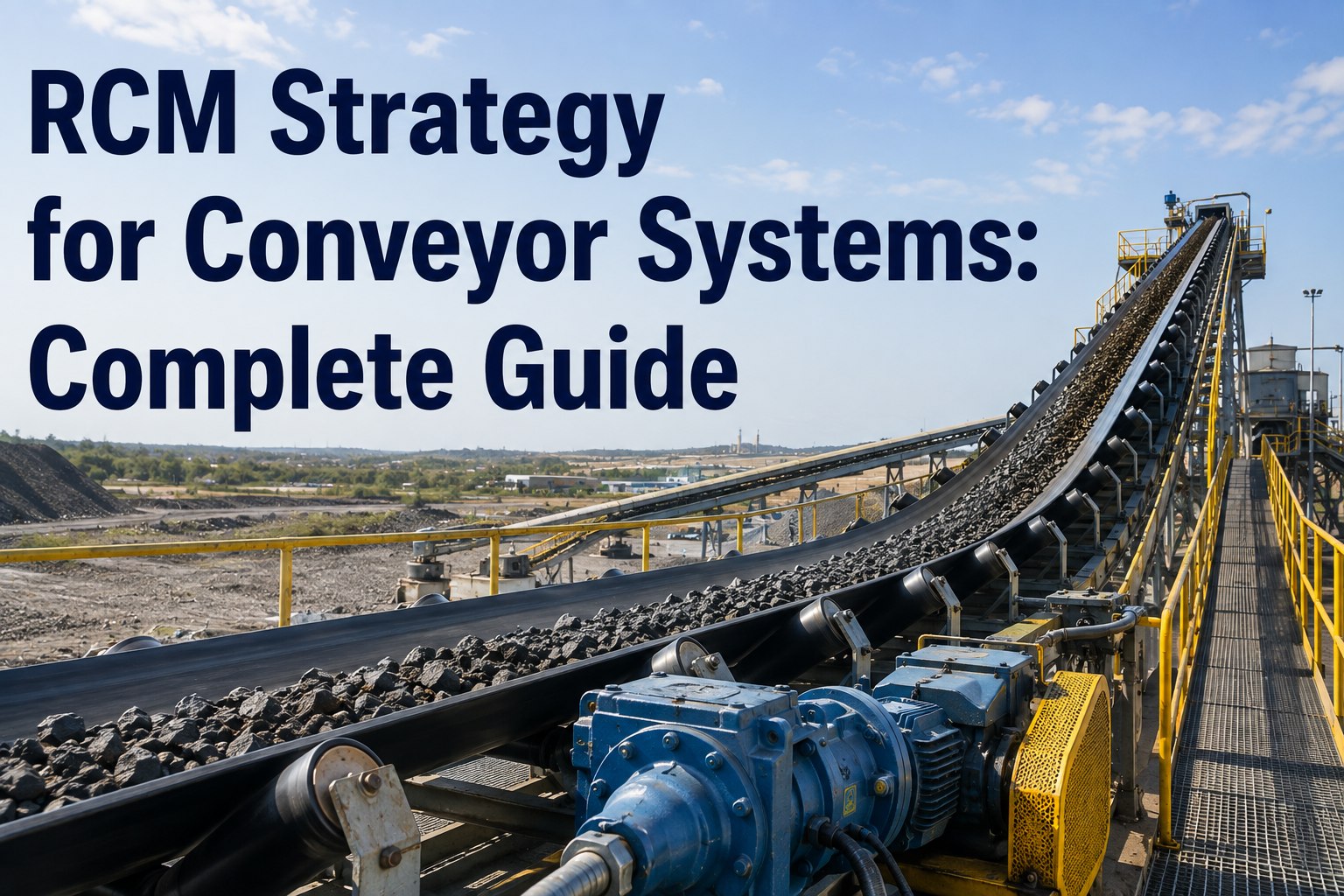
RCM Strategy for Conveyor Systems: Complete Guide
The 6-step RCM implementation methodology, the conveyor failure mode taxonomy with detection windows, the four-strategy routing decision per failure mode, and the CMMS architecture that turns RCM output into scheduled work orders.
-
$260K/hr
average unplanned downtime cost (Aberdeen)
-
-30 to -50%
unplanned downtime reduction after RCM deployment
-
4–8 wk
typical bearing wear detection window on vibration
-
+60%
MTBF extension from structured RCM programme
The 6-Step Methodology
Applied to a Conveyor Asset — Not a Textbook Motor
RCM is a 6-step methodology per SAE JA1011. Below is the working sequence applied to a conveyor drive assembly — the working practitioner's version, not the framework diagram.
Define Function & Performance Standard
Deliver continuous torque at target belt speed; availability ≥99.0%; unplanned motor-caused downtime ≤4h/quarter; throughput meets line takt without persistent speed sag. Numerical, not aspirational.
Identify Functional Failures
Belt speed slip beyond spec, complete stoppage, thermal trip, belt mistracking beyond edge tolerance, spillage above threshold, encoder jitter. Each functional failure is measurable at the process level.
Identify Failure Modes (FMEA)
Idler bearing wear, belt splice fatigue, pulley alignment drift, gearbox mesh degradation, motor winding fault, belt carcass damage, drive coupling backlash, take-up assembly wear. The critical analytical step — the deeper the mode identification, the more precise the strategy routing.
Analyse Failure Effects & Consequences
Bearing seizure to belt damage to 4-24hr production stop at $260K/hr. Motor thermal trip to planned cool-down + restart. Consequence classified as safety, operational, or non-operational — pharma weights safety-critical near-absolutely; distribution weights throughput.
Select Optimal Maintenance Task
Condition-based on bearings (vibration monitoring, 4-8 week P-F interval). Time-based on lubrication (grease intervals per OEM). Run-to-failure on low-consequence idlers where replacement is cheap. Redesign where no task fits and consequence is severe.
Implement & Continuously Improve
Load tasks into CMMS with cadence, thresholds, and evidence requirements. Review quarterly against actual failure data — modes that keep escaping the strategy get re-analysed. RCM is a living document, not a report.
The Failure Mode Taxonomy
Six Dominant Conveyor Failure Modes — With Their Detection Windows
Below are the six failure mode families that account for the vast majority of conveyor breakdowns, each with the sensor that detects it, the typical warning window, and the RCM strategy that fits.
Idler / Drive Bearing Wear
BPFO/BPFI vibration signatures rising, bearing housing temp creep, ultrasonic emissions. Detect on triaxial accelerometer + IR temperature.
Belt Mistracking & Edge Wear
Edge temperature drift, spillage rising, accelerated edge wear. Detect on vision AI + tracking sensors + edge thermal.
Belt Splice Fatigue & Carcass Damage
Acoustic anomaly at splice pass, VFD torque uptick without speed change, visible cover degradation. Detect on acoustic + drive current.
Motor Overload & Winding Fault
Motor current drift, thermal signature rising, insulation resistance dropping. Detect on CT/VFD data + IR imaging + IR test.
Gearbox Mesh & Oil Degradation
Mesh frequency sidebands, oil temperature rising, magnetic plug debris. Detect on vibration spectrum + oil analysis + temp trending.
Pulley Alignment & Coupling Backlash
Increasing lateral vibration, coupling wear signatures, belt tracking degradation traceable to pulley shift. Detect on laser alignment + vibration.
The Business Case
$260K/hr × 4hr Average Outage = $1M+ Per Event. RCM Is the Cheapest Insurance There Is.
A single conveyor failure event runs $50K-$250K in direct impact and cascades to $1M+ when downtime is included. Structured RCM programmes cost a fraction of that per year and deliver 30-50% unplanned downtime reduction plus MTBF extensions up to 60%. Payback on a typical pilot (10-15 assets, $12K-$25K in sensors + software) runs 6-11 months. Oxmaint runs the RCM programme end-to-end from failure mode library to scheduled work order.
The Strategy Routing
Failure Mode to RCM Strategy to CMMS Work Order Type
RCM analysis produces one of four strategies per failure mode. Below is the working routing table showing which conveyor failure modes go where, and what CMMS WO type each strategy generates.
| Failure Mode | Consequence | Strategy | CMMS WO Type |
|---|---|---|---|
| Non-critical idler bearing (isolated) | Low — easily replaced | RTF | Corrective WO on failure |
| Grease lubrication (bearings, pulleys) | Known wear-out age | TBM | Auto-scheduled PM WO on interval |
| Drive bearing wear (critical asset) | Cascading — belt/motor damage | CBM | Vibration threshold WO |
| Belt mistracking & edge wear | Progressive — production loss | CBM | Vision AI threshold WO |
| Motor overload / thermal | Immediate stop + damage risk | CBM | Current + thermal threshold WO |
| Take-up assembly geometry limit | Non-preventable at wear-out | Redesign | Change control + engineering WO |
Built for Manufacturing Reliability Teams
How Oxmaint Runs the Conveyor RCM Programme End to End
-
Failure Mode Library
Conveyor-Specific FMEA Templates
Pre-built failure mode library covering bearings, belts, motors, pulleys, gearboxes, take-up assemblies. Each mode pre-tagged with typical P-F interval and recommended RCM strategy — starting point rather than blank spreadsheet.
-
Criticality Ranking
Live Consequence-Weighted Priority
Asset criticality computed from downtime cost × failure probability × cascading impact. Reliability engineers focus RCM effort on top-quartile assets first. Rankings update live as failure data accumulates.
-
Strategy Routing Engine
Mode to RTF / TBM / CBM / Redesign to WO
Every failure mode assigned a strategy that auto-routes to the correct WO type — TBM to scheduled PM, CBM to threshold-triggered, RTF to corrective, redesign to engineering change control. RCM output becomes executable work automatically.
-
Sensor Ingestion
Vibration, Current, Thermal, Acoustic
Wireless vibration accelerometers, motor current transformers, IR temperature, acoustic emission sensors ingested via BACnet / Modbus / OPC-UA. Threshold breach on any sensor auto-generates WO with sensor trend chart attached.
-
ERP Overlay
SAP, Maximo, Oracle, Dynamics Compatible
Runs as execution layer alongside existing SAP PM, IBM Maximo, Oracle EAM, or Dynamics 365 — cost centres and financial close stay in the ERP, RCM execution runs in Oxmaint on mobile.
-
Free Forever Plan
Pilot 10-15 Critical Assets First
Cloud-based, mobile-first. Pilot on the top 10-15 critical conveyor assets, prove the 30-50% downtime reduction and MTBF gain, then scale to the full portfolio. Typical pilot payback 6-11 months.
Frequently Asked
Conveyor RCM Strategy Questions
Does RCM replace all fixed calendar PMs on conveyors?
No. RCM refines rather than eliminates calendar-based PM. Time-based PM remains the correct strategy for grease lubrication, belt cleaner blade replacement, gearbox oil changes, and other components with known predictable wear-out. Condition-based monitoring replaces calendar PM only where a detectable P-F interval exists (bearings, belts, motors). Run-to-failure applies to low-consequence assets where replacement cost is trivial and no cascading damage results. RCM's contribution is selecting the right strategy per mode, not defaulting to one strategy for all. Start free and load the failure mode library today.
Which conveyor assets should be prioritised for RCM analysis?
Rank by consequence × frequency: single-point-of-failure conveyors where an outage stops the entire process, high-tonnage main-line conveyors in mining and bulk material handling, and safety-critical assets where failure creates injury risk. A typical Pareto: 15-25% of conveyor assets account for 70-80% of unplanned downtime cost. Start RCM on that top quartile, prove the model, then scale. Attempting full-fleet RCM in month one is the most common way to stall a reliability programme before it delivers.
What sensors are needed for CBM coverage?
Core sensor set for a typical belt conveyor: wireless triaxial vibration accelerometers on drive motor bearings and critical idlers, current transformers or VFD data on drive motors, IR temperature sensors on bearing housings and gearbox, and belt tension sensors at take-up assemblies. Acoustic sensors add belt splice condition. Vision AI or edge-detection sensors add belt tracking coverage. Six to twelve sensor points per conveyor typically covers 80%+ of high-consequence failure modes. Most sensors install during a normal maintenance window without extended shutdown. Book a demo to see the sensor spec for your conveyor class.
How long to see measurable results after RCM deployment?
Sensor baseline established in 4-6 weeks of normal operation. First CBM-triggered work orders within 6-8 weeks as thresholds tune. Measurable downtime reduction visible at the 3-month mark on the instrumented cell. Full 30-50% reduction and 60% MTBF extension typically visible 6-12 months in, as the AI models tune to site-specific patterns and the RCM strategy library refines with actual failure data. Payback on typical pilot (10-15 assets, $12K-$25K investment) runs 6-11 months.
Is there a free plan to pilot RCM on our critical conveyors?
Yes. Oxmaint offers a free forever plan — enough to load 10-15 critical conveyor assets, load the failure mode library, assign RCM strategies per mode, and start running RCM-driven work orders with sensor ingestion. Cloud-based, mobile-first — no server procurement to start. Sign up and pilot on your top critical conveyors today.
6 Steps · 6 Failure Modes · 4 Strategies · 30-50% Downtime Cut
Every Failure Has a Detectable Signature. RCM Is How You Actually Catch It.
Six failure modes covering the majority of conveyor breakdowns. Four RCM strategies routing each mode to the correct work order type. 4-8 week detection windows on bearings, 2-6 weeks on belt tracking, 2-4 weeks on motor faults. Oxmaint runs the full loop from failure mode library through sensor ingestion to closed work order — with 30-50% unplanned downtime reduction and MTBF extensions up to 60% as the delivered outcome.