Reliability-centered maintenance asks one deceptively simple question of every injection molding machine: not "how do we service this?" but "what does each part need to keep doing, and what happens when it stops?" On an IMM — where a single barrel-temperature or hydraulic-pressure deviation turns a good batch into scrap in minutes — that distinction is the difference between a PM calendar full of low-value tasks and a strategy that targets the failures that actually cost you production. Reactive molding operations lose 15–25% of available production hours to unplanned stoppages. This guide walks the full RCM strategy — criticality ranking, failure-mode analysis, task selection, and interval setting — and how an AI-native CMMS keeps it living instead of frozen in a spreadsheet. Start free on OxMaint or schedule a demo.
RCM · FMECA · Criticality · PM Optimization
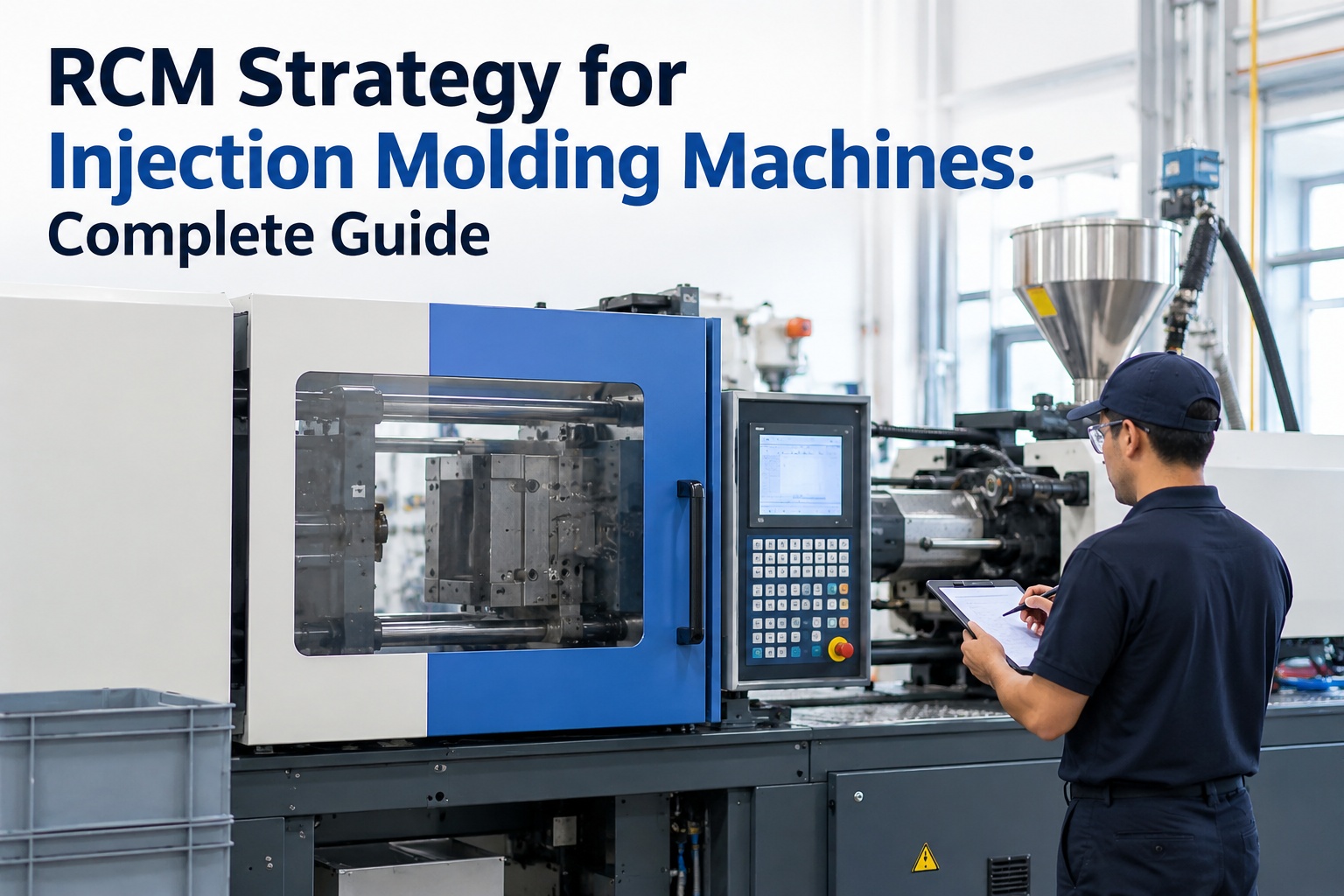
RCM Strategy for Injection Molding Machines: Complete Guide
Stop servicing every part the same way. Build a reliability strategy that spends maintenance effort where failure actually hurts production — and keep it alive with real machine data.
15–25%
Of production hours lost to unplanned IMM stoppages when maintenance is reactive
30–50%
Downtime reduction reported by structured PM programs vs reactive
±0.5%
Shot-weight drift is the trigger to measure screw-barrel clearance
5
Critical subsystems every IMM RCM program must rank and cover
What RCM Actually Changes
Most molding plants run a maintenance calendar — a list of tasks tied to dates, inherited from the machine manual and rarely questioned. RCM inverts the logic. Instead of asking what tasks to schedule, it asks what functions each subsystem performs, how it can fail, what that failure costs, and only then what task — if any — is worth doing. The output isn't more maintenance; it's the right maintenance, with run-to-failure deliberately chosen for parts where prevention costs more than the failure. That's why RCM programs cut cost while raising uptime at the same time.
Calendar PM
Every asset serviced on the same schedule
Tasks inherited from the manual, never challenged
Effort spread evenly, regardless of failure cost
Over-maintains cheap parts, under-protects critical ones
→
RCM Strategy
Effort concentrated on high-consequence failures
Every task justified by a failure mode it prevents
Run-to-failure chosen where prevention isn't worth it
Lower total cost and higher uptime together
The Five-Step RCM Journey
An IMM RCM strategy isn't a document you write once — it's a repeatable analysis you run per machine and per subsystem. These five steps take you from a fleet of presses to a defensible, prioritized maintenance program.
1
Rank Criticality
Score each machine and subsystem by production impact, safety, and cost of failure. The critical few get the deep analysis; the trivial many don't.
2
Run FMECA
For critical subsystems, map failure modes, effects, and a Risk Priority Number (severity × occurrence × detection) to rank what to tackle first.
3
Select the Task
Match each high-RPN failure to the right response: on-condition monitoring, scheduled restoration, scheduled replacement, or deliberate run-to-failure.
4
Set the Interval
Trigger by shot count and operating hours, not just calendar — a 24/7 press hits "annual" wear in 5–6 months. Intervals follow real usage.
5
Monitor & Refine
Feed failure history and condition data back in. RCM is a living loop — intervals tighten or relax as the machine tells you what it actually needs.
Replace Spreadsheet RCM With a Living Program — Free Forever
OxMaint turns the five-step analysis into an operating system: criticality and FMECA held per asset, PM tasks auto-generated from the failure modes you rank, and cycle-count triggers that fire when the machine actually reaches the interval — not when a calendar says so. No card, no time limit.
The Five Critical Subsystems
Every IMM RCM analysis converges on the same five subsystems — because this is where the dominant failure modes live. Here's what fails in each, and the RCM task type that best defends it.
Hydraulic System
Fails by: Seal leakage, oil contamination, valve wear, pressure drop
RCM task: On-condition — oil sampling & pressure trending
Screw & Barrel
Fails by: Clearance wear, shot-weight drift, banding, inconsistent melt
RCM task: On-condition — shot-weight monitoring, annual pull inspection
Clamp & Toggle
Fails by: Link lubrication failure, platen misalignment, tie-bar strain
RCM task: Scheduled restoration — lubrication & alignment checks
Heaters & Thermocouples
Fails by: Heater band burnout, thermocouple drift, temperature deviation
RCM task: On-condition — probe verification against setpoints
Controls & Safety
Fails by: Cabinet dust, terminal loosening, interlock & e-stop faults
RCM task: Scheduled restoration — cleaning & interlock verification
Choosing the Right RCM Task
RCM's discipline is in the task decision. Not every failure deserves a preventive task — the method routes each one to the cheapest effective response. This is the logic that stops a program from over-maintaining.
On-Condition
The failure gives warning — wear, drift, contamination. Monitor a measurable condition and act before functional failure. Best for hydraulics, screw wear, heaters.
Scheduled Restoration
Restore or overhaul at a set interval regardless of condition — where wear is steady and predictable. Toggle lubrication, cabinet service.
Scheduled Replacement
Discard and replace at a life limit — for parts with a known safe-life and cheap swap. Seals, filters, wear consumables.
Run-to-Failure
A deliberate choice, not neglect — where the failure is cheap, non-critical, and prevention costs more than the fix. Documented and justified.
How OxMaint Runs Your IMM RCM Program
Continuous RCM, live FMECA, criticality analysis, predictive monitoring, digital work orders, and reliability reporting on one AI-native platform — so the strategy stops living in a spreadsheet and starts running the shop floor, with audit-ready records for ISO 55000 and your internal program.
Analyze
Criticality & FMECA
Rank machines and subsystems, hold failure modes and RPN per asset — the analysis lives with the equipment, not in a lost file.
Generate
Auto PM Tasks
PM tasks generated straight from the failure modes you rank — every task tied to the failure it prevents, no orphan calendar entries.
Trigger
Cycle-Count Intervals
PM fires by shot count or operating hours, whichever comes first — the 24/7 press serviced on real wear, not a calendar guess.
Monitor
IoT & Vibration Data
Real-time barrel temperature, hydraulic pressure, and vibration feed condition alerts — on-condition tasks that act before failure.
Execute
Mobile Work Orders
Technicians close work orders from the floor against the machine record, with full history at the point of service.
Report
Reliability & ISO 55000
Audit-ready reliability reports and dashboards for planners, plant managers, and reliability directors — overlay SAP PM or Maximo.
See Your Molding Fleet Run on Living RCM
Free forever plan — no card, no time limit. Build criticality and FMECA per press, auto-generate PM from failure modes, trigger by shot count, and report reliability leadership can act on. Or book 30 minutes and we'll map your injection molding RCM program onto the platform end to end.
Frequently Asked Questions
How is RCM different from a normal PM schedule for molding machines?
A PM schedule lists tasks by date; RCM decides which tasks are worth doing at all. It starts from each subsystem's function and failure modes, ranks them by consequence, and routes each to the cheapest effective response — including deliberate run-to-failure for cheap, non-critical parts. The result is lower total cost and higher uptime, because effort concentrates on the failures that actually stop production.
Which IMM subsystems should an RCM analysis prioritize?
Five carry the dominant failure modes: the hydraulic system (seal and contamination failures), screw and barrel (clearance wear and shot-weight drift), clamp and toggle (lubrication and alignment), heaters and thermocouples (band burnout and drift), and controls and safety (interlocks and terminal faults). Criticality ranking tells you which of these to analyze first on your specific machines.
Book a demo to see it structured per press.
Should PM intervals be calendar-based or cycle-based?
Cycle-based wins for any press above single-shift. A machine running 24/7 accumulates the wear of a full "annual" interval in roughly 5–6 calendar months, so a date-driven schedule either over-services light machines or under-protects hard-run ones. Trigger by shot count or operating hours, whichever comes first — which is exactly what a CMMS automates.
What is FMECA's role in the strategy?
FMECA is how you rank what to fix first. For each critical subsystem you list failure modes, their effects, and a Risk Priority Number from severity, occurrence, and detectability. High-RPN failures earn a preventive task; low-RPN ones may be left to run-to-failure. It turns "everything feels urgent" into a defensible order of work.
Why move RCM off spreadsheets into a CMMS?
A spreadsheet RCM freezes the day it's written — nobody updates it, and the PM tasks drift from the analysis behind them. An AI-native CMMS keeps it living: failure modes and criticality sit with the asset, PM tasks auto-generate from them, IoT data feeds condition alerts, and reliability reports stay audit-ready for ISO 55000.
Start free to replace your spreadsheet.