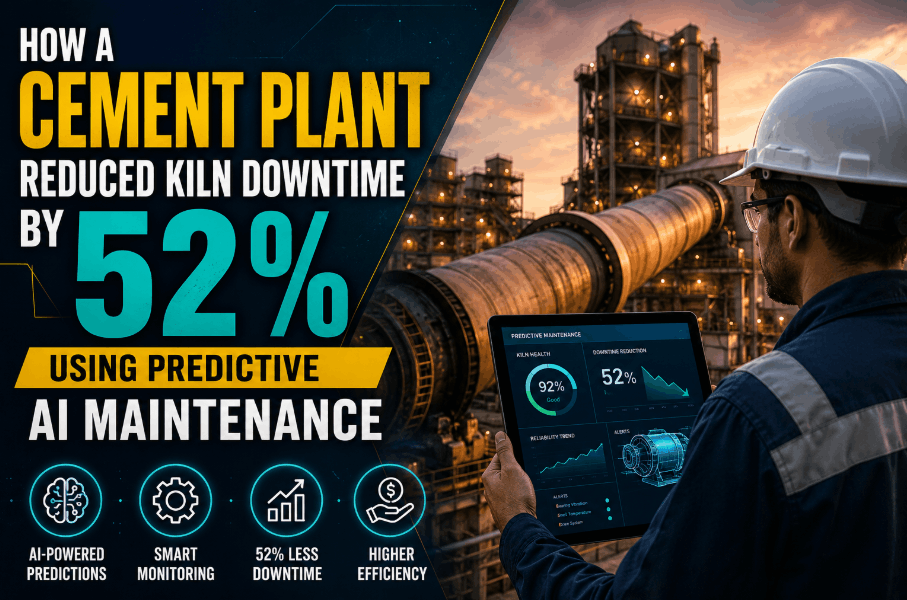
Cement plants operate some of the most energy-intensive and mechanically demanding equipment in heavy industry — rotary kilns running 24/7 at 1450°C, crushers processing 300 tons per hour, and grinding mills consuming 40% of total electricity costs. A single kiln shutdown costs $200,000 per day while unoptimized fuel consumption adds millions to annual operating expenses. AI-powered maintenance and kiln optimization are revolutionizing how cement manufacturers maximize uptime, reduce energy costs, and improve clinker quality. Try OxMaint free or book a consultation to discover how leading cement producers are achieving 95%+ kiln availability and cutting fuel costs by 12%.
The High Cost of Traditional Cement Plant Maintenance
Cement production combines extreme temperatures, abrasive materials, and continuous operation in a process where equipment failures cascade across the entire production chain. Reactive maintenance approaches and manual kiln control leave millions in unrealized efficiency on the table.
Transform reactive firefighting into proactive precision
OxMaint combines predictive maintenance with AI kiln optimization to prevent failures, reduce fuel consumption, and maximize production efficiency.
AI-Driven Optimization for Cement Manufacturing
Kiln Performance Optimization
Machine learning algorithms analyze hundreds of process variables in real-time — fuel flow, oxygen levels, feed rates, kiln speed, preheater temperatures — to identify optimal operating windows that minimize fuel consumption while maintaining clinker quality.
The AI adjusts control setpoints automatically or provides operators with precise recommendations, typically reducing thermal energy consumption by 8-12% and improving clinker strength consistency by eliminating temperature fluctuations.
Predictive Equipment Monitoring
Continuous analysis of vibration signatures, bearing temperatures, motor current, and performance trends predicts failures 2-6 weeks before they occur across kilns, crushers, mills, conveyors, and fans.
Early warnings trigger automated work orders with specific failure modes, recommended parts, and optimal repair windows. Maintenance teams arrive prepared, spare parts are in stock, and repairs happen during scheduled production breaks.
Clinker Quality Forecasting
AI models predict clinker quality parameters based on raw material composition, kiln conditions, and fuel characteristics, allowing operators to adjust the process proactively rather than discovering quality issues during laboratory testing hours later.
This reduces off-spec production by 40%, minimizes quality-related kiln adjustments that waste fuel, and ensures consistent cement strength for downstream blending operations.
Mill Efficiency Analytics
Raw and finish mill optimization through real-time monitoring of grinding media wear, separator efficiency, feed characteristics, and power consumption. AI recommendations improve throughput by 6-10% while reducing specific energy consumption.
The system detects classifier degradation, identifies optimal media top-up schedules, and prevents over-grinding that wastes electricity without improving particle size distribution.
Comprehensive Monitoring Across Cement Operations
Refractory condition monitoring, shell temperature profiles, tire and roller health, drive system analysis, and thermal efficiency tracking.
Cyclone blockage detection, heat exchanger efficiency, suspension preheater performance, and tertiary air duct monitoring.
Jaw and impact crusher wear prediction, bearing condition, hydraulic system health, and throughput optimization algorithms.
Vertical and ball mill performance, separator efficiency, grinding media consumption, and specific energy tracking.
Finish grinding optimization, media wear forecasting, power consumption analysis, and particle size distribution control.
Belt tension monitoring, bucket wear assessment, bearing temperature tracking, and alignment verification.
ID fan, PA fan, and cooler fan vibration analysis, impeller balance, bearing health, and efficiency degradation detection.
Belt condition, idler bearing failures, drive pulley wear, spillage detection, and automated lubrication verification.
Grate cooler plate wear, air distribution optimization, cooler fan performance, and clinker temperature control.
Quantifiable Results from AI Implementation
Fuel Cost Reduction
AI kiln optimization cuts thermal energy consumption through precise control of combustion, feed rates, and process temperatures.
Kiln Availability
Predictive maintenance prevents unplanned shutdowns and optimizes scheduled maintenance windows for minimal production impact.
Mill Energy Savings
Grinding optimization reduces specific electricity consumption while maintaining or improving product fineness and quality.
Less Off-Spec Clinker
Quality forecasting enables proactive adjustments that minimize rejected batches and rework requirements.
Fewer Emergency Repairs
Early failure detection shifts maintenance from reactive to planned, reducing emergency callouts and overtime labor.
Annual Savings
Typical mid-size cement plant realizes this through combined fuel savings, reduced downtime, and optimized maintenance.
Unlock your cement plant's hidden efficiency potential
Leading cement manufacturers using OxMaint achieve industry-leading OEE while dramatically cutting energy costs and maintenance expenses.
From Installation to Full ROI in 90 Days
Sensor Deployment
Install wireless sensors on critical equipment, connect to existing DCS and SCADA systems, establish secure data pipelines, and configure initial dashboards for operations team.
Baseline & Training
AI establishes normal operating patterns, technicians learn mobile maintenance workflows, and first predictive alerts begin flagging potential issues before failures.
Optimization Activation
Kiln control optimization goes live with operator-in-the-loop recommendations, mill efficiency algorithms begin suggesting adjustments, and clinker quality forecasting starts.
Full Integration
Automated work order generation from predictive alerts, continuous optimization refinement based on performance feedback, and complete ROI calculation with ongoing improvement.
| Process Area | Traditional Control | AI Optimization | Typical Improvement |
|---|---|---|---|
| Kiln Fuel Efficiency | Manual operator adjustments | Real-time AI setpoint optimization | 8-12% fuel reduction |
| Raw Mill Energy | Fixed operating parameters | Dynamic efficiency algorithms | 6-10% power savings |
| Clinker Quality | Reactive lab testing | Predictive quality models | 40% less off-spec |
| Crusher Maintenance | Time-based or run-to-failure | Condition-based prediction | 50% longer component life |
| Refractory Management | Visual inspections, sudden failures | Temperature profiling, wear prediction | 3x longer kiln campaigns |
Frequently Asked Questions
AI-Powered Maintenance and Optimization for Cement Plants
Every percentage point of fuel savings, every avoided kiln shutdown, and every hour of extended equipment life directly impacts your bottom line. OxMaint transforms cement plant operations from reactive to predictive, from wasteful to optimized, from expensive to efficient.