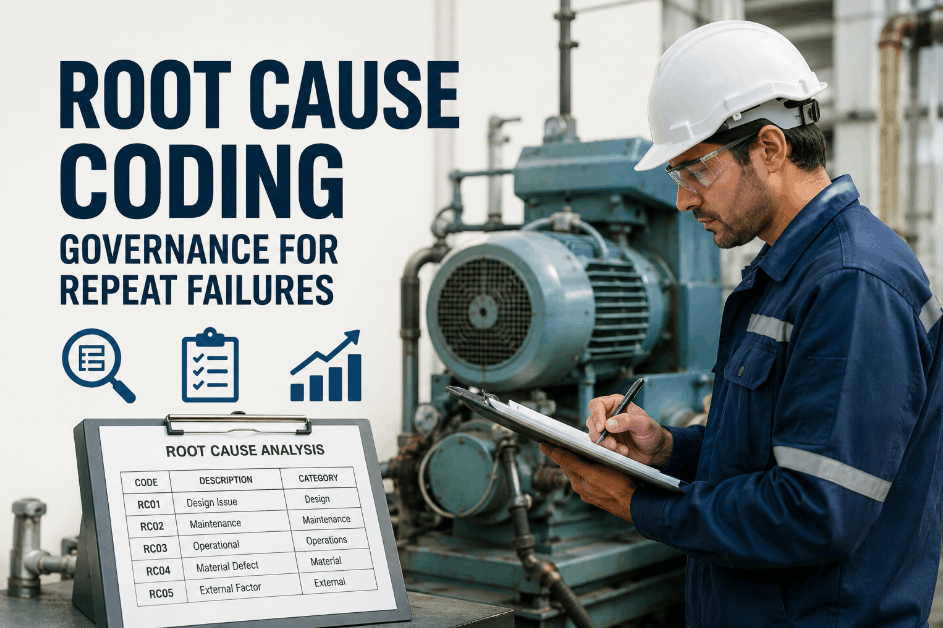
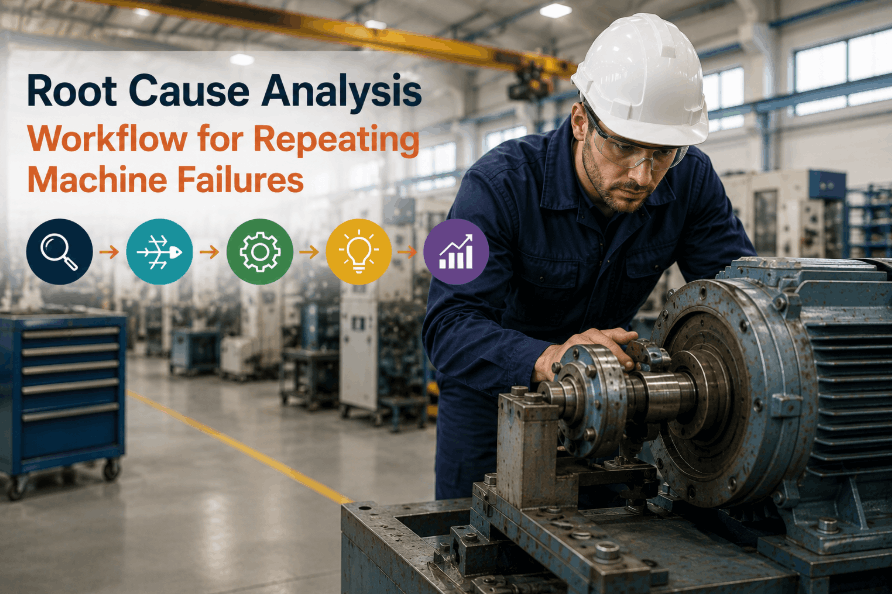
A root cause escalation workflow is the operational bridge between reactive firefighting and structured failure elimination. When the same asset fails repeatedly — a pump bearing replaced three times in six months, a conveyor motor that trips weekly, a compressor that generates more corrective work orders than any other machine on the line — the answer is not faster response. The answer is a governed escalation path that moves repeated failures from the work order queue into a documented root cause investigation with assigned ownership, defined timelines, and tracked corrective actions. Sign Up Free on OxMaint to configure automatic failure escalation triggers that detect recurrence patterns and create structured root cause investigation work orders before the next failure occurs. Plants that build a clean escalation workflow reduce failure recurrence by eliminating causes rather than managing symptoms — converting reactive maintenance spend into preventive reliability investment. Book a Demo to see how OxMaint's escalation logic connects repeated work orders to root cause action in a single workflow.
What Is a Root Cause Escalation Workflow?
A root cause escalation workflow is a defined process that automatically or systematically elevates repeated failure events from standard corrective work orders into structured root cause analysis (RCA) investigations. It defines the trigger conditions for escalation — such as the same failure code appearing three or more times on the same asset within 90 days — the investigation process, the ownership assignments, the corrective action requirements, and the verification criteria that confirm the failure has been eliminated rather than just repaired. Without a formal escalation workflow, repeated failures are handled one at a time in the corrective work order queue — generating cost and downtime indefinitely without moving toward resolution.
Defined recurrence thresholds — failure count, elapsed time window, downtime cost, or safety classification — that automatically flag an asset for root cause investigation when exceeded.
Assigned responsibility for the RCA process — typically the reliability engineer or maintenance supervisor — with a defined timeline and escalation to management if investigation milestones are missed.
Documented corrective actions — PM interval changes, part upgrades, design modifications, operating procedure updates — tracked to completion with assigned owners and due dates in the CMMS.
A defined monitoring period following corrective action implementation that confirms the failure mode has not recurred — closing the RCA loop with evidence rather than assumption.
Why Repeated Failures Stay Unresolved Without an Escalation Workflow
Sign Up Free on OxMaint to deploy escalation triggers that detect repeated failures automatically — ending the cycle of responding without resolving.
Standard corrective work order processes treat every failure as a new event. Without a system that correlates failure codes across work orders on the same asset over time, the third bearing failure on the same pump looks identical to the first — and is handled the same way, without triggering investigation into why the failures keep occurring.
In production environments, the operational priority is to restore the asset to service as quickly as possible. This is correct for the immediate failure — but without a formal escalation workflow that runs in parallel, the root cause investigation never gets scheduled, resourced, or completed. Speed of repair and depth of analysis require separate, parallel processes.
When no specific person is assigned responsibility for an RCA investigation — with a due date and management visibility — the investigation is deferred indefinitely. Repeated failures without assigned investigation ownership represent an organizational gap, not a technical one. The escalation workflow resolves this by creating an accountable owner at the moment the recurrence threshold is triggered.
Even when root cause investigations are completed informally, the corrective actions — replace a specific part grade, modify the lubrication interval, adjust an operating parameter — are frequently captured in a maintenance report that is filed and not acted upon. A governed escalation workflow tracks corrective actions as CMMS work orders with due dates and owner assignments — ensuring implementation, not just documentation.
Root cause findings that reveal inadequate PM intervals, wrong lubricant specifications, or operator procedure gaps need to feed directly into the PM plan update process. Without a formal link from the RCA corrective action to the asset's PM schedule in the CMMS, the reliability improvement from the investigation is not operationalized — and the failure eventually recurs under the original, unmodified maintenance regimen. Book a Demo with OxMaint to see how RCA corrective actions update PM schedules automatically.
Root Cause Escalation Workflow Design Reference
| Workflow Stage | Trigger / Input | Owner | Output / Deliverable | OxMaint Capability |
|---|---|---|---|---|
| Recurrence Detection | Same failure code ≥ 3× on same asset in 90 days | CMMS automation | Escalation flag and notification | Automated failure threshold alerts |
| Escalation Work Order Creation | Escalation flag triggered | Maintenance planner | RCA investigation work order assigned | Auto-generated RCA work order template |
| Data Collection | RCA work order open | Reliability engineer | Failure timeline, parts history, PM records | Asset work order history export |
| Root Cause Identification | Data collection complete | Reliability engineer + supervisor | Documented probable cause and contributing factors | RCA form embedded in work order |
| Corrective Action Assignment | Root cause documented | Maintenance manager | Actions assigned with owners and due dates | Follow-on work orders linked to RCA |
| PM Plan Update | Corrective action complete | Planner / Reliability engineer | Updated PM interval or procedure | Direct PM schedule modification in CMMS |
| Recurrence Verification | PM update implemented | Maintenance manager | 90-day monitoring period with no recurrence | Automated recurrence monitoring report |
Building a Root Cause Escalation Workflow in 5 Steps
Set differentiated escalation thresholds based on asset criticality. Critical assets — those whose failure stops production or creates safety risk — should escalate after two recurrences within 60 days. Non-critical assets can use a three-recurrence threshold over 90 days. Define secondary triggers based on downtime cost, labor spend, or safety classification to catch high-cost failures that do not meet recurrence frequency thresholds.
Connect your failure code history to an automated escalation rule that notifies the reliability engineer and maintenance manager when a threshold is crossed. The notification should include the asset ID, failure code, recurrence count, total downtime, and a link to the full work order history for that asset — giving the investigation team everything they need to begin data collection without a manual search.
Build an RCA work order template with defined sections: failure timeline, physical evidence, contributing factors, probable root cause, and corrective action recommendations. Assign a mandatory due date at creation — typically 14 days from escalation trigger — and configure management escalation if the investigation work order is not completed on schedule. Standardized templates reduce investigation variance and ensure every RCA produces actionable output.
Require that every completed RCA produces at least one of three outputs: a PM interval change, a procedure update, or a design modification work order. Create a direct link in the CMMS between the RCA corrective action and the PM task it modifies — ensuring that investigation findings become operational changes rather than archived documents. Track the corrective action work orders to completion with the same rigor applied to production work orders.
After corrective actions are implemented, activate a 90-day monitoring period that automatically alerts the reliability engineer if the same failure code recurs on the same asset. If recurrence is detected, the escalation workflow reopens with the previous RCA findings as context — accelerating the second investigation by eliminating redundant data collection. Sign Up Free on OxMaint to activate recurrence monitoring and escalation automation on your asset fleet.