Repeating machine failures are not bad luck — they are a system failure in how your maintenance program identifies, documents, and eliminates the true cause of breakdowns. When the same motor trips for the third time in a quarter, or the same conveyor bearing fails on a four-week cycle, the cost is not just the repair bill — it is the compounding production loss, technician overtime, and erosion of confidence in your maintenance program. Sign Up Free to see how OxMaint builds root cause analysis directly into your work order workflow, so every recurring failure triggers a structured investigation — not just another reactive repair. The difference between a reactive plant and a reliability-centered one is whether failure data drives decisions. Book a Demo to see how OxMaint connects failure history, work order data, and RCA workflows in one platform built for manufacturing maintenance teams.
Stop Fixing the Same Failures Twice with OxMaint
Connect failure history, structured RCA workflows, and automated work orders — all in one platform designed to eliminate recurring equipment breakdowns.
Why Recurring Machine Failures Keep Happening
Most plants repair the symptom and close the work order. Without a structured root cause analysis workflow embedded into the CMMS, failure patterns remain invisible — buried across hundreds of unlinked work orders. Book a Demo to explore how OxMaint links every failure event to asset history, enabling maintenance teams to surface recurring failure signatures before the next breakdown occurs. The three most common causes of repeat failures — inadequate RCA documentation, no failure code standardization, and missing corrective action tracking — are all addressable through the right CMMS workflow design.
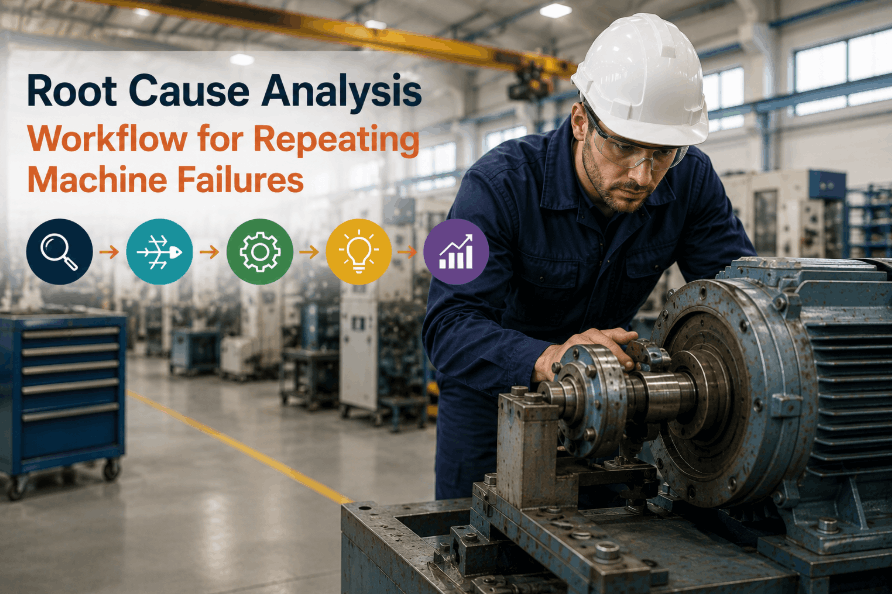
The 6-Step Root Cause Analysis Workflow for Machine Failures
A repeatable RCA workflow transforms failure investigation from an ad hoc activity into a structured reliability process. Sign Up Free and deploy OxMaint's work order system with built-in failure code capture, corrective action tracking, and asset-linked failure history — giving your team the foundation every effective RCA workflow requires.
Failure Event Documentation
Every unplanned failure must be captured with consistent data: failure time, mode, symptom description, operating conditions at failure, and the technician's initial observation. OxMaint's mobile work order capture ensures this data is collected at the point of failure — not reconstructed hours later from memory.
Failure Mode Classification
Standardized failure codes — electrical fault, mechanical wear, lubrication failure, operator error, design deficiency — allow failure data to be aggregated across assets and sites. Without standardized coding, RCA analysis becomes impossible at scale. OxMaint supports custom failure mode taxonomies aligned to your equipment types.
Asset Failure History Review
Before any RCA investigation begins, the full maintenance history of the affected asset — all prior work orders, repairs, PM completions, and parts replaced — must be reviewed. OxMaint surfaces this history automatically on every work order, eliminating the manual file search that delays most RCA processes.
Root Cause Identification
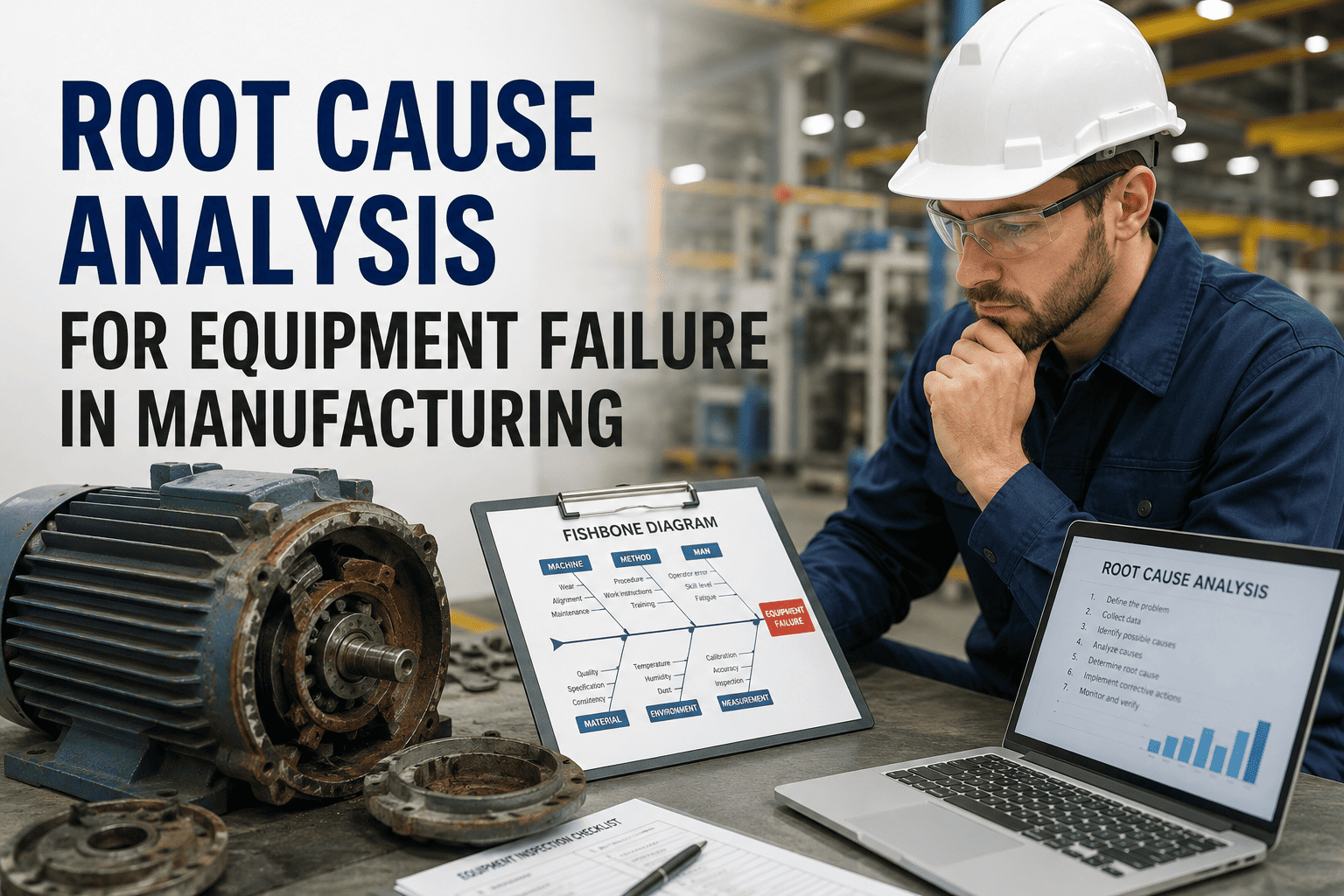
Using 5-Why analysis, fishbone diagrams, or fault tree analysis, the investigation team identifies the physical, human, and latent root causes behind the failure. OxMaint work orders include structured RCA fields where investigation findings and cause classifications are captured directly in the maintenance record.
Corrective Action Assignment
Every completed RCA must produce at least one corrective action: a PM task modification, a design change, a lubrication interval adjustment, or an operator procedure update. OxMaint links corrective actions directly to follow-up work orders with assigned technicians, due dates, and completion tracking — closing the loop on every investigation.
Recurrence Verification
A corrective action is only effective if the failure does not recur. OxMaint's asset failure tracking monitors whether the same failure mode returns after a completed RCA — automatically flagging the asset if the failure repeats within the monitoring window, triggering escalation for deeper engineering review.
Root Cause Analysis Methods: When to Use Each
| RCA Method | Best For | Complexity | Time Required |
|---|---|---|---|
| 5-Why Analysis | Simple recurring failures with a clear chain of causation | Low | 30–60 minutes |
| Fishbone / Ishikawa Diagram | Multi-cause failures involving people, processes, equipment, and environment | Medium | 1–3 hours |
| Fault Tree Analysis | Complex systems failures with multiple failure paths | High | Half day to full day |
| FMEA (Failure Mode Effects Analysis) | Proactive risk assessment before failure occurs on new or critical assets | High | Multi-day team effort |
| Change Analysis | Failures that occurred shortly after a process, material, or personnel change | Low–Medium | 1–2 hours |
How to Build an RCA Workflow Into Your Maintenance Program
Define Your RCA Trigger Threshold
Not every failure requires a full RCA. Define which events automatically trigger investigation: any failure on a Tier-1 critical asset, any failure that caused more than two hours of production downtime, or any failure mode that has repeated more than twice in 90 days. OxMaint's failure tracking can automate these triggers.
Standardize Failure Codes Across All Assets
Build a failure mode library that every technician uses when closing a work order. Consistent failure classification is the foundation of all RCA analysis. Without it, you cannot identify which failure modes are recurring or which assets generate the most avoidable downtime.
Link Every RCA to a Corrective Work Order
An RCA without a corrective action is just a report. In OxMaint, every completed root cause investigation generates a linked corrective work order — with assigned owner, due date, and completion verification. This ensures investigation findings translate into physical changes on the floor.
Review RCA Findings in Monthly Reliability Meetings
Present RCA outcomes — number of investigations completed, corrective actions closed, failure recurrence rates — in monthly reliability reviews. This keeps leadership visibility on recurring failure elimination and drives accountability for corrective action completion. Book a Demo to see how OxMaint's analytics surface these metrics automatically.
Use Failure Trend Data to Prioritize PM Updates
When RCA findings consistently point to the same failure cause — inadequate lubrication frequency, incorrect torque specs, worn gasket material — update the PM task library to address the root cause at the preventive level. OxMaint allows PM tasks to be updated directly from RCA findings, closing the loop between investigation and prevention.
Track Recurrence Rates as a Reliability KPI
Measure the percentage of investigated failures that recur within 90 days. A world-class maintenance program targets below 5% recurrence on RCA-investigated failures. Sign Up Free and use OxMaint's reliability dashboard to track this KPI live — making recurring failure elimination a measurable program outcome, not an aspiration.
What a Structured RCA Workflow Delivers
Where RCA Workflows Generate the Most Value
Rotating Equipment Failures
Motors, pumps, and compressors with recurring bearing or seal failures are the highest-priority RCA targets. OxMaint links vibration data, failure codes, and repair history to surface the true cause — whether misalignment, wrong lubricant grade, or installation error.
Production Line Stoppages
Conveyors, presses, and assembly equipment that stop repeatedly during production shifts generate disproportionate downtime cost. RCA embedded in OxMaint work orders ensures every stoppage event is investigated and tracked to resolution.
Electrical and Control System Faults
Recurring VFD faults, PLC errors, and sensor failures often have a single root cause — environmental contamination, loose wiring, or inadequate cooling — that surfaces only through structured investigation and historical data review.
Multi-Site Failure Pattern Analysis
OxMaint's cloud platform allows reliability managers to compare failure codes across facilities — identifying when the same failure mode affects identical equipment across sites, enabling a single RCA investigation to protect assets plant-wide.
Build RCA Into Every Work Order with OxMaint
OxMaint embeds failure code capture, corrective action tracking, and recurrence monitoring directly into your maintenance workflow — turning every breakdown into a reliability improvement opportunity.
Root Cause Analysis for Machine Failures — Common Questions
Ready to Eliminate Recurring Failures for Good?
OxMaint gives your maintenance team the failure history, structured RCA workflow, corrective action tracking, and recurrence monitoring to stop fixing the same machine twice.