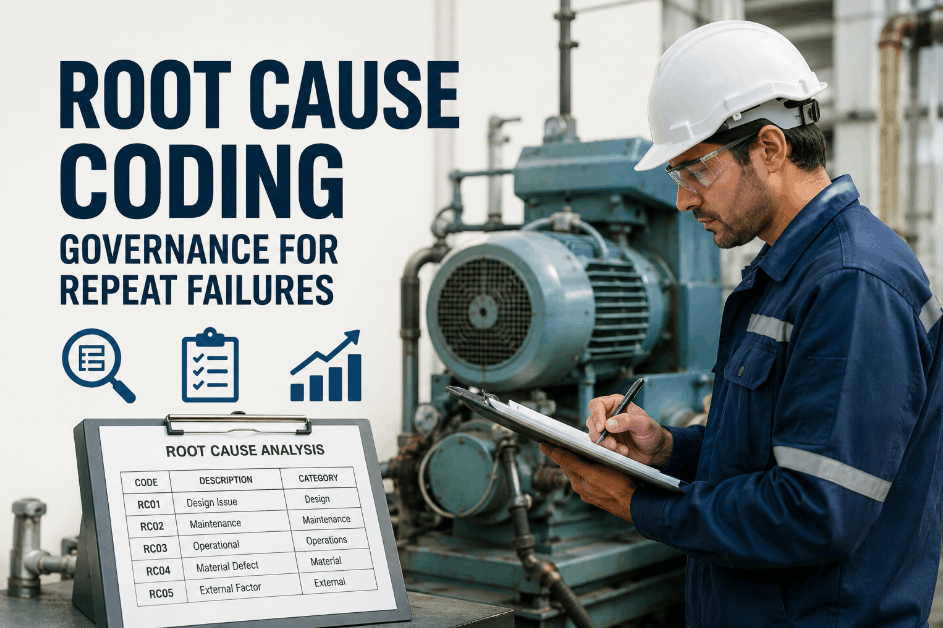
Repeat failures in maintenance operations are rarely mysteries — they are classification problems. When technicians apply different root cause codes to the same failure mode, trend analysis produces noise instead of signal, and the corrective actions that should follow never get prioritized because the pattern never surfaces cleanly. Root cause coding governance sets the rules that make your failure data consistent, comparable, and actionable. Sign Up Free on Oxmaint and establish a structured fault classification system inside your CMMS so every work order captures failure mode data in a format that drives reliable trend analysis. Facilities that enforce consistent root cause coding reduce repeat failure rates, accelerate corrective action decisions, and build the asset history needed for predictive maintenance planning. Book a Demo to see how Oxmaint structures failure classification and repeat defect tracking across asset portfolios.
Why Root Cause Coding Inconsistency Undermines Reliability Programs
Without defined coding governance, the same failure — a bearing that overheats due to lubrication neglect — might be coded as mechanical failure, operator error, or maintenance backlog depending on who closes the work order. Each of those codes routes the failure into a different trend bucket, preventing the pattern from accumulating enough occurrences to trigger corrective action. Sign Up Free on Oxmaint to implement structured failure taxonomies and mandatory root cause fields that enforce classification consistency at work order closure.
When technicians create new root cause codes for each job rather than selecting from a governed list, code libraries grow to hundreds of rarely used entries. This fragments failure data across categories that are too granular to produce reliable trend volumes, making pattern detection practically impossible without manual data cleaning.
Different technicians reading the same failure symptom will assign different root cause codes without governance definitions. Over a 12-month asset history, this variance produces a failure pattern that appears spread across multiple unrelated causes — hiding what is actually a single recurring failure mode on the same asset type.
Inconsistent coding sends repeat failures to the wrong corrective action pathway. A mechanical failure code triggers a maintenance response; an operator error code triggers a training response; a procurement delay code triggers an inventory review. All three responses miss the true fix when the coding is unreliable.
When reliability teams cannot trust that identical failure modes are consistently coded, they stop relying on CMMS trend reports and revert to manual review of individual work orders. This eliminates the scale advantage of a CMMS and makes repeat failure identification dependent on individual knowledge rather than system-captured data.
Root Cause Code Governance Standards by Failure Category
A well-governed code library uses a tiered structure — broad failure categories at the top level, with specific failure modes nested below — so technicians make consistent selections without requiring exhaustive memorization. Book a Demo to see how Oxmaint's work order failure classification supports tiered code structures and mandatory field completion at closure.
| Failure Category | Sub-Code Examples | Typical Asset Types | Corrective Action Route | Review Trigger |
|---|---|---|---|---|
| Mechanical Wear | Bearing failure, seal degradation, shaft misalignment | Pumps, motors, gearboxes | PM schedule adjustment | 3+ occurrences / 90 days |
| Electrical Fault | Insulation breakdown, contactor failure, wiring damage | Panels, drives, controls | Electrical audit / replacement | 2+ occurrences / 60 days |
| Lubrication Failure | Over-lubrication, under-lubrication, wrong lubricant type | Rotating equipment | PM procedure review | Any occurrence on critical asset |
| Operator Influence | Incorrect parameter setting, overload, improper startup | Production equipment | Operator training review | 2+ occurrences / 30 days |
| Design / Specification | Undersized component, incompatible material, installation defect | New or modified assets | Engineering review / OEM consult | First occurrence |
| Maintenance Error | Incorrect torque, wrong part installed, procedure deviation | Any asset post-PM | Procedure and training audit | First occurrence |
Implementing Root Cause Coding Governance in Your CMMS
Audit Your Existing Code Library for Redundancy and Gaps
Before designing a new code structure, export your current root cause codes and count usage frequency. Codes used fewer than five times in 12 months are candidates for consolidation. Failure types appearing in open-text fields without a corresponding code are candidates for new additions. Oxmaint's work order reporting surfaces this data without manual extraction.
Build a Two-Level Code Taxonomy With Defined Boundaries
Design a top-level list of 8–12 failure categories covering the full scope of your asset types. Below each, create specific sub-codes with written definitions that clarify the boundary between adjacent categories. The definition matters as much as the code label — ambiguous boundaries are where inter-technician variance originates.
Make Root Cause Code a Required Field at Work Order Closure
Governance without enforcement produces partial data. Configure your CMMS so root cause code is a mandatory field that must be selected before a work order can be closed. Optional fields generate completion rates well below 100%, which is enough to make trend analysis unreliable. Required fields generate the complete datasets that make governance worthwhile.
Run Monthly Code Consistency Audits
Review a sample of work orders each month to verify that technicians are applying codes consistently across similar failure scenarios. Focus on assets with multiple work orders in the period. Inconsistencies reveal where code definitions need clarification or where targeted technician coaching will improve data quality.
Link Repeat Failure Codes to Corrective Action Workflows
Configure threshold-based triggers so that when the same root cause code appears three or more times on the same asset within 90 days, a corrective action work order is automatically generated for reliability review. This closes the loop between failure classification and actual improvement action — the gap that most CMMS implementations leave open.