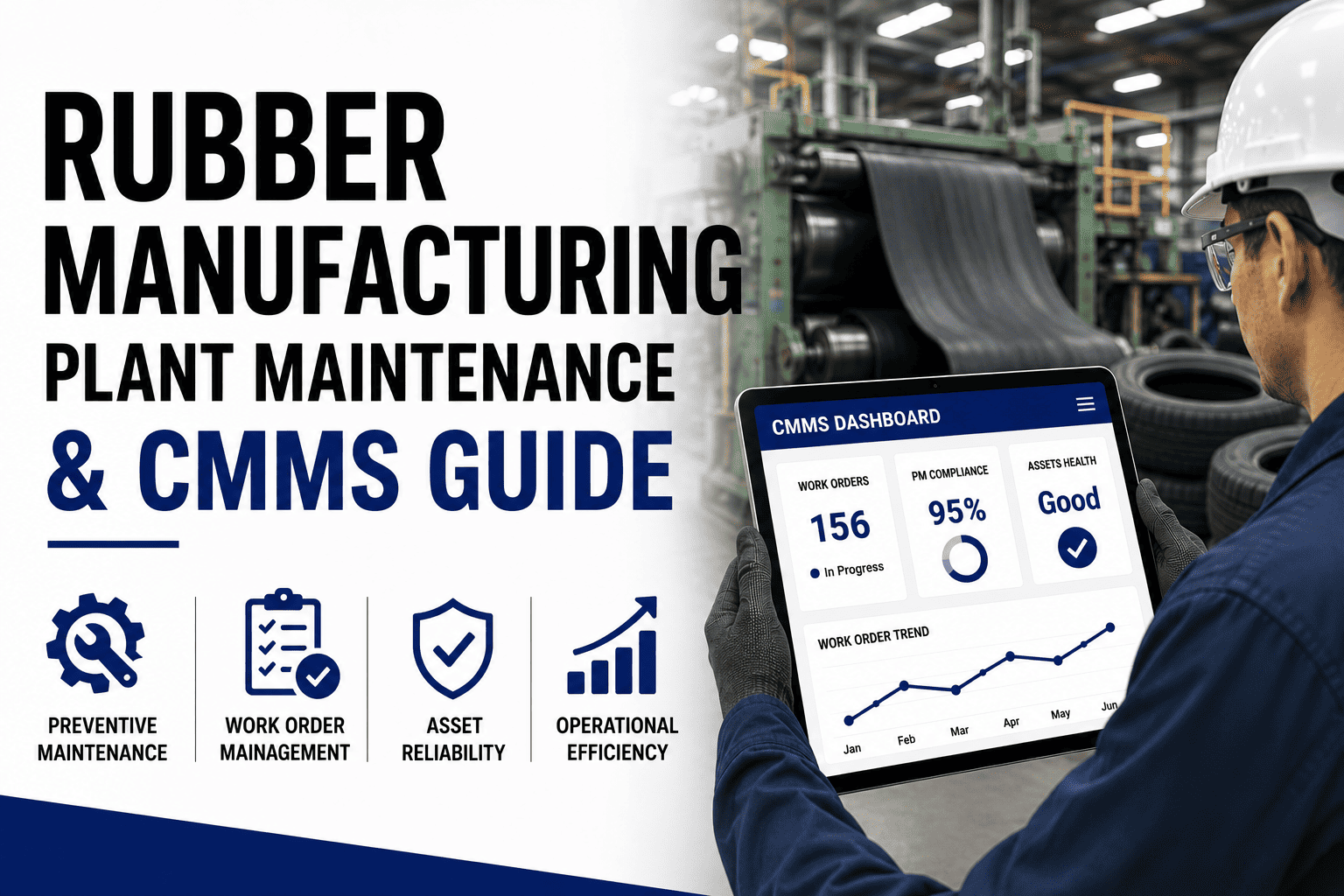
Rubber manufacturing plants operate at the intersection of high-temperature mixing, calendering, extrusion, and vulcanization — environments where equipment failure can halt production within minutes. A dedicated rubber plant CMMS is essential for managing the aggressive wear, thermal degradation, and contamination risks inherent to tire, seal, and hose manufacturing. This rubber manufacturing maintenance guide covers preventive maintenance strategies for extruders, vulcanizing presses, and curing ovens, showing how modern maintenance management software prevents unplanned downtime. To see how OxMaint maps your asset hierarchy and automates your PM schedules, you can Start Free Trial today.
Rubber Plant Maintenance 2026
Is reactive maintenance eating your rubber manufacturing margins?
When a banbury mixer or vulcanizing press fails unexpectedly, a single line can lose over $8,000 per hour in lost throughput. Transitioning from reactive firefighting to predictive rubber plant PM protects your OEE and keeps high-temperature compounding lines running consistently.
Equipment Wear & Failure Modes
Critical rubber equipment maintenance challenges
Rubber manufacturing plants combine high-temperature mixing, calendering, extrusion, and vulcanization. Each process introduces unique wear and contamination challenges that demand rigorous tracking to prevent catastrophic line shutdowns.
Banbury & High-Intensity Mixers
Rotor blades and chamber walls endure extreme shear forces and abrasive carbon black. Without scheduled rotor gap adjustments and thermal inspections, compound contamination and bearing seizures spike, degrading batch quality.
Vulcanizing & Curing Presses
Hydraulic presses operate at 150–200°C under extreme tonnage. Degraded seals, uneven platen heating, and die fouling cause under-curing and flash defects, leading to high scrap rates and safety hazards.
Calender & Extruder Lines
Calender roll surfaces and extruder screws face relentless friction and material buildup. Unplanned roll grinding or screw replacement can take lines offline for days, crippling throughput and inventory buffers.
Rubber Manufacturing PM Guide
Rubber plant PM checklist for tire, seal & hose lines
A structured rubber plant PM program shifts maintenance from reactive breakdowns to scheduled interventions. Below is a tiered preventive maintenance guide for the most critical rubber manufacturing assets.
- ✓ Inspect banbury mixer cooling water flow and temperature differentials
- ✓ Clean vulcanizing press platens and inspect for hydraulic fluid micro-leaks
- ✓ Check calender roll surface temperature uniformity across the face
- ✓ Lubricate extruder gearbox bearings and check seal flushes
- ✓ Clear dust collection systems and verify carbon black conveyor sensors
- ✓ Calibrate temperature and pressure sensors on curing ovens and presses
- ✓ Perform vibration analysis on mixer motors, gearboxes, and extruder drives
- ✓ Inspect hydraulic system filters and test relief valve pressure settings
- ✓ Measure calender roll crown and profile for wear and deflection
- ✓ Verify thermocouple accuracy in multi-zone extruder barrels
- ✓ Strip down and rebuild banbury mixer rotors; replace wear liners
- ✓ Recondition vulcanizing press molds and replace all hydraulic seals
- ✓ Conduct ultrasonic thickness testing on pressure vessels and piping
- ✓ Grind and re-chrome calender rolls to restore surface tolerances
- ✓ Perform full infrared thermography on electrical distribution panels
| Asset / Equipment | Critical Failure Mode | Recommended PM Frequency | KPI to Monitor |
|---|---|---|---|
| Internal Banbury Mixer | Rotor bearing seizure | Weekly lubrication / 6-mo vib analysis | Vibration (mm/s) & Temp |
| Vulcanizing Press | Hydraulic seal failure / platen distortion | Daily visual / Quarterly cal | System pressure & scrap rate |
| Calender Line | Roll surface scoring / bearing wear | Daily inspection / Annual regrind | Sheet gauge variance |
| Extruder Screw & Barrel | Wear & polymer degradation | Weekly checks / Quarterly cal | Motor amperage & melt temp |
| Curing Oven | Heating element failure / airflow block | Monthly calibration | Zone temperature variance |
ROI & Cost Analysis
How much does downtime cost a rubber manufacturing plant?
Quantifying maintenance ROI in rubber manufacturing requires calculating both the direct cost of parts and labor and the hidden cost of lost production throughput during unplanned line stoppages.
Consider a 180-asset tire and seal plant running a high-volume calender line. If the plant experiences 120 hours of unplanned downtime annually, losing $7,500 per hour in margin, the baseline downtime cost is $900,000. By implementing a predictive CMMS rubber manufacturing strategy and reducing downtime by 35%, the facility saves $315,000 in the first year — yielding a payback period of less than 3 months on software deployment.
Software Solutions
How OxMaint optimizes rubber equipment maintenance
OxMaint is an AI-powered CMMS and EAM platform built to handle the complex thermal and mechanical demands of rubber manufacturing. Here is how our capabilities map directly to your plant floor challenges.
AI-Powered Predictive Maintenance
OxMaint analyzes vibration, temperature, and pressure data from banbury mixers and curing presses to predict bearing failures and seal degradation before they cause unplanned downtime.
Automated PM Work Orders
Trigger automated work order generation for calender roll inspections and vulcanizing press calibrations based on runtime hours or calendar days, eliminating missed maintenance intervals.
Spare Parts Inventory Tracking
Link critical BOMs directly to assets so that when a screw or hydraulic seal fails, technicians instantly see available stock in real-time and reorder automatically at min thresholds.
Mobile Maintenance Analytics
Technicians access interactive schematics, update work orders, and capture photos of press wear or roll scoring via mobile devices on the plant floor, feeding data into executive dashboards.
See OxMaint on your assets — book a 30-min demo
Discover how OxMaint digitizes your rubber plant PM, predicts vulcanizing press failures, and tracks critical inventory to keep your tire, seal, and hose lines running at peak OEE.
Frequently Asked Questions
Rubber plant CMMS & maintenance FAQs
What is a CMMS for rubber manufacturing?
A CMMS for rubber manufacturing is a specialized maintenance management platform that schedules preventive maintenance, tracks work orders, and monitors asset health for high-temperature equipment like banbury mixers, extruders, and vulcanizing presses. OxMaint layers AI predictive analytics on top of these CMMS fundamentals to prevent catastrophic line failures before they occur.
How often should vulcanizing presses be maintained?
Vulcanizing presses require daily visual inspections of platens and hydraulic seals, monthly calibration of temperature and pressure sensors, and a full seal replacement and mold reconditioning during annual shutdowns. Maintaining this schedule manually is complex, so plants use OxMaint to Start Free Trial and automate these exact PM triggers based on cycle counts.
Can a CMMS help with ISO 55000 compliance in rubber plants?
Yes. Achieving ISO 55000 asset management compliance requires a documented, auditable trail of maintenance history, risk assessments, and performance metrics. OxMaint automatically logs every work order, inspection, and part replacement, providing instant audit readiness and a clear asset lifecycle history for compliance officers.
How does predictive maintenance apply to calender rolls?
Predictive maintenance for calender rolls relies on continuous monitoring of vibration signatures and bearing temperature. By establishing baseline performance curves in a CMMS, algorithms can detect the micro-deviations in roll balance and surface wear that precede costly sheet gauge defects, allowing you to schedule roll grinding during planned outages rather than emergency stoppages.
How long does it take to implement a rubber plant CMMS?
A standard CMMS implementation for a rubber manufacturing plant takes 4 to 8 weeks, depending on the number of assets and existing data cleanliness. OxMaint accelerates this timeline with bulk asset import tools and pre-configured PM templates for common rubber equipment; you can Book a Demo to see the deployment roadmap for your specific facility.
Ready to modernize your rubber plant maintenance?
Join the maintenance leaders using OxMaint to eliminate reactive breakdowns, optimize spare parts, and maximize OEE across their manufacturing lines.
Free 14-day trial · No credit card