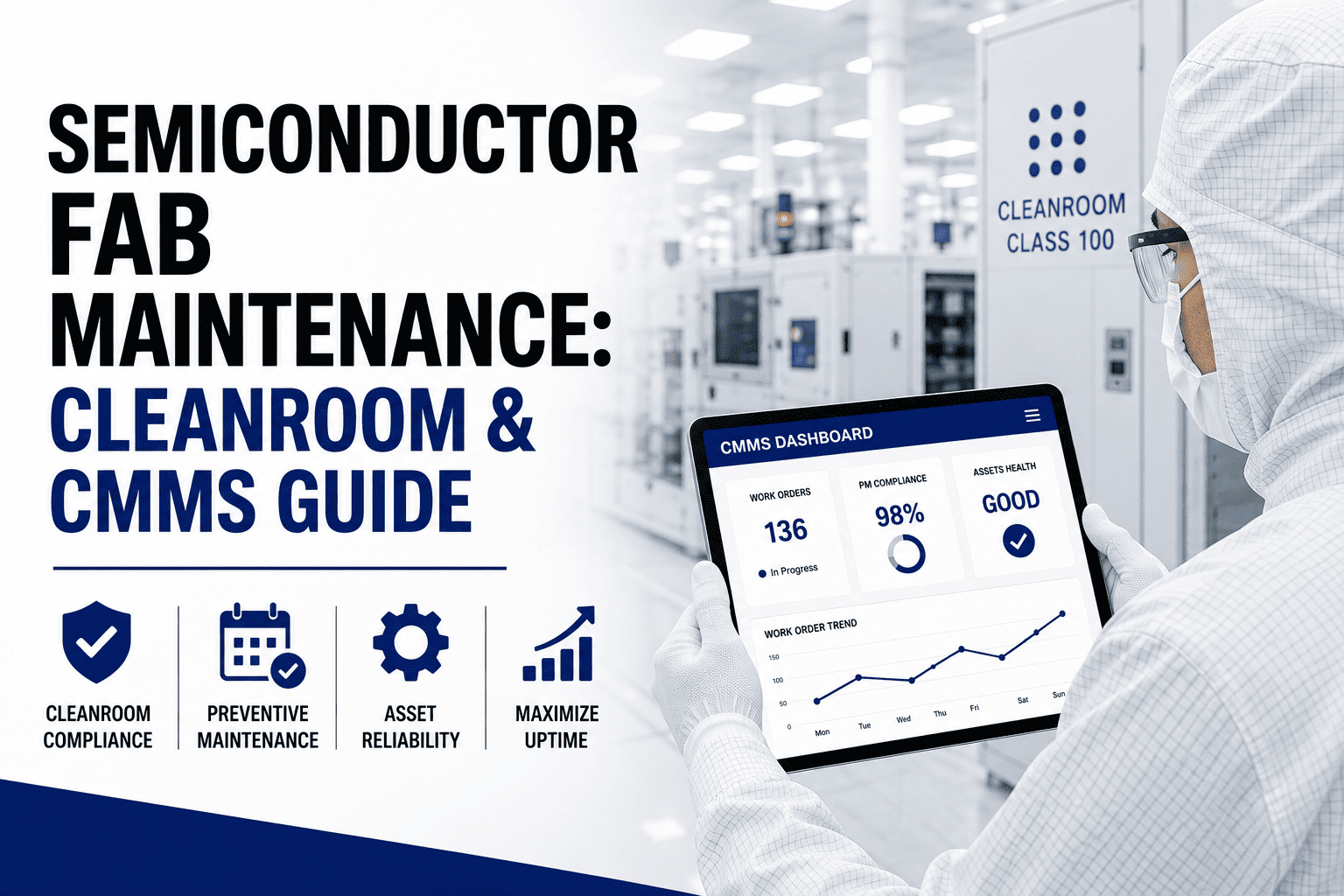
Semiconductor fab maintenance is the most demanding reliability discipline in manufacturing — governing ISO Class 3–5 cleanrooms, sub-nanometer lithography tolerances, and 24/7/365 production schedules where a single unplanned tool failure can cost $2–4M per day in lost wafers. This guide walks through cleanroom-safe preventive maintenance, chemical delivery system upkeep, gowning-linked work orders, and how a purpose-built semiconductor CMMS protects yield across billion-dollar equipment sets. See how OxMaint orchestrates fab-wide maintenance by starting your Start Free Trial or booking a personalized demo today.
Is your fab still losing wafers to reactive maintenance?
In a 300mm fab running at 85% utilization, a single tool-hour of unplanned downtime can scrap $200K of product. OxMaint's AI-powered CMMS shifts semiconductor plant maintenance from firefighting to predictive — protecting yield, audit readiness, and your maintenance budget.
What goes into semiconductor fab maintenance?
A modern 300mm fab maintains 500–1,200 production tools across lithography, etch, deposition, CMP, and ion implant — each with OEM PM checklists running on 7-day to 365-day cycles under ISO 14644-1 Class 3–5 cleanroom protocols.
Each tool carries 20–60 OEM-defined PM tasks with sub-nanometer tolerance specs.
A single immersion scanner outage can scrap an entire day's wafer starts.
Particles as small as 0.1µm can defect a die — every PM must be cleanroom-certified.
World-class fabs sustain >95% OEE through disciplined preventive maintenance.
Cleanroom maintenance semiconductor checklist: 6 critical PM zones
Fab maintenance teams manage six interlocking PM domains. Missing any one can trigger particle excursions, chemical contamination, or litho overlay drift — all of which silently erode yield.
Cleanroom HVAC & HEPA filtration
- HEPA/ULPA filter replacement per differential-pressure trend (typically 18–36 months)
- Air-change rate validation (240–600 ACH for ISO 3–5 zones)
- Fan filter unit (FFU) motor amperage logging and vibration checks
- Temperature / humidity stability verification ±0.1°C / ±1% RH
Photolithography equipment PM
- Optical column alignment and wavefront aberration checks
- Stage calibration — overlay budget <2nm per layer
- Immersion water quality monitoring (resistivity, TOC, dissolved gases)
- Reticle handling robotics cleanliness inspection
Chemical delivery system maintenance
- UPW (ultrapure water) resistivity logging at every loop (18.2 MΩ·cm)
- Gas cabinet leak testing — quarterly per SEMI S2
- Chemical distribution pump calibration and flow-rate verification
- Filter change-out based on particle count trending, not just calendar
Etch & deposition chamber PM
- Chamber wet clean cycles based on RF-hour accumulation
- Electrostatic chuck (ESC) backside particle baselining
- MFC (mass flow controller) calibration verification
- Endpoint detection system sensitivity validation
CMP & wafer handling systems
- Polishing pad conditioning disc replacement per wafer-count
- Slurry delivery line flush and particle monitoring
- FOUP (front-opening unified pod) door cycling and seal inspection
- EFEM (equipment front-end module) atmospheric robot teach-check
Facilities & utilities infrastructure
- Chilled water system flow balancing and heat exchanger inspection
- Process cooling water (PCW) chemistry sampling
- Vacuum pump oil/mist replacement and bearing vibration trending
- Abatement system thermocouple and flow verification
The cost of a missed PM: a real fab scenario
A 200mm fab running 420 tools on spreadsheets and paper work orders deferred a quarterly HEPA filter change on an ISO 4 lithography bay to hit a production milestone. Eight weeks later, particle counts spiked, wafer defect rates climbed from 1.2% to 4.8%, and the bay was shut down for 72 hours of emergency remediation. The total cost: $890,000 in scrapped wafers, $310,000 in lost revenue, and a yield-loss ripple across three downstream process steps.
With a fab maintenance CMMS like OxMaint, that filter change would have been auto-scheduled, escalation-triggered when deferred beyond 7 days, and linked to a gowning-certified technician with the correct cleanroom-grade materials pre-staged in inventory — total cost avoided: $1.2M.
How OxMaint's CMMS transforms semiconductor plant maintenance
OxMaint brings AI-driven preventive and predictive maintenance, cleanroom-compliant work order management, and real-time analytics to fab reliability teams — replacing spreadsheets, paper travelers, and siloed OEM service portals with a single source of truth.
Gowning-linked work orders
Every work order carries a gowning-level requirement, cleanroom zone code, and material compatibility flag — ensuring the right-certified technician is dispatched with cleanroom-approved tools and parts, every time.
Eliminates contamination events from improper gowningAI predictive maintenance
OxMaint's engine ingests tool sensor data — vibration, amperage, temperature, particle counts — and predicts failure windows 5–21 days in advance, so PMs shift from calendar-based to condition-based, cutting unnecessary interventions 30–40%.
Reduces unplanned downtime 30–50%Cleanroom-safe spare-parts inventory
Track every spare with dual-contamination-grade tagging (cleanroom vs. grey-room), auto-reorder points tied to PM schedules, and lot-level traceability for SEMI S2 compliance audits — no more "wrong filter in the wrong bay."
Cuts parts stockouts 60% and audit prep time 80%SEMI-compliant maintenance analytics
Auto-generate SEMI E10 reliability metrics — MTBF, MTTR, availability, utilization — per tool, per bay, per shift. Dashboards update in real time so reliability engineers can spot drift before it becomes a yield excursion.
Improves fab OEE from 82% to 94%+ within 6 monthsSpreadsheets vs. fab CMMS: what changes when you digitize
| Maintenance capability | Spreadsheets & paper | OxMaint fab CMMS |
|---|---|---|
| PM scheduling | Manual calendar reminders; 15–20% missed PMs | Auto-triggered by sensor data or calendar; <2% missed |
| Gowning & zone control | Technician discretion; contamination risk | Work order enforces gowning level + zone authorization |
| Spare parts traceability | Lot numbers in separate Excel files | Full lot-to-tool traceability with SEMI S2 audit export |
| Downtime cost tracking | Estimated quarterly; often inaccurate | Real-time $/hour per tool; auto-rolled to fab-level dashboards |
| Failure prediction | Reactive — failure discovered at production loss | AI predicts 5–21 days ahead; PM scheduled before failure |
| Compliance reporting | 2–4 weeks of manual assembly per audit cycle | One-click SEMI E10 / ISO 14644 reports ready in seconds |
How to deploy a semiconductor CMMS in 90 days
Import asset hierarchy, PM templates & spare-parts data
OxMaint's onboarding team ingests your tool BOM, OEM PM checklists, current inventory, and gowning-zone map. Typical fab: 500–1,200 tools live in 3 weeks. Historical work-order data is migrated for baseline MTBF/MTTR calculations.
Connect tool sensors & activate condition-based PM triggers
Integrate via OPC-UA or MQTT with fab tool sensors — vibration, particle counts, RF hours, amperage. OxMaint begins correlating sensor drift with failure modes and auto-schedules PMs when thresholds are crossed, not just when the calendar says so.
Activate AI prediction engine & roll out dashboards
After 60 days of baseline data, OxMaint's AI engine goes live — generating failure predictions with confidence scores, recommending PM windows that minimize wafer-start disruption, and delivering SEMI E10 dashboards to reliability engineers and fab management.
See OxMaint on your fab assets — book a 30-min demo
Walk through a live semiconductor CMMS environment: gowning-linked work orders, AI failure predictions, SEMI E10 dashboards, and cleanroom-safe inventory. We'll map it to your tool set and uptime targets.
Semiconductor fab maintenance: frequently asked questions
What is semiconductor fab maintenance?
Semiconductor fab maintenance is the disciplined practice of preventive, predictive, and corrective maintenance on production tools, cleanroom environments, chemical delivery systems, and facilities infrastructure within an integrated circuit manufacturing plant. It operates under ISO 14644-1 cleanroom standards and SEMI E10 reliability metrics, targeting >99.5% tool availability to protect wafer yield across 24/7/365 production cycles.
Why does a semiconductor fab need a CMMS?
A semiconductor CMMS replaces spreadsheets and paper travelers with automated PM scheduling, gowning-linked work orders, real-time sensor-driven predictive maintenance, and full lot-level spare-parts traceability. Without one, fabs typically miss 15–20% of scheduled PMs, face 30–50% higher unplanned downtime, and spend weeks manually compiling compliance reports. Explore OxMaint's capabilities by starting your Start Free Trial.
How does cleanroom CMMS for semiconductor fabs handle gowning compliance?
A cleanroom CMMS like OxMaint embeds gowning-level requirements, zone authorizations, and cleanroom-material certifications directly into each work order. The system verifies that the assigned technician holds the correct gowning certification and that all parts and tools staged for the job meet ISO 14644-1 cleanliness standards before the work order can be released — preventing contamination events at the point of dispatch.
How much does unplanned downtime cost in a semiconductor fab?
Unplanned downtime in a 300mm fab typically costs $2–4 million per day per major tool, with an immersion lithography scanner potentially exceeding $200,000 per hour in lost wafer output. Industry benchmarks show that 87% of these events are preventable with a structured CMMS — making the ROI of implementing OxMaint often measurable within the first 90 days. Book a demo at calendly.com/oxmaintapp/30min to see the math for your fab.
How long does it take to implement a fab maintenance CMMS?
A typical semiconductor plant CMMS implementation takes 60–90 days: Month 1 covers asset hierarchy and spare-parts data onboarding; Month 2 integrates tool sensors and activates condition-based PM triggers; Month 3 goes live with AI predictive maintenance and SEMI E10 analytics dashboards. OxMaint's onboarding team handles data migration and integration, so your reliability engineers can begin using the system within the first two weeks.
Stop losing wafers to reactive maintenance
Join the fabs using OxMaint to cut unplanned downtime 30–50%, achieve >94% OEE, and pass every SEMI and ISO audit with one-click reports. Your 90-day path to predictive maintenance starts here.
Free 14-day trial · No credit card