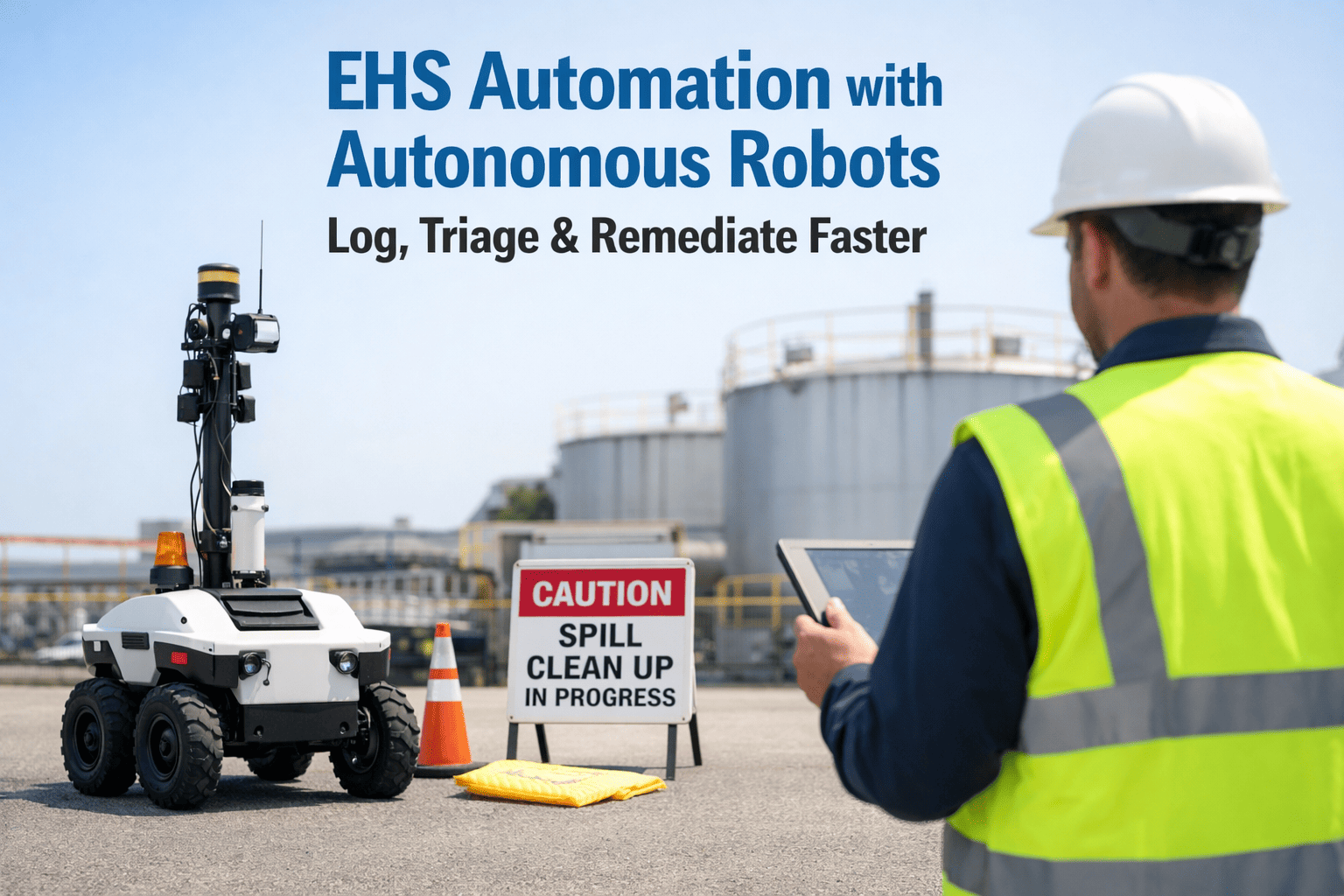
Steel mills and oil refineries are among the most hazardous industrial environments on earth — extreme temperatures exceeding 1,200C, toxic gas pockets of H2S and CO, and equipment that operates under constant thermal and mechanical stress. Traditional walk-around inspections with handheld thermal cameras and portable gas sniffers happen once a week at best, leaving days of unmonitored exposure between rounds. Robot-mounted thermal and gas sensors now patrol these zones continuously, capturing thousands of data points per shift and feeding exceedance alerts directly into maintenance management systems. When paired with a CMMS like Oxmaint, every threshold breach becomes a prioritized work order in seconds — not days. Book a demo to see how Oxmaint converts robot sensor data into instant maintenance action at your facility.
24/7
Continuous patrol coverage with zero shift gaps
<3 min
Detection-to-work-order response time
78%
Less worker exposure to hazardous zones
92%
Of anomalies caught between manual rounds
The Problem with Walk-Around Inspections in High-Risk Plants
In blast furnace operations, molten metal ladles reach 1,400C — and refractory degradation that leads to a catastrophic breakout can develop in hours, not weeks. Handheld thermal surveys done every few days simply cannot catch fast-moving failures. At refineries, pinhole gas leaks at flanges and valve stems are intermittent; a technician passing by at the wrong moment misses a plume that a continuous robotic patrol would flag instantly. The cost of these gaps is measured in unplanned shutdowns worth millions, safety incidents, and regulatory penalties. Connecting robotic detection to your sign up with our work order management system closes this gap permanently.
Steel Mill Risks
Ladle/torpedo breakouts from undetected refractory wear
Transformer and busbar failures from thermal overload
CO buildup in casting and furnace enclosed areas
Bearing seizure in rolling mill stands from thermal creep
Oil & Gas Risks
Methane leaks at wellheads, flanges, and compressor seals
H2S exposure in sour gas processing and tank farms
VOC emissions violating LDAR compliance requirements
Fired heater and exchanger hot spots signaling tube failure
Stop relying on weekly walk-arounds. Oxmaint turns every robot patrol into an automated safety and maintenance checkpoint across your entire plant.
Sign Up
What Sensors Go on a Patrol Robot — And What They Detect
A single patrol robot carries a multi-sensor payload that replaces several handheld instruments and multiple inspection disciplines. The sensor configuration depends on the target hazards, classified zone requirements, and the assets being monitored. Here is the standard sensor stack used across steel and oil/gas deployments.
Radiometric Thermal Camera
640x480 resolution | 0.03C sensitivity | -20C to 1,500C range
Detects refractory degradation in ladles, hot spots on electrical switchgear, bearing overheating in rolling mills, and pipe insulation failures. Every pixel carries calibrated temperature data — not just a visual image.
Multi-Gas Detector Array
CH4, H2S, CO, SO2, O2 | Electrochemical + catalytic bead | <15s response
Simultaneous detection of combustible and toxic gases at ppm-level accuracy. Measures both TWA exposure and peak concentrations. Auto-calibration verification runs between each patrol cycle.
Optical Gas Imaging (OGI) Camera
Cooled InSb detector | 3.2-3.4 um band | Hydrocarbon visualization
Makes invisible gas plumes visible on video for leak confirmation at flanges, valves, and pipe joints. Critical for LDAR compliance documentation and pinpointing exact leak locations from standoff distances up to 30 meters.
LEL Safety Shutdown Module
Auto-shutdown at 10% LEL | ATEX/IECEx Zone 1 compliant
Prevents the robot from becoming an ignition source in explosive atmospheres. When ambient gas reaches 10% of the Lower Explosive Limit, the robot powers down all non-intrinsically-safe systems and transmits its last known position and reading to Oxmaint.
Setting Alert Thresholds That Trigger the Right Work Order
Detection alone does not prevent incidents — the response does. The critical step is mapping each sensor reading to a specific alert tier in Oxmaint so that every exceedance generates the correct work order priority, assigns the right crew, and attaches the sensor evidence. These thresholds should be calibrated during a 30-60 day baseline period after deployment, then refined as your preventive maintenance program matures.
Thresholds align with OSHA PELs (29 CFR 1910.1000), NIOSH RELs, and API RP 505 zone classifications. Oxmaint logs every exceedance with timestamp, GPS position, and raw sensor data for compliance audits.
Need help configuring thresholds for your assets? Our team maps sensor configurations to your equipment hierarchy and builds the auto-alert rules inside Oxmaint.
Book a Demo
From Sensor Exceedance to Completed Repair — The Automated Pipeline
The real value of robot patrols is what happens in the seconds after a threshold breach. Here is exactly how Oxmaint processes a detection event and turns it into a resolved maintenance action — with zero manual data entry anywhere in the chain.
1
Robot Flags Exceedance
Patrol robot reads ladle shell at 345C — 25C above the 320C warning threshold. Onboard edge processor packages the radiometric thermal image, GPS coordinates, asset proximity tag, and timestamp into a structured alert payload.
2
Oxmaint Receives and Classifies
Alert data arrives via REST API or MQTT. Oxmaint matches the sensor reading against the asset threshold rules, determines priority (P3 warning), identifies the assigned maintenance team, and checks parts availability in inventory.
3
Work Order Auto-Generated
A new work order is created with: asset ID, thermal image attached, exact reading vs. threshold, location map, priority tag, SOP reference, and estimated completion time. Assigned to the on-shift refractory inspection team.
4
Crew Responds via Mobile
Technician receives push notification on the portal, reviews the thermal evidence, performs physical inspection, documents findings with photos and notes, and closes the work order. Full audit trail preserved for compliance.
Where to Deploy Robot Patrols — Zone Planning by Facility Type
Patrol routes must be designed around each facility's specific hazard map. Steel plants prioritize thermal surveillance of molten metal handling and high-power electrical systems. Oil and gas sites focus on gas detection across process equipment, storage, and pipeline corridors. Both benefit from a structured maintenance management platform that ties patrol data to asset histories.
Melt Shop & BOF — EAF shell exterior, ladle transfer paths, torpedo car tracks. Thermal focus on refractory hot spots indicating breakout risk. CO gas monitoring in enclosed overhead areas.
Continuous Casting — Tundish shells, mold oscillation bearings, strand guide segments, spray chambers. Thermal + gas detection for steam/CO buildup.
Hot Rolling Mill — Work roll bearings, motor terminal boxes, gearbox housings, run-out table cooling headers. Combined thermal and vibration correlation.
Power Distribution — HV switchgear, busduct connections, transformer windings, cable terminations. Weekly thermal patrol catches loose connections before arc flash events.
Wellheads & Manifolds — Valve packing, flange gaskets, PRV outlets. Multi-gas for CH4 + H2S. OGI camera confirms plume location at each programmed stop point.
Compressor Stations — Shaft seal areas, intercooler joints, lube oil return lines, exhaust stacks. Thermal on bearing housings + methane detection around seals.
Tank Farm & Loading — Shell hot spot scans, floating roof seal status, loading arm flex joints. VOC monitoring for EPA LDAR compliance documentation.
Fired Heaters & Exchangers — Tube skin temperatures, tube sheet flanges, stack damper operation. Thermal deviation from baseline flags fouling or flame impingement.
Bridge the Gap Between Robotic Detection and Maintenance Execution
Oxmaint maps thermal and gas thresholds to auto-generated work orders, routes alerts to the right crews instantly, and builds a compliance-ready audit trail of every detection event across your steel plant or oil facility.
Connecting Robot Fleet Data to Your Existing Plant Systems
Robot patrol sensors do not operate in isolation. They feed into an integration architecture that connects fleet management, sensor telemetry, SCADA, and your CMMS to create a closed-loop detection-to-resolution workflow.
Handheld Surveys vs. Robot Patrols with CMMS Integration
The operational difference between traditional inspections and automated robot patrols connected to a CMMS is not incremental — it is a fundamental shift in how hazards are caught and resolved.
Manual Handheld
Capability
Robot + Oxmaint
Weekly or biweekly rounds
Patrol Frequency
Continuous or multi-daily
Single 4-gas handheld detector
Sensor Coverage
Thermal + multi-gas + OGI in one pass
Paper forms or spreadsheets after shift
Data Logging
Auto-logged with GPS, timestamp, images
Manual WO creation hours or days later
Work Order Speed
Auto-generated in seconds on exceedance
Technicians enter hazardous zones
Worker Safety
Zero personnel exposure to risk areas
Hours to Days
anomaly to action
Under 3 Minutes
anomaly to assigned work order
Ready to move from reactive inspections to continuous robotic monitoring? Sign up for Oxmaint and connect your robot fleet to automated work order generation today.
Sign Up
Step-by-Step Deployment Checklist
Deploying robot patrols with CMMS integration is a coordinated effort across operations, maintenance, safety, and IT. This phased approach ensures accurate baselines, minimized false positives, and a smooth transition from pilot to plant-wide coverage.
Week 1-2
Hazard Mapping & Route Design
Identify priority patrol zones by hazard severity
Define sensor payload per zone (thermal, gas, OGI)
Build asset hierarchy and threshold rules in Oxmaint
Week 3-4
Infrastructure & Integration
Install robot docking and charging stations
Deploy network coverage across patrol corridors
Connect robot fleet API to Oxmaint endpoints
Week 5-6
Baseline & Calibration
Run 30-day baseline data collection per asset
Calibrate sensors against known reference sources
Tune alert thresholds to eliminate false positives
Week 7+
Go-Live & Expansion
Activate autonomous patrols with live WO generation
Track response time KPIs and optimize workflows
Expand to additional zones and multi-robot fleets
Turn Every Robot Patrol Into a Maintenance Decision
Your robots collect thousands of thermal readings and gas measurements every shift. Without CMMS integration, that data sits in dashboards while hazards go unresolved. Oxmaint converts every sensor threshold breach into an assigned, tracked, and auditable work order — from blast furnace refractory checks to refinery flange leak repairs.
Frequently Asked Questions
Which robot platforms work best for thermal and gas patrol in industrial plants?
Both wheeled and quadruped (legged) robots are used. Wheeled platforms suit flat refinery floors and pipe racks. Quadrupeds like Boston Dynamics Spot handle stairs, grated platforms, and uneven steel mill terrain. Oxmaint integrates with any platform that supports REST API or MQTT data output — the integration is sensor-agnostic and robot-agnostic.
How does Oxmaint prevent false-positive alerts from creating unnecessary work orders?
Oxmaint supports configurable dead-bands, consecutive-reading requirements, and multi-sensor correlation rules. A single thermal spike from a steam vent or splash will not trigger a work order — the system can require sustained exceedance over multiple consecutive readings or confirmation from a second sensor type before generating an alert. All rules are customizable per asset class.
Book a demo to see the alert configuration interface.
Does robot-collected data satisfy OSHA and EPA regulatory compliance?
Yes. Gas detection data with timestamps, GPS coordinates, calibration records, and sensor IDs satisfies LDAR requirements under EPA Method 21 and NSPS OOOOa. Thermal inspection logs meet NFPA 70B for electrical maintenance documentation. Oxmaint stores all data with full audit trails accessible during regulatory inspections.
What happens when a robot detects gas above the critical LEL threshold?
Two things happen simultaneously: the robot's onboard LEL safety module shuts down all non-intrinsically-safe systems to prevent ignition, and Oxmaint generates a P1 emergency work order with instant SMS, email, and push notifications to the safety team. The work order includes exact GPS location, gas type, concentration reading, and the recommended emergency response procedure from your site's safety plan.
Sign up for Oxmaint to configure emergency workflows.
What is the typical ROI timeline for robot patrol + CMMS integration?
Most facilities see measurable savings within 60-90 days. In steel mills, early detection of a single ladle refractory issue can prevent a breakout worth millions in damage and downtime. Oil and gas sites typically recover investment through faster leak repairs, reduced manual LDAR survey labor, and elimination of gas-related safety incidents that carry both financial and regulatory consequences.