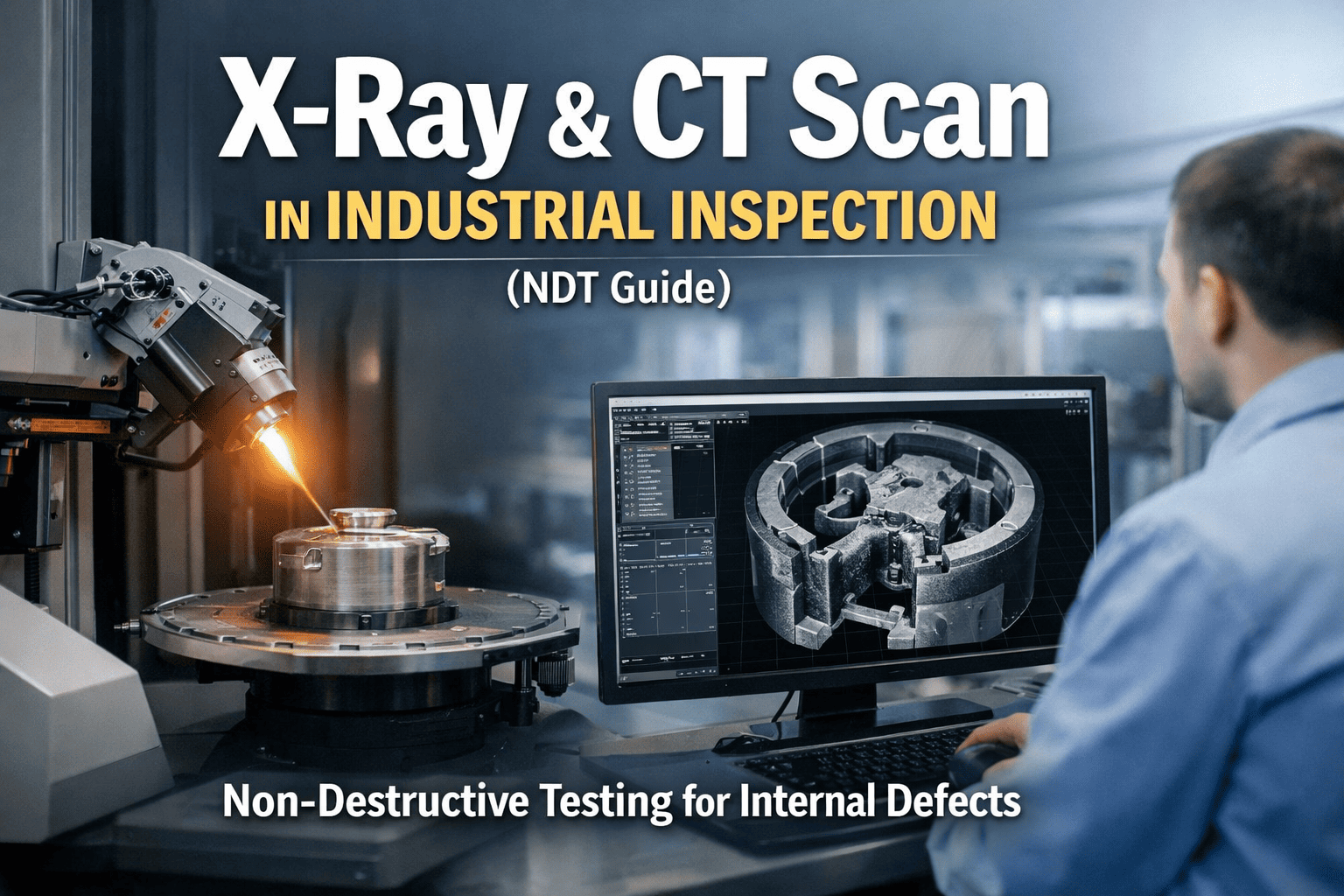
A cracked casting, a voided weld, a bridged solder joint — none of these announce themselves before they cause a field failure. X-ray and CT scanning are the two NDT methods that see inside a component without cutting it open, and choosing the wrong one for the wrong application costs time, money, and defect escapes. Sign up for Oxmaint to connect your radiographic inspection results, work orders, and equipment maintenance schedules into one system — so every defect found becomes a tracked, resolved, and documented event in your quality record.
X-Ray & CT Scan in Industrial Inspection: The Complete NDT Guide
How manufacturers across aerospace, automotive, electronics, and casting use radiographic testing and industrial CT to detect internal defects that no other method can find — without destroying a single part.
Internal Defects Cannot Be Found at the Surface. That Is the Entire Problem.
Destructive testing — cutting, sectioning, and cross-sectioning — gives you the most accurate view of what is inside a component. It also destroys the part you just inspected. For production volumes, safety-critical parts, and high-value assemblies, that trade-off is unacceptable. Non-destructive testing (NDT) methods give you internal visibility without sacrificing the part — and radiographic testing (RT) using X-rays or CT scanning is the most capable NDT method for detecting volumetric internal defects including porosity, cracks, voids, inclusions, and assembly errors invisible to every surface technique.
Tiny gas pockets trapped during solidification in castings. Invisible externally, they weaken the structure and concentrate stress under load.
Material contraction during cooling creates internal cavities that reduce cross-section strength and create leak paths in pressure-holding components.
Slag, oxide, or foreign material trapped in welds or castings. Inclusions disrupt grain structure and can initiate fatigue cracks under cyclic loading.
2D Radiography vs 3D Computed Tomography: What Each Method Actually Shows You
Both methods use X-rays. The difference is how many angles they capture, what they reconstruct from those angles, and what that means for your ability to characterise, locate, and measure a defect.
Which Method Should You Use? A Practical Decision Framework
The right choice depends on part complexity, inspection objective, throughput, and budget. This framework gives quality engineers and production managers a clear starting point.
Track Every NDT Inspection Result in Oxmaint
Connect your X-ray and CT inspection findings to work orders, equipment records, and corrective actions — so defect data becomes part of your permanent quality and maintenance record, not a standalone scan report on someone's desktop.
Where X-Ray and CT Inspection Is Mandatory, Not Optional
Different industries use radiographic testing under different regulatory and contractual requirements. Here is what each vertical actually inspects and what defects they are looking for.
| Industry | Typical Components Inspected | Primary Defects Sought | Method Used | Key Standard |
|---|---|---|---|---|
| Aerospace | Turbine blades, structural castings, welds, additive parts | Porosity, cracks, inclusions, internal geometry deviation | CT + X-Ray | ASTM E1030, NAS 410 |
| Automotive | Aluminium die castings, engine blocks, brake components, battery cells | Shrinkage porosity, cold shuts, wall thickness deviation | CT preferred | ASTM E1316, IATF 16949 |
| Electronics | PCBs, BGA packages, solder joints, IC packages | Void percentage, bridging, misalignment, delamination | X-Ray (AXI) | IPC-7711/7721, ASTM E801 |
| Oil & Gas | Pipeline welds, pressure vessel seams, valves, flanges | Lack of fusion, porosity in welds, corrosion-induced voids | X-Ray (RT/DR) | API 1104, ASME V |
| Medical Devices | Implants, device housings, assemblies with internal components | Internal geometry, foreign material, assembly verification | CT primary | ISO 13485, FDA 21 CFR 820 |
| Food & Pharma | Packaged goods, sealed blister packs, bulk ingredients | Metal, glass, stone, hard plastic contamination | X-Ray inline | FSMA 204, HACCP |
Inside an Industrial CT Scanner: From Rotation to 3D Reconstruction
Understanding the physics of CT inspection helps quality engineers set correct parameters, interpret results, and recognise the limits of what a scan can resolve.
The component is placed on a precision rotary stage between an X-ray source and a flat-panel digital detector. Source voltage (kV) is selected based on material density — electronics inspection uses 60–130 kV; casting inspection may require 150–320 kV or higher for dense alloys.
As the part rotates through 360 degrees, hundreds to thousands of 2D X-ray projections are captured at different angular positions. Denser internal structures absorb more radiation and appear lighter on the detector. These projections are the raw data for reconstruction.
Reconstruction software applies back-projection algorithms to the projection set, creating a 3D voxel volume where each voxel represents a tiny cube of material with a grey value corresponding to its density. This volume can be virtually sliced in any plane — axial, sagittal, coronal, or oblique — without touching the part.
Analysis software identifies density anomalies — voids, cracks, inclusions — by their grey value deviation from surrounding material. Each defect can be measured in 3D: volume, position, longest dimension, and distance from critical surfaces. AI-assisted defect detection increasingly automates this step, flagging regions for human review.
The 3D scan volume is aligned to the nominal CAD model, producing a colour-mapped deviation report that shows where the actual part geometry matches design intent and where it diverges. Output formats — STL, DICOM, RAW — integrate with engineering tools. The inspection report is stored as a permanent quality record.
What Happens After the Scan: Why NDT Results Need a CMMS Behind Them
An X-ray or CT scan produces a result. That result needs to trigger action, be tracked to resolution, and live in a permanent record. Without a system behind the scan, findings sit in standalone reports, corrective actions slip, and the same defect patterns recur without anyone noticing the trend.
When a defect is found, Oxmaint generates a corrective work order automatically — assigned to the responsible team, with the defect classification, severity, and deadline embedded in the task.
Defects found during inspection are linked to the specific machine, die, or tool that produced them. Over time, this builds a defect history per asset — making recurring failure patterns visible before they escalate.
Periodic NDT inspection — monthly weld surveys, quarterly casting audits, annual pressure vessel radiography — is scheduled as recurring PM work orders so inspection intervals never slip and compliance records stay complete.
Every inspection, result, corrective action, and sign-off is stored with date, technician, and outcome — creating the audit-ready record that ASME, API, ISO, and FDA inspections require when they ask for inspection history.
NDT Radiographic Testing Standards Your Quality Team Needs to Know
X-Ray & CT Inspection — Questions Quality Engineers Ask
Film radiography captures the X-ray image on silver halide film requiring darkroom processing, whereas digital radiography (DR) uses flat-panel detectors that produce images immediately in digital format. DR offers better dynamic range, faster turnaround, easier image sharing, lower operating cost (no film or chemicals), and direct integration with automated defect detection software. Most modern production environments have shifted to DR, though film is still used where legacy standards require it. Book a demo to see how Oxmaint stores and tracks DR inspection records against your asset and work order history.
X-ray inspection reliably detects volumetric weld defects — porosity, slag inclusions, and voids — because they create density differences that appear as contrast changes in the radiograph. However, tight planar defects such as cracks oriented parallel to the X-ray beam are difficult or impossible to detect because the beam passes through the crack without significant attenuation change. For crack detection in welds, ultrasonic testing (UT) is often used alongside radiography to provide complementary coverage. Sign up to manage multi-method NDT inspection schedules and findings in a single system.
CT scan time ranges from a few minutes for small, simple parts to several hours for large or dense components. Key variables are part size, material density (which determines required X-ray energy and exposure time), required resolution (finer voxel sizes need more projections), and the number of projections captured. Modern CT systems can reduce inspection times significantly compared to earlier generation systems — some high-throughput configurations bring scan time to under five minutes for automotive castings. Book a demo to discuss how CT inspection scheduling integrates with your production throughput in Oxmaint.
Industrial radiographic systems require radiation shielded enclosures (typically lead-lined cabinets for cabinet systems, or controlled exclusion zones for larger installations), interlocked safety doors that cut off the beam when opened, and compliance with national radiation protection regulations. Operators working with portable or open radiography systems require radiation dosimetry badges and training certification under standards such as IRRP (UK) or 10 CFR Part 34 (US). Cabinet-based systems used for production inspection are largely self-contained and pose minimal exposure risk when properly maintained. Sign up to schedule radiation safety equipment maintenance and compliance checks in Oxmaint.
Oxmaint schedules NDT inspections as recurring PM work orders alongside equipment maintenance tasks — so weld surveys, casting audits, and pressure vessel radiography never slip between scheduling cycles. Inspection findings are logged against the specific asset, triggering corrective work orders when defects exceed acceptance criteria. All inspection records, results, and corrective actions are stored with full audit trail, supporting compliance with ASME, API, ISO, and FDA inspection documentation requirements. Book a demo to see an NDT inspection programme configured in Oxmaint for your facility type.
X-Ray Finds the Defect. Oxmaint Makes Sure It Gets Fixed.
An inspection finding without a work order behind it is just a report waiting to be forgotten. Oxmaint connects your NDT results, corrective actions, equipment history, and compliance records into one system — so every defect found is tracked to resolution and every inspection interval is met on time.