
Every major power plant failure begins with a signal that was either missed, misread, or buried in a system that no one was watching at the right time. AI-powered root cause analysis inside a CMMS platform like Oxmaint changes that equation — connecting vibration readings, temperature anomalies, chemistry exceedances, and work order histories into a coherent diagnostic picture before the failure completes. If your plant still investigates equipment failures by pulling paper logs and interviewing technicians after the fact, this page explains why that approach consistently costs more than the alternative.
AI Root Cause Analysis for Power Plant Failure Diagnostics
How machine learning and CMMS data integration transform reactive failure investigation into predictive pattern recognition — cutting unplanned downtime and protecting plant revenue.
Traditional RCA Is a Postmortem. AI RCA Is a Forecast.
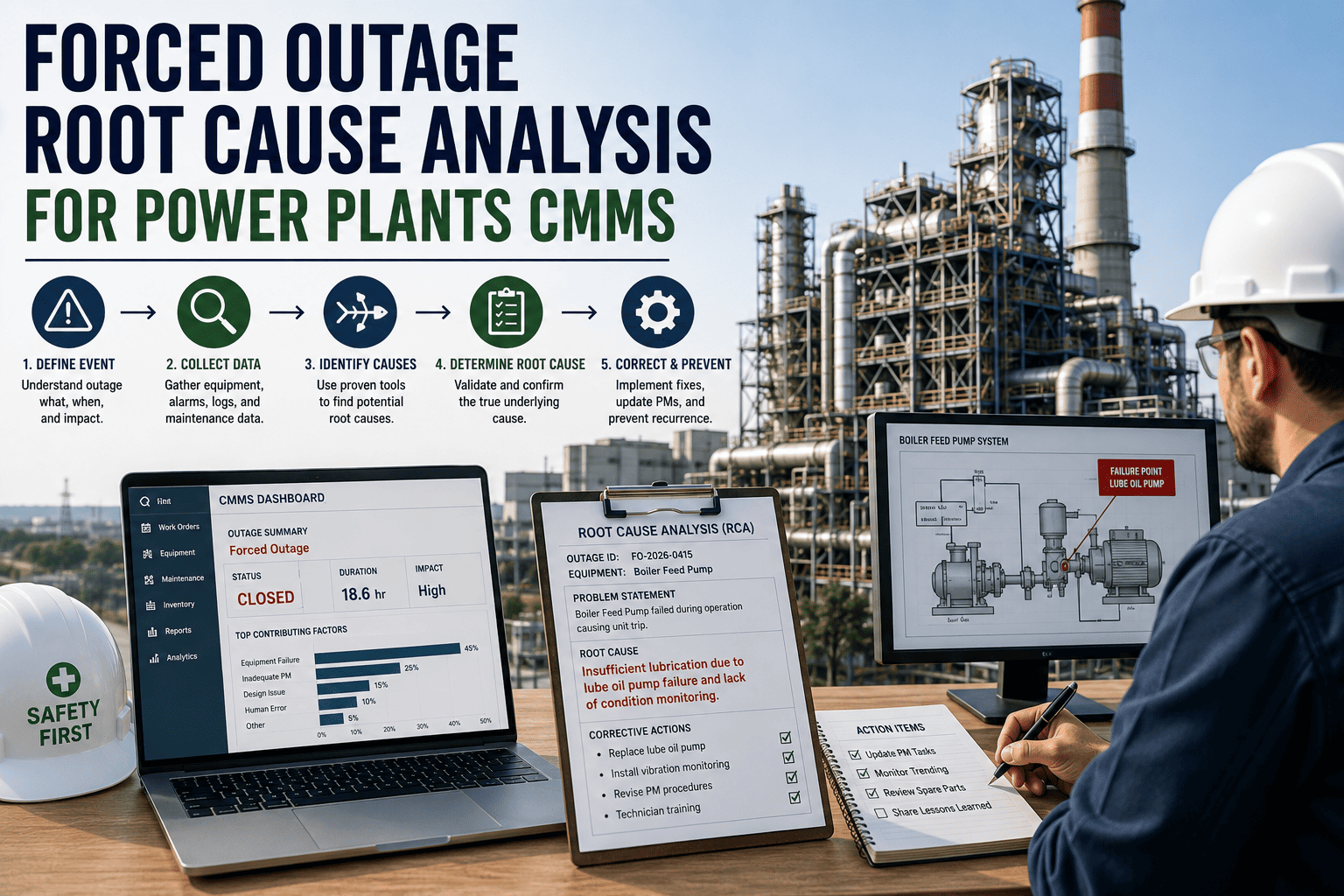
Most power plants conduct root cause analysis the same way they did in 1995 — after the failure, with a team of engineers reviewing logs, interviewing operators, and building a timeline from fragmented records. This process is valuable, but it is inherently backward-looking. By the time the RCA report is written, the next failure in the same failure chain may already be progressing.
Five Layers of AI Diagnostic Intelligence in a Power Plant CMMS
AI root cause analysis is not a single feature — it is a stack of connected analytical layers, each feeding the next. Oxmaint structures these layers around the asset record so every diagnostic output connects directly to a maintenance action.
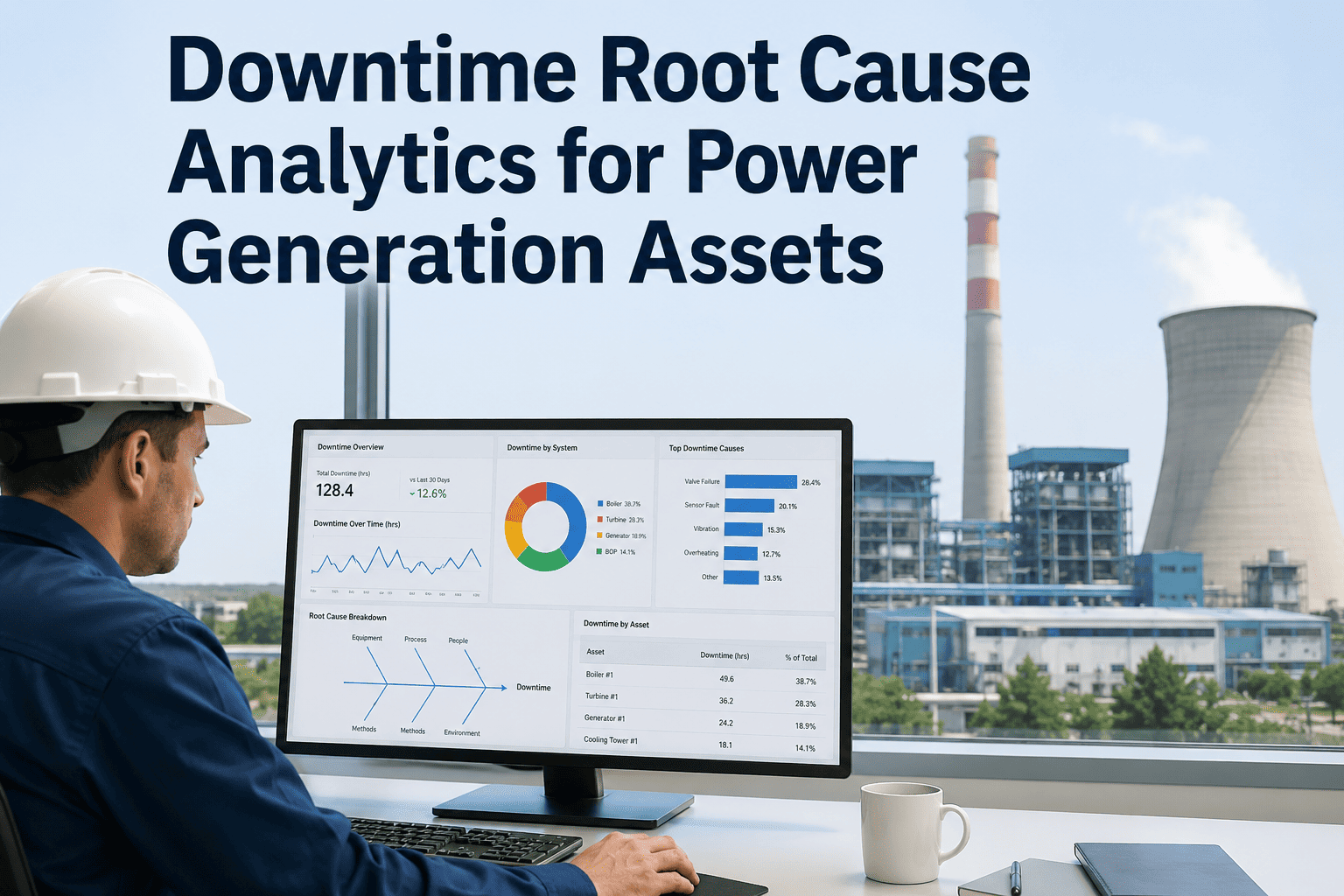
Continuous monitoring of vibration, temperature, pressure, and flow readings against dynamic baselines. AI identifies deviations that statistical thresholds miss — gradual drift, intermittent spikes, and multi-parameter correlations that individually appear normal but together indicate a developing fault.
Machine learning scans the CMMS work order history for recurring failure modes on the same asset class — same failure description, same component, similar operating conditions. If a boiler feed pump has failed at bearing position 2 three times in 18 months, AI surfaces this pattern rather than treating each event as isolated.
Each anomaly signal is matched against a library of known power plant failure modes — cavitation signatures, fouling patterns, corrosion progression curves, and electrical fault indicators. The system ranks probable root causes by confidence score, giving maintenance engineers a prioritised hypothesis list rather than a blank investigation sheet.
Failures rarely occur in isolation in a power plant. AI maps upstream and downstream asset dependencies — if the cooling tower fan degrades, condenser backpressure rises, turbine output drops, and boiler firing rate increases. Oxmaint traces these propagation pathways so a single sensor deviation triggers investigation across the entire affected asset chain.
When AI confirms a probable root cause, the CMMS automatically generates a structured corrective work order — pre-populated with the failure mode, recommended inspection steps, required parts based on historical repairs, and suggested skill level. The gap between diagnosis and dispatched maintenance action closes from days to minutes.
See AI Root Cause Analysis in Action Inside Oxmaint
Our team will show you how Oxmaint connects sensor data, work order history, and failure mode libraries to surface root causes before equipment fails — configured for your specific asset types and failure history.
What AI Analyses to Diagnose a Power Plant Failure
What Changes When AI RCA Connects to Your CMMS
| Metric | Without AI RCA | With Oxmaint AI RCA | Business Impact |
|---|---|---|---|
| Mean Time to Diagnose (MTTD) | 8–24 hours post-failure | Under 2 hours, often pre-failure | Faster return to service |
| Repeat Failure Rate (same asset) | Industry avg: 23% repeat within 90 days | Root cause addressed — repeat eliminated | Maintenance cost reduction |
| Unplanned Outage Events per Year | Baseline: industry average | 30–50% reduction through early detection | Revenue protection per unit |
| RCA Report Completion Time | 3–10 business days | Same shift, auto-generated | Engineering time recovered |
| Corrective Work Order Lead Time | Days from finding to work order | Automatic on diagnosis confirmation | No gap between finding and action |
| Cross-Asset Failure Visibility | Each asset investigated independently | Propagation chain mapped automatically | Secondary failures prevented |
AI Root Cause Analysis in Power Plants — What Engineers Ask
Oxmaint supports both approaches. For plants with DCS or historian integration, sensor readings flow in continuously and AI monitors in near-real time. For plants using manual rounds, operators log readings through the Oxmaint mobile app and the diagnostic engine analyses each entry against historical baselines and work order patterns. Start free to configure your input method.
Initial pattern recognition begins immediately using Oxmaint's built-in power plant failure mode library. The system improves as your own work order and sensor history accumulates — typically 90 days of operational data produces meaningful asset-specific baselines. Historical CMMS data import accelerates this significantly. Book a demo to see how onboarding works.
Yes. Oxmaint's diagnostic engine covers rotating equipment (turbines, pumps, compressors, fans), heat transfer assets (condensers, HRSGs, heat exchangers), and electrical systems (motors, transformers, switchgear) within a single asset hierarchy. Failure mode libraries are asset-class specific, so the diagnostic logic applied to a boiler feed pump differs correctly from that applied to a transformer. Sign up to build your plant's asset hierarchy.
When the AI confirms a root cause hypothesis above a configured confidence threshold, Oxmaint automatically generates a structured corrective work order — with failure mode, recommended procedure, required materials, and priority level — assigned to the responsible crew. No manual translation step required between diagnosis and maintenance dispatch. See this workflow in a live demo.
Technicians can override any AI diagnosis through the Oxmaint mobile app, recording the actual root cause found during inspection. This feedback loop directly retrains the diagnostic model for your specific plant — false positives decrease over time as the system learns asset-specific behaviour that differs from the generic failure mode library. Sign up to start building your plant-specific diagnostic model.
Your Plant's Failure History Contains the Pattern for Its Next Failure. AI Can Find It.
Oxmaint connects your CMMS work order history, sensor data, and failure mode libraries into a diagnostic engine that identifies root causes before they complete — reducing unplanned outages and protecting plant revenue without adding headcount.
-root-cause-analysis-and-prevention-programs.png)


