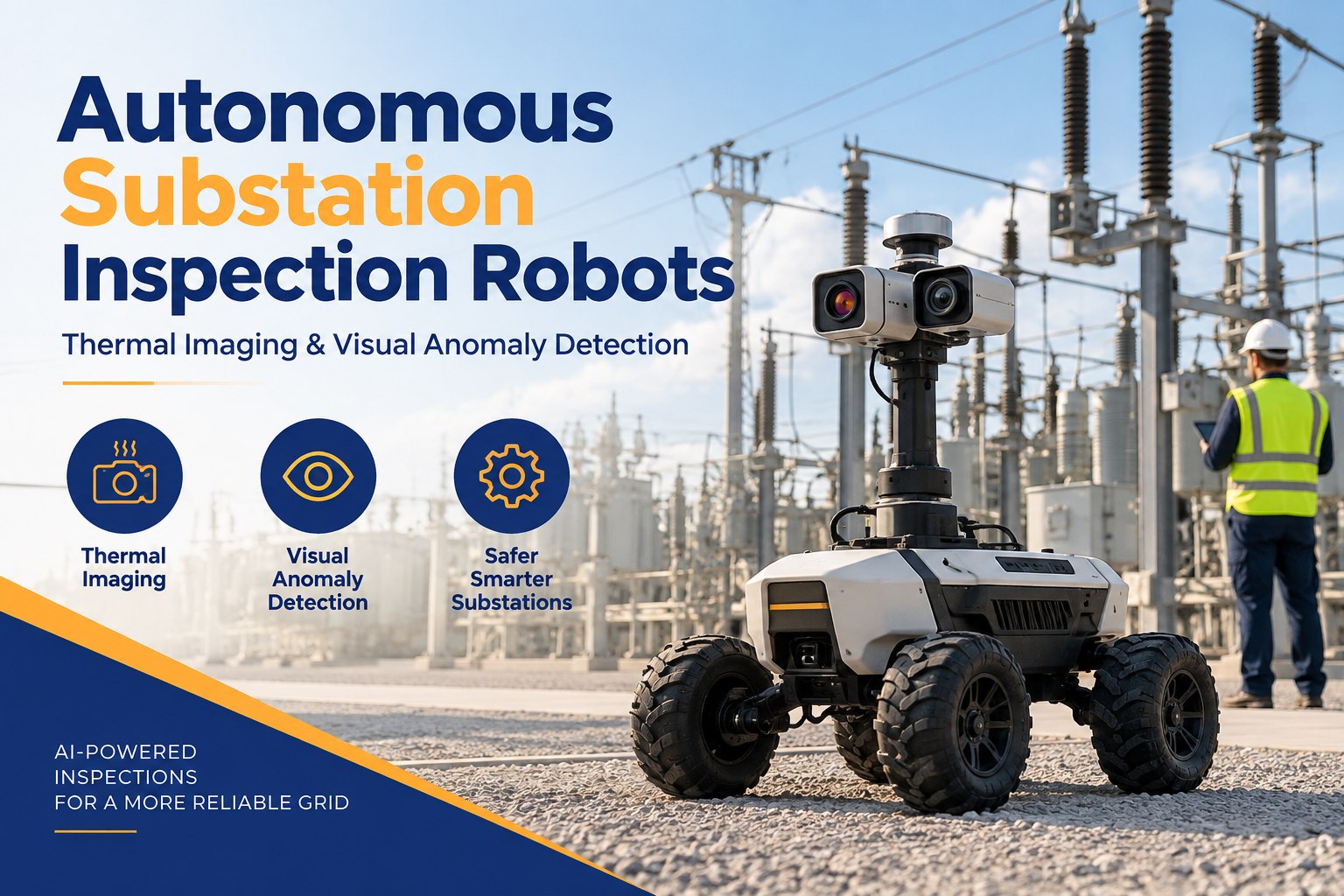
A transformer doesn't fail on a schedule it fails between inspections. Most substations still run on quarterly handheld infrared scans and annual walk-downs, which means a bushing can go from a warm spot to a flashover in the weeks nobody was looking. Autonomous inspection robots close that gap by walking the yard every day, reading thermal and visual signatures on every asset, and turning a temperature drift into a work order before it turns into an outage. This guide breaks down how thermal + visual anomaly detection actually works on an autonomous robot platform, using OXMAINT AI, the AI-powered CMMS that turns every robot patrol into a closed-loop maintenance event.
Autonomous Substation Inspection Robots: Thermal Imaging & Visual Anomaly Detection
OXMAINT AI sends robot thermal and visual readings directly to asset records, flags deviations as defects, and converts confirmed issues into prioritized work orders with images attached. Every patrol also builds asset history for smarter preventive scheduling.
The Blind Spot Between Inspections
A bushing running hot doesn't wait for your inspection calendar. Between two handheld IR scans, a loose connection can go from a small rise to a full thermal runaway — and the crew that could have caught it was never standing in front of it at the right moment. Robots remove the "right moment" problem entirely: they're always standing in front of it. OXMAINT AI takes every reading the robot captures and checks it against the asset's own history, not a generic threshold. Start free and put your first patrol route on OXMAINT AI.
- Weeks of blind spot between one IR scan and the next
- Crew standing in a live high-voltage bay to take the reading
- One temperature snapshot, no trend, no baseline comparison
- Findings written on a clipboard before they reach a work order — if they ever do
- Analog gauges read by eye, once, on inspection day only
- Every asset re-scanned daily — the blind spot shrinks to hours
- Robot enters the bay; humans stay behind the fence
- Every reading compared to that asset's own thermal baseline over time
- A confirmed drift becomes a work order automatically, image attached
- Gauges and dial readings logged and trended every single patrol
How the Robot Actually Sees an Anomaly
Detecting a problem isn't one camera taking one picture — it's four steps happening in sequence, on every asset, every patrol. OXMAINT AI runs this pipeline the moment the robot docks and syncs, so a raw thermal frame becomes a ranked, evidence-backed work order without anyone opening a spreadsheet. Book a demo to see the pipeline run on your own footage.
What the Robot Is Actually Watching
Not every asset needs the same eyes. OXMAINT AI applies a different read on every component class, so a switchgear cubicle and an oil gauge don't get scored the same way. Sign up free and map your own asset classes in OXMAINT AI.
| Asset | What's captured | Common anomaly | Typical trigger |
|---|---|---|---|
| Transformer | Bushing & tank thermal, oil-level gauge, visual leak check | Overheating bushing, oil leak, tap-changer drift | Thermal rise above own baseline |
| Switchgear | Contact & joint thermal, panel visual, door/seal check | Loose connection, hot joint, corrosion | Localized hot spot on one phase |
| Breaker | Contact thermal, mechanism visual, SF6 pressure gauge | Contact wear, gas pressure drop | Gauge reading outside trend band |
| Analog gauges | Visual dial read, trend log every patrol | Slow drift no one checks daily | Reading trending toward limit |
A Missed Reading Doesn't Announce Itself. A Robot Doesn't Miss It.
The failures that take down a substation are rarely sudden — they're a slow drift nobody was watching closely enough. OXMAINT AI turns every patrol into a data point on a trend line, so the drift shows up before the failure does.
A Patrol, Timestamped
Here's what one flagged anomaly actually looks like moving through OXMAINT AI, from the moment the robot captures it to a closed work order. Book a demo to see this run on your own substation.
Handheld Scan vs. Continuous Robotic Patrol
| What matters | Handheld IR (quarterly) | Robot + OXMAINT AI (daily) |
|---|---|---|
| Time between readings | Up to 90 days | Every patrol cycle |
| Human exposure to live bay | Direct, every scan | None |
| Comparison basis | Fixed threshold | Asset's own trend line |
| Evidence on the work order | Manual notes, if any | Thermal + visual + trend, attached |
| Analog gauge trending | Not tracked | Logged every patrol |
Frequently Asked Questions
Let the Robot Stand in the Bay. Let OXMAINT AI Watch the Trend.
Move your substation from quarterly snapshots to daily thermal + visual patrols — every reading trended, every anomaly cross-checked, every confirmed defect turned into a work order with the evidence already attached.