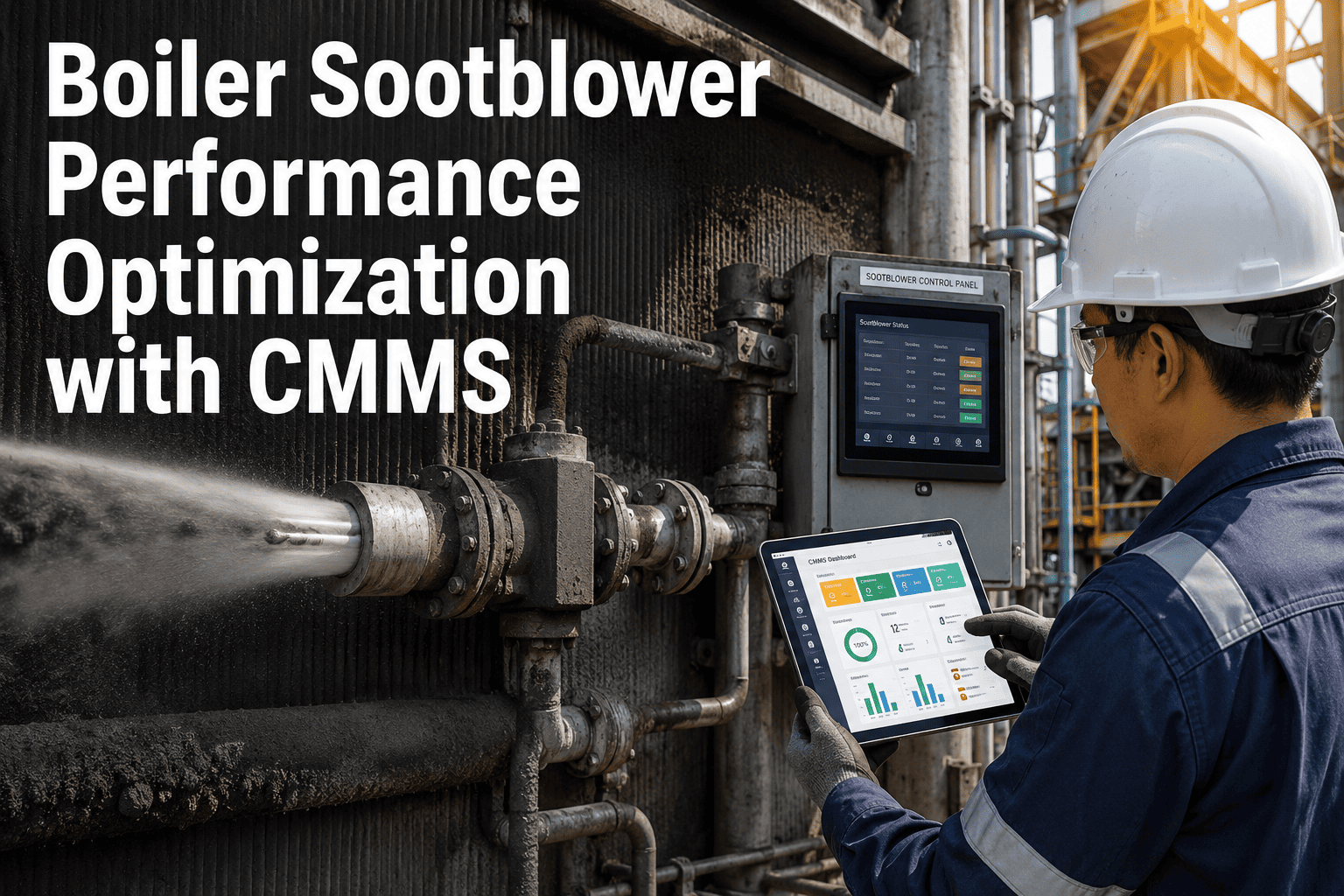
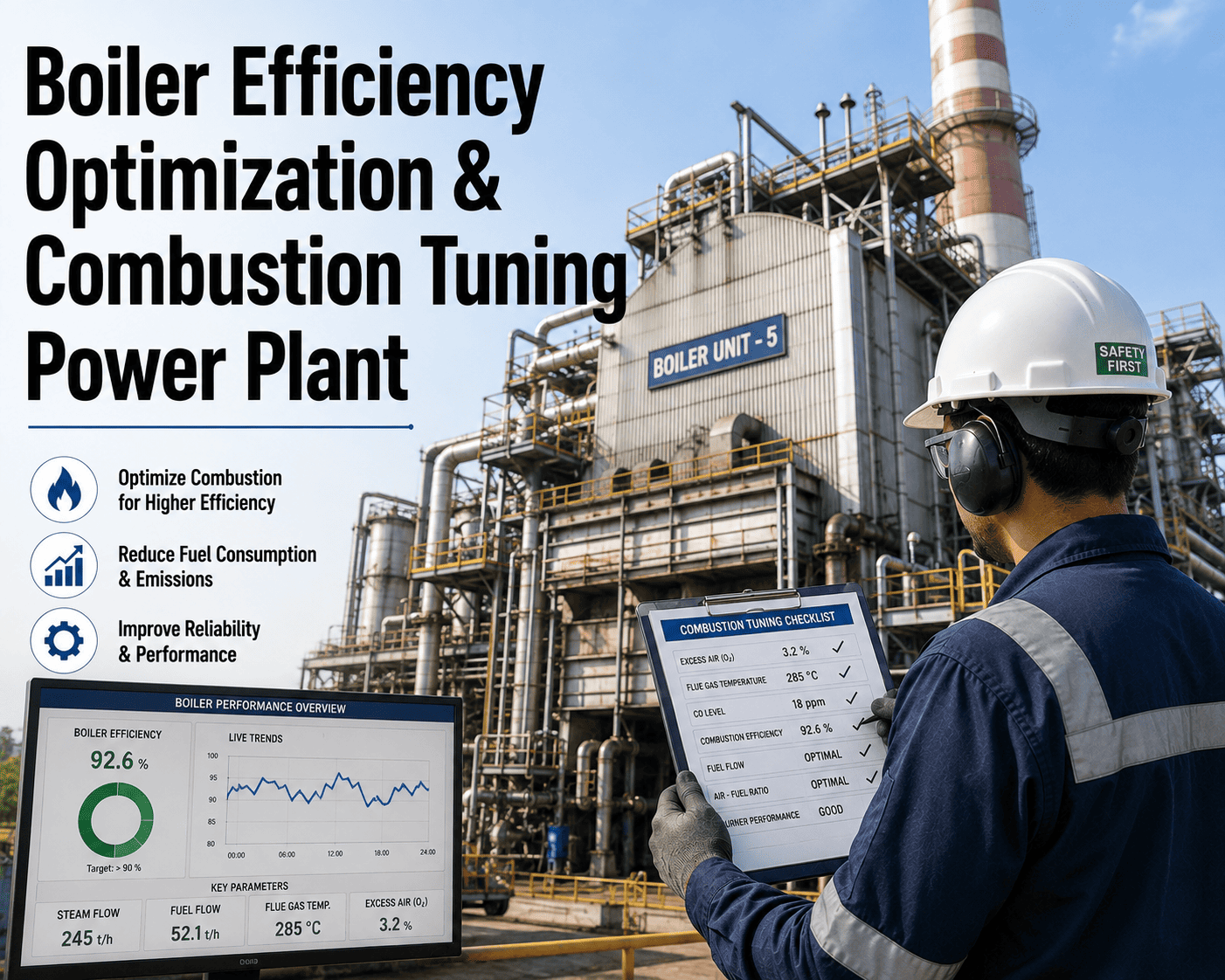
A boiler that is 2% less efficient than design specification costs a 500 MW thermal plant an additional $1.8 million in fuel annually — and the single largest controllable driver of boiler efficiency loss after the first year of operation is fouling on heat transfer surfaces that a poorly managed sootblower program failed to prevent. Sootblowers are often treated as set-and-forget auxiliary equipment, but the data from plant heat rate audits consistently shows the opposite: the plants with the lowest heat rates run sootblower programs driven by flue gas temperature trends and differential pressure measurements, not by fixed-time cycles. The plants with the highest heat rates run every sootblower on a 4-hour timer regardless of what the boiler is actually telling them. This guide covers the fouling mechanisms, the performance indicators that signal sootblower program deterioration, and the CMMS scheduling and tracking logic that keeps heat transfer surfaces clean without overcooling tube metal or wasting steam — and shows how OxMaint's preventive maintenance platform is used by boiler engineering teams to move from fixed-cycle to condition-triggered sootblowing programs.
Boiler Systems · Sootblower Optimization · CMMS
2% Efficiency Loss Costs $1.8M/Year. Your Sootblowers Are the Fix.
2.1%
Average heat rate degradation in plants with unoptimized sootblower programs
$1.8M
Annual fuel cost penalty on a 500 MW unit operating at 2% heat rate deficit
40%
Of sootblower-related tube erosion caused by incorrect sequencing, not fouling itself
0.8%
Typical heat rate recovery when condition-based sootblowing replaces fixed-cycle programs
Fouling Mechanisms: Why Clean Tubes Are an Active Maintenance Achievement
Heat transfer surface fouling in a coal, biomass, or heavy oil boiler is not a slow, uniform process. It is zone-specific, fuel-dependent, and highly sensitive to operating conditions. Understanding the mechanism determines which sootblowers matter most, how often they need to fire, and what the CMMS should track as a performance indicator.
Furnace walls (radiant section)
Slag — molten ash deposition
Ash fusion temperature, fire-side temp
Furnace exit gas temperature (FEGT)
Long retractable IK
Superheater / reheater
Sintered ash bridging between tubes
Ash alkali content, gas velocity
SH/RH outlet temperature vs design
Long retractable / rotary
Economizer
Dry ash accumulation
Fly ash loading, gas temperature
Economizer gas temperature differential
Rotary / air lance
Air preheater
Ammonium bisulfate deposit
SCR NH3 slip, flue gas dew point
APH differential pressure, exit temp
Water wash / rotary
Condition-Based vs Fixed-Cycle Sootblowing: The Performance Gap
Fixed-cycle sootblowing — every sootblower fires on a 4-hour or 8-hour timer — was the default program design when DCS capability was limited. It creates three problems simultaneously: it fires sootblowers on clean surfaces (wasting steam and eroding tubes), it misses actual fouling events that occur between cycles, and it provides no feedback on whether the blowing was effective. Condition-based programs solve all three.
Fixed-Cycle Program
Fires every sootblower on identical intervals regardless of fouling state
Steam consumption: 3–5% of boiler steam output used for sootblowing
Tube erosion from 40% of blows onto already-clean surfaces
No confirmation that fouling was actually removed after blowing
CMMS has no data on individual sootblower effectiveness
Condition-Based Program (OxMaint)
Sootblower fires when FEGT, temperature differential, or ΔP crosses threshold
Steam consumption reduced 20–35%; only fouled zones are blown
Tube life extended — blowing frequency on clean surfaces eliminated
Post-blow temperature delta confirms effectiveness; re-blow triggered if threshold not met
CMMS tracks per-sootblower effectiveness history — identifies failed or degraded blowers
The CMMS Sootblower Program: What OxMaint Tracks and Why It Matters
A CMMS without sootblower-specific tracking is a scheduling tool, not an optimization tool. OxMaint treats each sootblower as a maintainable asset with its own performance history, failure mode profile, and condition indicators — enabling the shift from interval-based maintenance to evidence-based maintenance on a per-blower basis.
Blow effectiveness score
OxMaint calculates a post-blow effectiveness score for each sootblower activation: the improvement in FEGT or zone temperature differential within 15 minutes of blowing versus the pre-blow baseline. A blower scoring below 40% effectiveness on three consecutive activations generates a maintenance work order — it is either mechanically failed, operating on a clean surface, or positioned incorrectly.
Steam consumption per blow
Each sootblower has a design steam flow rate and blow duration. OxMaint logs actual steam consumption per activation and compares to design. A blower consuming 30% more steam than design is likely suffering from a packing gland leak, valve seat erosion, or nozzle damage — conditions that waste boiler steam and reduce cycle efficiency if unaddressed.
Travel time and retraction health
Long retractable sootblowers have drive motors, gearboxes, and lance tubes that wear over time. OxMaint monitors the time from initiation to full extension and full retraction against design cycle time. A blower taking 20% longer to complete a full cycle indicates mechanical drag — tube bowing, drive gearbox wear, or guide roller failure — before it causes a blower jam or stuck lance.
Interlock and trip history
Every sootblower interlock trip — high tube metal temperature, low steam pressure abort, position fault — is logged as a maintenance event in OxMaint. A blower with three interlock trips in a 30-day period is flagged for inspection. Interlock trips are the primary leading indicator of lance tube failure and furnace wall erosion from improper blower positioning.
Fouling rate trend by zone
OxMaint tracks how quickly each boiler zone refouled after the last successful blow — the time from post-blow temperature improvement to threshold re-trigger. A zone fouling to the re-blow trigger in 2 hours versus the expected 8 hours indicates a change in fuel quality, combustion conditions, or load profile that requires engineering review, not just another sootblower activation.
Tube metal temperature protection
OxMaint cross-references sootblower activation schedules against tube metal thermocouple readings. If a scheduled sootblower activation would occur when tube metal in the target zone is already at or near design maximum, the activation is deferred and an alert is raised. Thermal shock from cold steam impact on overheated tube metal is a significant contributor to tube failures at weld joints.
Optimize every blower activation
Stop Running Sootblowers on Timers. Start Running Them on Data.
OxMaint connects your boiler's FEGT, temperature differentials, and ΔP readings to a condition-based sootblower program — with per-blower effectiveness tracking and automatic maintenance work orders when performance degrades.
Common Sootblower Failure Modes and CMMS Response
Failure Mode
Observable Symptom
OxMaint Detection
Work Order Priority
Stuck lance (jam on extension)
Activation initiated, no return signal from position feedback
Travel time overrun alert within 5 min of initiation
P1 — Immediate
Nozzle erosion (worn tip)
Reduced blow effectiveness, steam consumption elevated
Effectiveness score below threshold × 3 consecutive blows
P2 — Next outage
Packing gland steam leak
Steam consumption 25%+ above design; visible leak on walkdown
Steam consumption KPI flag + walkdown work order
P2 — Scheduled
Drive motor overheating
Drive current elevation, thermal imaging flag
Motor current monitoring + thermal scan WO
P2 — Scheduled
Steam supply valve seat leak
Steam consumption between activations; tube erosion downstream
Continuous steam flow monitoring between blow cycles
P1 — Immediate
Frequently Asked Questions
Q1 How does a CMMS improve sootblower performance versus just using the DCS?
The DCS controls sootblower activation sequences but has no memory of individual blower performance history, no failure mode tracking, and no ability to generate maintenance work orders. A CMMS like OxMaint adds the asset management layer: each sootblower has its own maintenance record, effectiveness history, and failure mode checklist. When a sootblower underperforms three consecutive activations, the DCS sees a normal sequence completion — OxMaint sees a degradation trend and creates a targeted work order for that specific blower. The DCS is the execution layer; OxMaint is the reliability layer that keeps execution performing at design specification.
Start a free trial to see the sootblower asset profile setup.
Q2 What data does OxMaint need to implement condition-based sootblowing?
The minimum dataset for condition-based sootblowing is furnace exit gas temperature (FEGT), superheater and reheater outlet temperatures, economizer inlet and outlet temperatures, and sootblower activation feedback signals (initiated, extended, retracted). These are standard DCS measurements in any modern boiler control system. OxMaint connects via OPC-UA, Modbus, or historian API — no new instrumentation is required for most plants. Air preheater differential pressure is the one measurement that benefits from additional instrumentation if not already monitored, as it is the primary fouling indicator for APH condition-based washing programs.
Book a demo to review integration options for your specific DCS.
Q3 How much heat rate improvement can we realistically expect from a CMMS-optimized sootblowing program?
Heat rate improvement from condition-based sootblowing typically ranges from 0.6% to 1.1% of full-load heat rate, depending on fuel quality, boiler age, and how far the existing program was from optimal. The improvement comes from two sources: better fouling removal (reducing convective section temperature differentials) and reduced boiler blowdown steam waste (firing fewer unnecessary blows). On a 500 MW unit with a heat rate of 9,500 BTU/kWh, a 0.8% improvement at $3.50/MMBTU fuel cost yields approximately $1.05 million in annual fuel savings. Most plants see the majority of this improvement within the first 90 days of condition-based program activation.
Q4 What is the biggest maintenance risk in sootblower programs that CMMS tracking prevents?
The single largest risk is a stuck lance — a long retractable sootblower that does not return to its home position after activation. A stuck lance in the furnace or convective sections is exposed to gas temperatures that will erode or melt the lance tube within hours, potentially causing a tube leak or foreign object damage to downstream tube banks. OxMaint prevents this by monitoring travel time against the design cycle specification and triggering a P1 immediate work order if retraction is not confirmed within the expected window. This early detection gives operators time to initiate emergency retraction procedures before the lance is thermally damaged.
Start a free trial to configure stuck-lance detection on your sootblower fleet.
Q5 Can OxMaint handle multiple boilers and multiple fuel types on the same plant?
Yes — OxMaint supports multi-unit and multi-fuel configurations with separate asset hierarchies, threshold sets, and sootblower programs per boiler. A plant switching between coal and biomass blends, for example, can maintain separate condition-based thresholds for each fuel configuration, with the active threshold set selected by a fuel mode parameter from the DCS. This is particularly important because biomass fouling characteristics differ significantly from coal — ash fusion temperatures are lower, alkali content is higher, and convective section bridging occurs at lower FEGT levels. OxMaint captures these differences in per-fuel baseline profiles rather than applying a single threshold to both conditions.
Book a demo to see a multi-fuel boiler configuration.
Fuel savings start with sootblower data
A 0.8% Heat Rate Improvement on Your Boiler Pays for a CMMS Program Many Times Over.
OxMaint gives your boiler engineering team the per-blower effectiveness data, condition-based trigger logic, and maintenance work order trail that converts your sootblower fleet from a fixed-cost auxiliary program into a measurable fuel efficiency asset. Connect your DCS data. Start optimizing in weeks, not months.