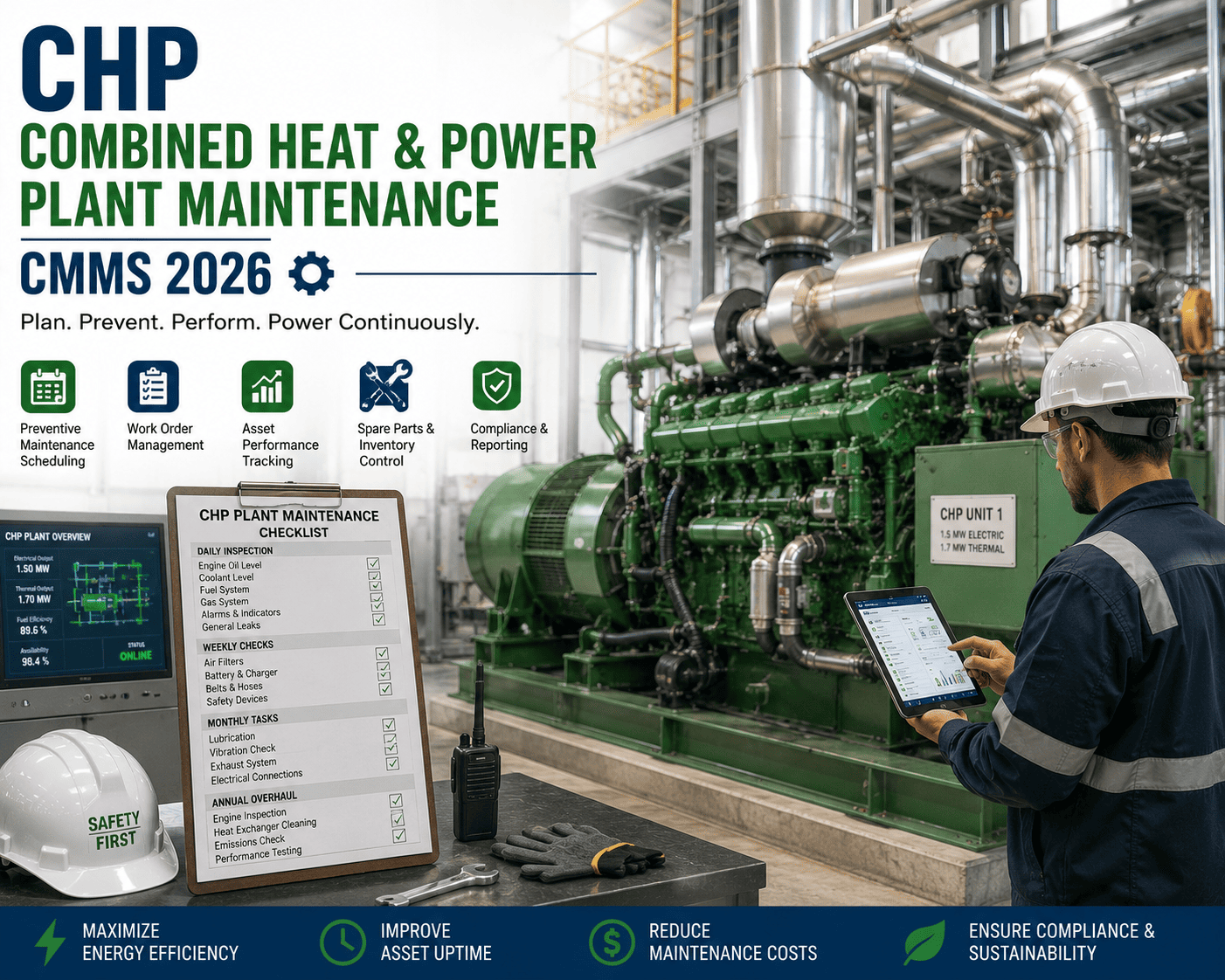
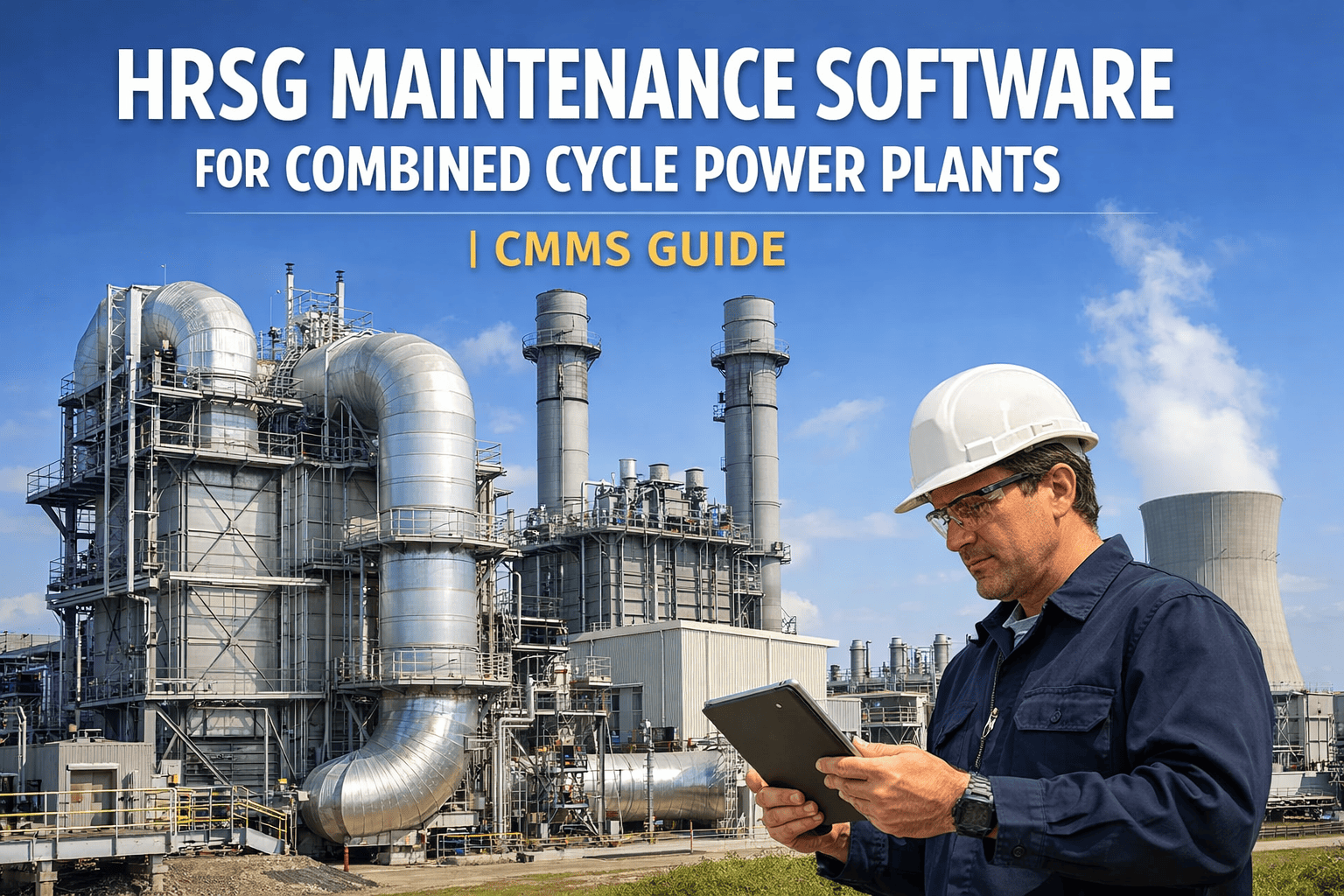
Combined heat and power plants run at 75 to 90% total fuel efficiency — nearly double the 45 to 55% efficiency of separate heat and power generation — yet that dual-output advantage comes with a dual-asset maintenance obligation that most CMMS deployments are not structured to handle. A CHP plant does not fail like a boiler or a generator alone; it fails at the intersection of both — an HRSG tube failure shuts down steam output and forces the gas turbine offline simultaneously, and a cooling water chemistry deviation can cascade from the heat recovery side into turbine blade damage. The global CHP market reached USD 29 billion in 2025 and is expanding at a 6% CAGR through 2034, with industrial and municipal operators investing in plants that have 20-to-30-year asset lifecycles — which makes structured CMMS not a nice-to-have but the difference between designed efficiency and delivered efficiency. To see how OxMaint manages CHP asset hierarchies across both power and heat recovery systems, start a free trial or book a 30-minute CHP maintenance walkthrough with a specialist.
CMMS Guide / Cogeneration / CHP Plant Operations 2025
CHP Plant Maintenance CMMS — Managing Both Sides of the Dual-Output Asset
A practical guide for cogeneration operators on building a CMMS program that tracks power generation and heat recovery assets together — not as two separate systems.
80–90%
CHP total fuel efficiency vs 45–55% for separate generation
$29B
Global CHP market in 2025, growing at 6% CAGR
30 yrs
Typical CHP asset lifecycle — structured PM is non-negotiable
2-in-1
Every failure event affects both power and heat output simultaneously
The CHP Maintenance Problem — Why Standard CMMS Falls Short
Most CMMS tools are designed around single-output assets — a pump, a boiler, a generator. CHP plants require something different: a maintenance platform that understands the dependency chain between power generation assets and heat recovery assets, and can track failure modes that span both sides.
Power Generation Side
Gas Turbine / Reciprocating Engine
Electrical Generator
Fuel System & Valves
Combustion Controls
Exhaust Ducting & Diverter
Lube Oil System
Each asset needs its own PM schedule, failure codes, and service history — independent of heat-side events.
Heat Recovery Side
HRSG — Tubes, Headers, Drums
Steam Turbine (if applicable)
Condensate & Feedwater System
Water Treatment & Chemistry
Heat Exchangers
Distribution Pipework
HRSG pressure part failures — tubes, headers, connecting piping — are the most frequent HRSG reliability threat in CHP plants.
Why This Matters
When a gas turbine HRSG coupling fails, both power output and heat supply drop simultaneously. A CMMS that tracks these as separate systems misses the cross-system dependency — and cannot trigger coordinated corrective action across both asset groups at once.
Five Critical CHP Asset Groups — What Each Needs from a CMMS
Each asset group in a CHP plant has a distinct failure pattern, a distinct inspection frequency, and distinct data requirements. CMMS delivers value when it is configured to each group — not as a generic work order system.
01
Gas Turbine / Prime Mover
The prime mover is the highest-value single asset in the plant. Gas turbine maintenance is driven by fired hours, starts, and fuel quality — not calendar time alone. CMMS must track actual running hours, start-stop counts, and fired-hour intervals to trigger combustion inspections, compressor washes, and blade condition checks on the correct cycle.
Trigger typeFired hours + start count
Key PM tasksCombustion inspection, compressor wash, lube oil analysis, blade boroscope
Failure riskHot section degradation, compressor fouling, lube oil contamination
02
Heat Recovery Steam Generator (HRSG)
HRSG pressure parts — tubes, headers, and connecting piping — represent the most frequent reliability threat in cogeneration plants. Most HRSGs in current operation were not designed for the thermal cycling stress of modern flexible dispatch. CMMS must link HRSG inspections to turbine operating cycles, not fixed calendar intervals, because tube fatigue is driven by the number of thermal cycles, not elapsed time.
Trigger typeCycle count + calendar hybrid
Key PM tasksTube visual/UT inspection, header thickness check, drum level calibration, safety valve test
Failure riskThermal fatigue cracking, flow-accelerated corrosion, tube-to-header weld failure
03
Water Treatment & Chemistry System
Water chemistry is the silent driver of HRSG degradation and a leading root cause of forced outages in CHP plants. Oxygen ingress, dissolved solids, and pH excursions damage tube internals without any visible external symptom until a tube rupture occurs. CMMS tracks chemistry sampling as a recurring PM with pass/fail thresholds — and links out-of-range results directly to corrective work orders before damage occurs.
Trigger typeTime-based with condition gate
Key PM taskspH, conductivity, dissolved oxygen, silica, hardness testing; dosing pump checks
Failure riskInternal corrosion, scale buildup, oxygen pitting in drum and economizer
04
Electrical Generator & Auxiliaries
The generator converts mechanical output to exported power. Generator maintenance covers insulation resistance testing, bearing condition monitoring, cooling system checks, and excitation system calibration. These tasks run on calendar and meter intervals that differ from the turbine — a separate asset record in CMMS ensures each interval is tracked independently without one masking the other.
Trigger typeCalendar + running hours
Key PM tasksInsulation resistance (Megger) test, bearing vibration, cooling air filter, excitation check
Failure riskWinding insulation breakdown, bearing failure, excitation system fault
05
Heat Distribution & Condensate Recovery
The downstream heat distribution network — heat exchangers, steam traps, condensate return lines, and expansion joints — is the most maintenance-dense part of the CHP system by work order volume. Steam trap failures are a significant source of energy loss; a failed-open trap wastes steam directly and a failed-closed trap floods lines and causes water hammer. CMMS automates the inspection cycle and logs every steam trap condition at each survey.
Trigger typeCalendar-based survey cycles
Key PM tasksSteam trap survey, heat exchanger fouling test, expansion joint inspection, condensate pump check
Failure riskSteam losses, water hammer, heat exchanger fouling, condensate contamination
Configure Your CHP Asset Hierarchy in OxMaint
Set up power-side and heat-side assets as linked systems — with independent PM schedules, shared dependency flags, and unified compliance reporting across your entire cogeneration plant.
CHP Maintenance Frequency Guide — What Gets Inspected When
CHP maintenance intervals span daily chemistry checks to multi-year major overhauls. The table below organises the core inspection calendar for a gas turbine CHP plant — the structure that a CMMS enforces automatically as recurring work orders.
| Interval |
Asset |
Task |
Trigger Basis |
| Daily |
Water chemistry |
pH, conductivity, dissolved oxygen sampling |
Calendar — shift log |
| Daily |
Gas turbine |
Lube oil level, vibration readings, exhaust temperature review |
Operator round / sensor alert |
| Weekly |
HRSG |
Drum level calibration check, safety valve visual, blowdown log |
Calendar PM work order |
| Weekly |
Condensate system |
Pump suction/discharge pressure, condensate quality |
Calendar PM work order |
| Monthly |
Generator |
Cooling filter inspection, excitation system check, bearing temperature log |
Calendar PM work order |
| Monthly |
Steam distribution |
Steam trap survey — ultrasonic or thermographic |
Calendar PM work order |
| Quarterly |
Gas turbine |
Compressor wash (offline or online), lube oil sample for analysis |
Running hours + calendar |
| Quarterly |
HRSG |
Safety valve test, pressure gauge calibration, tube surface visual |
Calendar PM work order |
| Annual |
Gas turbine |
Combustion inspection — hot gas path components, fuel nozzles, transition pieces |
Fired hours threshold |
| Annual |
HRSG |
Internal tube inspection (UT/visual), header weld check, drum inspection |
Calendar + cycle count |
| Annual |
Generator |
Full insulation resistance (Megger) test, winding condition assessment |
Calendar PM work order |
| Major Overhaul |
Gas turbine + HRSG |
Hot gas path inspection or major inspection — per OEM fired hours schedule |
OEM fired hours milestone |
OxMaint creates all of the above as linked recurring work orders — with meter-based triggers for the gas turbine and calendar triggers for water chemistry. Start a trial to configure your plant's inspection calendar.
How CMMS Tracks the Dual-Output Efficiency KPIs That Matter
CHP operators are accountable for two output streams — electricity exported and heat delivered. CMMS supports both by linking asset condition data to the efficiency metrics that finance and operations teams actually use to evaluate plant performance.
Heat Rate Degradation
Tracking gas turbine heat rate over fired hours reveals compressor fouling and hot-section wear before it becomes a forced outage. CMMS logs the data from each combustion inspection and links it to the asset's performance trend line.
Power-side KPI
Heat Recovery Effectiveness
HRSG output against theoretical maximum reveals fouling, tube degradation, and water chemistry problems. CMMS work orders document inspection findings that explain deviations — closing the loop between observed efficiency loss and root cause.
Heat-side KPI
Forced Outage Rate
Every forced outage affects both power and heat output simultaneously — the defining characteristic of CHP reliability risk. CMMS failure code libraries capture root cause at the asset level, enabling trend analysis that identifies which components are driving availability loss.
Dual-output KPI
PM Compliance Rate
Regulatory bodies, insurers, and grid operators increasingly require documented PM compliance for CHP plants. CMMS provides the time-stamped, auditable records of every inspection completed — exportable on demand for compliance submissions.
Compliance KPI
Frequently Asked Questions
What makes CHP maintenance different from standard boiler or generator maintenance?
CHP plants require maintenance across two interdependent output streams simultaneously — power generation and heat recovery. A failure in one directly affects the other. CMMS configured for CHP must link these asset groups, support both fired-hours-based triggers (for the turbine) and calendar-based triggers (for water chemistry and HRSG inspections), and track cross-system dependency.
Book a demo to see how OxMaint structures this.
How often should HRSG tubes be inspected in a CHP plant?
HRSG tube inspection frequency should be based on thermal cycle count as well as calendar time — because tube fatigue is driven by repeated startup and shutdown stress, not just elapsed operating hours. Plants with frequent cycling require more frequent tube wall thickness checks (ultrasonic testing) than baseload plants. Most operators run a visual and ultrasonic survey annually and a full internal inspection during scheduled outages.
Set up your HRSG inspection schedule in OxMaint.
What role does water chemistry play in CHP reliability?
Water chemistry is one of the most underestimated drivers of CHP plant failures. Oxygen ingress, high dissolved solids, and pH excursions degrade HRSG tube internals silently — there is no visible symptom until a tube rupture causes an unplanned outage. Daily chemistry sampling with pass/fail thresholds logged in CMMS is the standard for preventing chemistry-driven failures in industrial CHP plants.
Can OxMaint handle both fired-hours triggers and calendar-based PM in the same plant?
Yes. OxMaint supports meter-based triggers (fired hours, start counts, cycle counts) for turbine and HRSG assets alongside calendar-based triggers for water chemistry, steam trap surveys, and generator checks — all within a single unified plant asset hierarchy.
Start a trial to configure your trigger mix.
What compliance documentation do CHP operators typically need to produce?
CHP operators are typically required to document combustion inspection records, HRSG pressure vessel inspection reports, water chemistry treatment logs, safety valve test records, and environmental emissions compliance data. OxMaint stores all inspection outcomes as time-stamped, auditable work order records that can be exported for regulatory submission, insurance review, or grid operator audits.
Book a walkthrough to review the compliance package.
CHP Efficiency Is Maintained, Not Designed
A cogeneration plant is designed to run at 80 to 90% fuel efficiency — but that efficiency requires a structured maintenance program that tracks both power and heat recovery assets on the right intervals, with the right triggers, and with documented outcomes that satisfy regulators and insurers. OxMaint gives CHP operators a single platform to manage the entire dual-output asset hierarchy, from daily water chemistry to major turbine overhauls.