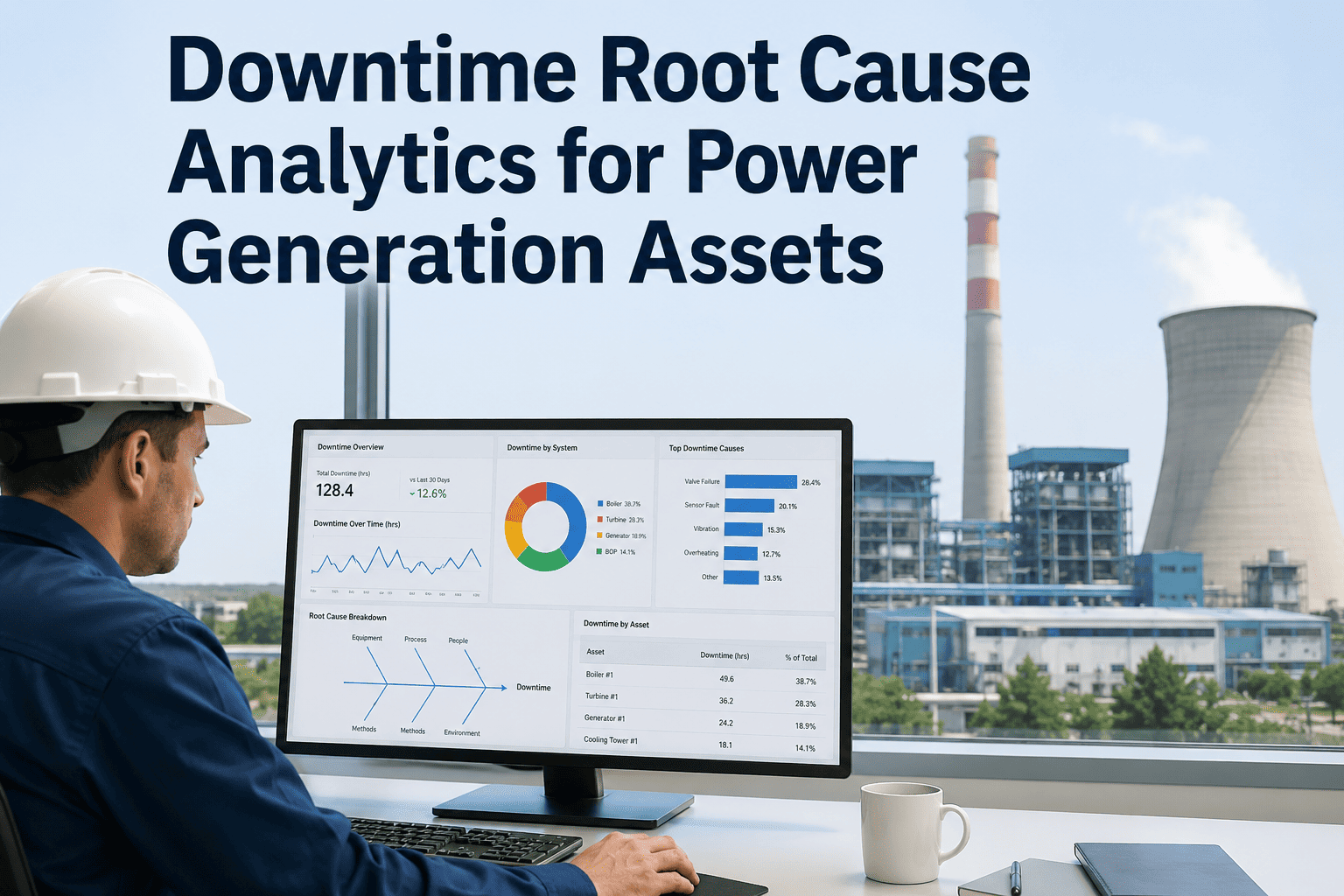
AI data centers do not consume electricity the way industrial loads do. During active model training runs, a single hyperscale campus can swing demand by hundreds of megawatts within seconds — faster than traditional grid control systems were designed to track. That volatility does not stay contained at the transmission level. It propagates directly into the operational reality of every generating asset dispatched to serve that demand, driving thermal cycling on turbines, voltage transients on transformers, and ramp-rate stress on auxiliaries that were sized for steady-state operation. Power plant maintenance planners who ignore this new load profile are mismatching their PM intervals, vibration monitoring thresholds, and inspection schedules to an operating reality that has fundamentally changed. OxMaint's analytics and reporting platform gives plant teams the visibility to see what volatile load is doing to specific assets — and the workflow tools to respond before that stress accumulates into an unplanned failure. If your plant is experiencing increased ramp cycles without a corresponding update to your maintenance strategy, book a consultation to see how data-driven maintenance planning closes the gap.
Analytics & Reporting — Grid Reliability
Your Equipment Was Designed for Steady Load. AI Data Centers Just Changed the Operating Conditions.
Load volatility from AI compute workloads is creating new failure patterns in power plant equipment. OxMaint analytics connect your operating data to your maintenance plan — so volatile dispatch conditions don't become unplanned outages.
Equipment Impact Analysis
How Load Volatility Damages Specific Plant Assets
Each major power plant equipment class responds differently to rapid load cycling. Understanding which assets accumulate the most damage under volatile dispatch conditions is the first step to adapting your maintenance plan.
Gas Turbines
Volatility effect
Thermal fatigue accumulation at hot-section components from rapid ramp cycles — equivalent operating hours increase faster than calendar hours
At-risk components
Combustion liners, transition pieces, first-stage blades, fuel nozzles
Maintenance adaptation
Shift hot-section inspection intervals from calendar-based to equivalent operating hour-based — OxMaint tracks both simultaneously
High impact asset
Step-Up Transformers
Volatility effect
Rapid load swings cause inrush current transients and thermal cycling in windings — accelerating insulation degradation beyond nameplate rated life
At-risk components
Winding insulation, bushing seals, tap changer contacts, cooling fans
Maintenance adaptation
Increase dissolved gas analysis frequency from annual to quarterly — OxMaint auto-generates oil sampling work orders on adjusted schedule
High impact asset
Generator Excitation Systems
Volatility effect
Reactive power swings from volatile loads stress excitation control systems and rotor windings — increasing brush wear and slip ring degradation rates
At-risk components
Exciter brushes, slip rings, AVR electronics, rotor winding insulation
Maintenance adaptation
Brush wear inspection moved from annual outage to quarterly running inspection — work order auto-generated by OxMaint based on ramp event counter
Medium impact asset
Cooling Water Systems
Volatility effect
Load swings create thermal shock cycles in heat exchangers and condenser tube bundles — accelerating erosion and fouling deposition patterns
At-risk components
Condenser tube bundles, CW pump seals, expansion joints, heat exchanger gaskets
Maintenance adaptation
Fouling index and differential pressure trending flagged against ramp event log — correlation analysis identifies stress-driven fouling acceleration
Medium impact asset
Your PM schedule was designed for your old dispatch profile. OxMaint analytics help you adapt it to the one you're actually operating under.
Real-time asset analytics, ramp-event correlated maintenance triggers, and automated work order generation — OxMaint connects your operating data to your maintenance plan so volatile load stops accumulating as hidden equipment damage.
OxMaint Analytics
Connecting Load Data to Maintenance Action
OxMaint's analytics layer does not stop at dashboards. It converts operating condition data into maintenance actions — so volatile dispatch conditions automatically update what your team does next.
Step 1
Operating Data Ingestion
MW output, ramp rate events, equivalent operating hours, fuel flow, and ambient conditions ingested from DCS or historian every 5 minutes. No manual data entry.
Step 2
Fatigue Model Calculation
Ramp events weighted by magnitude and temperature delta. Equivalent operating hours calculated per OEM hot-section model — updated continuously, not at outage intervals.
Step 3
PM Trigger Adjustment
When accumulated fatigue brings the next inspection window forward, OxMaint updates the PM due date automatically and notifies the maintenance planner with the updated timeline and recommended work scope.
Step 4
Work Order Dispatch
Updated PM work order created, parts availability checked, crew assigned, and mobile notification sent to field technicians — all without planner manual intervention once the system is configured.
Reliability Reporting
Metrics That Matter for Grid Reliability Compliance
Capacity markets and grid operators increasingly require plants to report reliability metrics. OxMaint generates these reports directly from maintenance and operations data — no manual assembly required.
Forced Outage Rate (FOR)
Calculated from actual unplanned outage duration vs. available hours — formatted for NERC GADS reporting submission
Equivalent Forced Outage Rate (EFOR)
Includes partial outage deratings from equipment degradation — tracks the full reliability impact, not just full stops
Mean Time Between Failures (MTBF)
Per asset class and per equipment family — identifies which equipment categories are most affected by volatile dispatch conditions
Mean Time to Repair (MTTR)
Tracked per failure type — highlights whether response time or parts availability is the primary driver of outage duration
PM Compliance Rate
Percentage of PMs executed within scheduled window — leading indicator of future forced outage risk and maintenance program health
Ramp Event Fatigue Index
OxMaint-calculated index correlating load ramp events to equipment fatigue accumulation — unique metric for volatile dispatch environments
FAQ
Questions About Load Volatility and Maintenance Planning
Our plant was not designed for frequent cycling — how does OxMaint help us manage that?
OxMaint tracks equivalent operating hours and ramp event counts alongside calendar time — so when cycling is increasing equipment wear faster than your current PM schedule assumes, the system flags the gap and adjusts inspection intervals before cumulative damage causes a failure.
Book a consultation to configure your cycling parameters.
Can OxMaint produce NERC GADS-compatible reliability reports?
Yes. OxMaint generates Forced Outage Rate, Equivalent Forced Outage Rate, and availability factor reports from completed work order and outage event data — formatted for NERC GADS submission. Report generation is automated and requires no manual data assembly.
Start your free trial to explore the reporting module.
How does OxMaint handle equipment from multiple OEMs with different fatigue models?
OxMaint stores OEM-specific equivalent operating hour models per equipment asset — different formulas for GE, Siemens, and Mitsubishi turbine families are applied to the same ramp event data and output asset-specific fatigue accumulation scores. Each asset class can have a distinct model.
We have a capacity market obligation — can OxMaint help us document availability for that?
Capacity market availability is documented through OxMaint's outage event log — every forced and planned outage recorded with start time, duration, cause code, and resolution action. This data maps directly to PJM, ERCOT, and MISO availability reporting formats.
Book a demo to see capacity market reporting configured for your region.
Is there a way to model what our current dispatch profile is doing to remaining equipment life?
OxMaint's remaining useful life (RUL) module projects end-of-life dates for major components based on current operating conditions including ramp frequency and magnitude. RUL projections update as dispatch conditions change — giving planners a live view of what today's operating profile means for next year's major maintenance scope.
Start your free trial to activate RUL tracking on your critical assets.
The load profile serving data centers is new. Your maintenance plan needs to catch up to it.
OxMaint analytics connect your real operating conditions — ramp events, equivalent hours, thermal cycles — to your maintenance schedule. Every volatile dispatch event is tracked, analyzed, and converted into a maintenance action before it becomes a reliability statistic.