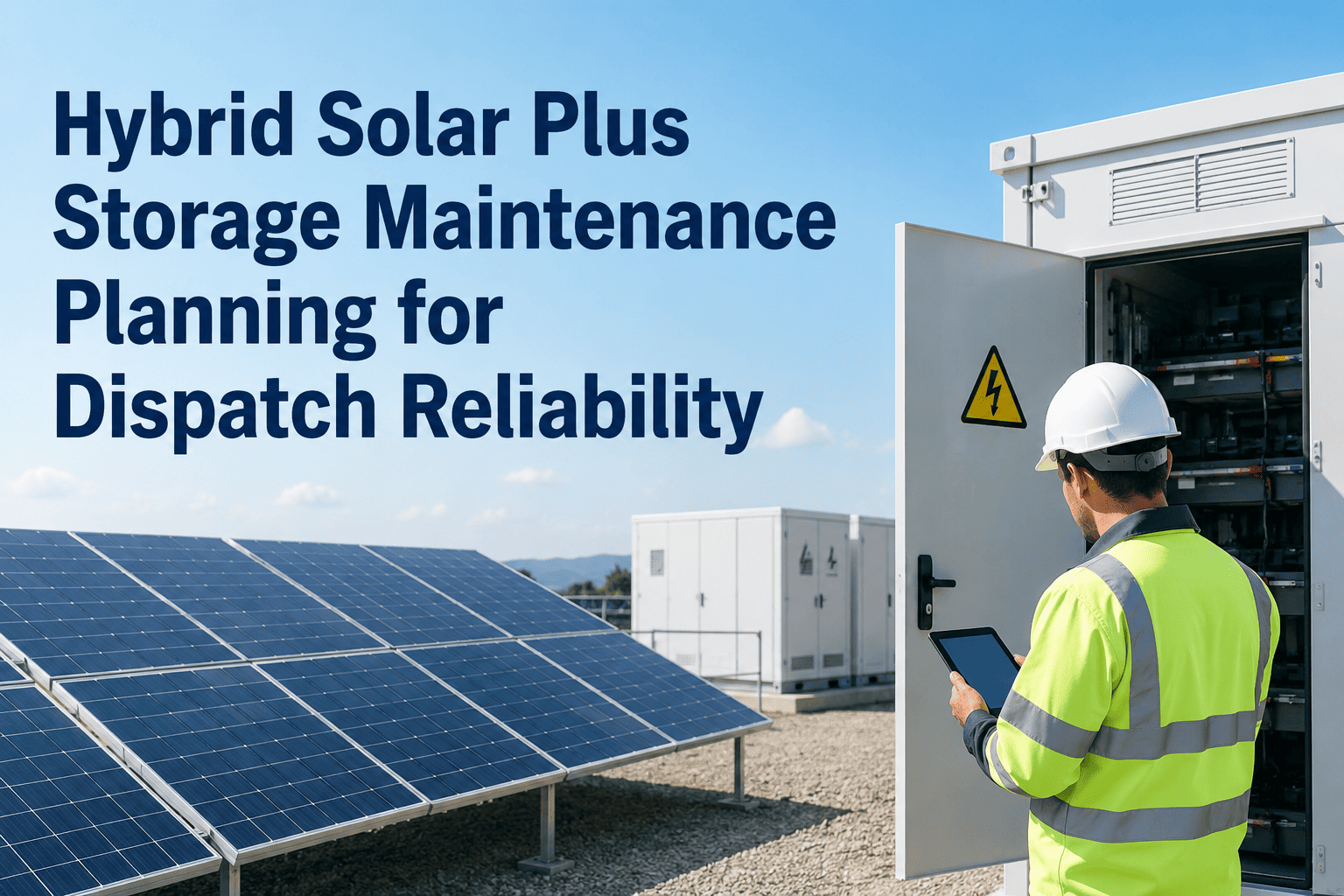
As of 2024, hybrid solar-plus-storage projects represent nearly half of all new renewable capacity entering grid interconnection queues in the United States — 49 GW of generation paired with 24.2 GWh of storage deployed across a single point of interconnection. These assets are more valuable precisely because they are dispatchable: unlike standalone solar, a hybrid plant can shift generation, absorb curtailment, and respond to market signals in near-real time. But that dispatch flexibility depends entirely on both the solar array and the BESS being available simultaneously, and that co-availability is not guaranteed without coordinated preventive maintenance across both asset types. A tracker motor failure that reduces solar output on a high-dispatch day is not just a generation loss — it is a dispatch shortfall that can carry contract and market penalties. OxMaint is the maintenance platform that gives hybrid plant operators a unified PM schedule, cross-asset work order system, and availability dashboard to manage both assets as the single dispatchable unit they are contracted to be.
Hybrid Solar + Storage Operations
One Maintenance System for Two Interdependent Assets
Hybrid plant dispatch reliability requires solar and BESS availability in sync. OxMaint gives O&M teams a single platform to schedule preventive maintenance, assign work orders, track availability losses, and prove compliance — across every inverter, tracker, battery string, and HVAC unit on site.
Why Hybrid Assets Demand More From Maintenance Teams
A standalone solar farm or standalone BESS has one maintenance domain. A hybrid plant has two — with dispatch obligations that make both domains simultaneously critical. This is what makes hybrid maintenance harder than either asset alone.
2×
Asset types to maintain under a single dispatch obligation — solar array degradation and BESS capacity loss compound each other's impact on contracted availability
46%
Of new US renewable projects in interconnection queues are hybrid — the operations workforce is learning hybrid maintenance without mature tooling or established standards
$70K
Additional annual revenue recovered per 1% availability improvement at a 10 MW solar site — CMMS-driven PM scheduling compounds this across a 25-year asset life
5–6%
Renewable curtailment rate across high-penetration markets by 2026 — hybrid plants absorb curtailment revenue losses that preventive BESS maintenance can reduce
Asset-by-Asset Maintenance Requirements for Hybrid Plants
Every component in a hybrid plant has a distinct failure mode, PM interval, and dispatch impact. OxMaint tracks all of them under one system with asset-specific work order templates and scheduling logic.
Solar Array
String Inverters
Quarterly: IV curve test, output verification, cooling check, firmware review
Failure: Loss of up to 100 kW per inverter — undetected degradation compresses RoI
Single-Axis Trackers
Monthly: Motor lubrication, angle calibration, torque arm inspection, limit switch test
Failure: 25–35% generation loss per stuck row during peak irradiance hours
PV Panels
Semi-annual: Thermographic scan, IV curve, soiling measurement, micro-crack visual
Failure: Hotspots accelerate degradation across adjacent modules if undetected
Combiner Boxes
Quarterly: Fuse continuity, IR scan of terminals, water ingress check, string current balance
Failure: Multiple string loss — often attributed to inverter fault until combiner traced
Battery Storage (BESS)
Battery Modules
Quarterly: Capacity test per string, SOH curve update, cell balance verification
Failure: SOH decline below dispatch threshold — contracted capacity unavailable
Thermal Management
Monthly: Coolant flow rate, delta-T per zone, HVAC filter differential, refrigerant check
Failure: Cell temperature exceedance voids OEM warranty and accelerates degradation
PCS / Inverters
Semi-annual: Output efficiency test, RTE verification, firmware update, cooling unit service
Failure: Loss of charge/discharge capability — dispatch obligation cannot be met
BMS and Controls
Monthly: Alarm log review, fault code clearance, software calibration verification
Failure: False alarms or missed faults — emergency shutdown or undetected capacity loss
Built for Hybrid Plant O&M Teams
OxMaint unifies solar and BESS maintenance into one platform — one PM schedule, one work order system, one availability dashboard across both asset types.
No dual-tool overhead. No gaps between solar tracker logs and BESS inspection records. Just a complete maintenance operation sized for how hybrid plants actually work.
How Maintenance Gaps Translate to Dispatch Failures
Hybrid plant operators often underestimate how maintenance decisions made weeks earlier determine dispatch outcomes on high-value days. These are the three most common pathways from missed PM to lost dispatch revenue.
Scenario 1
Inverter Degradation Unseen
A string inverter running at 82% output efficiency — detectable with a quarterly IV curve test — goes unchecked for 14 months. On a peak-generation day, actual plant output misses contracted capacity by 9%. The shortfall triggers a performance penalty and a reactive investigation that costs more than three years of scheduled PM would have.
Solar Asset
Scenario 2
BESS Dispatch Window Missed
HVAC maintenance is deferred during a busy month. Cell temperatures in two BESS containers exceed the BMS threshold during a heat event. The BMS limits discharge to 60% capacity during a 4-hour evening dispatch window — the window with the highest energy price of the quarter. Revenue loss exceeds three months of HVAC service costs.
BESS Asset
Scenario 3
Curtailment Absorption Lost
Grid curtailment order arrives mid-afternoon. The hybrid plant's BESS is partially unavailable — a capacity test flagged two strings at reduced SOH, but the corrective work order was not yet closed. The plant absorbs 40% less curtailed solar than contracted, triggering offtake penalties. The BESS issue was known for 11 days before the event.
Both Assets
Frequently Asked Questions
Can OxMaint manage both solar and BESS assets under a single maintenance platform?
Yes. OxMaint supports asset registers that include solar panels, trackers, inverters, combiner boxes, BESS modules, PCS units, thermal management systems, and substation equipment — all with asset-specific PM templates, work order workflows, and availability tracking. Start your free account at
app.oxmaint.ai and load your hybrid site asset register in under an hour.
How does OxMaint help hybrid plant operators meet dispatch availability commitments?
OxMaint tracks PM completion rates and overdue tasks per asset in real time — giving O&M managers visibility into availability risk before a dispatch window opens, not after a shortfall occurs. Compliance dashboards show which assets have open corrective work orders so dispatch-critical maintenance can be prioritized before high-value operating periods.
Does OxMaint support condition-triggered maintenance for weather-related events at solar farms?
Yes. OxMaint supports condition-triggered work orders — a hailstorm, soiling event, or thermal anomaly detected in monitoring data can generate an immediate inspection WO linked to the affected asset. The resulting inspection record and photo evidence are stored against the asset history for insurance, warranty, and PPA compliance purposes.
Book a demo to see condition-triggered workflows configured for hybrid site scenarios.
Can OxMaint track solar generation availability alongside BESS capacity in a single dashboard?
OxMaint's reporting module tracks PM compliance rate, overdue tasks, MTBF trending, and work order closure rates per asset type and per site. For hybrid plants, maintenance managers can filter by asset category — solar or BESS — and view availability risk exposure across both in a single consolidated view without switching between systems.
How long does it take a hybrid plant O&M team to set up OxMaint?
Most hybrid site teams complete asset import, PM schedule setup for both solar and BESS assets, and technician onboarding within two to three working days using OxMaint's bulk upload template and pre-built PM task libraries. No IT project, no implementation engineers, and no long-term contract commitment required.
Protect Your Dispatch Reliability
Join hybrid plant operators using OxMaint to keep solar and BESS available together — so every dispatch window is met with the capacity it requires.
Start free with no credit card or IT project required. Or book a 30-minute demo and see exactly how OxMaint handles your hybrid site asset structure, PM scheduling, and dispatch availability reporting.