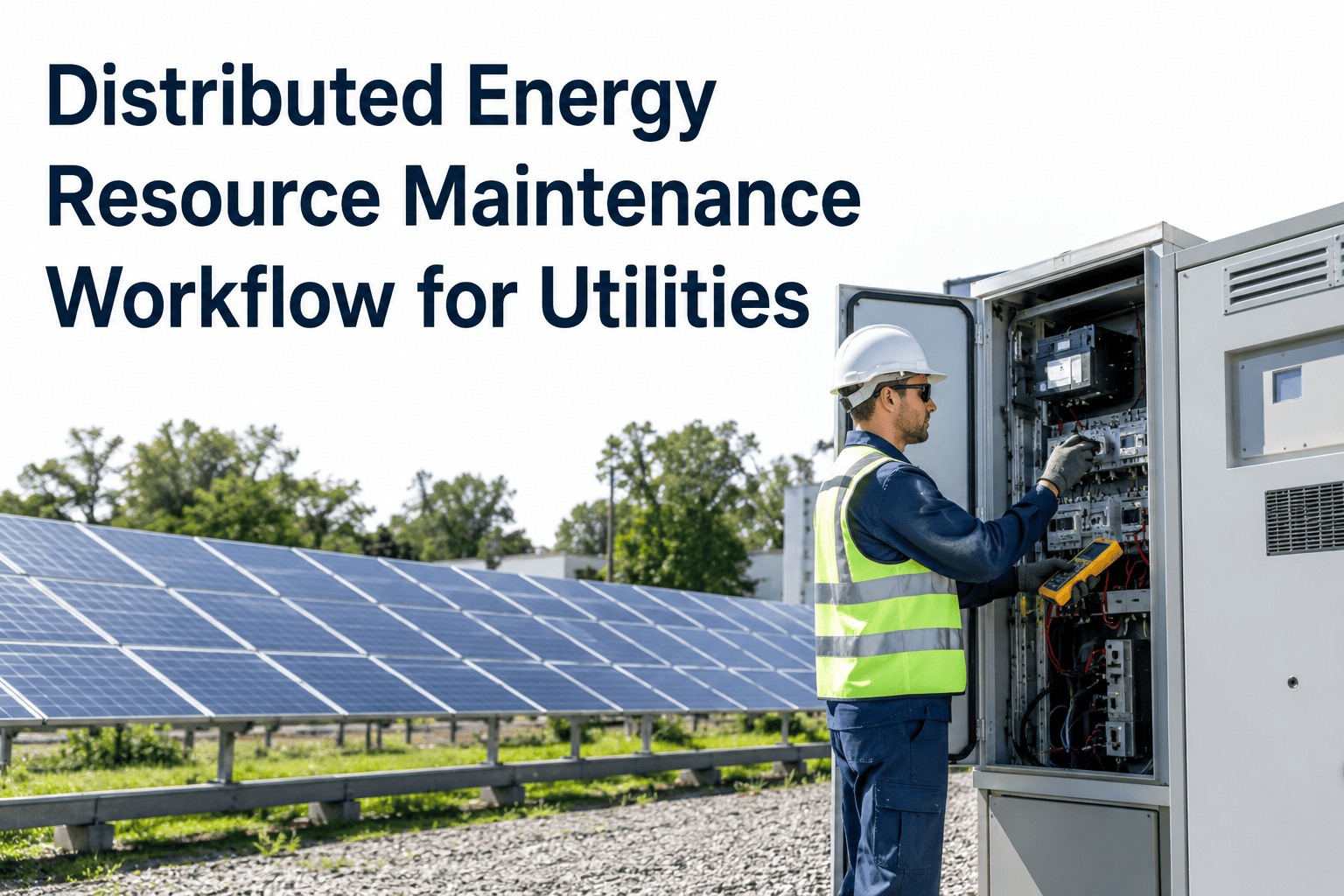
Utility operators managing distributed energy resources face a coordination problem that conventional CMMS platforms were never designed to solve. A single utility territory may contain thousands of DER assets — rooftop solar arrays, battery energy storage systems, small wind installations, and demand response nodes — spread across hundreds of square kilometres, owned by a mix of commercial, industrial, and residential customers, all contributing to grid stability in ways that are invisible unless the maintenance data behind each asset is aggregated and acted upon in real time. When a battery storage system underperforms during a demand peak, or a solar inverter silently degrades to 70% output over three months, the grid reliability impact is invisible until it compounds into a measurable reliability event. Utilities using Oxmaint to manage DER asset maintenance workflows report a 38% reduction in unplanned DER asset downtime within the first six months of deployment. Sign up for Oxmaint to begin building a structured DER maintenance workflow for your utility, or book a demo to see how distributed asset management works at scale.
Why DER Maintenance Breaks Every Conventional Maintenance Workflow
Traditional utility CMMS platforms were built around centralised generation assets — large, static, few in number, and easy to assign ownership to. Distributed energy resources invert every one of those assumptions.
DER assets in a utility's territory may span hundreds of kilometres across urban, suburban, and rural zones. A maintenance dispatch model built for central plant cannot route field crews efficiently across a DER portfolio without asset location intelligence and travel-time-aware scheduling.
Behind-the-meter DERs are owned by commercial or residential customers who contracted with the utility for grid services. Maintenance responsibility boundaries — who performs the work, who pays, who schedules access — require a workflow layer that paper-based or legacy CMMS systems cannot support.
A single utility DER portfolio may contain 12 different BESS manufacturers, 7 solar inverter types, 4 demand response hardware platforms, and 2 small wind turbine models — each with different maintenance intervals, firmware requirements, and failure signatures. A single PM template cannot serve this range.
A failed BESS unit at a grid-critical peak-shaving location has a fundamentally different priority than a failed residential solar inverter that represents 5 kW of generation. DER maintenance workflows must prioritise work orders by grid impact, not just by asset criticality alone — a distinction that generic CMMS platforms cannot make.
One Platform for Every DER Asset, Every Work Order, Every Field Crew — Regardless of Portfolio Scale
Oxmaint's asset management module handles DER portfolios from 50 assets to 50,000 — with geo-mapped asset registers, asset-type-specific PM templates, mobile work order execution, and grid-impact-aware priority scoring built in from day one.
Maintenance Workflow Configuration by DER Asset Type
Oxmaint supports asset-type-specific PM schedules, inspection checklists, failure mode libraries, and work order templates for every DER asset class in a utility portfolio.
| DER Asset Type | Primary Failure Modes | Maintenance Frequency | Oxmaint Workflow Features | Grid Impact Risk |
|---|---|---|---|---|
| Battery Energy Storage (BESS) | Cell degradation, BMS firmware, thermal runaway risk, connection corrosion | Monthly inspection; quarterly capacity test; annual thermal scan | SoH trending, firmware update tracking, temperature alert integration | Critical |
| Utility-Scale Solar Arrays | Inverter fault, soiling accumulation, string underperformance, tracker failure | Semi-annual cleaning; quarterly inverter check; annual thermographic inspection | PR ratio trending, soiling schedule automation, string-level fault logging | High |
| Small Wind Turbines | Blade erosion, gearbox wear, yaw system misalignment, pitch control failure | Bi-annual mechanical inspection; annual blade inspection; quarterly oil sample | Vibration data integration, oil sample record management, blade condition photo log | High |
| Demand Response Hardware | Communication node failure, controller firmware lag, sensor drift | Annual device inspection; firmware audit per manufacturer cycle | Connectivity status monitoring, firmware version register, remote test scheduling | Medium |
| Behind-the-Meter Solar (C&I) | Inverter degradation, disconnect fault, monitoring comms failure | Annual inspection; semi-annual inverter check for high-value sites | Customer site access scheduling, owner notification workflow, compliance record | Medium |
| Grid-Edge EV Chargers | Connector wear, OCPP communication fault, power module degradation | Monthly connectivity check; quarterly physical inspection; annual PM | OCPP fault log integration, connector wear tracking, NEVI compliance record | Medium |
The Oxmaint DER Maintenance Workflow — From Asset Registration to Closed Work Order
Every DER asset is registered with GPS coordinates, asset type, owner/customer record, make/model, installation date, and assigned maintenance zone. Bulk import from existing spreadsheets takes under 30 minutes for portfolios of any size.
Each asset type is assigned a maintenance template with manufacturer-aligned PM intervals, asset-specific inspection checklists, and spare parts lists. Templates apply automatically to all assets of that type — no manual configuration per asset.
The Oxmaint scheduler groups due work orders by geographic cluster and assigns them to the nearest available field technician — reducing drive time by up to 40% on multi-site DER inspection routes compared to manual dispatch.
Field technicians receive work orders on the Oxmaint mobile app, scan the asset QR code to confirm location, complete the checklist, upload photos, log parts used, and close the work order — all without returning to a desk or calling dispatch.
Completed inspections feed a per-asset reliability dashboard tracking mean time between failures, PM compliance rate, recurring fault patterns, and component replacement frequency — enabling reliability engineers to identify systemic issues across asset classes before they drive grid reliability events.
DER Maintenance Workflow — Common Questions from Utility Operations Teams
Oxmaint supports a flexible ownership model within the asset register — each asset can be assigned a primary owner, a maintenance responsible party, and a billing account independently. For behind-the-meter DER assets where the customer owns the hardware but the utility has a contracted maintenance obligation, the work order is generated against the utility's maintenance schedule, routed to the utility field crew, and closed with customer site access confirmation logged as part of the work record. This gives utility reliability managers full visibility over the condition of every contracted DER asset regardless of who legally owns it. Customer notification workflows can be configured to automatically send access request messages to the customer contact on file when a work order is approaching its scheduled date. Sign up to configure your DER asset ownership structure in the Oxmaint asset register.
Yes — Oxmaint provides a REST API and pre-built webhook integrations that allow DERMS platforms and SCADA systems to push fault alerts and alarm events directly into Oxmaint as corrective work orders. When a DERMS platform detects a BESS cell underperformance event or an inverter communication dropout, the fault data is transmitted to Oxmaint and a work order is auto-generated against the specific asset with the alarm details pre-populated, the asset location and maintenance history attached, and the work order assigned to the appropriate field crew based on zone and availability. This eliminates the manual step of a reliability engineer receiving an alarm notification, creating a work order, and dispatching a crew — cutting response time from hours to minutes. Book a demo to see a live DERMS-to-Oxmaint fault-to-work-order integration.
Oxmaint automatically generates maintenance compliance reports from closed work order data — showing PM completion rates by asset type, asset zone, and calendar period. These reports are formatted to support utility regulatory filing requirements and NERC reliability standard documentation, with audit trails showing who completed each inspection, when, what was found, and what corrective action was taken. For utilities participating in state DER incentive programs that require documented maintenance records as a condition of incentive payment, Oxmaint's exportable compliance reports provide the complete maintenance history in a format recognised by state regulatory bodies. Reports can be filtered by DER asset class, geographic zone, or contract customer to support programme-specific reporting requirements.
For a utility DER portfolio of 1,000 to 5,000 assets, Oxmaint deployment typically completes within 5 to 10 working days — from initial data upload to the first PM work orders being dispatched to field crews. The asset register build uses a structured bulk import template that accepts data from existing spreadsheets, GIS systems, or DERMS asset databases. PM templates for standard DER asset types — BESS, utility solar, small wind, demand response hardware — are pre-configured in the Oxmaint library and require only minor customisation for site-specific intervals. Field crew mobile onboarding takes under 2 hours per technician. No IT infrastructure, server provisioning, or lengthy implementation project is required. Sign up to start your DER asset register build today.
Each asset in the Oxmaint DER register can be assigned a grid impact weighting that reflects its role in the utility's grid stability model — peak-shaving BESS at a grid-critical substation feeder carries a higher impact weight than a residential solar inverter of equivalent nameplate capacity. When work orders are generated, the priority score multiplies asset criticality by grid impact weighting to produce a final dispatch priority. This means that a moderate fault on a high-grid-impact BESS unit is dispatched before a more severe fault on a low-impact residential solar asset — which is the correct operational decision from a grid reliability perspective. The grid impact weightings are configured by the utility's reliability engineers during initial setup and can be revised as the grid model evolves.
Your DER Portfolio Is Growing Faster Than Your Maintenance Workflow Can Handle. Oxmaint Changes That Equation.
Oxmaint gives utility operations teams a single platform to register, schedule, dispatch, and track maintenance across every distributed energy resource in their territory — from utility-scale BESS to behind-the-meter solar — with geo-optimised dispatch, mobile field execution, and regulatory compliance reporting built in.