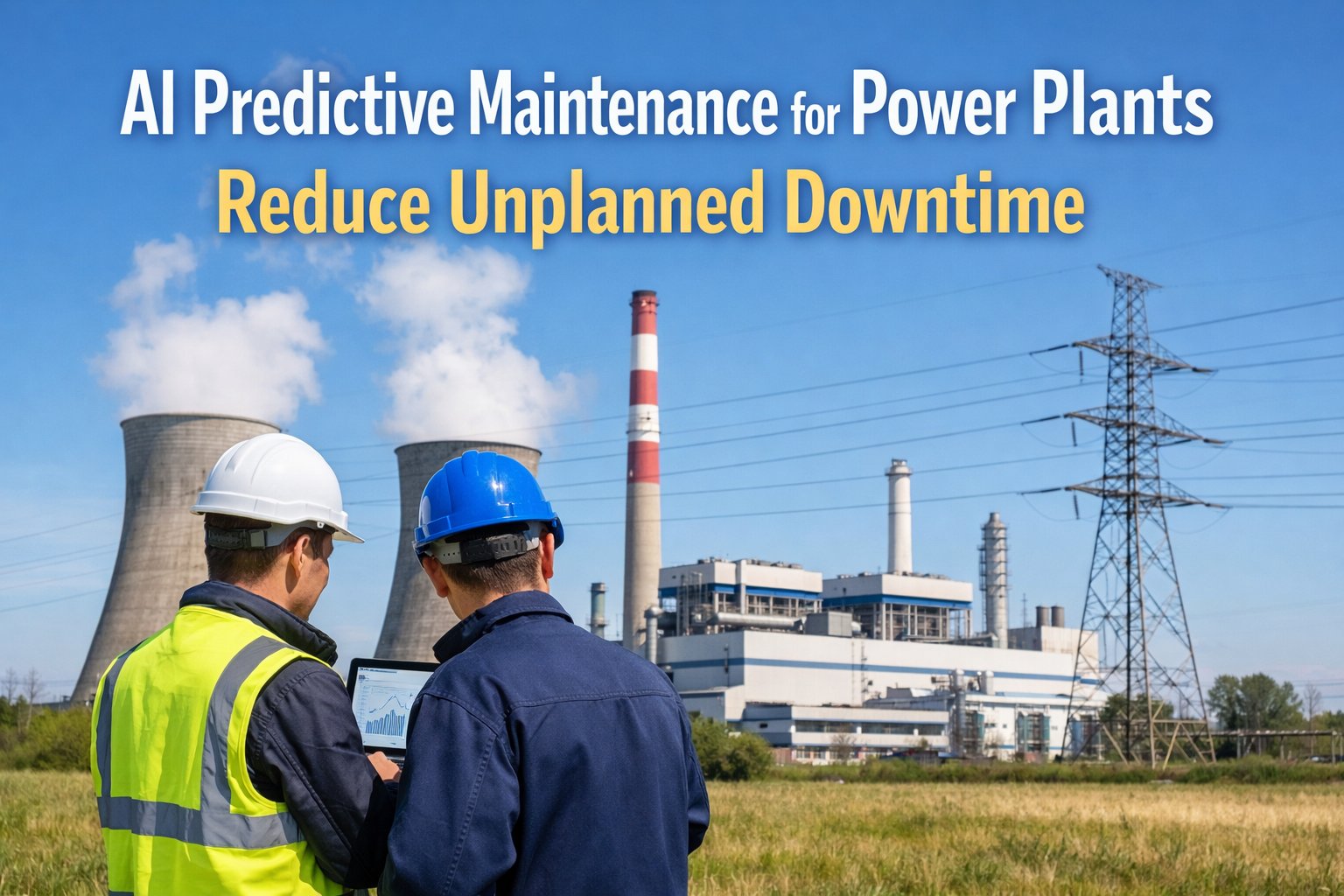
Power plants cannot afford to wait for cloud round-trips when a turbine bearing is failing. Edge AI brings the model to the machine — processing vibration, thermal, current, and pressure signals directly on industrial hardware within milliseconds of capture, detecting failure signatures weeks before they escalate into forced outages. Plants running edge AI predictive maintenance report 70–82% reductions in unplanned downtime, 40–60% drops in false alarm rates versus threshold-based SCADA alerts, and maintenance cost reductions of 22–31% by replacing calendar-based overhauls with condition-triggered interventions. Sign up free on OxMaint to connect your power plant's edge AI data streams to automated work order generation, asset condition tracking, and maintenance scheduling — all in one platform built for industrial operations.
Power Plant Operations · Edge AI · Real-Time Failure Detection
Edge AI for Predictive Maintenance in Power Plants
Process sensor data at the machine. Detect failures before they happen. Eliminate cloud latency from your most time-critical maintenance decisions.
$490K
Average cost per hour of unplanned downtime at a thermal power plant
82%
Of unplanned power plant outages are preventable with real-time predictive monitoring
40ms
Edge AI detection latency vs 2–5 seconds for cloud-routed sensor analysis
3–6 wks
Typical advance warning window before critical failure when edge AI anomaly detection is active
Architecture Comparison
Why Edge AI — Not Cloud — for Power Plant Failure Detection
Cloud-based monitoring introduces latency, connectivity dependency, and bandwidth costs that make it structurally unsuitable for real-time failure detection on rotating machinery. Edge AI eliminates every one of these constraints by processing data where it is generated.
☁
Cloud-Based Monitoring
- 2–5 second detection latency — too slow for high-speed rotating equipment failure propagation
- Connectivity-dependent — remote plants lose monitoring during outages
- Bandwidth costs escalate with high-frequency vibration and acoustic data streams
- Raw OT sensor data leaving the plant perimeter creates cybersecurity exposure
- Cloud model updates require downtime windows and IT coordination
VS
⚡
Edge AI — On-Plant Processing
- Sub-50ms detection latency — catches bearing spall and winding fault signatures in real time
- Operates fully offline — air-gapped plants and remote hydro sites fully supported
- Only anomaly flags and condition scores transmitted — 95% bandwidth reduction
- Raw sensor data never leaves OT network — full NERC CIP compliance maintained
- Model updates deployed locally via CMMS integration — no IT dependency
How It Works
The Edge AI Detection Pipeline — From Signal to Work Order
Edge AI does not replace your SCADA or DCS — it sits between your sensors and your CMMS, extracting failure intelligence from raw signals that rule-based threshold systems cannot decode.
01
Multi-Signal Acquisition
Vibration (10–25 kHz), temperature, current, pressure, and acoustic emission sensors feed raw time-series data into the edge hardware at full sampling rate — no downsampling before AI processing.
→
02
On-Device AI Inference
LSTM and autoencoder models run locally on industrial edge hardware (NVIDIA Jetson, Siemens IPC, or embedded Linux platforms), computing anomaly scores and failure mode probabilities without network dependency.
→
03
Failure Mode Classification
The model classifies anomalies by failure type — bearing outer race fault, rotor imbalance, winding insulation degradation, cavitation, or thermal runaway — not just generic "deviation from normal."
→
04
OxMaint Work Order Generation
Confirmed anomalies push condition data to OxMaint, which auto-generates a work order against the affected asset with failure type, severity, recommended action, and estimated intervention window already populated.
Asset Coverage
Critical Power Plant Assets Monitored by Edge AI
Each asset class in a power plant produces a distinct failure signature profile. Edge AI models are trained per asset type — not generic anomaly detectors applied uniformly across all equipment.
Gas & Steam Turbines
Blade vibration FFT
Rotor bow
Bearing temp gradient
Avg failure lead time with edge AI: 21 days
Generators & Transformers
Winding insulation PD
Stator current signature
DGA trending
Avg failure lead time with edge AI: 28 days
Boiler Feedwater Pumps
Cavitation acoustics
Impeller wear index
Seal leakage vibration
Avg failure lead time with edge AI: 14 days
Cooling Towers & Condensers
Fan blade imbalance
Fouling resistance index
Approach temperature delta
Avg failure lead time with edge AI: 18 days
Compressors & Air Blowers
Surge detection
Discharge pressure variance
Bearing race fault
Avg failure lead time with edge AI: 16 days
Switchgear & Circuit Breakers
Contact resistance trend
Mechanism timing drift
Partial discharge count
Avg failure lead time with edge AI: 35 days
Connect Edge AI Alerts to Automated Work Orders
OxMaint bridges your edge AI anomaly outputs and your maintenance team — turning failure probability scores into structured, prioritized work orders with asset history, recommended spares, and scheduled window in seconds.
Failure Signatures
What Edge AI Actually Detects — Signal by Signal
Threshold-based SCADA alerts fire when damage has already occurred. Edge AI detects the physics-based precursors to failure — the subtle signal changes that appear 2–6 weeks before any threshold is breached.
Bearing Outer Race
92% detection rate
Rotor Imbalance
97% detection rate
Gear Mesh Fault
88% detection rate
Edge AI analyzes FFT spectra at full 25 kHz resolution — impossible to transmit to cloud at scale
Winding Hotspot
89% detection rate
Bearing Thermal Runaway
94% detection rate
Cooling Fouling Index
85% detection rate
Gradient analysis catches thermal runaway 4–8 hours before SCADA temperature threshold breach
Stator Winding Fault
91% detection rate
Rotor Bar Crack
86% detection rate
Partial Discharge Event
93% detection rate
Motor current signature analysis requires no additional sensors — uses existing CT installations
Deployment Architecture
How Edge AI Integrates With Your Existing Plant Systems
Edge AI deployment does not require ripping out your DCS or SCADA. It layers between your sensor network and your CMMS — adding intelligence without disrupting operational systems.
Layer 1 — Sensor Network
Vibration Sensors
RTD / Thermocouple
Current Transformers
Pressure Transmitters
Acoustic Emission
↓ Raw signals at full sampling rate (no aggregation)
Layer 2 — Edge AI Hardware (On Plant Floor)
Industrial Edge Server
LSTM Anomaly Models
Failure Mode Classifier
Severity Scoring Engine
← Real-time alerts to SCADA/DCS
Condition data to OxMaint CMMS →
Layer 3A — Control Room
SCADA Dashboard
DCS Integration
Operator Alerts
Layer 3B — OxMaint CMMS
Auto Work Orders
Asset Condition History
PM Scheduling
Maintenance Schedule
Edge AI–Triggered Maintenance Intervals by Asset Class
These are condition-based intervals — edge AI anomaly scores replace fixed calendar triggers. Load these into OxMaint to automate work order generation from your edge AI data feed.
| Asset |
Primary Signal |
Anomaly Trigger |
Recommended Action |
Priority |
| Gas Turbine Bearing |
Vibration RMS + FFT |
Anomaly score > 0.72 for 15 min |
Lubrication inspection, bearing clearance check |
Critical |
| Generator Stator Winding |
Partial discharge count |
PD rate > 3× baseline for 1 hr |
Winding insulation resistance test, thermal scan |
Critical |
| Boiler Feed Pump |
Acoustic emission + flow delta |
Cavitation index > 0.65 |
Suction strainer inspection, NPSH verification |
High |
| Main Transformer |
DGA + winding temperature |
Ethylene trend > 15% per week |
Full oil sampling, dissolved gas analysis lab test |
Critical |
| Cooling Tower Fan |
Blade vibration imbalance |
1× running speed amplitude > 2× baseline |
Fan blade inspection, balance verification, hub check |
High |
| Air Compressor |
Discharge pressure variance |
Pressure oscillation CV > 8% |
Valve plate inspection, intercooler fouling check |
High |
| HV Circuit Breaker |
Contact resistance + timing |
Operate time drift > 12ms from baseline |
Mechanism lubrication, contact surface inspection |
Critical |
Common Questions
Frequently Asked Questions: Edge AI for Power Plant Maintenance
How does edge AI differ from existing SCADA alarm systems?
SCADA alarms fire when a measured value crosses a fixed threshold — meaning damage has already progressed to a measurable level. Edge AI detects the statistical patterns that precede threshold breaches by 2–6 weeks: changes in vibration frequency content, gradual current signature shifts, and correlated multi-sensor deviations that no single threshold can identify. Edge AI reduces false alarm rates by 60–70% compared to threshold-based systems by requiring pattern confirmation across multiple signals before generating an alert.
What hardware is required to deploy edge AI at a power plant?
Industrial edge servers — including platforms from NVIDIA (Jetson AGX), Siemens (IPC 427), Dell EMC (PowerEdge XR), and Advantech — provide the compute needed to run LSTM and autoencoder inference on high-frequency sensor streams. Most deployments require one edge node per 20–40 monitored assets. Existing sensors can typically be used — only a data acquisition gateway (Modbus, OPC-UA, or 4–20mA) is needed to connect legacy instruments to the edge AI platform.
How long does edge AI model training take for a new power plant deployment?
Initial model training requires 4–8 weeks of baseline operational data to establish normal operating signatures across load profiles, ambient conditions, and startup/shutdown cycles. Pre-trained foundation models for common asset types (turbines, generators, pumps) can reduce this to 2–3 weeks by transfer learning from existing datasets. Most edge AI deployments are generating useful anomaly scores within 30–45 days of sensor connection.
Can edge AI work alongside an existing CMMS like OxMaint?
This is exactly how OxMaint is designed to operate. Edge AI systems push anomaly events, failure mode classifications, and severity scores via API or webhook to OxMaint, which maps each alert to the correct asset record and auto-generates a work order with the failure type, urgency tier, and recommended action pre-populated. Maintenance teams receive a structured, actionable work order — not a raw sensor alert — enabling faster response without requiring them to interpret signal data directly.
See how this integration works in a live demo.
Start Preventing Failures Before They Happen
Every Asset. Every Signal. Every Work Order — Automated.
OxMaint connects your edge AI anomaly detection to structured maintenance workflows — turning failure probability scores into scheduled, documented, and tracked work orders across every asset in your power plant.