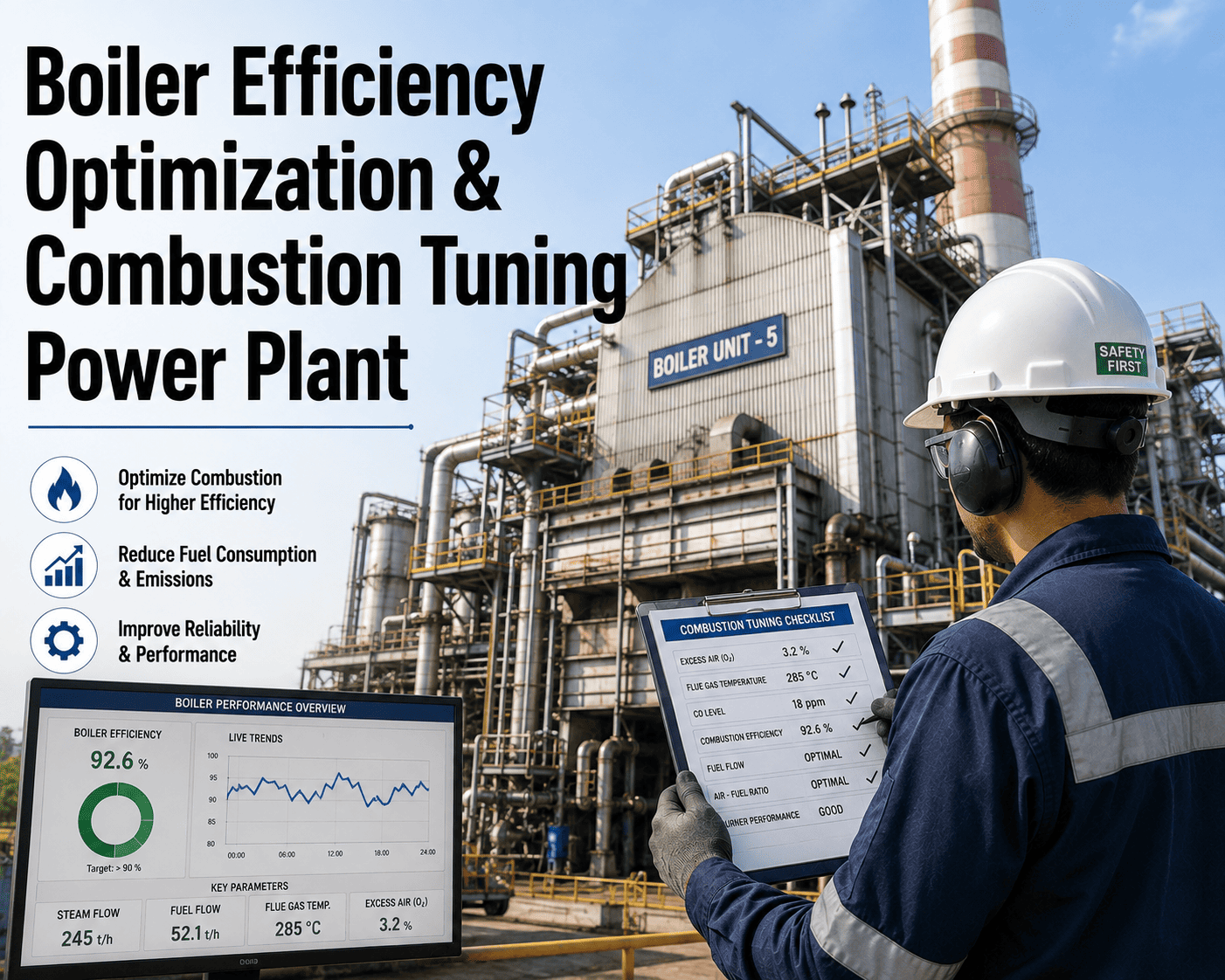
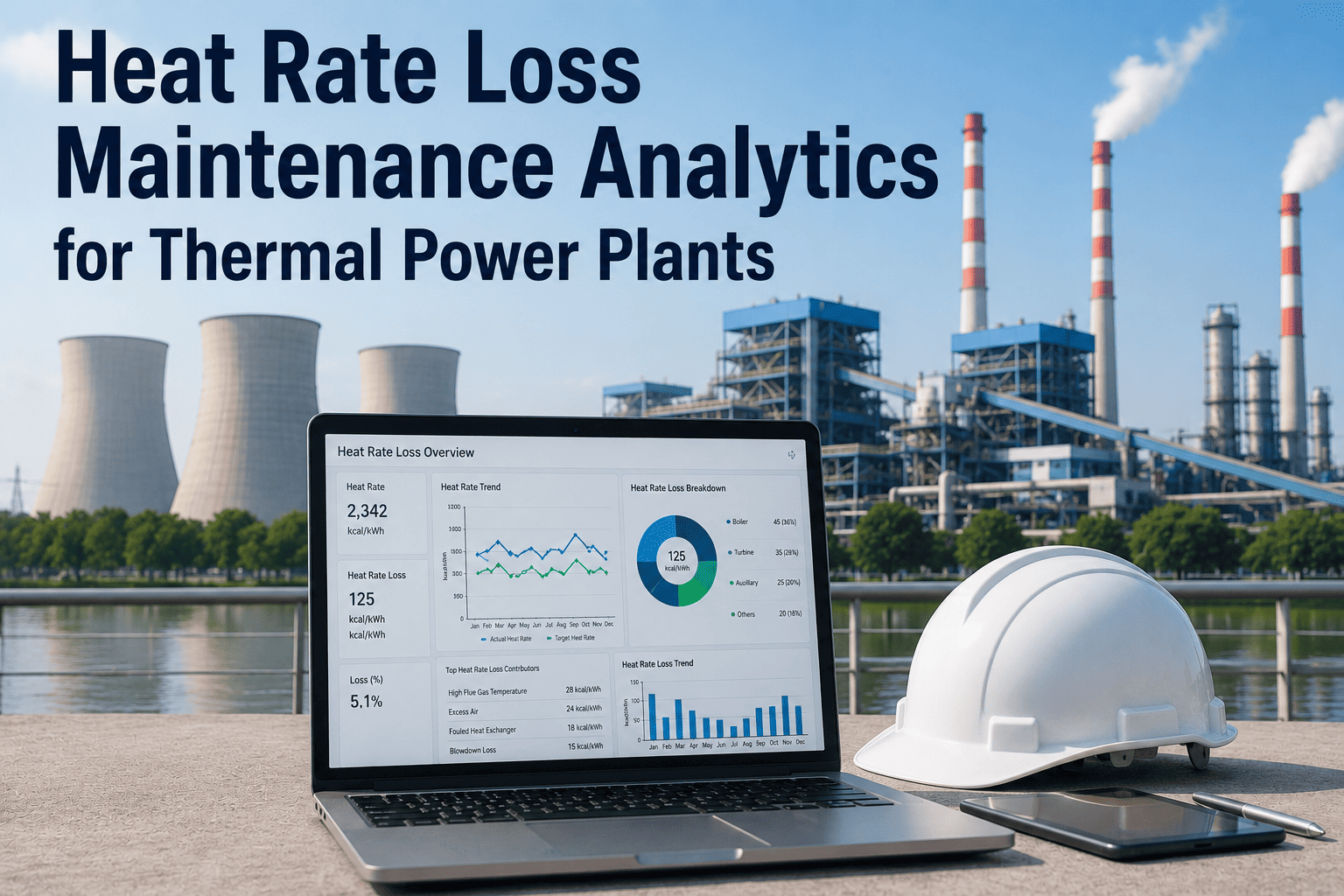
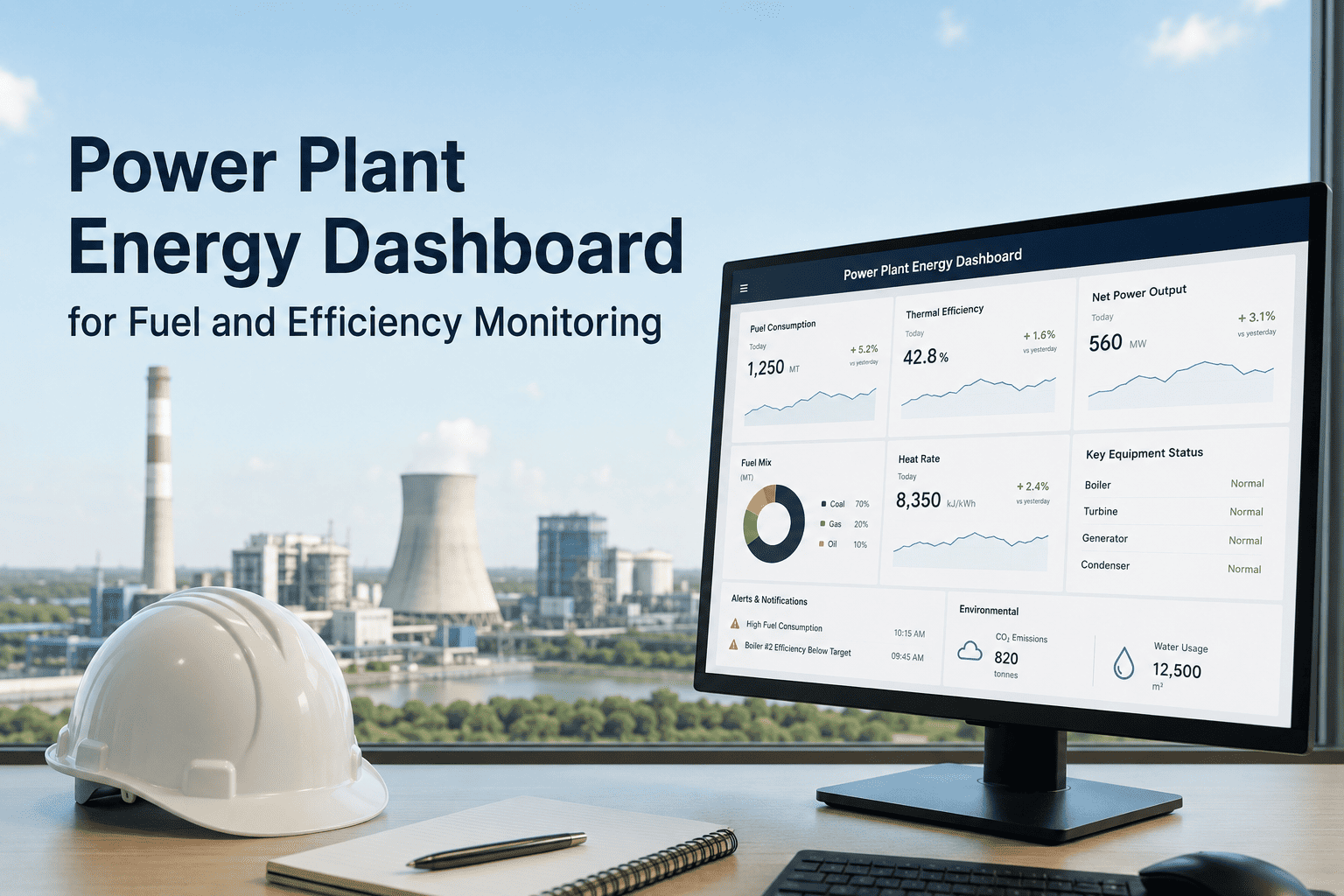
A power plant burning 10,000 BTU/kWh when its design spec calls for 9,200 BTU/kWh is not a capacity problem — it is a maintenance problem worth millions of dollars per year. Heat rate degradation does not announce itself. It accumulates invisibly across fouled air preheater baskets, worn turbine blade profiles, condenser tube scaling, and fuel system inefficiencies — each contributing fractions of a percent that compound into sustained fuel waste. The plants that close the gap between actual and design heat rate are not the ones with the newest equipment. They are the ones running maintenance analytics that connect work order history to efficiency trend data. OxMaint gives operations and maintenance teams the analytics layer that turns every PM completion into a measurable heat rate impact. Start your free trial and begin tracking heat rate degradation from your first asset today.
HEAT RATE ANALYTICS
Every 100 BTU/kWh of Heat Rate Degradation Costs a 500 MW Plant ~$1.2M Per Year in Fuel.
OxMaint analytics connect your maintenance history to heat rate trends — so every PM on a boiler, turbine, condenser, or air preheater is measured by its efficiency impact, not just its completion date.
1–3%
Typical heat rate improvement achievable through targeted maintenance alone
$2.4M
Annual fuel savings from a 1% heat rate improvement at a 500 MW coal plant
40%
Share of heat rate degradation traced to air preheater and condenser maintenance gaps
Where Heat Rate Hides — The Equipment Contributors
Heat rate degradation is not random. It follows predictable patterns tied to specific asset classes, each with a measurable contribution to overall plant efficiency. Understanding which equipment degrades fastest — and which maintenance actions recover the most BTU/kWh — is where analytics-driven maintenance begins.
Heat Rate Degradation by Equipment Category
Air Preheater Fouling
Up to 150 BTU/kWh
Condenser Tube Fouling / Air Ingress
Up to 120 BTU/kWh
Turbine Blade Deposit / Seal Wear
Up to 100 BTU/kWh
Boiler Tube Fouling / Sootblower Gaps
Up to 90 BTU/kWh
Fuel System Valve and Damper Wear
Up to 60 BTU/kWh
Auxiliary Power Excess (Fans, Pumps)
Up to 40 BTU/kWh
Each bar represents the typical degradation contribution when that asset class goes unmaintained past its optimal PM interval. OxMaint tracks actual vs. design parameters for all six categories simultaneously.
The Five Assets Your Heat Rate Analytics Must Cover
Heat rate optimization through maintenance analytics is not about monitoring every sensor in the plant. It is about identifying the six equipment classes where maintenance actions have the largest, most measurable impact on fuel consumption — and making sure every PM on those assets is tracked against efficiency outcomes.
Key Parameter
Excess O₂ / Stack Temperature
Degradation Signal
Rising stack temp, high unburned carbon
Maintenance Action
Sootblowing optimization, tube cleaning, burner tuning
A 10°C rise in stack temperature from fouled heat transfer surfaces represents approximately 0.5% heat rate penalty. Sootblower PM compliance directly controls this number.
Key Parameter
Stage efficiency / Steam flow deviation
Degradation Signal
Output drop at constant steam flow, HP exhaust temp rise
Maintenance Action
Seal inspection, blade deposit removal, gland steam tuning
Turbine efficiency losses of 1–2% develop gradually over 8,000–12,000 operating hours. Tracking stage efficiency against hours since last overhaul gives the predictive trigger that prevents silent degradation.
Key Parameter
Back pressure / Cleanliness factor
Degradation Signal
Rising back pressure, TTD increase, air ejector load
Maintenance Action
Tube cleaning, air leak survey, waterbox inspection
Every 1 inHg of excess back pressure from fouled condenser tubes adds approximately 0.5–0.8% to heat rate. A condenser cleanliness program tied to back pressure trending is one of the highest-ROI maintenance investments in thermal generation.
Key Parameter
X-ratio / Air leakage / DP
Degradation Signal
Rising outlet gas temperature, DP increase, O₂ rise at economizer
Maintenance Action
Water wash, sector plate seal replacement, basket replacement
Air preheater leakage above 10% can add 80–150 BTU/kWh to net heat rate. The air preheater is one of the single highest-impact assets in the plant for maintenance-driven heat rate recovery.
Key Parameter
Coal fineness / Fuel flow balance / Loss on ignition
Degradation Signal
High LOI, uneven burner loading, classifier wear
Maintenance Action
Mill classifier inspection, burner tip cleaning, fuel valve calibration
Coal fineness below 70% through a 200-mesh screen increases loss on ignition and adds 50–90 BTU/kWh to net heat rate. Mill maintenance intervals directly determine combustion efficiency.
Analytics Without Maintenance Data Is Just Charts. OxMaint connects heat rate trends directly to the work orders and PM completions that drive them — so you can see which maintenance actions recovered efficiency, and which gaps caused the degradation.
How OxMaint Analytics Close the Heat Rate Gap
Most plants have DCS data showing heat rate trends. Very few have a system that connects those trends to the specific maintenance events — completed PMs, deferred inspections, partial repairs — that caused the trend to move. OxMaint builds that connection automatically.
Step 1 — Baseline Every Efficiency Asset
Each boiler, turbine, condenser, and air preheater is configured with design efficiency parameters — stack temperature, back pressure, turbine stage efficiency, X-ratio — as the performance baseline. OxMaint tracks actual vs. design continuously from every reading logged by operations.
Step 2 — Link Work Orders to Efficiency Parameters
Every PM and corrective work order is tagged to the efficiency parameter it affects. A condenser tube cleaning is linked to back pressure. An air preheater water wash is linked to stack temperature and X-ratio. When the parameter improves after maintenance, OxMaint calculates the recovery in BTU/kWh.
Step 3 — Trigger Maintenance from Efficiency Drift
When a tracked parameter drifts beyond a configurable threshold — condenser back pressure up 0.5 inHg, stack temperature up 8°C — OxMaint automatically generates a work order with the asset, parameter deviation, and last-maintenance history attached. Maintenance is triggered by performance data, not calendar dates.
Step 4 — Report Heat Rate Impact by Asset and Period
OxMaint's heat rate analytics dashboard shows cumulative efficiency loss by asset class, estimated fuel cost impact, and the maintenance actions that recovered efficiency in prior periods. This is the data that justifies maintenance budgets, supports ESG reporting, and drives outage scope decisions.
Heat Rate Optimization Metrics OxMaint Tracks
Effective heat rate analytics requires a consistent set of KPIs that connect operational performance to maintenance activity. These are the metrics OxMaint tracks against every efficiency asset.
Net Heat Rate
BTU/kWh
Primary plant efficiency indicator. Tracked actual vs. design on a rolling 30-day basis. Deviations above 0.5% trigger an efficiency review work order.
Condenser Back Pressure
inHg absolute
Real-time indicator of condenser cleanliness, air in-leakage, and cooling water temperature. OxMaint flags trend deviation from seasonal baseline.
Turbine Efficiency Index
% of design
Calculated from actual vs. expected output at measured steam conditions. Declining trend triggers seal and stage inspection scheduling.
APH Gas Outlet Temperature
°C corrected
Corrected for load and ambient conditions. Rising trend identifies basket fouling or increased leakage before fuel impact becomes significant.
Auxiliary Power Ratio
% of gross output
Tracks fan, pump, and compressor auxiliary load as share of generation. Unexpected increases point to bearing failures, damper leakage, or valve wear.
Specific Fuel Consumption
kg/MWh
Combined fuel quality and combustion efficiency indicator. OxMaint tracks against rolling 90-day average, flagging deviations above 2% for investigation.
Frequently Asked Questions
How does maintenance analytics actually improve heat rate — not just measure it?
By connecting the efficiency degradation signal to the maintenance action that fixes it. When OxMaint detects back pressure rising, it triggers a condenser tube cleaning work order — not a report. When air preheater DP climbs, it schedules a water wash. The analytics layer drives maintenance actions, not just dashboards.
Start free to connect your first efficiency asset.
Which assets should be prioritized for heat rate maintenance analytics?
Air preheater and condenser together account for 40–50% of recoverable heat rate degradation in most coal and gas plants. These two assets should be the starting point for any analytics-driven heat rate program. Turbine steam path and boiler sootblowing are the next highest-impact areas.
Book a demo to see an asset prioritization walkthrough.
Does OxMaint integrate with existing DCS or PI historian data for heat rate trending?
Yes. OxMaint connects to DCS, SCADA, and OSIsoft PI via standard protocols. Continuous efficiency parameters flow in automatically; maintenance data from work orders provides the action layer that the historian alone cannot supply.
Can heat rate analytics data support ESG and sustainability reporting?
Yes. OxMaint's energy analytics module exports fuel consumption, specific heat rate, and efficiency trend data in formats compatible with GRI, CDP, and internal ESG reporting frameworks. Every efficiency improvement achieved through maintenance is documented with before/after data.
Start free to capture your first efficiency recovery event.
How long before a plant sees measurable heat rate improvement after deploying OxMaint?
Baseline trending begins in the first 30 days. The first maintenance-triggered efficiency recovery — typically a condenser or air preheater PM — is usually measurable within the first quarter. Plants with deferred maintenance backlogs typically see the largest early gains.
Your Heat Rate Gap Is a Maintenance Gap. Close It With Analytics.
OxMaint connects boiler, turbine, condenser, air preheater, and fuel system maintenance directly to heat rate outcomes — so every work order completion is measured by its fuel cost impact, and every deferred PM is quantified as a heat rate penalty before it reaches your CFO's desk.