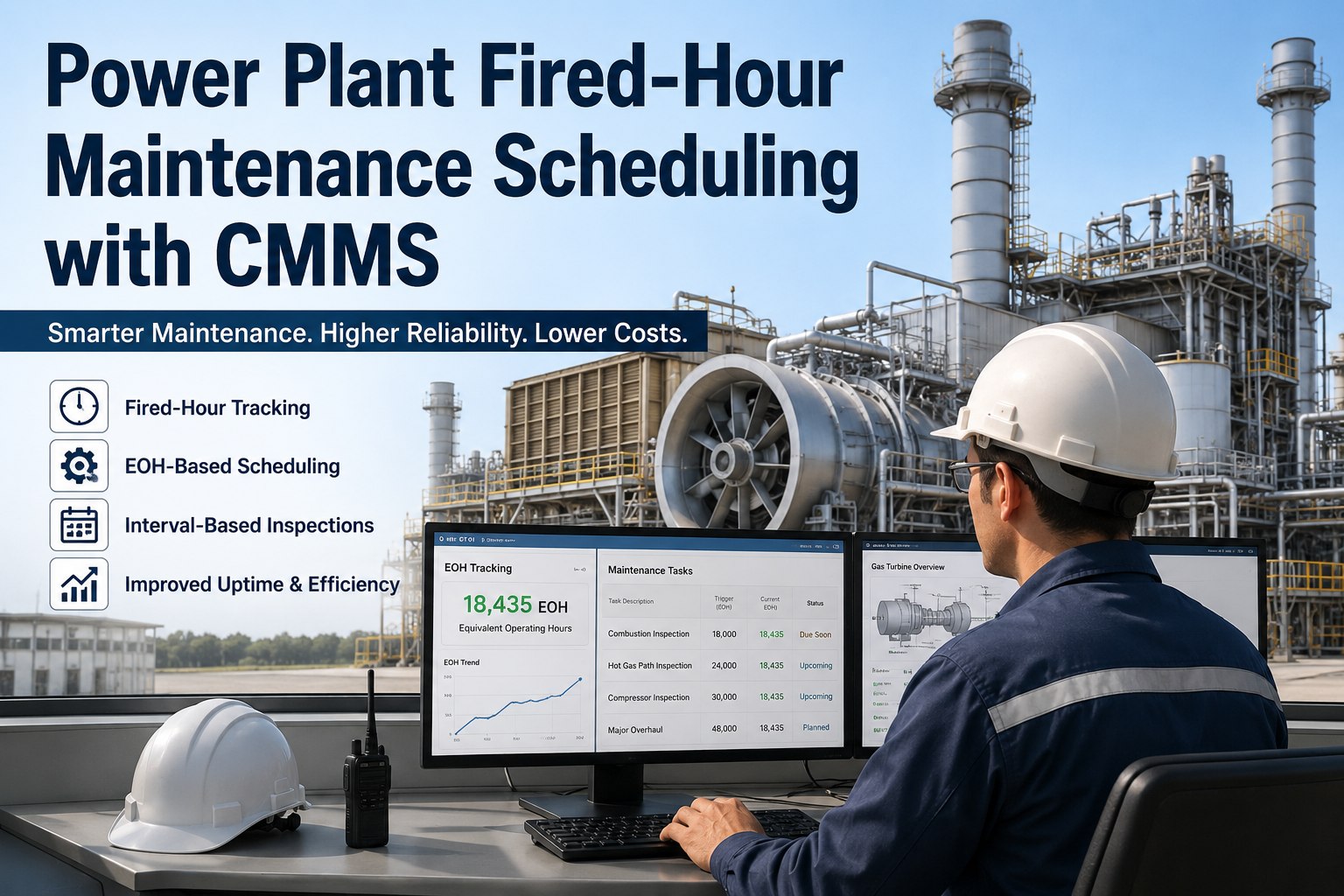
Gas turbines are the most capital-intensive assets in any power plant — a single frame-class unit can represent $50M–$150M in capital investment, and a missed combustion inspection caused by manual hour-tracking can cascade into a hot gas path failure that costs $2M–$8M in unplanned repairs plus $220,000 per hour in lost generation revenue. The stakes of getting turbine maintenance intervals wrong are not theoretical; they are the leading cause of unplanned outages at combined cycle and simple cycle plants worldwide. OxMaint's gas turbine maintenance software tracks fired hours, factored starts, and equivalent operating hours (EOH) in real time — automatically calculating when your CI, HGPI, and major inspection intervals come due based on GER-3620 OEM standards and your actual operating profile, not a calendar estimate someone entered three years ago. Whether you operate a GE 7F, Siemens SGT, or Mitsubishi M501, OxMaint enforces the correct inspection hierarchy so combustion inspections inherit into HGP scope, and HGP scope rolls into major inspection checklists — eliminating the manual coordination that lets critical tasks fall through the cracks during high-pressure outage windows. Start your free trial and configure your first turbine inspection schedule in under 60 minutes.
Gas Turbine Maintenance · Fired Hours · OEM Interval Tracking
Stop Tracking Turbine Hours on Spreadsheets.
Your $100M Asset Deserves Better.
Gas turbines live and die by their fired hours and factored starts — not the calendar. OxMaint's purpose-built tracking engine calculates FFH, FFS, and EOH from your actual operating data, triggering CI, HGPI, and major inspection work orders automatically at the right interval, every time.
$220K
Per hour of unplanned turbine downtime
48,000
Fired hours to Major Inspection — tracked automatically
3×
Higher repair cost when inspections are missed or delayed
Why Fired Hours Matter
Calendar Time Lies to Your Turbine. Operating Hours Tell the Truth.
A gas turbine running base load 7,000 hours a year reaches its hot gas path inspection interval in under four years. The same unit running peaker duty at 2,500 hours a year takes over nine years to reach the same interval — but accumulates far more starts, each one adding thermal fatigue equivalent to dozens of operating hours. Managing both dimensions manually, across multiple units, is where maintenance programs fail.
Fired Hours (FFH)
Real operating time adjusted for load level, firing temperature, and fuel type — the primary driver of hot section wear
Factored Starts (FFS)
Each start adds thermal shock equal to 10–20 equivalent hours — critical for peaker units with high start counts
EOH (Equivalent Operating Hours)
The combined measure of hours plus start-weighted stress — the real number your OEM inspection interval is built around
OEM Inspection Hierarchy
The Four-Stage Gas Turbine Inspection Lifecycle
Based on GE GER-3620 and equivalent OEM standards, every gas turbine follows a structured inspection hierarchy. Each tier builds on the previous scope — and missing the sequence costs exponentially more than maintaining it.
0 – 8,000–12,000 FFH
Combustion Inspection (CI)
Fuel nozzles · Combustion liners · Transition pieces · Crossfire tubes · Flame detectors
Performed twice before each HGPI. Early-stage wear detection before it reaches hot section blades.
24,000 FFH or 800 Factored Starts
Hot Gas Path Inspection (HGPI)
Full CI scope · Turbine blades · Nozzles · Shrouds · Casing cover removal for rotor access
Includes all CI tasks. Turbine casing opened to inspect rotor components under extreme thermal stress.
40,000–48,000 FFH
Major Inspection (MI)
Flange-to-flange teardown · Compressor · Rotor inspection · Bearings 1–4 · Full CI + HGPI scope
Complete disassembly. Rotor replacement, life extension, or refurbishment decisions made here.
Continuous
Borescope & Condition Checks
Quarterly vibration · Compressor wash · Inlet filter checks · Bearing temperature · Lube oil analysis
Non-invasive monitoring between major intervals — the early warning layer that protects your schedule.
The Manual Tracking Problem
Three Ways Spreadsheet-Based Hour Tracking Fails Your Turbine Fleet
01
Hours and Starts Tracked in Silos
88% of multi-unit plants
Fired hours sit in one spreadsheet. Start counts sit in another. Factored starts are calculated manually — if at all. One data entry error shifts an inspection date by months, and nobody catches it until the turbine is already overdue.
02
EOH Calculations Done Wrong
3× repair cost when EOH is underestimated
Equivalent operating hours require weighting for load level, peak firing, fuel type, and water injection. Most maintenance teams default to raw hours — systematically underestimating wear on cycling units and over-servicing baseload units.
03
Inspection Scope Not Inherited
Most common cause of missed critical tasks
When an HGPI is due, the full CI checklist must be included. When an MI is due, HGPI and CI scope both inherit. Manual checklist management routinely drops tasks at scope boundaries — and a missed transition piece inspection becomes a $4M blade replacement.
See It In Action
Ready to Automate Your Turbine Inspection Schedule?
Configure fired hours counters, factored starts, and OEM inspection intervals for your turbine fleet — live in under 60 minutes. No implementation fee, no credit card.
How OxMaint Works
From Raw Operating Hours to Automated Inspection Triggers
01
Configure Your Turbine's Operating Profile
Enter your turbine model, OEM inspection intervals (GER-3620 or equivalent), fuel type, and operating mode (baseload or cycling). OxMaint applies the correct weighting factors for starts, peak firing events, and water injection hours to your EOH formula automatically.
02
Real-Time Fired Hours and Starts Accumulation
OxMaint tracks multiple meter types per asset — fired hours, factored starts, and EOH — each with independent trigger points. As hours accumulate, the system continuously recalculates your position in the CI–HGPI–MI cycle and updates projected inspection dates in real time.
03
Automatic Inspection Scope Inheritance
When an HGPI is triggered, OxMaint automatically includes the full CI checklist in scope. When a Major Inspection fires, both the HGPI and CI tasks inherit. No manual compilation — the system enforces OEM inspection hierarchy every time, for every unit in your fleet.
04
Outage Planning and Parts Pre-Staging
60–90 days before an inspection interval matures, OxMaint generates the outage work package — parts kit from PM templates, MRO inventory check, procurement requests for long-lead components like turbine blades and transition pieces. Zero last-minute scrambles during the outage window.
05
Inspection History and Next Interval Projection
Every inspection is logged with timestamped findings, replaced components, borescope reports, and technician sign-off. OxMaint projects the next inspection window from the actual completion date and actual hours at close — not an estimate entered before the work started.
Platform Capabilities
Everything a Gas Turbine Maintenance Team Needs — Built In
FFH
Factored Fired Hours tracking per unit with configurable OEM weighting
FFS
Factored Fired Starts — each start weighted for thermal cycle severity
EOH
Equivalent Operating Hours combining all stress factors in one metric
CI
Combustion Inspection auto-triggers at configured FFH threshold
HGPI
Hot Gas Path Inspection with inherited CI scope and blade replacement tracking
MI
Major Inspection with full flange-to-flange scope and rotor lifecycle records
Manual vs. OxMaint
What Changes When You Stop Tracking Fired Hours Manually
Hours and starts in separate spreadsheets, reconciled monthly
EOH estimated — starts rarely factored into interval math
CI scope manually re-entered at each HGPI — tasks frequently missed
Inspection date known only to the person who last updated the file
Parts ordered 4–6 weeks before outage — frequently short on long-lead items
Compliance documentation assembled manually post-inspection
Single counter per unit tracking FFH, FFS, and EOH simultaneously
EOH auto-calculated using your configured weighting formula per OEM spec
CI inherits into HGPI, HGPI inherits into MI — automatically, every time
Real-time inspection dashboard visible to entire plant and management team
Parts kits auto-generated 60–90 days before interval — procurement triggered immediately
Digital audit trail on every inspection, finding, and component replacement
We had three GE 7FA units and were tracking fired hours in Excel. We missed an HGPI on Unit 2 by 1,200 hours because someone updated the wrong column. After moving to OxMaint, the system caught Unit 3 approaching its CI interval six weeks before we would have noticed manually. The early intervention saved us an estimated $1.4M in blade damage that had already started forming.
Fleet Maintenance Manager · 900 MW Combined Cycle Plant · 3 GE 7FA Gas Turbines
Measurable Impact
What Power Plants Report After Automating Fired Hours Tracking
50%
Reduction in unplanned downtime
Structured PM programs integrated with CMMS platforms cut unplanned outages by up to 50%
40%
Equipment life extension
Correct interval management extends turbine hot section component life by 20–40%
90 days
Advance outage planning window
Automated interval projection enables parts procurement before long-lead items become emergency orders
3×
Lower emergency repair cost
Planned inspections at correct intervals cost 3× less than reactive repairs after undetected wear escalates
No Credit Card · Free Trial · Live in 60 Minutes
Your Gas Turbines Know How Many Hours They've Worked. Does Your Maintenance System?
OxMaint tracks every fired hour, every start, and every equivalent operating hour across your entire turbine fleet — automatically scheduling CI, HGPI, and major inspections at exactly the right interval. Set it up in under 60 minutes and never manually calculate an inspection due date again.
Frequently Asked Questions
Gas Turbine Maintenance Software — What Teams Ask Most
How does OxMaint calculate Equivalent Operating Hours (EOH) for different turbine models?
OxMaint lets you configure the EOH formula per turbine unit based on your OEM specification — GE GER-3620, Siemens, Mitsubishi, or custom formulas. You define the weighting factors for starts, peak firing events, fuel type (natural gas vs. liquid), and water injection hours. OxMaint then applies those factors to every operating event logged, calculating true EOH continuously. When you reach 90% of an inspection interval, the system alerts maintenance planners automatically — giving enough lead time to stage parts and schedule outage windows without emergency procurement.
See EOH configuration in a live demo.
Does OxMaint handle the CI–HGPI–Major Inspection scope inheritance automatically?
Yes — this is one of OxMaint's core gas turbine capabilities. You define the inspection hierarchy once: which tasks belong to CI scope, which additional tasks are added at HGPI, and which full scope is required at Major Inspection. When OxMaint triggers an HGPI work order, the complete CI checklist is automatically included. When a Major Inspection fires, both the HGPI and CI tasks inherit into the work package. No manual compilation, no risk of dropped tasks at inspection scope boundaries. Every technician opens the work order with the complete, correct checklist — every time.
Try it free — configure your first turbine inspection hierarchy.
Can OxMaint track multiple gas turbines at a combined cycle plant with different interval schedules?
Yes. Each turbine unit in OxMaint has its own fired hours counter, factored starts counter, and EOH accumulator — completely independent of other units. A plant with three gas turbines at different points in their inspection cycles gets a single dashboard view showing where each unit sits against its CI, HGPI, and MI intervals. Planned outage windows for each unit appear on a shared maintenance calendar so you can coordinate outages, optimize resource scheduling, and avoid having two units down simultaneously. Multi-site portfolio views are also available for fleets spread across different plants.
How does OxMaint handle borescope inspection records and condition-based maintenance between major intervals?
OxMaint supports both time-based and condition-based maintenance triggers. Borescope inspections are scheduled as calendar-based PMs (quarterly or as-needed) with structured digital checklists covering blades, vanes, combustors, and fuel nozzles. Findings are recorded with condition ratings against each component. If a borescope reveals early-stage wear that warrants accelerating an upcoming CI or HGPI, maintenance planners can adjust the inspection trigger date in OxMaint — overriding the hour-based schedule while maintaining a complete audit trail of the decision and the supporting borescope evidence.
See borescope and condition-based workflows in a demo.