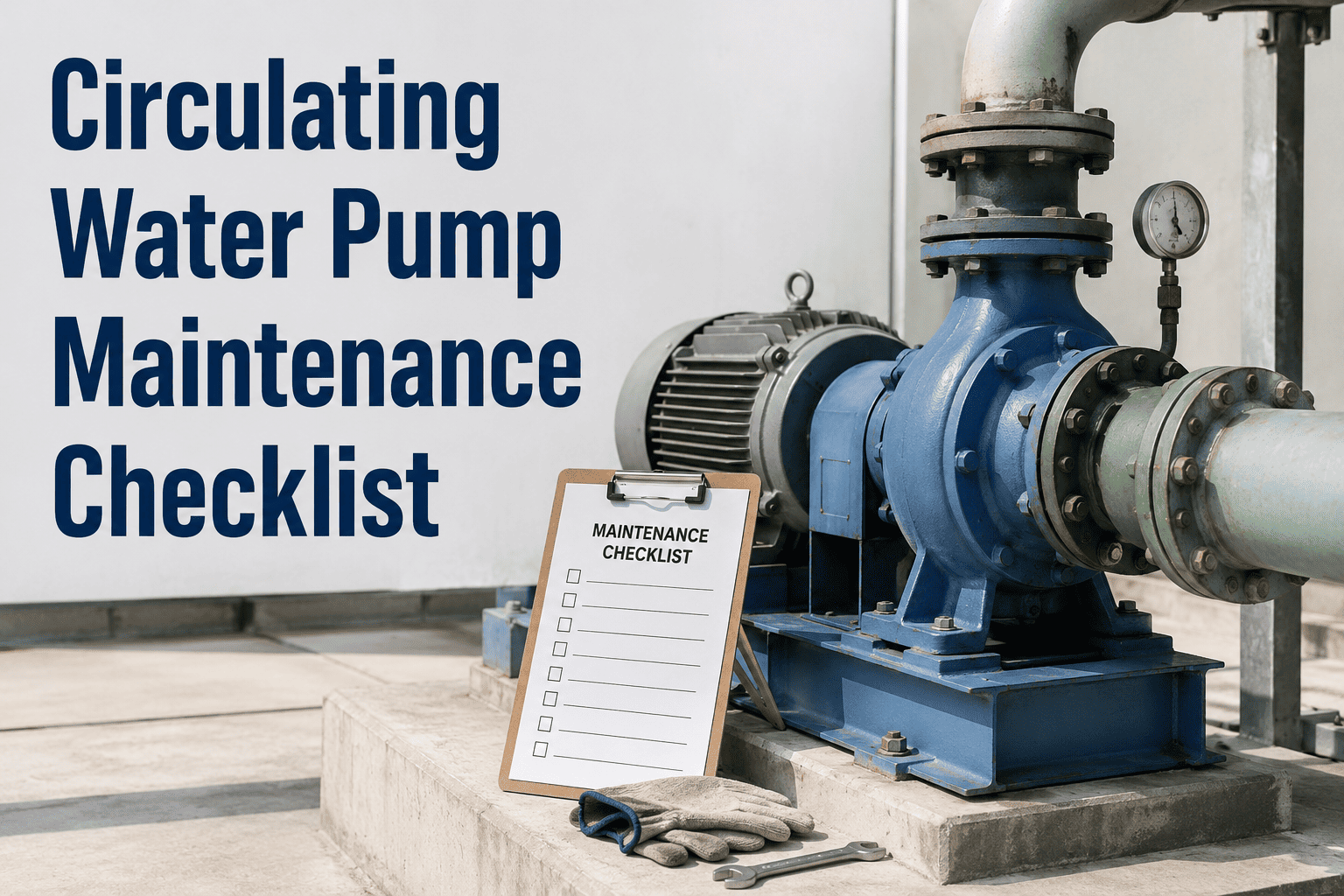
A circulating water pump that trips on bearing failure during peak summer load doesn't just take one pump offline — it forces condenser vacuum to collapse, drops unit load by 30–50%, and in a worst case causes a turbine trip that takes 6–8 hours to recover from. CW pumps are among the highest-consequence, lowest-maintenance-attention assets in a thermal power plant. Most plants run them to failure precisely because they appear robust. This checklist changes that by giving your mechanical, electrical, and reliability teams a structured inspection framework covering alignment, bearings, mechanical seals, motor current monitoring, and vibration analysis — with every check frequency-coded and role-assigned so your OxMaint preventive maintenance program can schedule, track, and close every task with a complete audit trail.
Circulating Water Pump Maintenance Checklist
A comprehensive inspection checklist for CW pump alignment, bearings, mechanical seals, motor current, vibration analysis, and cooling system reliability — structured for the engineers who keep condensers running at full vacuum.
Vibration Monitoring & Bearing Condition
Vibration is the earliest measurable signal of bearing deterioration, impeller imbalance, or misalignment. Most CW pump bearing failures give 4–6 weeks of warning in vibration data before they become a forced trip — if anyone is measuring and trending the data consistently.
Shaft Alignment & Coupling
Misalignment is the single largest cause of premature bearing and seal failure in rotating equipment. A CW pump that was aligned correctly at commissioning may drift out of tolerance within 6–12 months due to thermal growth, pipe strain, or baseplate settlement.
Mechanical Seal & Stuffing Box
Mechanical seal failure on a CW pump results in immediate water ingress into the motor, equipment damage, and potential electrical hazard. Seal leakage beyond the normal drip rate is always a maintenance-required condition — not a monitor-and-wait situation.
Pump failures don't send calendar invites. OxMaint schedules every check, captures field readings, and escalates developing faults to a corrective work order weeks before a trip — keeping your condenser at full vacuum and your unit at full load.
Motor — Current Monitoring & Electrical Health
The CW pump motor is one of the largest motors in the plant by kVA. Overloading, phase imbalance, or winding insulation deterioration on a motor this size means a significant repair cost and a long lead time for rewinding — both avoidable with consistent electrical monitoring.
Hydraulic Performance & Cooling Water System
A CW pump that is running but delivering below-design flow is not protecting the condenser. Impeller wear, inlet screen blockage, and cavitation all reduce effective cooling water delivery — and the first symptom is almost always a rising condenser back pressure rather than a pump alarm.
CMMS Records, Lubrication & Spare Parts Readiness
A CW pump failure during peak load is not a maintenance problem — it is a preparedness failure. Bearing kits, mechanical seal assemblies, and coupling elements that are not in the storeroom when a pump trips extend every forced outage by 2–5 days. Spare parts readiness is a maintenance discipline, not a procurement function.
Six Metrics That Confirm Your CW Pumps Are Reliable
| Metric | Measurement Method | Target | Review Cadence |
|---|---|---|---|
| Pump Availability | Running hours / Total scheduled hours | Above 99% | Monthly |
| Vibration Compliance | Readings below alarm limit / Total readings | 100% | Weekly |
| PM Completion Rate | Completed PMs / Scheduled PMs | 100% | Monthly |
| Mean Time Between Failures | Operating hours between unplanned stoppages | Above 25,000 hrs | Quarterly |
| Seal Replacement Rate | Seal replacements per pump per year | Below 1 per year | Monthly |
| Bearing Oil Analysis Pass Rate | Oil samples within spec / Total samples | Above 95% | Monthly |
Frequently Asked Questions
What vibration limit should trigger a CW pump bearing replacement?
For large centrifugal pumps per ISO 10816-3, vibration velocity above 4.5 mm/s RMS in Zone B (acceptable for continuous operation) should trigger investigation and increased monitoring frequency. Above 7.1 mm/s (Zone C), the machine should be taken out of service at the next planned opportunity. A rising trend is more diagnostic than a single high reading. OxMaint plots vibration trends against zone limits automatically.
How often should CW pump alignment be checked?
Laser alignment should be performed after every major maintenance activity (bearing replacement, seal replacement, motor removal) and as a minimum annually during planned outage. Elevated vibration or a rising coupling wear pattern is an additional trigger for an unscheduled alignment check regardless of the calendar interval.
What causes mechanical seal failure on CW pumps?
The three most common causes are misalignment (which causes the shaft to deflect and load the seal faces unevenly), inadequate or contaminated seal flush water (which allows particulates to score the faces), and dry running during start-up before the pump is fully primed. All three are preventable through structured pre-start checks and proper CMMS-tracked PM routines.
How does a blocked travelling screen affect condenser performance?
A heavily fouled inlet screen reduces the available suction head to the pump, which shifts the pump operating point down its curve — reducing flow without reducing speed. The first visible effect is a rise in condenser back pressure (lower vacuum), which reduces turbine output. Severe blockage can trigger pump cavitation, accelerating impeller and seal wear.
What critical spares should always be in stock for CW pumps?
At minimum: a complete bearing set for each pump type, a mechanical seal kit, coupling elements or elastomers, wear rings, and a set of instrumentation transmitters (vibration, temperature, pressure). For plants with single-train CW systems, a rotor assembly as an exchange spare is recommended. OxMaint links spares inventory directly to PM work orders so stock levels are checked before every planned overhaul.
Every Pump Check Scheduled. Every Bearing Trend Tracked. Every Failure Prevented.
OxMaint turns this checklist into mobile inspection rounds with timestamped readings, vibration trend charts, and auto-generated corrective work orders — so your reliability team catches a developing bearing fault weeks before it becomes a condenser trip.