A standard power transformer that took 7 to 14 months to deliver before 2020 now carries a lead time of 24 months or more, and for the largest generator step-up units, some specialized orders are stretching toward three to four years. Three demand waves — AI data center construction, industrial electrification, and grid modernization — are competing for the same limited factory capacity at the same time, with no sign of easing. For a maintenance team, the old rule of ordering once the budget is approved no longer works, because by the time a capital request clears, the factory slot may already be gone. OxMaint's mobile CMMS lets planners flag long-lead components on every critical asset the moment a degradation trend appears, so procurement can start months or years before the part is actually needed — sign up free to start tracking your critical spares, or book a demo to map your long-lead inventory.
INVENTORY MANAGEMENT · SUPPLY CHAIN RELIABILITY
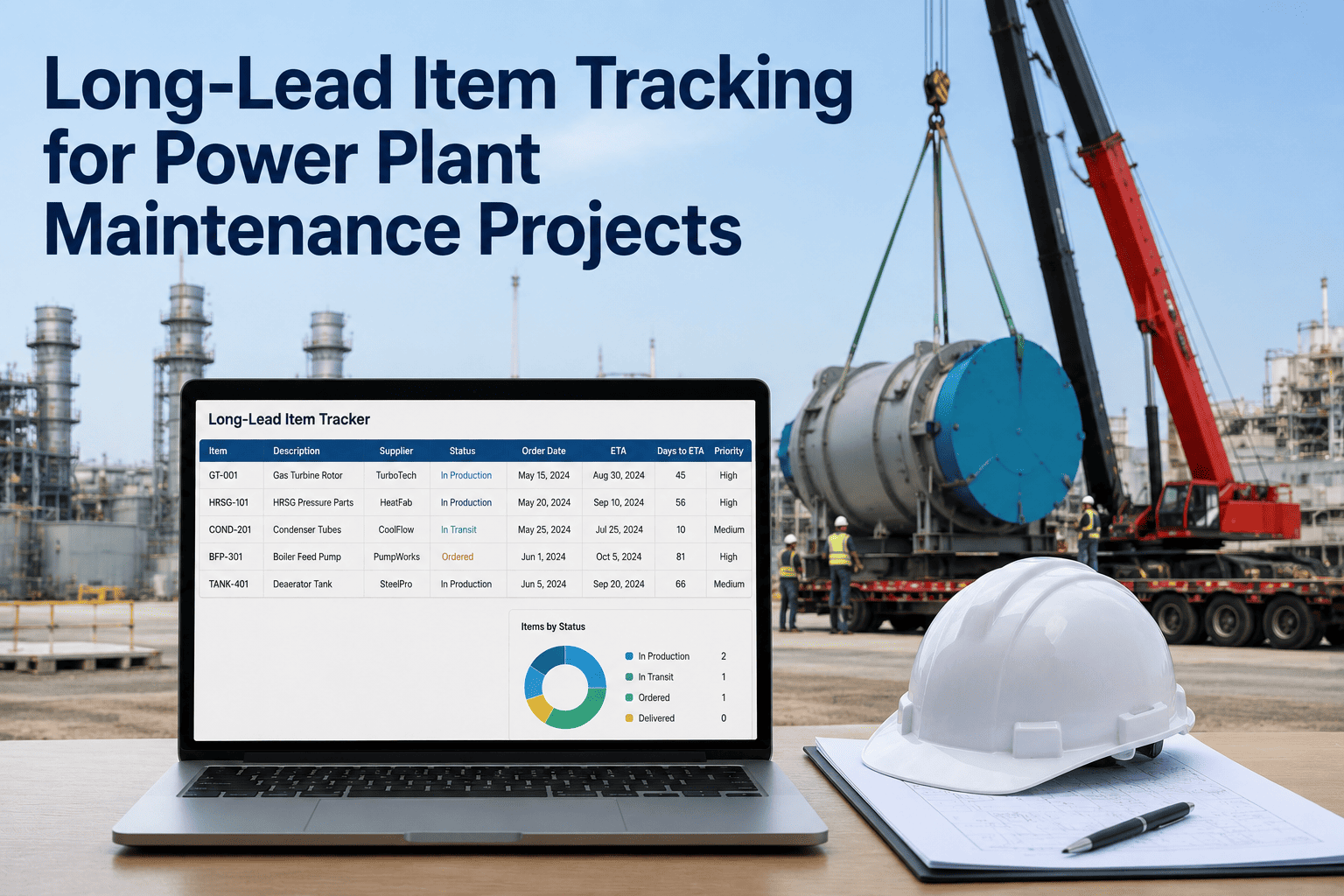
Long-Lead Item Tracking for Power Plant Maintenance Projects
Track procurement timelines for transformers, turbine components, and critical spares against asset condition trends, so ordering starts before the failure does, not after.
Up to 4 Years
Reported lead times for the largest specialized power transformers in 2026
80%
Share of large U.S. power transformers that are imported
THE LEAD TIME REALITY CHECK
How Long Critical Power Equipment Really Takes to Arrive
Lead times vary enormously by equipment class, and the gap between "in stock" and "custom build" can be the difference between a planned swap and a multi-year wait. The chart below reflects current 2026 market reporting for transformer procurement.
Distribution Transformers (under 10 MVA)
8-16 Weeks
Medium Power Transformers (10-100 MVA)
12-18 Months
Large Power Transformers (100+ MVA)
18-30 Months
Generator Step-Up Transformers
Up to 144 Weeks
Specialized / Custom Large Units
36-48 Months
WHAT HAPPENS WITHOUT TRACKING
The Cost of Treating Lead Time as Someone Else's Problem
RISK
A capital request approval does not start the procurement clock — the factory queue does
RISK
Degradation trends that point to a replacement two to three years out go unnoticed until the asset is already failing
RISK
Multiple critical assets across a fleet compete for the same supplier capacity without coordination
RISK
Emergency sourcing during a forced outage means paying premium prices for whatever capacity remains
Map Your Long-Lead Inventory Before the Next Outage
OxMaint links every long-lead component to the condition trend of the asset it serves, so your procurement team gets a head start measured in years, not weeks.
HOW IT WORKS
How OxMaint Tracks Long-Lead Items
01
Flag the Component
Any part with a lead time over six months is tagged on the asset record and linked to that asset's condition trend.
02
Track the Trigger
When the health score trajectory projects a replacement need inside the part's lead time window, a procurement flag is raised automatically.
03
Coordinate Across the Fleet
Long-lead flags roll up across sites, so units that need the same component can be pooled into a single order where possible.
04
Close the Loop
Once ordered, delivery status is tracked against the asset's projected need date, alerting planners if the timeline slips.
REACTIVE VS TRACKED
What Changes When Lead Time Is Tracked Against Asset Condition
| Factor | Reactive Sourcing | OxMaint Tracked Procurement |
| Procurement start |
After capital approval or failure |
At the first sign of a degradation trend |
| Lead time exposure |
Full lead time absorbed as downtime risk |
Runs in parallel with the asset's remaining life |
| Sourcing position |
Spot market, premium pricing |
Standard procurement channels |
| Fleet coordination |
Each site orders independently |
Long-lead needs pooled across sites |
| Delivery tracking |
Manual follow-up calls |
Status tracked against asset need date |
EXPERT REVIEW
Marcus Tully
Director of Supply Chain — Power Generation Equipment, 15 Years
Procurement teams used to plan around lead times measured in months. Now the planning horizon for a large transformer is measured in years, and that changes everything about how maintenance and procurement need to work together. The plants handling this well are not the ones with bigger budgets, they are the ones whose maintenance data flags a degrading asset early enough that procurement gets a real head start. Once the factory queue closes, no amount of budget gets you back to the front of the line.
FREQUENTLY ASKED
Long-Lead Item Tracking — Common Questions
How does OxMaint know which spare parts count as long-lead items?
Any component can be tagged with its expected procurement lead time on the asset record. OxMaint flags anything over a defined threshold, commonly six months, as a long-lead item tied to that asset's condition trend.
Sign up free to start tagging your spares.
Can OxMaint flag a long-lead item before the asset actually needs replacing?
Yes. When an asset's health score trajectory projects a replacement need that falls inside a component's lead time window, the procurement flag is raised automatically, often years ahead of the actual need date.
Does this help if we operate multiple plants using the same transformer models?
Yes. Long-lead flags roll up across a multi-site portfolio, so procurement teams can see when several units across different plants may need the same component and coordinate orders.
What happens if a long-lead order's delivery date slips?
OxMaint tracks delivery status against the asset's projected need date and alerts planners if the timeline shifts, giving time to adjust maintenance plans.
Book a demo to see delivery tracking.
How quickly can we start tagging long-lead items on our existing assets?
Most teams begin tagging critical components within the first week of onboarding, working from existing parts lists and OEM lead time documentation.
Book a demo to scope your asset list.
OXMAINT · SUPPLY CHAIN RELIABILITY
Start the Procurement Clock Before the Failure Does
OxMaint links every long-lead component to the condition trend of the asset it serves, so ordering starts the moment the data says it is time, not after the part is already overdue.