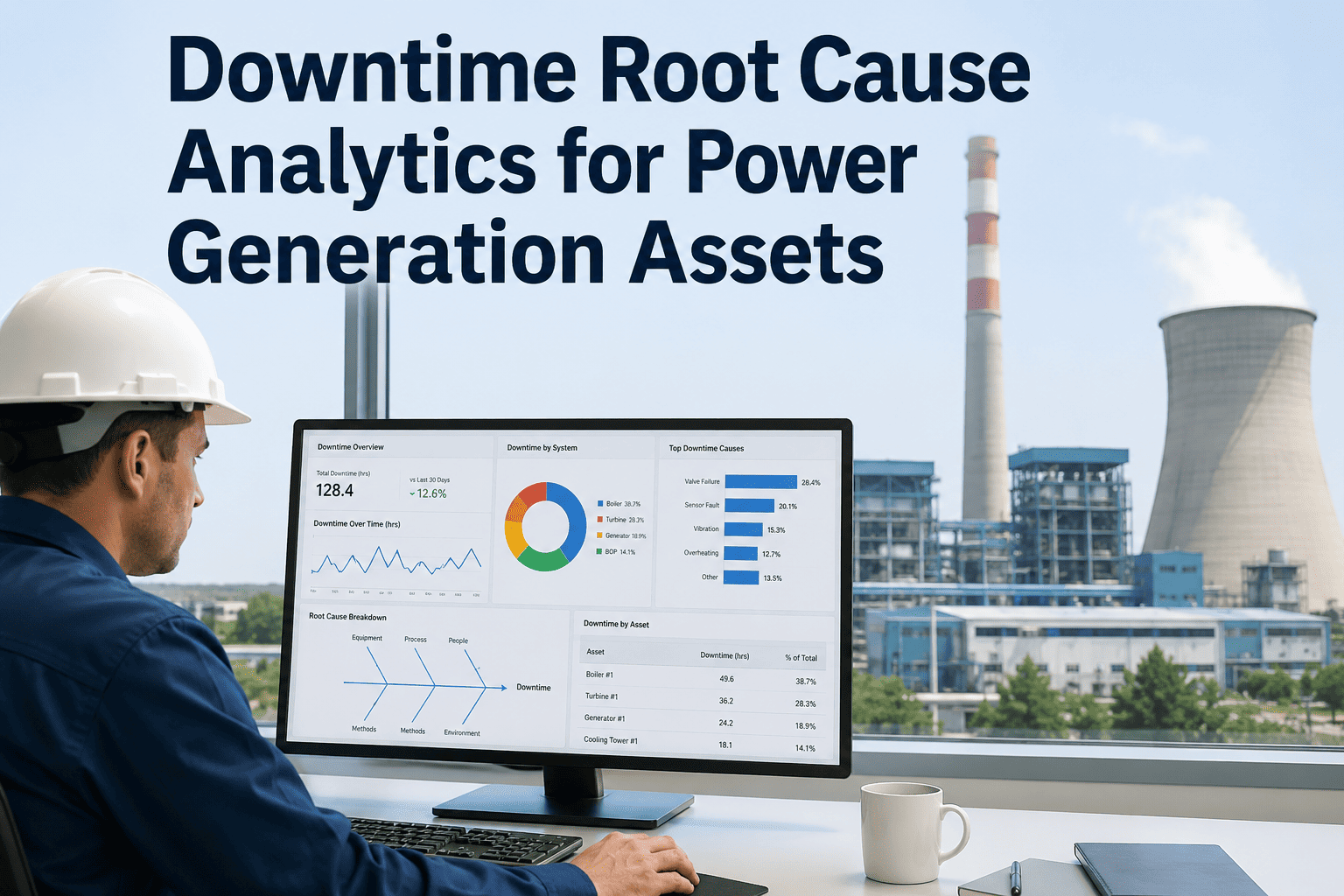
MTBF & MTTR Tracking Software for Power Plant Reliability

By Johnson on March 27, 2026

mtbf-mttr-software-power-plant-reliability

Power plant reliability teams that still log Mean Time Between Failures and Mean Time To Repair on spreadsheets are carrying a hidden liability — one unplanned outage costs over $300,000 per hour, and 43% of all plant incidents stem from mechanical failures that real-time tracking could have caught early. Start tracking MTBF and MTTR with Oxmaint — free trial, no credit card, up and running in under 60 minutes.

Reliability Analytics  ·  Power Generation  ·  CMMS

MTBF & MTTR Tracking Software for Power Plant Reliability

Every hour your turbines, boilers, and generators run without a structured reliability framework, you're accumulating risk. Plants using CMMS-driven MTBF and MTTR analytics cut unplanned downtime by up to 35% and reduce maintenance spend by 25% within the first year.

Live Reliability Snapshot
$300K+
Cost per hour of unplanned outage
43%
Plant incidents from preventable mechanical failures
35%
Downtime reduction with predictive CMMS tracking
95%
Of plants adopting predictive maintenance report positive ROI
Core Concepts

MTBF vs MTTR — Two Numbers Every Power Plant Engineer Must Own

Mean Time Between Failures
MTBF
Total Operational Hours ÷ Number of Failures
Tells you how long a turbine, boiler, or generator runs before breaking down. Higher is better. A declining MTBF trend is your earliest warning sign of accelerating wear — before the failure happens.
Example: A feed pump ran 2,400 hours with 4 failures → MTBF = 600 hours. If next month it drops to 400 hours, a failure cluster is forming.
Mean Time To Repair
MTTR
Total Repair Time ÷ Number of Repairs
Measures how fast your team gets critical equipment back online after a failure. Lower is better. MTTR exposes delays in fault detection, parts staging, technician response, and approval chains.
Example: 3 failures with repair times of 6h, 4h, 5h → MTTR = 5 hours. Industry best-in-class for steam turbines is under 3 hours.
Plant Availability
= MTBF ÷ (MTBF + MTTR)
Target: 97% or higher
The metric that ownership and regulators actually measure. It combines both reliability and repair speed into a single operational health score for each asset and the entire plant.
Example: MTBF = 600h, MTTR = 5h → Availability = 99.2%. Every 1% availability drop on a 500MW plant equals millions in annual lost generation revenue.
Stop Estimating. Start Measuring What Actually Matters.
Oxmaint automatically calculates MTBF, MTTR, and availability from your work order timestamps — no spreadsheets, no manual tallying, no lag in your reliability data.
Industry Reality

Why Power Plants Lose Millions Even When Engineers Know MTBF Theory

Knowing the formula is not the problem. The problem is that 70% of power plants have little visibility into when equipment is due for maintenance — because the data needed to calculate reliable MTBF and MTTR is scattered, delayed, or never captured at all.

01
Failure Timestamps Are Guesses
When technicians log repairs hours or days after the event, MTTR calculations are worthless. Oxmaint enforces real-time timestamps on every work order open and close, making your MTTR numbers defensible and precise.
02
No Failure Code Standardization
When every technician describes the same fault differently, you cannot aggregate MTBF by failure mode. Oxmaint uses controlled failure code libraries so trends surface automatically — not through manual audit.
03
Asset History Is Lost at Turnover
A 500MW plant cannot calculate meaningful MTBF if half the failure history walked out the door with retiring technicians. Digital asset records in Oxmaint preserve every failure, repair, and parts replacement permanently.
04
MTBF Lives in a Report Nobody Reads
Reliability metrics that sit in a monthly PDF don't prevent failures. Oxmaint puts MTBF trend alerts and MTTR dashboards in front of engineers and planners in real time — triggering PM actions before the metric degrades further.
05
Multi-Unit Benchmarking Is Impossible
If Unit 1 and Unit 3 track reliability differently, you cannot compare them or learn from your best-performing asset. Oxmaint standardizes KPI collection across every unit and every site in your portfolio.
06
Planned vs Unplanned Work Is Blended
True MTBF only counts unplanned failures — not scheduled shutdowns. When plants don't categorize work orders properly, MTBF figures understate real reliability and mislead maintenance planning decisions.
How Oxmaint Works

From Raw Work Orders to Actionable Reliability Intelligence — Automatically

1
Technician Opens a Work Order
Failure reported via mobile app — even offline in switchgear rooms or turbine halls. Timestamp locked. Failure code selected from a controlled library. Asset auto-linked from the registry.
2
Repair Is Completed and Closed
Technician closes the work order with repair details, parts used, and photo evidence. System automatically captures total repair duration — no manual time entry required, no gaps in the data.
3
MTBF and MTTR Calculate in Real Time
The platform aggregates work order history per asset, per system, per unit, and per site. MTBF, MTTR, and availability update automatically — no monthly manual calculation, no waiting for the report cycle.
4
Alerts Trigger Before Metrics Degrade
When MTBF for a specific asset drops below threshold, maintenance planners are alerted. Preventive work orders auto-generate. The failure is caught in the trend — not after the unplanned shutdown.
Industry Benchmarks

Where Does Your Plant Stand? Power Generation MTBF & MTTR Reference Points

Equipment Type Industry Avg MTBF Best-in-Class MTBF Industry Avg MTTR Best-in-Class MTTR Availability Impact
Steam Turbine 2,800 hrs 5,000+ hrs 18 hrs 8 hrs High — drives capacity factor
Boiler / Boiler Feed Pump 1,200 hrs 2,500 hrs 6 hrs 2.5 hrs Critical — most common forced outage driver
Generator 4,500 hrs 8,000+ hrs 24 hrs 10 hrs High — regulatory reporting required
Cooling Tower 3,000 hrs 6,000 hrs 4 hrs 1.5 hrs Moderate — seasonal impact spike
HV Switchgear 6,000 hrs 12,000+ hrs 12 hrs 4 hrs High — safety and grid compliance
Air Compressors / Auxiliary 900 hrs 1,800 hrs 3 hrs 1 hr Moderate — cascading system risk

Reference benchmarks drawn from NERC reliability data, Siemens True Cost of Downtime 2024, and maintenance records across power generation facilities. Use these as starting baselines — book a demo to benchmark your specific asset fleet against industry peers.

Platform Capabilities

What Oxmaint Delivers for Power Plant Reliability Teams

Auto-Calculate
Real-Time MTBF & MTTR Dashboard
Reliability KPIs calculated automatically from work order timestamps. No manual data entry. No end-of-month calculation sprint. Every asset's MTBF and MTTR always current — from steam turbines down to individual feed pumps.
Failure Codes
Controlled Failure Code Library
Standardized failure mode taxonomy across every technician, shift, and unit. Aggregate MTBF by failure type, not just asset. Identify which failure modes are eating your uptime and attack them with targeted PM strategies.
Trend Alerts
MTBF Degradation Alerts
When an asset's MTBF trend drops below a configured threshold, engineers are alerted before the next failure. Preventive work orders auto-generate. Your reliability team moves from reactive firefighting to proactive asset management.
Multi-Site
Cross-Unit and Cross-Site Benchmarking
Compare MTBF and MTTR across units, plants, and asset classes in a single dashboard. Learn from your best-performing assets. Transfer proven PM strategies to underperforming equipment. Portfolio reliability management at scale.
Mobile
Offline Mobile Work Orders
Technicians capture failure data, timestamps, and repair details in boiler rooms, turbine halls, and switchgear areas with zero connectivity. Data syncs on reconnect. Timestamp integrity preserved. MTTR accuracy guaranteed.
CapEx
Reliability-Driven CapEx Forecasting
When MTBF consistently declines on a critical asset, the system flags it for capital review. Rolling 5–10 year replacement forecasts built from actual reliability data — not calendar age estimates or gut feel from the outgoing chief engineer.
Before vs After

Reactive Reliability Tracking vs. Oxmaint — The Operational Gap

Area Without Structured Tracking With Oxmaint CMMS
MTBF Calculation Monthly manual tally from paper logs — often weeks late and full of gaps Auto-calculated in real time from work order timestamps, always current
MTTR Accuracy Estimated from technician memory — MTTR inflated by 30–60% on average Captured digitally from work order open to close — accurate to the minute
Failure Trend Detection Identified after the 3rd or 4th failure — pattern visible only in hindsight Threshold alerts trigger on first deviation — PM issued before next failure
Cross-Unit Comparison Not possible — each unit uses different logs and terminology Standardized KPIs enable real-time benchmarking across all units and sites
Asset History at Turnover Lost when experienced technicians retire or leave Permanently stored per asset — searchable by any engineer at any time
PM Scheduling Basis Calendar intervals or OEM recommendation — ignores actual failure patterns Condition-based triggers from MTBF trends and sensor thresholds
CapEx Justification Anecdotal — "this pump has been trouble for years" Data-backed — declining MTBF, rising MTTR, and repair cost trend over 3 years
Common Questions

Power Plant Reliability Teams Ask Us These Every Week

How does Oxmaint calculate MTBF and MTTR without manual input?
Every work order in Oxmaint captures three mandatory timestamps — reported time, work started, and work completed. The platform uses these to calculate MTTR per failure and aggregate MTBF per asset automatically. No spreadsheets, no retrospective data entry. Start a free trial and see the dashboard populate from your first real work order.
Can Oxmaint connect to our existing plant DCS or SCADA system?
Yes. Oxmaint integrates with existing DCS, SCADA, and BMS systems via standard APIs. Sensor anomalies from your control system automatically trigger work orders in Oxmaint, capturing failure timestamps with digital precision. This is what makes MTTR calculation accurate instead of estimated. Book a 30-minute demo to walk through your specific integration setup.
How long before we have enough data to make MTBF trends meaningful?
For high-cycle equipment like feed pumps and compressors, meaningful MTBF trends typically emerge within 60–90 days. For long-cycle assets like turbines and generators, you can import historical paper records as backfilled entries to build the baseline faster. Start free — your baseline builds from day one without any implementation delay.
Does Oxmaint support NERC reliability reporting requirements for power generators?
Oxmaint's digital work order trails, timestamped inspections, and asset condition records are structured to support NERC, OSHA, and local regulatory compliance requirements. Audit-ready exports are available at any time without manual binder preparation or staff-hours overhead. Book a demo to review compliance reporting capabilities with our team.
What if our technicians work in areas with no mobile coverage?
Oxmaint's mobile app operates fully offline — technicians complete work orders, log failure codes, and capture photos in turbine halls, underground cable tunnels, and switchgear rooms. All data syncs automatically on reconnect. Timestamp integrity is preserved from the moment of capture. Try the offline mobile app — free trial, no infrastructure changes needed.
Every Month Without MTBF Tracking Is a Month of Data You'll Never Get Back
Plants that begin structured reliability tracking today will have 12–24 months of asset history to train predictive models on by 2027. Those that wait will be starting from zero when their competitors are already acting on failure predictions. Start now — free trial, no implementation fees, running in under 60 minutes.

Share This Story, Choose Your Platform!