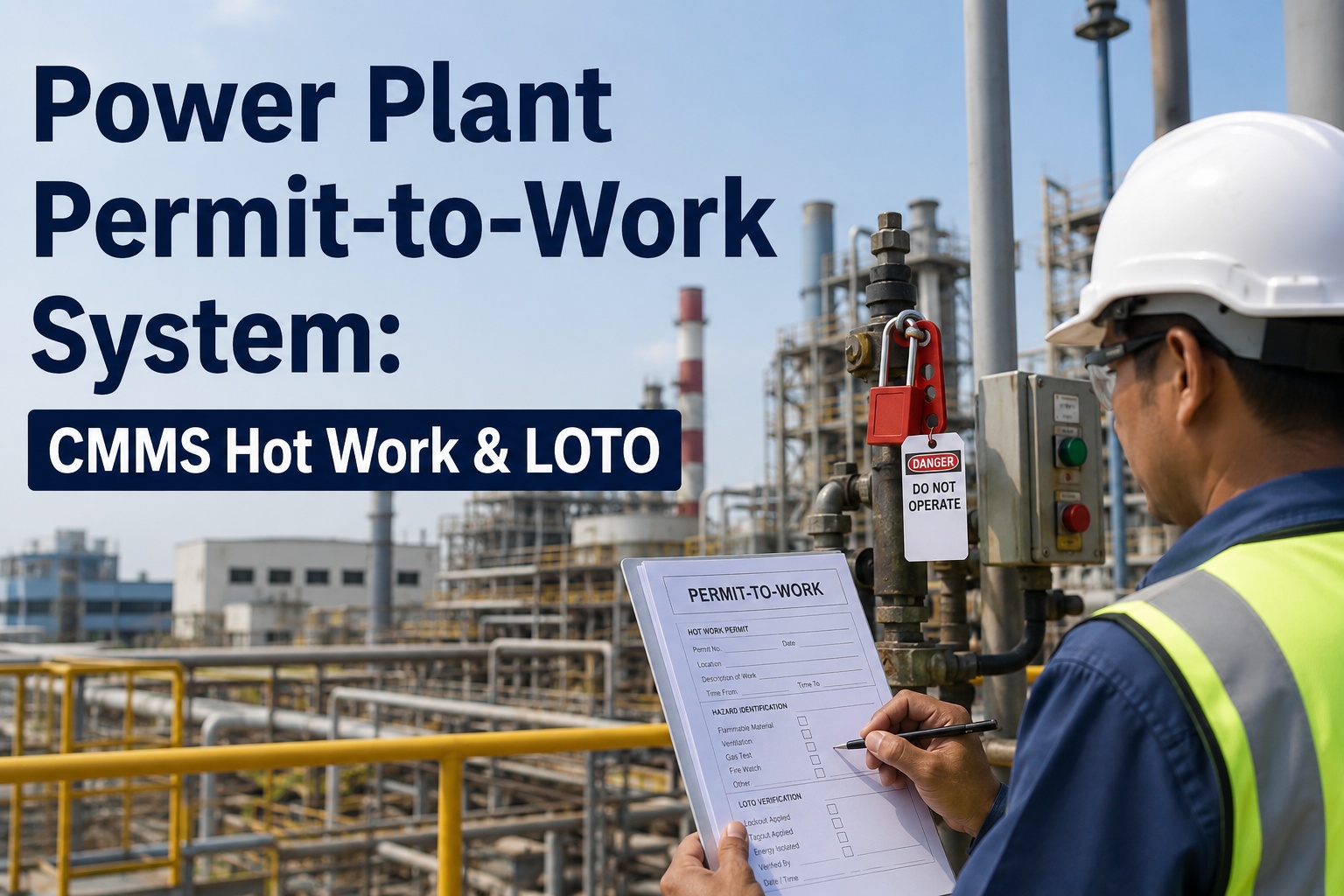
OSHA 1910.147 ranked fourth on OSHA's most-cited standards in FY 2025 with 2,177 citations — and the most common violation pattern is not that power plants lack written LOTO procedures, but that the procedures exist on paper and are never verifiably followed. A technician who photographs the wrong isolation point, skips the energy verification tryout step, or inherits a multi-point LOTO from a previous shift without confirming every lock is their own has created a life-threatening energy hazard that no paper binder can prevent. The tryout step — physically attempting to restart the equipment after all locks are applied to confirm zero-energy state — is the single most frequently skipped and most frequently cited violation in OSHA LOTO inspections. Mobile CMMS-enforced LOTO verification changes this by making it structurally impossible to advance a work order past any isolation step without photo-confirmed completion, authenticated user identity, and a GPS-verified location at the isolation point. Sign up for Oxmaint to deploy photo-verified digital LOTO procedures across your plant, or book a demo to see the full LOTO verification workflow in a live power plant scenario.
LOTO Procedure Verification with Mobile CMMS
How power plants replace paper lockout/tagout binders with photo-verified, step-gated digital isolation procedures that enforce every OSHA 1910.147 and 1910.269 requirement — and create the audit-ready compliance record that protects workers, satisfies inspectors, and closes the verification gap that causes fatalities.
Six Critical Verification Gaps in Paper-Based LOTO Systems
OSHA 1910.147(d)(6) requires that after applying all lockout devices, the authorised employee must attempt to start the machine — the "tryout" — to verify zero-energy state. This is the most frequently skipped and most frequently cited step in all LOTO inspections. Paper binders cannot enforce it; Oxmaint blocks work order progression until a tryout confirmation is logged.
In a power plant with hundreds of valves, breakers, and isolators within close proximity, a technician using a text-only LOTO procedure may lock the wrong valve or breaker — especially on night shifts or in unfamiliar bay configurations. Oxmaint embeds a photo of the specific isolation point in the procedure step so technicians see exactly what they are looking for before they apply the lock.
When multiple technicians and contractors work under the same LOTO, OSHA 1910.147(f)(3) requires each worker to apply their own personal lock. Paper systems cannot verify individual lock application for every worker — Oxmaint requires each worker to log their own lock application with name, ID, and timestamp, and tracks group LOTO close-out by confirming individual lock removal from every worker before the permit can be cleared.
OSHA 1910.147(f)(4) requires that during shift changes on ongoing maintenance, the outgoing shift must not remove their locks until the incoming shift has applied theirs — there must never be a gap in protection. Paper LOTO systems rely entirely on verbal communication at handover; Oxmaint's digital system enforces the overlap requirement and logs the exact handover timestamp for each worker.
Modern power plant equipment stores energy in multiple forms — electrical, hydraulic, pneumatic, thermal, gravitational, and spring tension — and each must be isolated and verified independently. A LOTO procedure that isolates the electrical supply but omits the hydraulic accumulator leaves stored energy that can cause fatal injury during maintenance. Oxmaint asset-specific procedures capture every energy source identified during the procedure build.
OSHA 1910.147(c)(6) requires a documented annual inspection of each energy control procedure by an authorised employee other than those who use the procedure. Plants frequently receive citations not for lacking LOTO procedures but for lacking documentation that the annual inspection was ever conducted. Oxmaint automatically schedules annual LOTO procedure inspections and generates the documentation record required by the standard.
Photo-Verified Isolation at Every Point. Step-Gated Sequence That Cannot Be Bypassed. Work Orders That Cannot Open Until LOTO Is Complete.
Oxmaint enforces every OSHA 1910.147 and 1910.269 LOTO requirement through a mobile-first digital workflow — guided step-by-step isolation with photo confirmation, GPS location verification, tryout confirmation gate, group LOTO individual lock tracking, shift handover documentation, and automatic annual inspection scheduling. The compliance record is created as the work happens, not reconstructed afterward.
Oxmaint LOTO Procedure — Eight Gated Steps Aligned with OSHA 1910.269(d)
Each step in the Oxmaint LOTO workflow is gated — the technician cannot advance to the next step without completing the current one. No step can be skipped. No sequence can be reordered. The work order remains locked until every step reaches verified completion.
| Step | Action Required | OSHA Reference | Oxmaint Enforcement Mechanism | Evidence Captured |
|---|---|---|---|---|
| 1 | Create digital LOTO permit — asset auto-populates all known energy sources | 1910.147(c)(4) | Asset-specific procedure pre-loaded; no blank-form bypasses | Permit timestamp, user ID, asset record link |
| 2 | Notify affected employees — equipment shutdown confirmed and logged | 1910.147(d)(2) | Notification logged before shutdown step becomes accessible | Notification log, shutdown confirmation timestamp |
| 3 | Isolate each energy source in sequence — each point photo-confirmed | 1910.147(d)(4) | Photo upload required at each isolation point — no photo, no advance | Photo at each isolation point, user ID, timestamp, GPS |
| 4 | Apply lockout/tagout devices — each worker logs own lock with ID | 1910.147(d)(4)(ii), (f)(3) | Individual lock entries required per worker for group LOTO | Per-worker lock log, device photo, employee/contractor ID |
| 5 | Release or restrain stored energy — hydraulic, pneumatic, thermal, gravitational | 1910.147(d)(5) | All energy types in procedure must be addressed before Step 6 unlocks | Bleed-down confirmation, spring compression log, photo evidence |
| 6 | Verify zero-energy state — attempt to start the machine (TRYOUT) | 1910.147(d)(6) | Explicit tryout confirmation required — most-cited step; cannot be skipped | Tryout confirmation, verified by authenticated user ID |
| 7 | Execute maintenance work — work order accessible only after Steps 1–6 complete | 1910.147(d) | Work order repairs tab locked until all LOTO steps verified complete | Work order activity log, parts, labour, completion photos |
| 8 | Remove LOTO — all workers confirm individual lock removal before re-energisation | 1910.147(e) | Each worker must confirm lock removal before permit can be cleared | Per-worker lock removal log, final re-energisation authorisation |
LOTO Procedure Verification — Questions from Power Plant Safety and Maintenance Teams
Each step in the Oxmaint LOTO workflow requires a specific completion action — photo upload at the isolation point, GPS-confirmed presence at the asset, or an explicit confirmation tap — before the next step in the sequence becomes accessible on the mobile interface. A technician who attempts to mark Step 4 (lock application) complete without first completing Step 3 (isolation confirmation) will find Step 4 is greyed out and non-interactive — the system does not allow out-of-sequence completion regardless of who the user is or what role they hold. There are no override codes, no supervisor bypass functions, and no field-level way to skip the tryout step. If a technician submits a photograph that is clearly not of the required isolation point — for example, a photo of the floor — the supervisor receives a step completion alert and can reject the photo and require a retake. This makes the Oxmaint LOTO workflow the first line of enforcement, not the last. Sign up to activate step-gated LOTO verification for your plant's critical maintenance assets.
Oxmaint LOTO procedures support any number of isolation points within a single permit, with each point displayed as a sequential checklist step that includes a photo of the specific valve, breaker, or isolator to be locked out, the equipment tag number, and the required lock position. For assets with 20 or 30 isolation points — such as a large steam turbine unit with multiple steam stop valves, extraction valves, oil supply isolations, hydraulic lines, and electrical feeds — the procedure is built once in the Oxmaint asset record and applied automatically every time a work order requiring that LOTO is raised. Technicians follow the on-screen guide from isolation point to isolation point with photo confirmation at each — replacing the experience of searching for the right binder, finding the right procedure page, and trying to identify a labelled valve in poor lighting with a clear visual guide on a mobile device. Book a demo to see a multi-point LOTO procedure navigated live on the Oxmaint mobile app.
Oxmaint supports contractor access through a mobile work order interface that can be activated for contractors without requiring a full platform user licence. For group LOTO situations involving a mix of internal technicians and contractors, each individual — regardless of employment status — must log their own lock application with their name, contractor ID, and the permit reference before they are authorised to begin work. The LOTO permit cannot be cleared at job completion until every individual, internal or contractor, has confirmed their lock removal in the system. This directly implements the OSHA 1910.147(f)(3) individual protection requirement for group LOTO and eliminates the common situation where a contractor's lock is removed by another party at job completion without verification that the contractor has cleared the work zone — a scenario that creates serious re-energisation hazards.
Oxmaint automatically schedules an annual LOTO procedure inspection work order for each energy control procedure in the plant's procedure library — timed to the anniversary of the last completed inspection. The inspection work order is assigned to an authorised employee other than those who routinely execute the procedure, as required by the standard. The inspection checklist in Oxmaint covers all four mandatory documentation points: the machine or equipment, the date of the inspection, the employees included in the inspection review, and the name of the inspector. When the inspection is completed in Oxmaint, the signed digital record is permanently archived against the procedure — creating the documentation evidence that OSHA compliance officers specifically request during inspections and that is the most common missing element in LOTO citation cases. Sign up to activate annual LOTO procedure inspection scheduling for your plant.
Oxmaint provides a REST API that accepts equipment state change events from DCS and SCADA systems and can trigger LOTO procedure initiation automatically when a maintenance work order is created for an asset that is flagged as requiring isolation. In practice, this means that when an operator takes a piece of equipment out of service in the DCS and a corrective maintenance work order is raised in Oxmaint, the system automatically attaches the relevant LOTO procedure to the work order and notifies the authorised technician that isolation must be completed before the work order can be opened. This DCS-to-LOTO integration closes the gap between the operational technology layer — where the equipment state lives — and the safety management layer — where the LOTO record lives — which are two systems that operate in complete isolation from each other in most power plants today. Book a demo to discuss SCADA-to-Oxmaint LOTO integration for your plant's control system environment.
The Technician Working on Your High-Voltage Switchgear Right Now Is Following a Paper LOTO Binder. That Is Not Enough Protection.
Oxmaint replaces paper lockout/tagout binders with a photo-verified, step-gated, GPS-confirmed digital LOTO system that enforces every OSHA 1910.147 requirement — tryout verification, individual group lock tracking, shift handover documentation, and annual inspection scheduling — and blocks every work order from opening until isolation is complete and verified.