A technician swung open a 13.8 kV switchgear cubicle to start a routine inspection — and the cubicle had never been proven dead, because the test-before-touch step lived on a paper permit back in the office. An arc flash in that gap reaches temperatures near 35,000 degrees Fahrenheit, roughly four times the surface of the sun, and does its damage in a fraction of a second, long before anyone can react. High-voltage work is unforgiving precisely because the margin for a skipped step is zero. A mobile safety checklist puts every rule — isolate, lock, test, ground, guard — in the worker's hand at the point of work, where it cannot be forgotten or back-filled later. You can run high-voltage maintenance on an enforced, point-of-work checklist by booking a 30-minute demo or starting a free trial on your own electrical work orders.
The Five Safety Rules
Five Rules That Make High-Voltage Work Safe
Before a qualified person touches high-voltage equipment, five rules turn a live hazard into an electrically safe work condition — and they must be done in order, every time. Skipping or reordering them is how routine work becomes an incident. The mobile checklist further down is built on these five, so the sequence is never assumed.
1
Disconnect
Identify and open every source of energy feeding the equipment, then visually confirm the break.
Why a single back-feed left live is enough to kill.
2
Secure
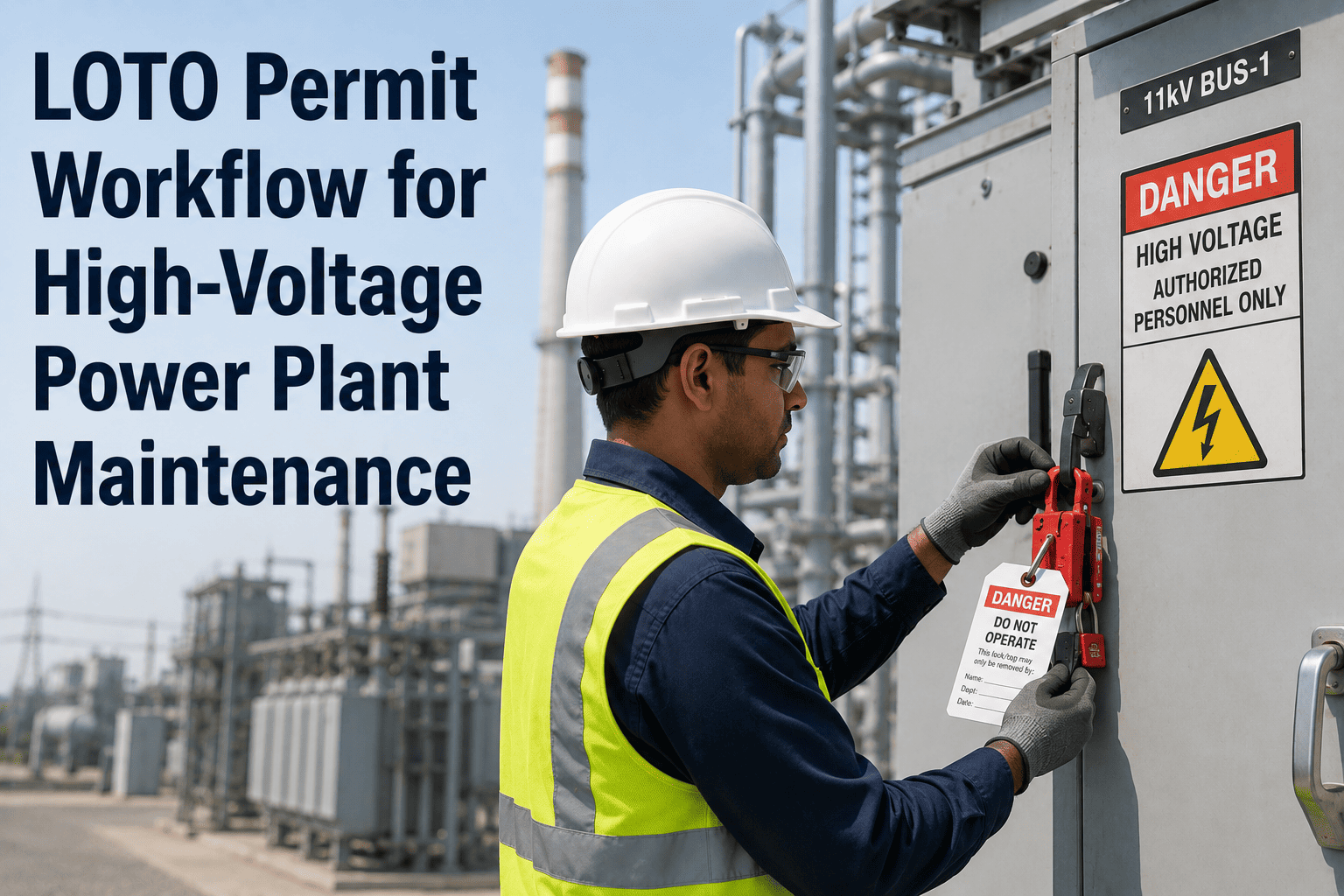
Apply lockout and tagout so no one can re-energize the circuit while work is underway.
Why de-energized but not locked out must be treated as still live.
3
Verify dead
Test for absence of voltage with a rated meter, proving the meter on a known source before and after.
Why the only proof a circuit is dead is a working test, not a switch position.
4
Ground
Apply temporary protective grounds rated for the fault current, bonding conductors into an equipotential zone.
Why induced or accidentally restored voltage flows to ground, not through the worker.
5
Guard
Barrier or insulate any adjacent live parts and hold the approach boundaries for the task.
Why most of the danger on a worksite is the energized equipment next to the dead one.
Hold the Boundary
The Approach Boundaries Around a Live Part
Even with the right protective gear, distance is a control. NFPA 70E defines boundaries around exposed energized parts, and who may cross each one depends on qualification, PPE, and authorization. The closer the line gets to the energized part, the tighter the rules become.
Arc Flash Boundary
Inside this line, arc-rated PPE matched to the incident energy is mandatory — it is the distance at which an arc would cause a second-degree burn.
Limited Approach
The shock boundary an unqualified person may not cross without a qualified escort.
Restricted Approach
Closest to the part: qualified person, voltage-rated PPE, and a documented plan only.
Energized part
The Field Checklist
The Mobile High-Voltage Safety Checklist
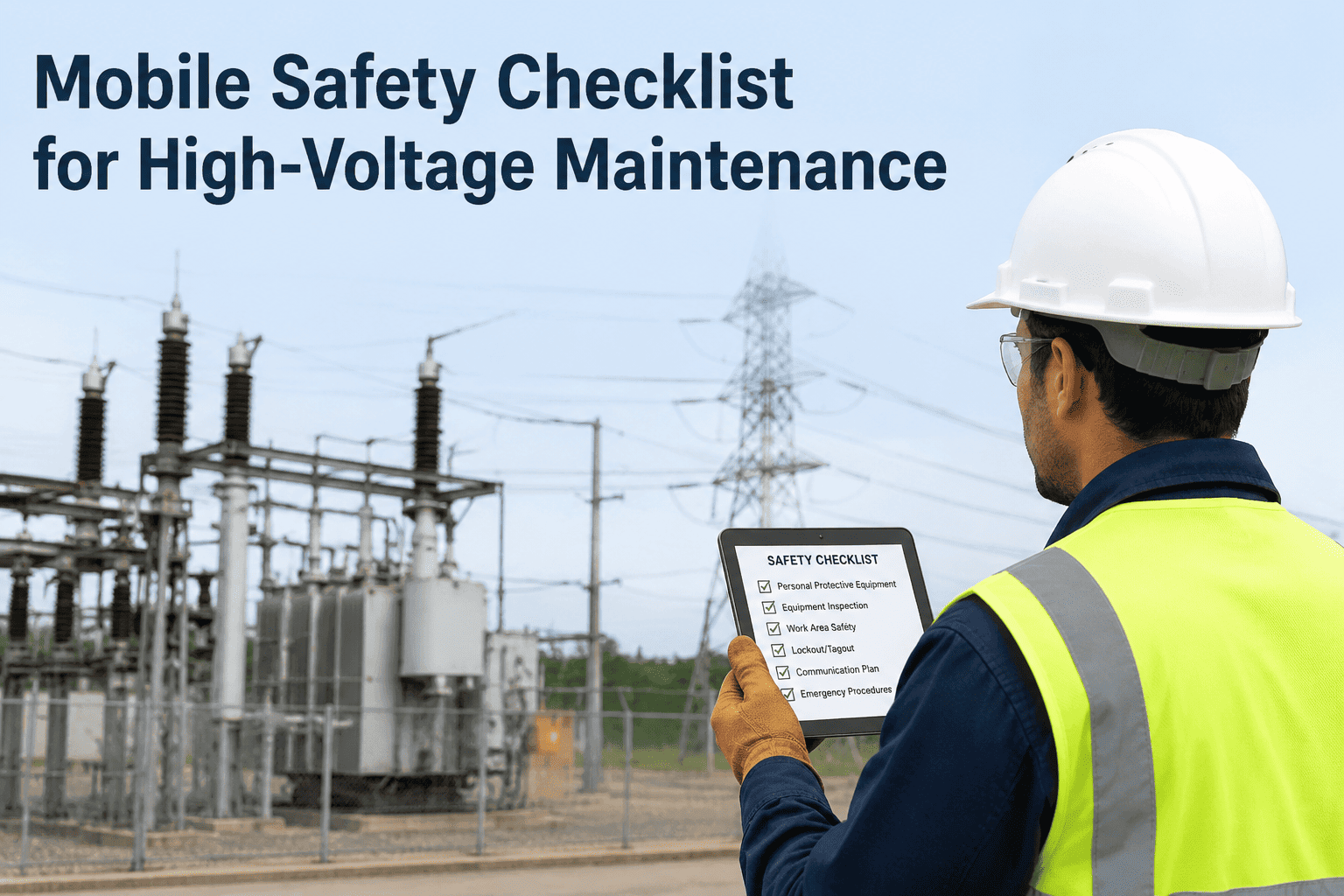
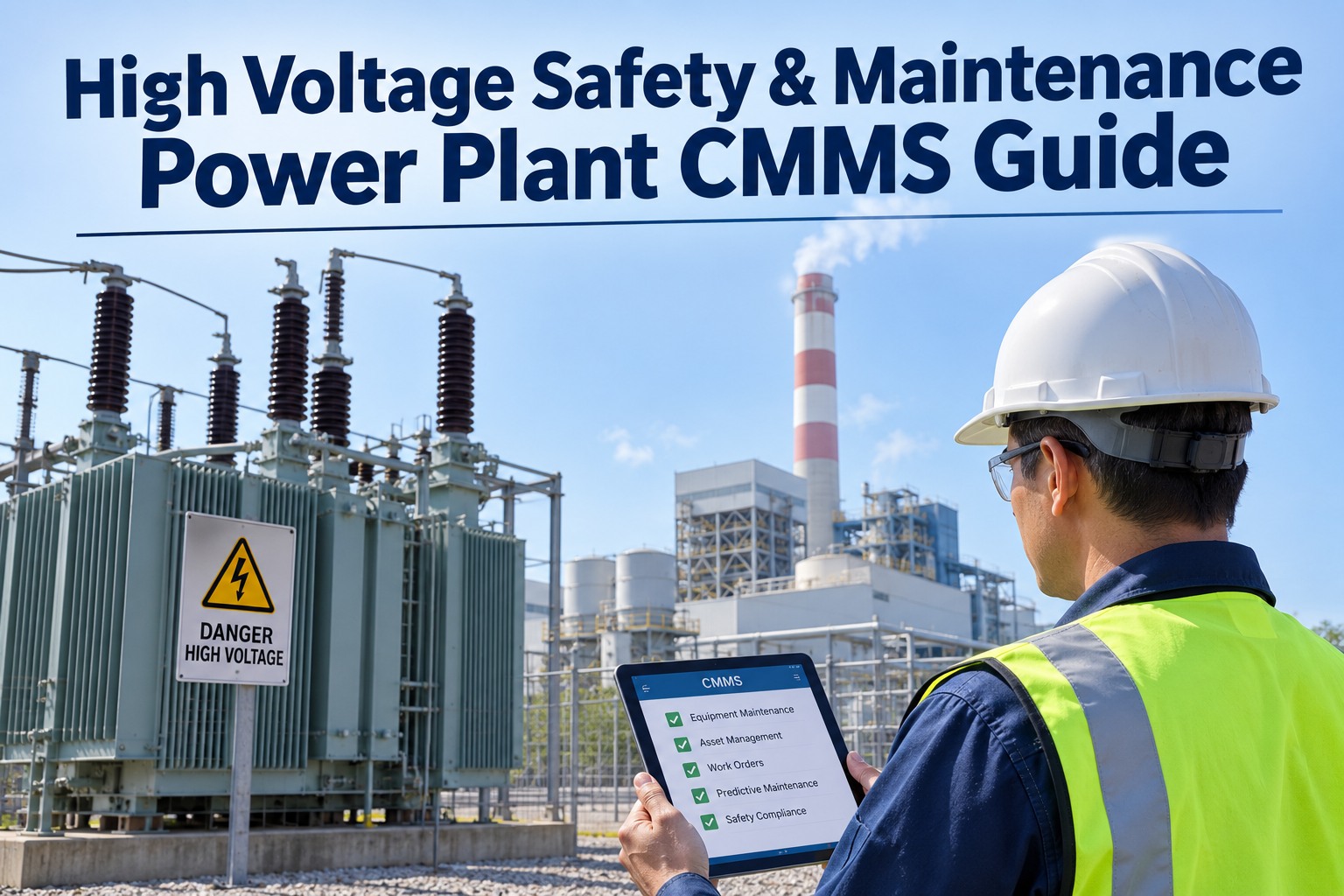
The five rules and the boundaries only protect you if they happen in order at the worksite, not on a form filed afterward. This checklist walks a high-voltage job from arrival to handback. In OxMaint Mobile CMMS it lives on the technician's phone, each item timestamped and photo-backed, and the work order will not close until every safety step is signed.
1Before the job
Job briefing held; hazards, roles, and emergency steps covered
Arc flash and shock risk assessed for the specific equipment
Correct PPE category selected and inspected before use
Voltage-rated gloves within test date; tools insulated and rated
2Before you touch
All energy sources identified and disconnected
Lockout and tagout applied to every isolation point
Stored mechanical and electrical energy released
Absence of voltage verified with a proven meter — test, dead, re-test
Temporary protective grounds applied where required
3While working
Approach boundaries marked and held by the crew
Adjacent live parts barriered or insulated
Conditions reassessed if the scope or equipment state changes
Buddy system maintained for higher-energy tasks
4Closing out
Grounds, barriers, and tools removed and accounted for
Lockout and tagout cleared by the holder, in order
Equipment returned to service and handed back to operations
Checklist signed and the work order closed with photos attached
Put the Safe Sequence in Every Worker's Pocket
Book a 30-minute walkthrough and we will build your high-voltage safety checklist into OxMaint Mobile CMMS — enforcing the five rules in order, capturing grounds and PPE as photos, and keeping the work order open until every step is signed.
PPE by Hazard Level
Arc Flash PPE Categories at a Glance
PPE is the last line of defense, and it must match the equipment's incident energy — found through an arc flash study or the NFPA 70E category tables. The four categories below set the minimum arc rating for each level of exposure, with heavier gear for higher energy.
| Category |
Min Arc Rating |
Typical Gear |
Example Task |
| Category 1 |
4 cal/cm² |
AR shirt and pants, face shield, gloves |
Operating an enclosed breaker |
| Category 2 |
8 cal/cm² |
AR clothing, balaclava, hood or face shield |
Routine work in a motor control center |
| Category 3 |
25 cal/cm² |
Multi-layer arc flash suit and hood |
Work near exposed energized bus |
| Category 4 |
40 cal/cm² |
Heavy multi-layer suit and hood |
High-voltage switching, substation work |
Above 40 cal/cm², NFPA 70E states the equipment should not be worked while energized — de-energize first. The arc flash boundary itself is set where incident energy reaches 1.2 cal/cm², the onset of a second-degree burn.
Why Mobile
Why a Mobile Checklist Changes High-Voltage Safety
A safety checklist only works if it is where the work is. On paper, the test-before-touch step gets signed at the desk and the grounds get assumed. On a phone at the cubicle, every step is captured as it actually happens.
Point-of-work, not paperwork
The checklist is on the phone at the equipment, completed step by step as the job runs rather than reconstructed afterward.
Photo and timestamp proof
Grounds applied, PPE worn, and isolation points are captured as photos, each stamped with who, when, and where.
Enforced sign-off
The work order will not close until each safety step is signed, so nothing critical can be back-filled or skipped under pressure.
Works offline in the field
At a remote substation with no signal, the checklist still runs and syncs automatically once the device is back in range.
The Stakes
The Numbers That Make This Non-Negotiable
~35,000°F
Peak arc flash temperature — roughly four times the surface of the sun
30,000 / yr
Arc flash incidents annually, causing around 7,000 burn injuries and 400 deaths
~149 / yr
Average U.S. workplace electrical fatalities — 1,940 across 2011 to 2023
1.2 cal/cm²
Incident energy at the arc flash boundary — the onset of a second-degree burn
6 inches
Drop in working distance that can double the incident energy of an arc
40 cal/cm²
The limit above which NFPA 70E says do not work energized — de-energize
From The Field
What 26 Years on High-Voltage Gear Teaches
High-voltage work does not punish you for being unlucky — it punishes you for being out of sequence. The fatalities I have investigated almost always traced to one of two things: a circuit that was never proven dead, or grounds that were assumed instead of applied. On paper, both steps get a signature at the end of the shift, and nobody can tell the difference. On a phone at the cubicle, the worker has to test the meter and photograph the grounds before the next step unlocks. That is the entire game — make the safe sequence the only sequence the job will allow.
FAQs
Frequently Asked Questions
What are the five safety rules for high-voltage work?
They are the ordered steps that create an electrically safe work condition: disconnect every source of energy, secure the isolation with lockout and tagout, verify the circuit is dead with a proven meter, apply temporary protective grounds, and guard any adjacent live parts. The order matters — a circuit that is de-energized but not locked out and tested must still be treated as live. A mobile checklist enforces the sequence so no step is assumed or done out of turn.
Book a demo to see the five rules built into your work orders.
Why does a high-voltage safety checklist need to be on a mobile device?
Because the steps that get skipped are the ones signed away from the equipment. Verifying absence of voltage and confirming grounds are point-of-work actions, and on paper they are easy to back-fill at the desk later. On a phone at the cubicle, each step is timestamped and photo-backed as it happens, and the work order will not close until they are signed.
Start a free trial to run safety checks at the point of work.
How do I know which arc flash PPE category to wear?
It comes from the equipment's incident energy, found either through an arc flash study or the NFPA 70E PPE category tables, and your gear must meet or exceed that level. Category 1 starts at 4 cal/cm² for routine tasks and Category 4 reaches 40 cal/cm² for high-voltage switching and substation work. Above 40 cal/cm², the standard says the equipment should not be worked energized at all.
Book a demo to attach PPE requirements to each electrical task.
What are the approach boundaries and who can cross them?
There are three lines around an exposed energized part. The arc flash boundary is where an arc would cause a second-degree burn, so arc-rated PPE is required inside it. The limited approach boundary marks where shock risk begins and may not be crossed by an unqualified person without a qualified escort, and the restricted approach boundary, closest to the part, requires a qualified person with voltage-rated PPE and a documented plan.
Start a free trial to record boundary checks on every job.
Does the mobile checklist still work at a remote substation with no signal?
Yes. The checklist runs offline on the device, so a crew at a remote substation or a dead-zone switchyard can complete every step, capture photos, and sign off without a connection. The records sync automatically once the device is back in range, with timestamps preserved exactly as they were captured. For field electrical work, that means the safety record is never dependent on coverage.
Book a demo to see offline mobile checklists in action.
Make the Safe Sequence the Only Sequence
OxMaint's Mobile CMMS runs your high-voltage safety checklist at the point of work — enforcing the five rules in order, capturing grounds and PPE as photos, and keeping the work order open until every step is signed — so a skipped check can never become an incident.