MTBF and MTTR are the two reliability metrics that determine whether a power plant turbine runs for 6,000 hours between failures or 600—and whether each forced outage lasts 8 hours or 80. For power generation assets, improving MTBF (Mean Time Between Failures) and reducing MTTR (Mean Time To Repair) directly controls plant availability, MWh revenue, and regulatory exposure. This guide breaks down the specific strategies—preventive scheduling, predictive analytics, digital SOPs, and spare-parts readiness—that move turbine and generator reliability KPIs in the right direction, and shows how a modern CMMS like OxMaint makes the execution repeatable. Ready to stop firefighting and start improving? Start Free Trial and see the difference on your assets this quarter.
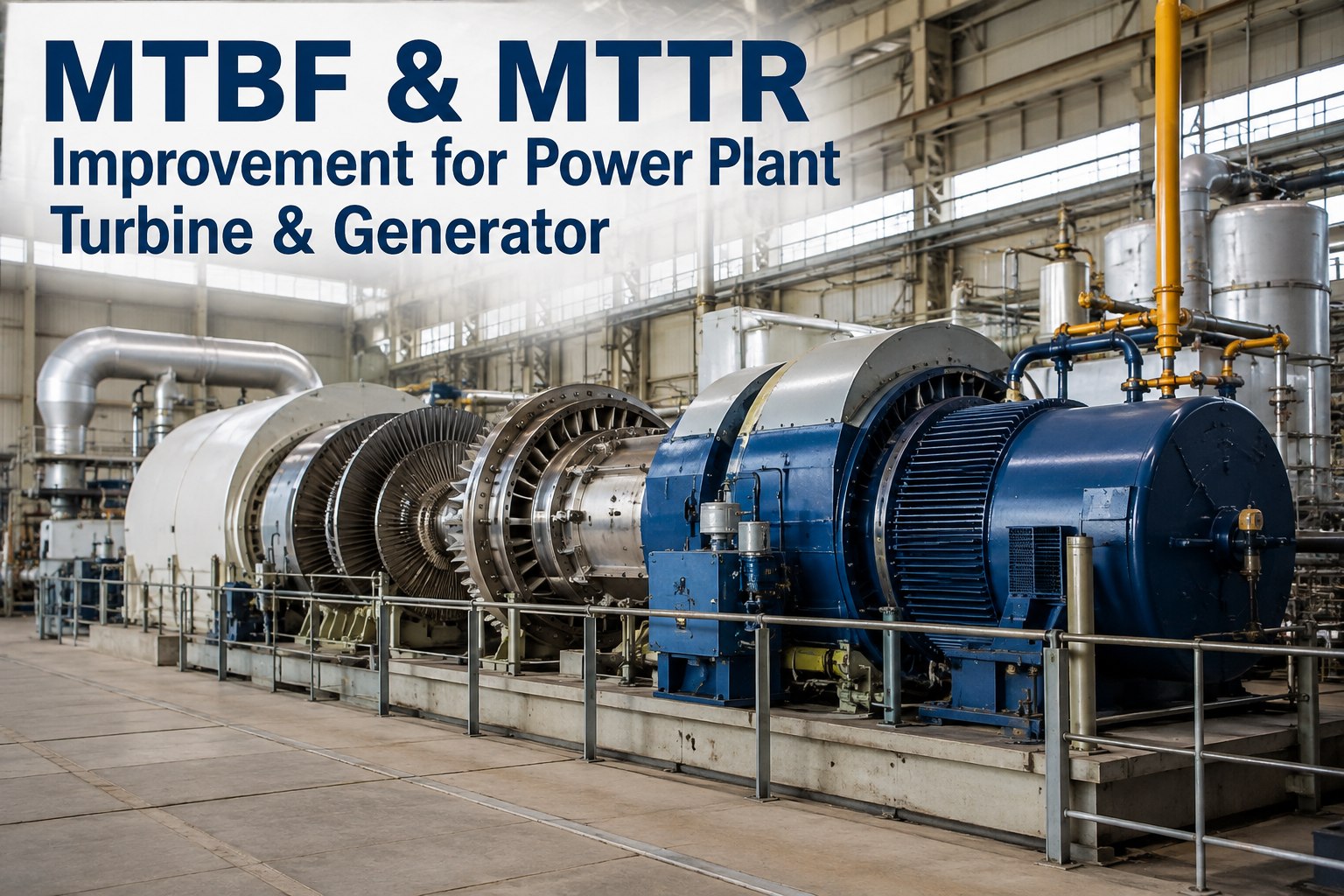
MTBF & MTTR Improvement for Power Generation
Every hour your turbine is down costs $10K–$50K in lost generation revenue. How much are reactive repairs costing you?
A single forced outage on a 500 MW turbine-generator set can cost $500K+ in replacement power, fines, and lost margin. Moving from reactive firefighting to data-driven MTBF and MTTR control is the single highest-leverage shift a power plant reliability team can make. OxMaint gives you the CMMS infrastructure to do it.
Power Plant Reliability Metrics
What drives MTBF and MTTR in power plant turbines and generators?
Turbine MTBF and generator reliability are governed by how well you control four variables: thermal cycling stress, lubrication quality, vibration trends, and spare-parts readiness. Industry data from NERC GADS shows that the top 10% of fossil plants achieve turbine MTBF above 8,000 hours, while the bottom quartile struggles below 1,500 hours. The gap isn't asset age—it's maintenance execution discipline.
Measures failure frequency. Higher is better. A turbine running 7,200 hours with 2 forced outages has an MTBF of 3,600 hours.
Measures repair speed. Lower is better. If those 2 outages took 40 hours total to resolve, MTTR is 20 hours per failure.
With MTBF at 3,600h and MTTR at 20h, turbine availability is 99.45%. Pushing MTBF to 6,000h and MTTR to 10h yields 99.83%—a massive revenue gain.
Cost of Inaction
The real cost of poor turbine MTBF and high generator MTTR
Consider a 180-asset combined-cycle power plant spending $42K per year on emergency turbine repairs and losing 120 hours annually to forced generator outages. At a conservative $8,000 per MWh lost margin, those 120 hours on a 300 MW unit translate to $288M in unrealized gross margin potential—eaten by unplanned downtime. Improving MTBF by 25% and cutting MTTR by 40% reclaims over 70 of those hours. That is the financial stakes of MTBF MTTR power plant management.
| Reliability Scenario | MTBF (Hours) | MTTR (Hours) | Annual Downtime | Est. Lost Revenue |
|---|---|---|---|---|
| Reactive Maintenance (Status Quo) | 1,800 | 32 | 156 hours | $1.25M |
| Preventive (Time-Based PM) | 3,500 | 22 | 55 hours | $440K |
| Predictive (CMMS + IoT) | 6,200 | 12 | 17 hours | $136K |
Improvement Strategy
How to improve MTBF and reduce MTTR for power plant assets
MTBF improvement in power generation requires moving from calendar-based maintenance to condition-based triggers. MTTR reduction requires digitizing the repair workflow so technicians spend time fixing—not searching for manuals, permits, and parts. Here is the 4-phase roadmap reliability engineers use to move the needle.
Audit Asset History & Failure Modes
Migrate 12–24 months of work order history into OxMaint. Run FMEA (Failure Mode and Effects Analysis) on the turbine-generator set to identify the top 20% of failure modes driving 80% of downtime (e.g., bearing degradation, stator winding insulation, blade fouling).
Deploy Condition-Based PMs & Predictive Triggers
Replace static PMs with dynamic triggers based on vibration analysis, oil quality, and thermal imaging data. OxMaint automatically generates work orders when IoT sensor thresholds are breached, catching bearing wear weeks before a forced outage occurs.
Digitize SOPs & Pre-Stage Critical Spares
Attach digital step-by-step repair SOPs, safety lockout/tagout (LOTO) procedures, and OEM manuals directly inside the OxMaint mobile work order. Pre-stage high-velocity spares (journal bearings, seals) in the inventory module to eliminate procurement delays during outages.
Analyze KPIs & Refine PM Frequency
Use OxMaint analytics dashboards to track MTBF MTTR CMMS trends monthly. If MTBF rises and failure modes shift, optimize PM intervals to avoid over-maintenance (which wastes cash) or under-maintenance (which spikes MTTR).
Stop calculating downtime costs. Start eliminating them.
See how OxMaint maps your turbine and generator failure data into automated work orders, predictive alerts, and measurable MTBF/MTTR gains. Book a 30-minute tailored demo today.
CMMS for Power Generation
How OxMaint improves MTBF and MTTR for power plant turbines
OxMaint is an AI-powered CMMS and EAM platform built to close the gap between asset reliability strategy and frontline execution. For maintenance and reliability teams managing power plant turbines and generators, it replaces spreadsheets and paper work orders with a connected digital workflow that drives both MTBF improvement and MTTR reduction simultaneously.
Predictive Maintenance AI
Ingests vibration, temperature, and oil analysis data to predict turbine bearing and generator winding failures 2–6 weeks in advance. Outcome: Cut unplanned downtime 30–50%.
Digital Work Orders & SOPs
Delivers step-by-step repair instructions, LOTO safety checklists, and OEM specs directly to technician mobile devices. Outcome: Reduce turbine MTTR by up to 60%.
Spare-Parts Inventory Tracking
Maintains real-time stock levels for critical turbine spares with auto-reorder points and supplier lead-time tracking. Outcome: Eliminate 95% of outage delays caused by missing parts.
Reliability Analytics Dashboard
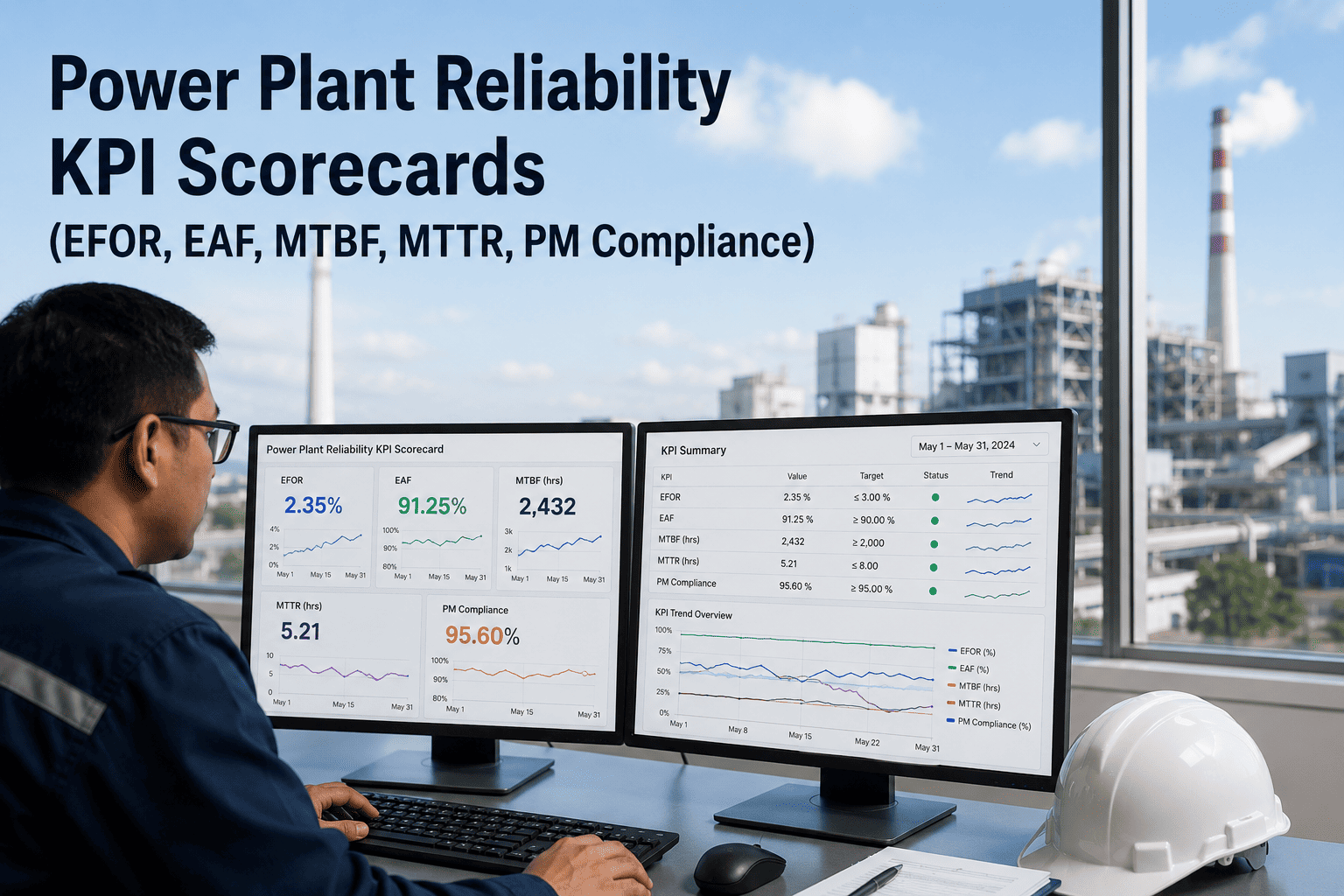
Auto-calculates MTBF, MTTR, OEE, and availability per asset, surfacing underperforming generators and PM compliance gaps in real-time. Outcome: ISO 55000 audit-ready reporting in one click.
Proven Results
What power plant reliability teams achieve with OxMaint
"We moved from paper logbooks to OxMaint and saw our turbine MTBF jump from 2,100 to 4,800 hours in 9 months. The predictive alerts on bearing vibration are a game-changer for our reliability program."
"MTTR during forced outages dropped from 28 hours to 11 hours. Having digital SOPs and pre-staged spares tracked in the CMMS means our technicians walk to the turbine with everything they need."
Frequently Asked Questions
Power plant MTBF and MTTR questions, answered
What is a good MTBF for a power plant turbine?
A good MTBF for a power plant turbine ranges from 4,000 to 8,000+ hours, depending on the asset age, operating profile (baseload vs. peaker), and fuel type. Top-quartile fossil plants tracked by NERC GADS achieve turbine MTBF above 6,000 hours. Consistently falling below 2,500 hours usually indicates a breakdown in preventive maintenance execution, which can be resolved by implementing a structured CMMS like OxMaint.
How do you calculate MTTR for a generator?
Generator MTTR is calculated by dividing the total repair hours by the number of failures in a given period. For example, if a generator experienced 3 forced outages totaling 45 repair hours over a year, the MTTR is 15 hours. You can automate this calculation and track trends in real-time using OxMaint's reliability analytics dashboard—Start Free Trial to see your baseline instantly.
How does a CMMS improve MTBF and MTTR in power generation?
A CMMS improves MTBF by enforcing preventive maintenance schedules and using predictive analytics to intercept failures before they happen. It reduces MTTR by digitizing repair SOPs, managing spare-parts inventory, and streamlining work order approvals so technicians can begin repairs immediately without hunting for permits or parts.
What are the top reliability KPIs for a power plant besides MTBF and MTTR?
Besides MTBF and MTTR, the top reliability KPIs for power plants include Availability (MTBF ÷ (MTBF + MTTR)), OEE (Overall Equipment Effectiveness), Planned Maintenance Compliance (PM Compliance), Forced Outage Rate (FOR), and Equivalent Forced Outage Rate (EFOR). Tracking these within a CMMS ensures alignment with ISO 55000 asset management standards.
How long does it take to see MTBF improvements after implementing a CMMS?
Most power plants see measurable MTBF improvements within 3 to 6 months of implementing a CMMS, with significant MTTR reduction occurring almost immediately as digital SOPs and spare-parts tracking are deployed. Full maturity—where predictive maintenance drives automated work order generation—typically takes 9 to 12 months. To map your timeline, Book a Demo with our reliability engineering team.
Ready to improve your turbine MTBF and cut generator MTTR?
Join the power generation reliability teams using OxMaint to predict failures, digitize repair workflows, and reclaim lost revenue. See it live on your assets in a 30-minute demo.
Free 14-day trial · No credit card required