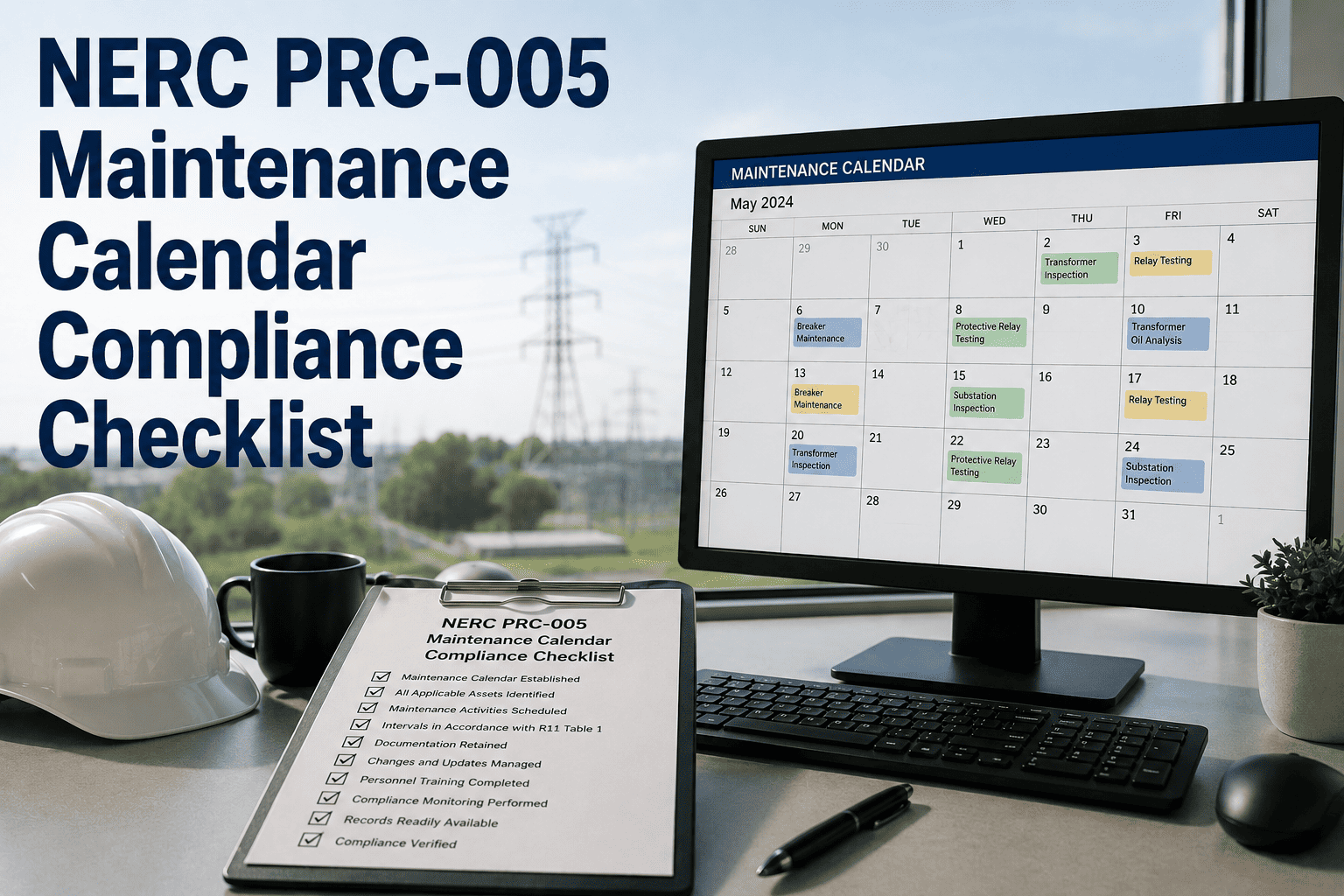
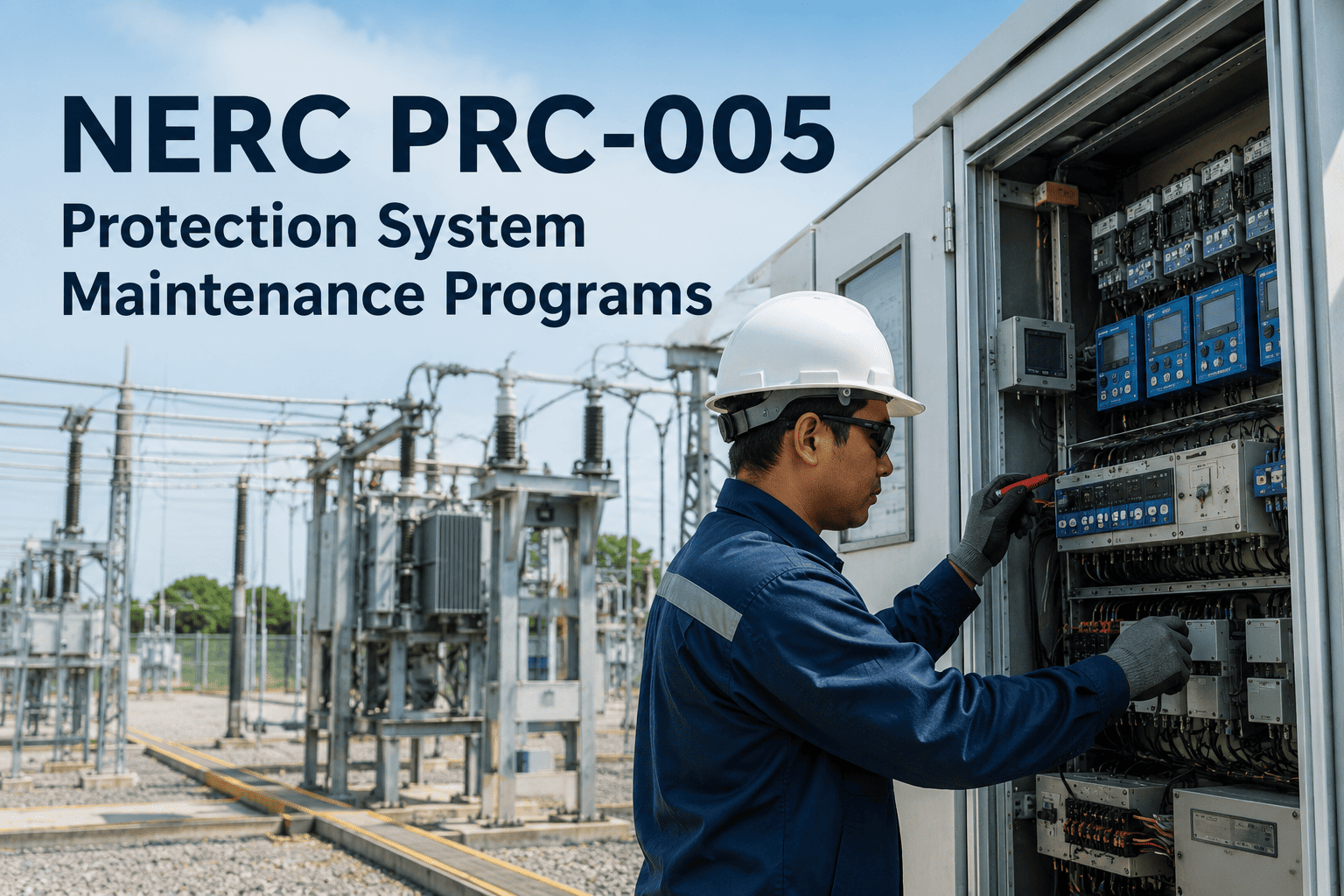
NERC PRC-005 requires utilities to prove that every protection system component — relays, batteries, communication systems, and control circuitry — is tested on documented intervals before an auditor ever asks. Most facilities that receive audit findings do not fail because their equipment is untested. They fail because they cannot produce a complete, time-stamped maintenance calendar that links every device to a completed activity and a qualified technician. If your PRC-005 intervals are tracked in a spreadsheet shared across three desks, that gap is already a liability. Start your OxMaint free trial and put your PRC-005 maintenance calendar on autopilot within days.
NERC PRC-005 · Protection System Maintenance · CMMS Compliance
Your Free NERC PRC-005 Maintenance Calendar Template — And the System That Makes It Stick
Download a ready-to-use PRC-005 maintenance calendar with correct relay, battery, DC supply, and communication equipment intervals. Then see how OxMaint automates every schedule, captures every result, and keeps your NERC audit evidence complete without spreadsheet scrambles.
PRC-005 Calendar — Q2 2025
Zone 1 Distance Relay
6-year max
Scheduled
Station Battery — Bus A
18-month
Due Soon
Pilot Channel — Line 1
3-year max
Scheduled
DC Control Circuit
6-year max
Overdue
Transformer Diff Relay
6-year max
Scheduled
Why PRC-005 Calendars Break Down
Five Reasons Utilities Miss PRC-005 Intervals Even When the Equipment Gets Tested
01
No Single Owner Per Device
PRC-005 applies at the component level — each relay, battery string, and pilot channel has its own interval. When ownership is informal, devices slip through without anyone noticing until an audit reveals a 26-month-old battery test on an 18-month cycle.
02
Interval Mix-ups Across Device Types
PRC-005 Table 1 defines different maximum intervals for different device categories — electromechanical versus microprocessor relays, vented versus valve-regulated batteries. A single calendar applying one interval to all devices will always produce compliance gaps on audit.
03
Evidence Stored Offline Per Technician
Test sheets, calibration reports, and battery load test results saved on individual drives or printed and filed provide no system-level view of which devices are current. One personnel change and that history becomes difficult to locate or verify.
04
Calendar Dates Drift After Extensions
PRC-005 allows a 30-day grace window in limited circumstances. When that extension is granted and the next interval is recalculated manually, calculation errors compound across dozens of devices — and the error only surfaces when the next deadline is already missed.
05
New Assets Added Without Onboarding
Every new relay, battery string, or SCADA communications device installed during a substation upgrade must enter the PRC-005 calendar immediately. Without a structured intake process linked to your maintenance system, new devices operate without a maintenance record for months.
The Template — What It Covers
NERC PRC-005 Maintenance Calendar Template: Every Component Category, Correct Intervals
This template is structured around NERC PRC-005-6 Table 1 device categories. Use it as a starting point for your program — then migrate to OxMaint to automate the tracking, evidence capture, and escalation that a static calendar cannot provide.
Device ID and location
Relay type (microprocessor / electromechanical)
Last test date and technician
Next due date (auto-calculated)
Test result pass/fail and comments
Verification of communications channel (if applicable)
Battery string ID and type (vented / VRLA)
Test type performed (capacity / performance / modified)
Float voltage and specific gravity readings
Capacity result as percentage of rated
DC supply continuity verification
Corrective action if below 80% capacity
Channel ID (power line carrier, fiber, microwave)
End-to-end channel verification date
Signal level and bit error rate (where applicable)
Trip test confirmation
Associated relay coordination confirmed
Next due date and responsible engineer
Circuit ID and associated breaker/device
Continuity test date and result
Trip coil current verification
Visual inspection findings
Wiring insulation resistance result
Technician sign-off and supervisor review
OxMaint · NERC PRC-005 · Automated Maintenance Calendar
A Static Template Gets You Started. OxMaint Keeps You Compliant.
OxMaint automates PRC-005 interval scheduling, captures test evidence per device, and produces complete audit packages without manual assembly. See it live in 30 minutes.
Template vs. CMMS — The Real Difference
What a Spreadsheet Calendar Cannot Do — And What OxMaint Does Automatically
| Capability |
Spreadsheet Calendar |
OxMaint CMMS |
| Interval Auto-Calculation |
Manual date entry — errors compound across hundreds of devices over multiple maintenance cycles |
Next due date calculated automatically from last completed activity per PRC-005 Table 1 intervals |
| Overdue Escalation |
Depends on someone reviewing the spreadsheet before an overdue date passes unnoticed |
Automated alerts sent to responsible technician and supervisor when intervals approach and when overdue |
| Test Evidence Storage |
PDFs and paper forms stored separately — no direct link between calendar entry and test documentation |
Test results, technician ID, timestamps, and attachments stored against each device record automatically |
| New Device Intake |
New assets added to the calendar manually if someone remembers to update it after a substation upgrade |
Asset registration automatically triggers PRC-005 schedule creation based on device category selected |
| Audit Evidence Export |
Manually compiling records from spreadsheet, email, and binders — days of work before an audit begins |
Filter by device, date range, or standard — complete timestamped record package exported in minutes |
| Personnel Change Risk |
Calendar knowledge and history live with specific engineers — turnover creates immediate compliance risk |
All schedules and evidence in the system — reassignment requires no calendar handover or history reconstruction |
PRC-005 Interval Reference
Maximum Maintenance Intervals by Protection System Component — PRC-005-6 Table 1
Use this as a quick-reference guide when building or verifying your maintenance calendar. Every interval shown corresponds to the maximum allowable period between documented maintenance activities under the current NERC standard.
Microprocessor-Based Relay
6 Years
Includes verification of inputs, outputs, and settings. Communication self-monitoring can extend to 12 years under supplemental criteria.
Electromechanical / Solid-State Relay
6 Years
Full functional test required including pickup, timing, and output contact verification at each interval.
Battery — Capacity Test
18 Months
Must demonstrate ability to supply load for the required duration. Replace or recondition if below 80% rated capacity.
Battery — Service / Modified Performance
Up to 6 Years
Permitted as alternative to capacity test under defined conditions. Must meet specific IEEE standards for the test methodology used.
Pilot Protection Communication Channel
3 Years
End-to-end channel verification required. Includes trip test confirmation and signal integrity check for associated relay coordination.
DC Control Circuitry and Trip Coils
6 Years
Continuity test, insulation resistance, and trip coil current verification. Visual inspection of wiring and terminal connections required.
How OxMaint Manages PRC-005
Four Things OxMaint Does That Your Calendar Template Cannot
01
Device-Level Schedule Automation
Every protection system component in your facility gets its own OxMaint asset record with the correct PRC-005 interval assigned at setup. Work orders generate automatically as deadlines approach — no engineer needs to check a calendar. When a test is completed and logged, the next interval calculates immediately from the completion date.
02
Timestamped Evidence Per Activity
Every work order closure in OxMaint captures the technician who performed the work, the exact completion timestamp, the test result recorded, and any corrective actions taken. That evidence is permanently linked to the device record — not filed in a binder or saved on a drive. When an auditor requests the maintenance history for a specific relay, it is available in seconds.
03
Escalation Before Intervals Expire
OxMaint sends configurable alerts when a PRC-005 maintenance window is 60 days out, 30 days out, and on the day a device becomes overdue. The alert goes to the assigned technician and the maintenance supervisor simultaneously — eliminating the dependency on one person checking a spreadsheet column to catch an approaching deadline.
04
One-Click Audit Package Export
Filter by asset type, substation, date range, or maintenance standard. OxMaint exports a complete, timestamped maintenance history with technician attribution and result data for every device in the selected scope. What previously required four days of document assembly becomes an afternoon task — with no gaps because no record was ever stored outside the system.
OxMaint · PRC-005-6 · Relay · Battery · Communications · Free to Start
Your PRC-005 Calendar Should Run Itself. Let OxMaint Run It.
Automated intervals. Timestamped evidence. Audit-ready exports. Every protection system component scheduled, tracked, and documented — without spreadsheets or last-minute scrambles. Go live with your full device register in days, no IT overhead required.
Frequently Asked Questions
NERC PRC-005 Maintenance Calendar — Common Questions
What is the maximum maintenance interval for a microprocessor-based relay under PRC-005-6?
The standard maximum interval for microprocessor-based protective relays is 6 years. However, relays equipped with continuous self-monitoring that meets the supplemental criteria defined in PRC-005-6 Table 1 may qualify for a 12-year interval. OxMaint lets you assign the correct interval per device based on monitoring category, and automatically calculates due dates from the last documented maintenance activity.
Set up your relay schedule in OxMaint free.
Does the PRC-005 template cover batteries and DC supply equipment?
Yes. The template includes separate sections for battery capacity tests (18-month maximum interval), service and modified performance tests (up to 6 years), float voltage checks, DC continuity verification, and corrective action fields for batteries below 80% rated capacity. Interval requirements differ by battery type, and the template separates vented and VRLA records accordingly.
See how OxMaint handles battery schedules in a live demo.
How does OxMaint handle the 30-day grace period allowed under PRC-005?
When a maintenance activity is completed within the 30-day extension window, OxMaint records the actual completion date and calculates the next interval from that date — not from the original due date. The extension and reason can be documented in the work order record. This prevents the compounding calculation errors that occur when extensions are tracked manually in spreadsheets across large device populations.
Can OxMaint generate a PRC-005 audit evidence package on demand?
Yes. OxMaint produces a complete maintenance history export filtered by device type, substation, date range, or standard. Every entry includes completion timestamp, technician attribution, test result, and any corrective actions — exactly the documentation NERC audit staff and regional entity compliance reviewers request.
Start a free trial and run a sample export against your asset list.