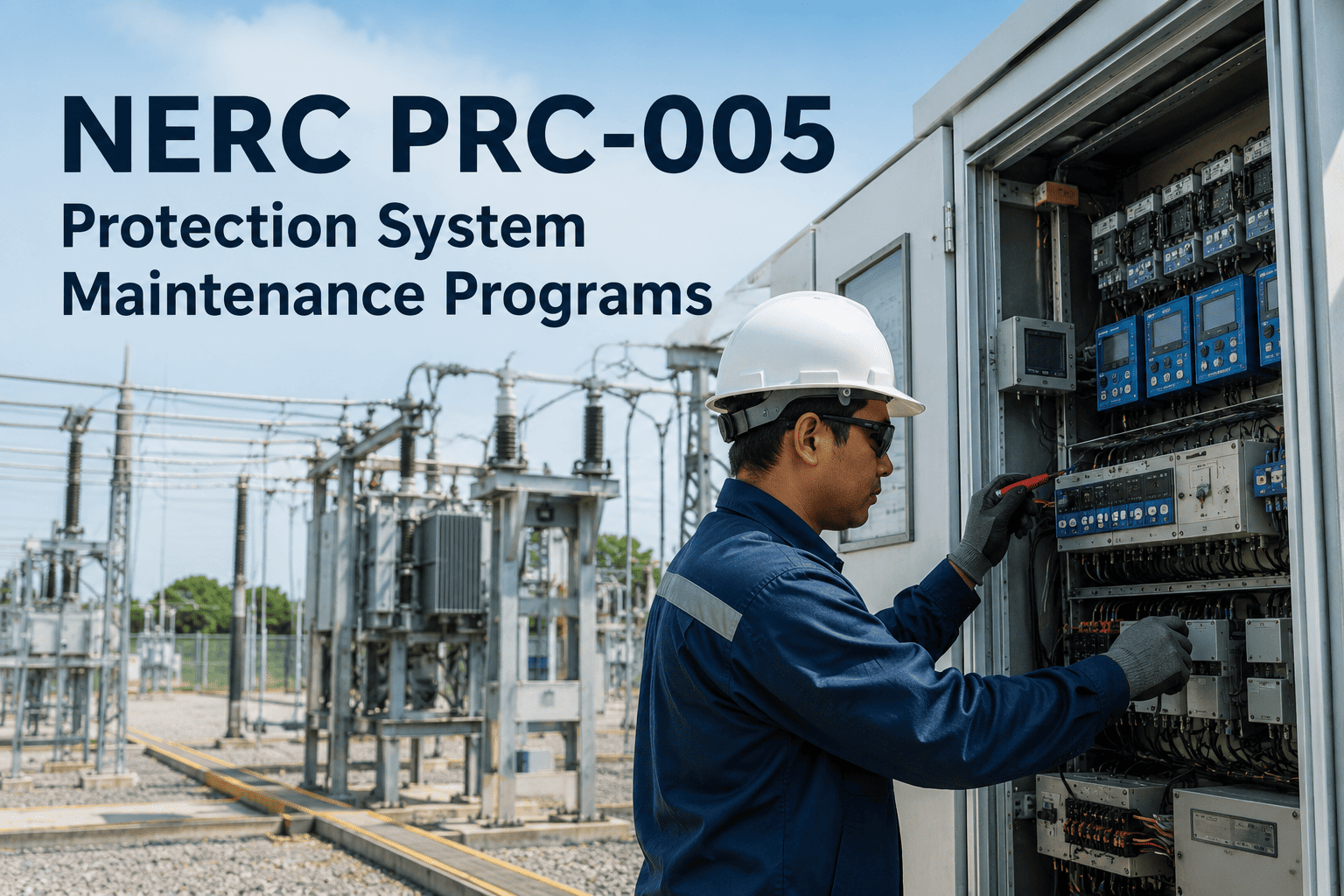
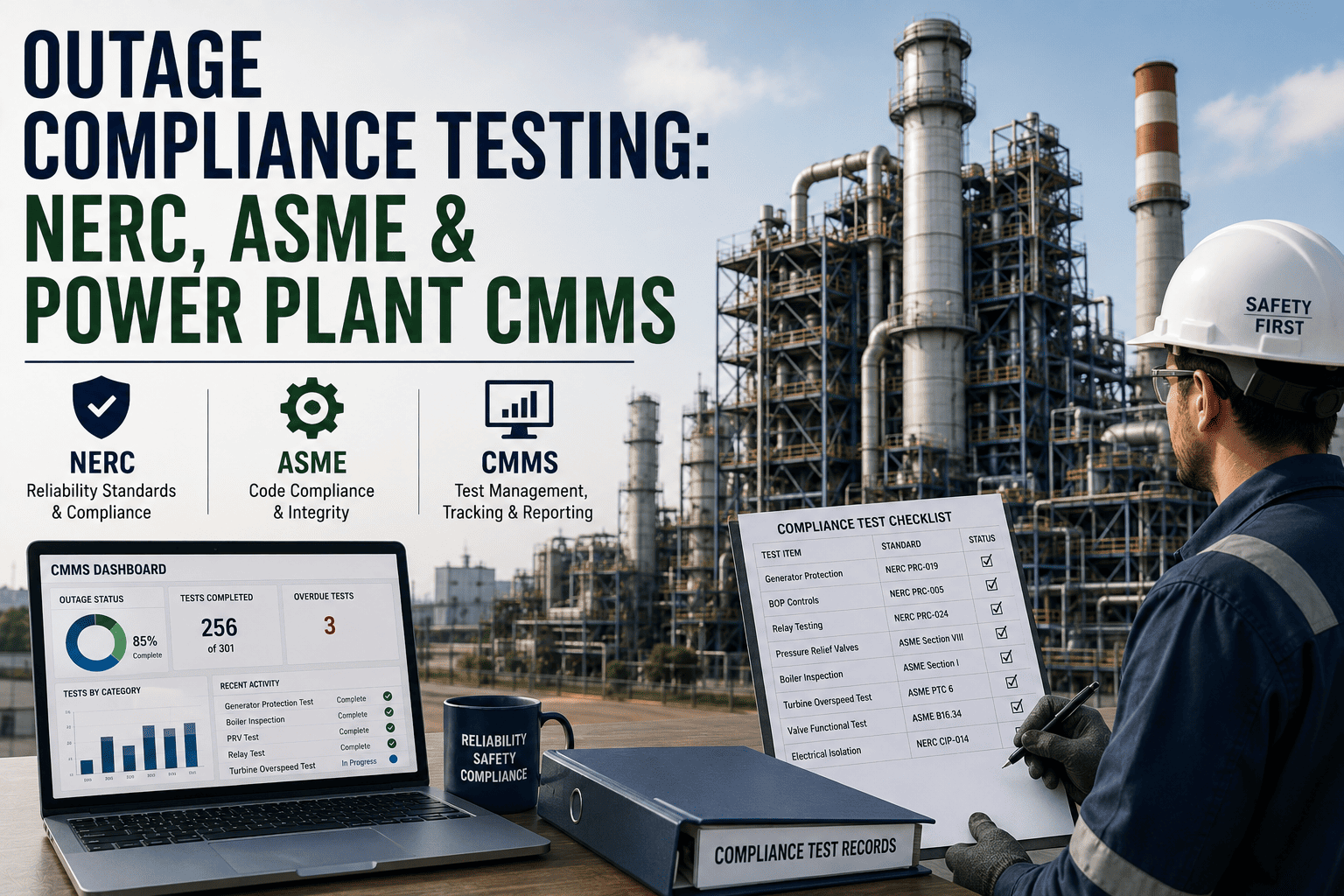
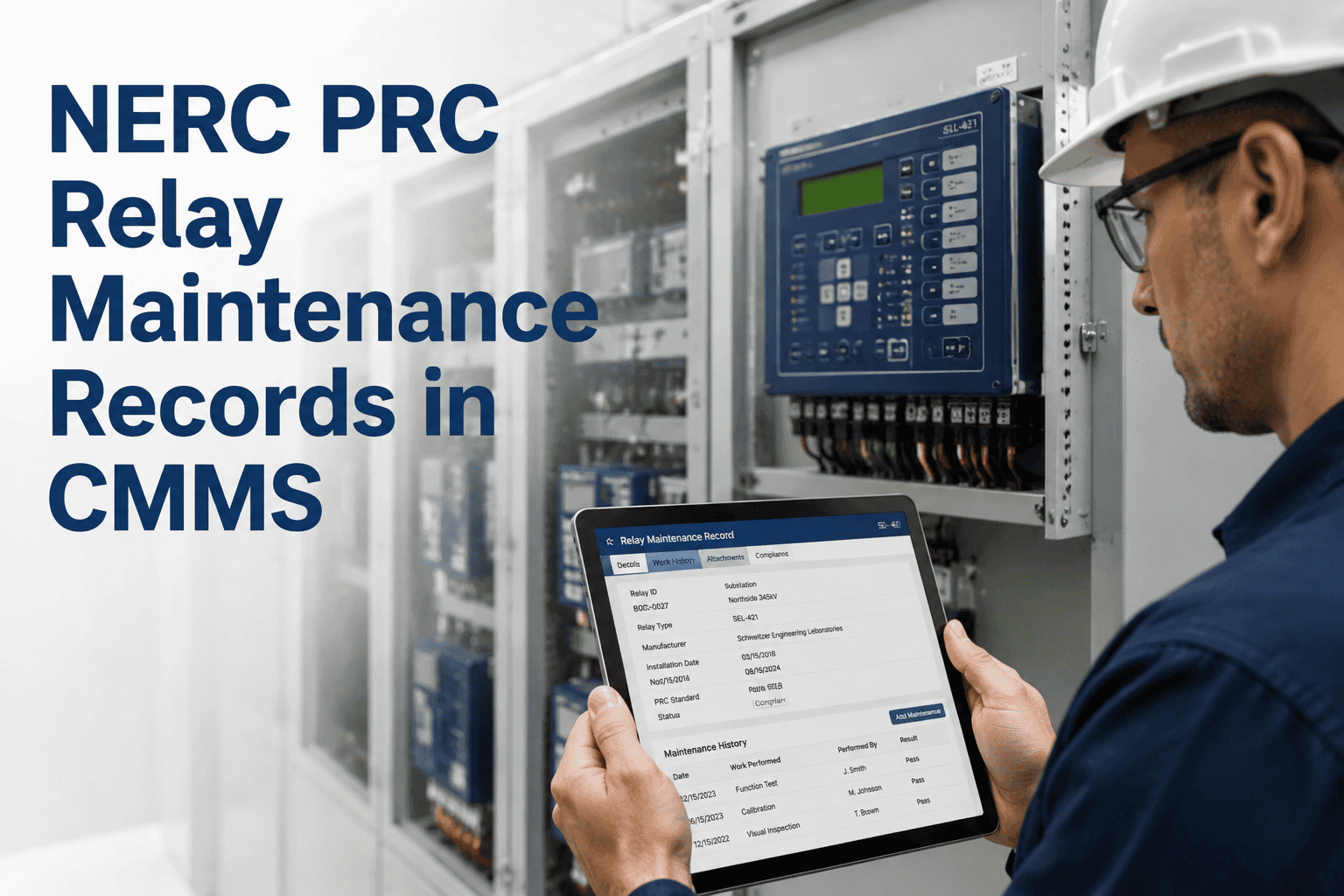
NERC PRC-005 is one of the most frequently violated reliability standards in North America — not because utilities are ignoring protection systems, but because the documentation requirements are unforgiving and the component population is enormous. A single large generation or transmission facility can have hundreds of relays, multiple battery strings, communication channels, voltage and current sensing devices, and control circuitry — each with its own maximum maintenance interval under the PRC-005 tables, each requiring a documented activity record that survives a NERC audit. A relay that was tested but not documented is indistinguishable from a relay that was never tested. Enforcement penalties for PRC-005 violations have reached $400,000 in a single case, and the standard carries a High Violation Risk Factor for time-based maintenance failures under R3. The utilities running clean PRC-005 programs share one trait: they manage their Protection System Maintenance Program (PSMP) in a CMMS that auto-tracks every component interval, generates work orders before deadlines, and builds the audit package as a byproduct of normal maintenance operations. Start a free OxMaint trial to see how a CMMS-backed PSMP works, or book a 30-minute demo with a PRC-005 compliance specialist.
NERC PRC-005-6 Compliance
NERC PRC-005 Protection System Maintenance Programs
Relay testing, battery maintenance, communication verification, and control circuitry — CMMS-tracked intervals, audit-ready records, and zero missed deadlines.
$400K
largest single PRC-005 penalty documented in NERC enforcement actions
High
Violation Risk Factor under R3 for time-based maintenance failures
Most Cited
PRC-005 ranks among the most frequently violated NERC standards since inception
3 Methods
Time-based, Performance-based, or combination — each with distinct documentation requirements
The Standard
PRC-005 in Plain Language — What You Actually Have to Do
PRC-005-6 requires Transmission Owners, Generator Owners, and Distribution Providers to establish and execute a documented Protection System Maintenance Program covering every protection system component on the Bulk Electric System. The standard is structured around four core requirements — each with its own evidence obligation.
R1
Document Your PSMP
Establish a written Protection System Maintenance Program that identifies every covered component, the maintenance method applied (time-based, performance-based, or combination), and the maintenance interval basis for each component type. Batteries must always be in a time-based program regardless of other method choices.
Evidence: Written PSMP document with component inventory and method documentation per component type
R2
Performance-Based Program (if used)
Entities using performance-based maintenance intervals must follow PRC-005 Attachment A procedures to establish and maintain those intervals — tracking Countable Events and adjusting intervals based on actual field performance data. Most utilities blend performance-based for relays with time-based for batteries.
Evidence: Countable Event log, performance interval calculation documentation, and interval review records
R3
Execute the Time-Based Program
This is the highest-risk requirement. Every component in the time-based program must be maintained within the maximum intervals in PRC-005 Tables 1-1 through 1-5, Table 2, Table 3, and Tables 4-1 through 4-3. A single component past its interval — documented or not — is a violation with a High Violation Risk Factor.
Evidence: Completed maintenance records with dates, technician identification, and activity confirmation per table requirements
R4
Manage Unresolved Maintenance Issues
When a maintenance activity cannot be completed within the required interval — due to outage constraints, equipment access, or parts availability — the entity must document the issue as an Unresolved Maintenance Issue (UMI) and demonstrate active corrective efforts. Undocumented UMIs are violations; documented ones with active remediation are defensible.
Evidence: UMI log with dates, responsible party, corrective action plan, and resolution documentation
Component Intervals
Maximum Maintenance Intervals by Component Type
PRC-005 does not use a single interval for all protection system components. Maximum intervals vary by component type, monitoring status, and whether the component is unmonitored or has NERC-defined alarming attributes. Monitoring can extend the maximum interval — but only if the monitoring meets the standard's specific alarm requirements.
PRC-005 Maximum Maintenance Interval Overview
6 Mo
Battery — Unmonitored
Inspect physical condition, verify charger voltage, measure specific gravity (VLA) or conductance/ohmic (VRLA). Verify intercell connection integrity.
Shortest interval in the standard. Batteries in time-based programs always, no exceptions.
12 Mo
Battery — Monitored with Alarming
Verify alarm functionality, confirm float voltage, conduct capacity test at required intervals. Monitoring must meet Table 1-4 alarm specifications to qualify for extended interval.
Extended interval only if monitoring meets NERC alarm attribute requirements.
3 Yr
Protective Relays — Unmonitored
Verify operation of the relay by testing calibration, trip output, and input sensing accuracy. Document as-found and as-left condition. Microprocessor relays with self-monitoring may qualify for extended interval.
Most frequently missed interval in utility fleets. Large component populations make tracking critical.
6 Yr
Relays — Monitored / Microprocessor
Microprocessor-based relays with continuous self-monitoring and alarming for power supply failure, change of settings, and communications loss may qualify for 6-year maximum interval under Table 1-1 conditions.
Qualification requires alarming to meet all Table 2 alarm attributes — document the basis.
12 Yr
Relays — Fully Monitored (All Attributes)
Protection systems with continuous monitoring covering all Table 1-1 alarm attributes — including relay output and trip path verification — qualify for the 12-year maximum interval. Rare in practice; requires comprehensive monitoring architecture.
12-year interval requires documentation of all qualifying monitoring attributes at each component.
6 Yr
Communication Systems (Unmonitored)
Verify communication system is functional. For pilot protection schemes, verify the end-to-end channel integrity and signal levels. Communication channels supporting distance and directional relaying require physical path verification.
Communication channel failures that go undetected disable the protection scheme without alarming.
OxMaint for PRC-005
Hundreds of Components. Multiple Intervals. Zero Margin for a Missed Deadline.
OxMaint tracks every PRC-005 component with its specific interval, auto-generates work orders before deadlines, and builds your audit evidence package continuously — so a NERC audit produces a report, not a violation notice.
Why Violations Happen
The Four Root Causes Behind Most PRC-005 Violations
NERC enforcement case summaries tell a consistent story. PRC-005 violations are almost never caused by willful non-compliance. They stem from four systemic documentation and tracking failures that are entirely preventable with the right program infrastructure.
01
Incomplete Component Inventory
Entities cannot maintain what they have not identified. The most common audit finding is that a component was in service but not included in the PSMP — typically because it was added during a capital project without updating the protection system asset register. Every component protecting a BES element must be in the program.
Enforcement pattern: 31.7% of DC circuits and 100% of batteries missed in one cited case
02
Calendar Drift on Large Populations
A utility with 500 relays on a 3-year interval has relays coming due every week. Managing that calendar manually — in spreadsheets or paper logs — virtually guarantees drift. A relay 2.5 months past its interval has the same compliance status as one never tested: a violation.
Enforcement pattern: 155 instrument transformers and multiple relays exceeded intervals at a single plant
03
Testing Done, Documentation Lost
Field technicians test relays and batteries but record results in paper test sheets that are filed, misplaced, or never transferred to a central system. During an audit, the entity cannot produce evidence that the maintenance occurred — even if it did. A tested relay without a retrievable record is an auditable violation.
Enforcement pattern: "ambiguous instructions related to documenting and retaining evidence" cited as root cause
04
Unresolved Maintenance Issues Not Documented
When a relay cannot be tested within interval due to a planned outage conflict or parts delay, PRC-005 requires the entity to log a formal Unresolved Maintenance Issue and demonstrate active corrective efforts. Entities that simply let the interval expire without logging a UMI have no defense during an audit.
Enforcement pattern: intervals exceeded with no UMI documentation — no corrective action evidence available
CMMS Solution
How OxMaint Closes Every PRC-005 Documentation Gap
Each of the four violation root causes has a direct CMMS solution. OxMaint is not a generic work order system applied to a compliance problem — it is structured around the specific documentation requirements of NERC PRC-005 for protection system asset populations.
Problem: Incomplete inventory
→
PSMP Asset Register in OxMaint
Every protection system component — relay, battery string, communication channel, CT/VT, and control circuit — is registered as an individual asset with component type, monitoring status, qualifying alarm attributes, and the resulting maximum maintenance interval. New equipment added during capital projects links to the PSMP automatically through asset creation workflow.
Problem: Calendar drift
→
Auto-Generated PM Work Orders
OxMaint calculates each component's next due date from the last completed maintenance record and generates a work order automatically at a configurable lead time — typically 30 to 60 days before the maximum interval expires. Supervisors see the upcoming due list by week, and technicians receive mobile work orders with the PRC-005 table requirements pre-loaded for that component type.
Problem: Documentation lost
→
Mobile Field Documentation
Technicians complete PRC-005 maintenance checklists on mobile devices at the equipment — recording test results, as-found and as-left readings, technician ID, and timestamp directly against the component asset record. No paper, no transcription, no post-trip data entry. The maintenance record is created at the moment of activity — exactly the evidence format NERC auditors expect.
Problem: UMIs undocumented
→
UMI Tracking and Escalation
When a work order cannot be completed before a maximum interval expires, the technician flags it as an Unresolved Maintenance Issue directly in OxMaint — triggering a formal UMI record with the date, reason code, responsible engineer, and corrective action plan. Escalation alerts notify management before the interval expires. Auditors see a defensible documented program, not a silence that implies non-compliance.
Audit Readiness
What a NERC PRC-005 Audit Actually Looks For
Regional Entity auditors follow a structured evidence request process. Understanding exactly what they ask for — and having it instantly available — is the difference between a clean audit outcome and a Notice of Alleged Violation.
| Auditor Request |
What They Verify |
Common Gap Found |
OxMaint Evidence Response |
| PSMP document |
Written program exists; component types identified; maintenance method documented per type; batteries in time-based program |
Program exists but component inventory is incomplete or battery method not explicitly documented |
PSMP document linked to full asset register with method and interval documented per component |
| Component inventory |
All protection systems protecting BES elements are identified and included in the program |
Components added during capital projects not enrolled in PSMP; inventory not reviewed after system changes |
Asset register with BES element linkage; new asset creation workflow enforces PSMP enrollment |
| Maintenance activity records |
Each component has a completed maintenance record within its maximum interval, with activity details matching the applicable PRC-005 table requirements |
Records in paper files, technician notebooks, or disconnected systems — cannot be produced on demand |
All completed work orders searchable by component, interval, date, and technician with activity detail attached |
| Battery maintenance evidence |
All batteries in time-based program; 6-month or 12-month interval met; specific gravity, conductance, or ohmic readings documented as applicable |
Battery readings logged but no evidence of comparison to baseline or threshold — readings without analysis |
Battery work orders with readings, baseline comparison, and as-found condition logged per Table 1-4 requirements |
| Countable Event log (PBM) |
If using performance-based intervals, Countable Events since last interval review are documented; interval adjustment process followed per Attachment A |
Entity claims performance-based program but has no Countable Event log or interval review documentation |
Countable Event records linked to component asset; interval review workflow with approval documentation |
| UMI records |
Any component that exceeded its interval has a documented UMI with corrective action evidence |
Intervals exceeded with no UMI — entity has no documentation and no defense |
UMI log with dates, reason codes, corrective plans, and resolution records per component |
FAQ
Frequently Asked Questions
Does every protection system component need to be in a time-based maintenance program under PRC-005?
Not necessarily — relays and communication equipment can be maintained under time-based, performance-based, or a combination of programs. However, all station DC supply batteries must always be included in a time-based program regardless of the method chosen for other component types. This is one of the most commonly misapplied rules in PSMP design.
Book a demo to see how OxMaint structures hybrid TBM and PBM programs.
How does OxMaint handle the different PRC-005 maximum intervals for monitored versus unmonitored components?
Each component in OxMaint carries a monitoring status field and an alarm attribute checklist that determines which PRC-005 table row applies. The system calculates and enforces the correct maximum interval per component — so a monitored microprocessor relay on a 6-year interval and an unmonitored electromechanical relay on a 3-year interval in the same substation each receive the correct PM schedule automatically.
Start a free trial to configure your component intervals.
What should we document when a relay test cannot be completed within its PRC-005 maximum interval?
PRC-005 requires a formal Unresolved Maintenance Issue record with the date the interval was exceeded, the reason maintenance could not be completed, the responsible party, and documentation of active corrective efforts. A UMI with corrective action evidence is a defensible position during an audit; an expired interval with no record is a violation. OxMaint auto-generates the UMI record when a work order passes its maximum interval date without completion.
How long does OxMaint need to retain PRC-005 maintenance records for a NERC audit?
NERC requires records for the most recent completed maintenance activity for each component where the interval exceeds the audit cycle, and all maintenance records since the previous scheduled audit date where intervals are shorter. In practice, maintaining at least two full maintenance cycles of records per component is standard practice. OxMaint retains all records indefinitely and exports them by component, date range, or regulatory scope on demand.
Start a free trial to see the audit export workflow.
Can OxMaint manage a PRC-005 program across multiple substations and generation facilities in one system?
Yes. OxMaint organizes assets by facility, voltage level, and protection system — so a Transmission Owner with 40 substations and a Generator Owner with 8 plants can manage every PRC-005 component in a single system. Regional reporting, facility-level compliance dashboards, and cross-facility audit exports are all available from one account.
Book a demo to see multi-facility PSMP management.
OxMaint for NERC PRC-005
A Missed Interval Is a Violation. A Missing Record Is a Violation. Fix Both — Before the Auditor Does.
OxMaint gives your protection system maintenance team a complete PSMP infrastructure — asset register with PRC-005 intervals per component, auto-generated PM work orders with lead time alerts, mobile field documentation, UMI tracking, and on-demand audit exports. Most utilities are up and running in under three weeks.