NERC PRC-005 is one of the most documentation-intensive reliability standards in the electric utility industry — requiring that every protection system component have a defined maintenance interval, a completed maintenance record, and a retention trail that survives the next audit cycle. Utilities that manage their PRC-005 program on spreadsheets or paper calendars consistently find themselves scrambling before a CIP/PRC audit, piecing together evidence from disconnected files. This page provides a complete NERC PRC-005 maintenance calendar compliance checklist covering relays, batteries, communication equipment, and CMMS record management — structured so your protection engineers and relay technicians can execute every interval on time with zero documentation gaps. Digital CMMS platforms like OxMaint make it possible to link every component to its maintenance interval, auto-schedule work orders, and produce audit-ready reports in seconds rather than days. Start your free OxMaint trial and build your PRC-005 maintenance calendar today.
NERC PRC-005 · Compliance Checklist · Free Guide
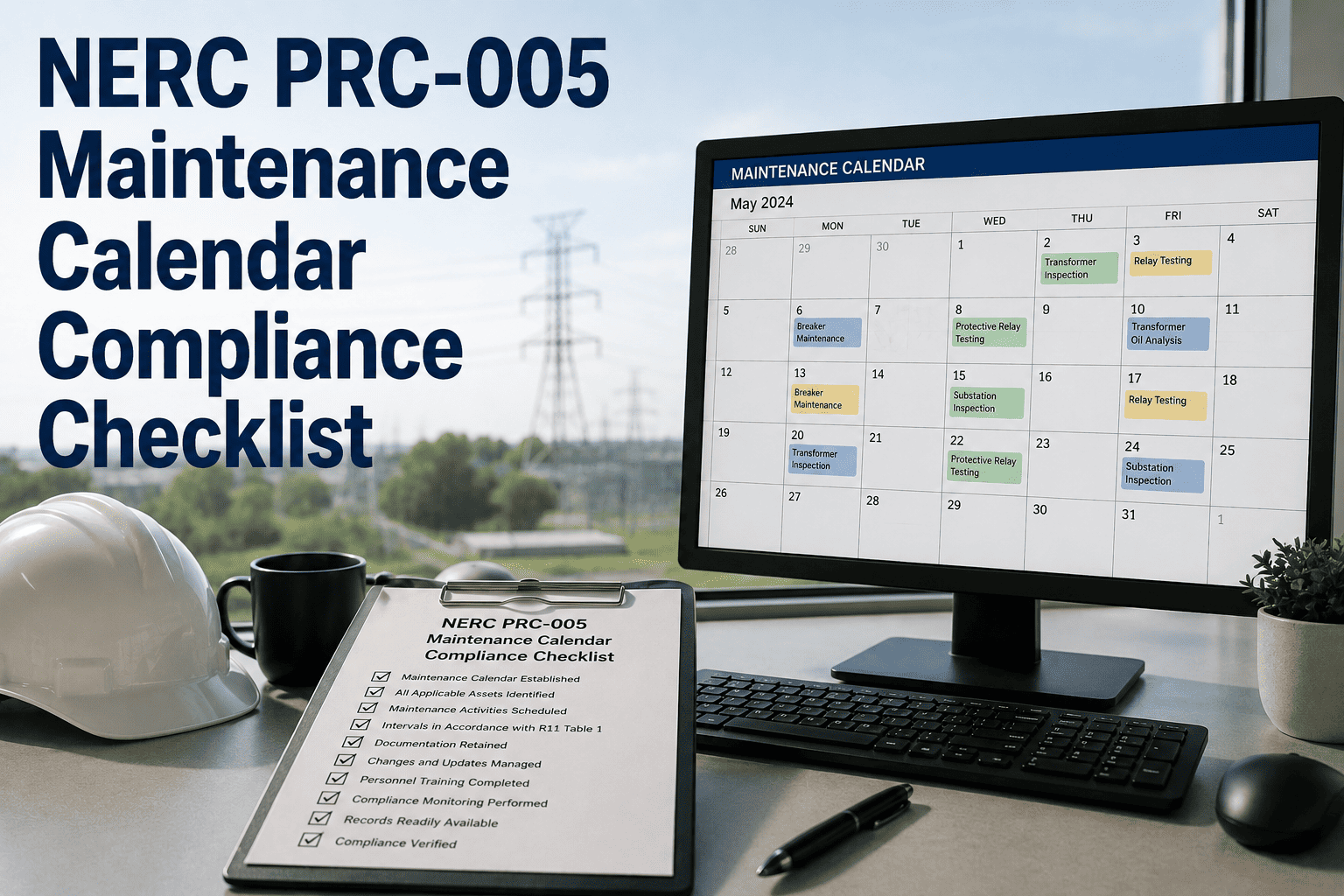
NERC PRC-005 Maintenance Calendar Compliance Checklist
Relay intervals, battery verification, communication equipment, and full CMMS-tracked audit records — every task your compliance program requires, structured for field execution.
6 yrs
Maximum interval for most PRC-005 component categories
3x
More audit findings at utilities without a digital maintenance calendar
100%
Component coverage required — no exceptions for secondary systems
90 day
Grace window for documented equipment unavailability
Standard Maintenance Intervals
PRC-005 Maximum Maintenance Intervals by Component Type
PRC-005 Table 1 defines maximum intervals for each protection system component category. The table below summarizes the most common intervals your maintenance calendar must track. Every interval must be documented in your PSMP with supporting records retained for at least one complete maintenance cycle plus one additional cycle.
| Component Category |
Maximum Interval |
Key Verification Tasks |
Record Required |
| Protective relays (microprocessor-based) |
6 years |
Functional test, setting verification, event record review |
Dated test sheet, technician sign-off |
| Protective relays (electromechanical/solid-state) |
6 years |
Trip test, timing test, operating coil current check |
Dated test sheet, technician sign-off |
| Station DC battery — 18-month verification |
18 months |
Terminal voltage, inter-cell connection resistance, electrolyte level |
Cell-by-cell voltage log |
| Station DC battery — capacity test |
6 years |
Full discharge test to rated capacity, load profile verification |
Capacity test report |
| Battery charger |
6 years |
Output voltage, float voltage, ripple voltage measurement |
Measurement log with calibrated instrument ID |
| Communication systems (protection channels) |
6 years |
Channel test, end-to-end trip test, signal level verification |
Channel test report, both-end sign-off |
| Trip coil and auxiliary tripping relays |
6 years |
Coil continuity, trip current test, breaker trip verification |
Trip test record with breaker operation confirmed |
| Current transformers and voltage transformers |
12 years |
Ratio test, polarity check, burden test, insulation resistance |
Instrument transformer test report |
The Full Compliance Checklist
NERC PRC-005 Maintenance Calendar — All Task Categories
This checklist is organized by the four core PRC-005 compliance pillars. In OxMaint, each task category maps to a scheduled work order type, enabling automatic tracking of every component's maintenance status against its defined interval.
Relay Maintenance
8 tasks
✓Verify relay settings match current approved setting file
Compare firmware-extracted settings to approved setting sheet
✓Functional trip test — inject fault current and verify trip output
Document pickup level, timing, and output relay operation
✓Review relay event records and oscillography files
Confirm no unexplained operations or missed trips since last test
✓Self-diagnostic and alarm output test
Confirm all self-monitoring alarms route correctly to SCADA
✓Input and output wiring continuity verification
Check CT and PT secondary wiring, output wiring to trip coil
✓Firmware version check and document
Record version; flag if manufacturer has issued security bulletin
✓Targets and indicators reset and function test
Confirm target reset clears all visual indicators correctly
✓Test documentation — technician signature and test equipment calibration record
Attach calibration certificates to work order in CMMS
Battery and DC Systems
7 tasks
✓Individual cell voltage measurement — all cells in the string
Flag any cell deviating more than 0.05V from string average
✓Inter-cell and inter-tier connection resistance measurement
Use micro-ohmmeter; compare to prior baseline and OEM spec
✓Electrolyte level and specific gravity check (flooded cells)
Top up with distilled water only; record gravity per cell
✓Battery room temperature and ventilation check
Confirm ambient within 15-27°C; check vent fans functional
✓Battery charger output voltage and float current verification
Document charger output voltage and confirm within design range
✓DC bus voltage and ripple measurement
Ripple must be within manufacturer limit; document instrument ID
✓Full capacity test (6-year interval) — discharge to rated load
Record full discharge curve; replace battery if capacity below 80%
Communication Equipment
6 tasks
✓End-to-end channel test — trip signal loopback verification
Confirm trip signal received at remote end within specified delay
✓Signal level and margin measurement at both terminals
Document receive level; confirm minimum margin per carrier spec
✓Guard and trip frequency verification on power line carrier
Measure transmit and receive frequencies against design settings
✓Fiber or microwave link signal quality measurement
Record BER, received optical power level, and link budget margin
✓Alarm and supervisory output function test
Verify channel fail alarm routes correctly to protection and operations
✓Both-end coordinated test with remote substation — documented sign-off
Both facilities sign the same work order or cross-reference records
Calendar and CMMS Records
6 tasks
✓Verify every protection system component has a CMMS-scheduled maintenance record
No component may exist without an assigned interval and next-due date
✓Review overdue maintenance items — all must have documented justification
Equipment unavailability extensions require dated management approval
✓Confirm retention policy — records for two complete maintenance cycles
Archive all completed work orders with attachments to long-term storage
✓Update PSMP document if any intervals or component categories have changed
PSMP revision history must be maintained and version-controlled
✓Pull compliance summary report — percent on-time by component category
Any category below 100% requires documented corrective action plan
✓Internal audit of records completeness before external NERC/regional entity audit
Assign internal reviewer separate from the maintenance team
No Credit Card · Audit-Ready in Days
Stop Managing PRC-005 Intervals on Spreadsheets
OxMaint tracks every protection component's maintenance interval, auto-schedules work orders before deadlines, and generates NERC-ready compliance reports on demand. Your next audit becomes a one-click export.
Most Common Audit Findings
Top PRC-005 Violations That Trigger NERC Fines
Understanding where utilities consistently fail helps you target your compliance program. These are the most frequently cited PRC-005 violations in NERC audit findings and self-reports.
01
Missing or Incomplete PSMP Documentation
The Protection System Maintenance Program document must explicitly define intervals for every component category. Undocumented component types are automatic violations regardless of whether maintenance was actually performed.
02
Expired Maintenance Intervals Without Approved Extension
Components whose last maintenance date exceeds the defined interval — even by a few days — constitute a violation. Equipment unavailability must be documented contemporaneously, not retroactively.
03
Insufficient Maintenance Records
Records must show what was tested, who tested it, the date, and what result was observed. A work order that simply says "relay tested — passed" without data is not sufficient for audit purposes.
04
Battery Maintenance Tasks Not Completed at Specified Intervals
The 18-month verification and 6-year capacity test have separate tracking requirements. Many utilities fail to separate these intervals in their CMMS, resulting in expired capacity tests going undetected.
05
Communication Channel Tests Missing Remote-End Sign-Off
PRC-005 requires both ends of a communication channel to have documented test records that cross-reference each other. A single-facility record that does not reference the remote end is non-compliant.
06
New Protection System Components Not Added to PSMP
After protection system upgrades or additions, the PSMP must be updated before the component enters service. A delay of even one month before adding a new relay to the maintenance calendar constitutes a compliance gap.
Frequently Asked Questions
NERC PRC-005 Maintenance Calendar — Top Questions
What is a Protection System Maintenance Program (PSMP) under PRC-005?
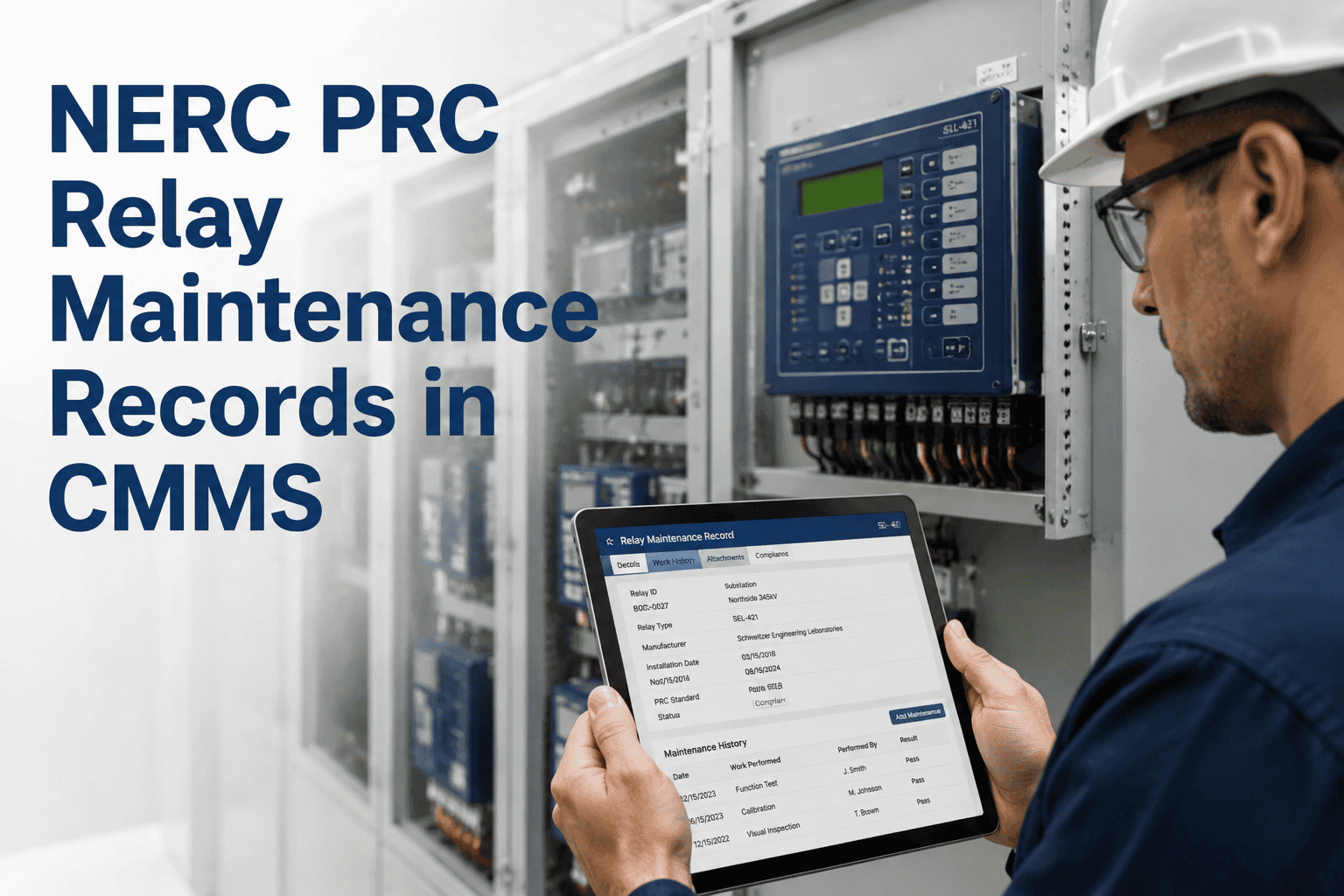
A PSMP is a documented program that defines the maintenance activities, intervals, and evidence requirements for every protection system component at each applicable facility. It must be written, approved by management, and updated whenever component types or intervals change. OxMaint can serve as the digital backbone of your PSMP — linking every component to its scheduled maintenance record.
See how OxMaint structures PSMP tracking.
How long must PRC-005 maintenance records be retained?
NERC requires records to be retained for the most recent two complete maintenance intervals for each component. For a 6-year interval relay, that means 12 years of records must be available. Digital CMMS records with automated retention policies are the most reliable way to meet this requirement without manual archive management.
Can maintenance intervals be extended if equipment is unavailable for testing?
Yes, with conditions. The unavailability must be documented contemporaneously with the reason for non-access (e.g., outage scheduling constraints), and maintenance must be completed as soon as the equipment returns to service. Retroactive documentation of unavailability is typically not accepted in audits.
Book a demo to see how OxMaint manages unavailability documentation.
Does OxMaint support multi-facility PRC-005 tracking across a utility fleet?
Yes. OxMaint supports enterprise-wide asset hierarchies with facility-level, substation-level, and component-level maintenance tracking. Compliance dashboards aggregate status across all facilities, so regional compliance managers can see outstanding items fleet-wide without querying individual substation teams.
What test equipment calibration records are required under PRC-005?
PRC-005 does not prescribe specific calibration requirements, but NERC audit teams consistently expect that maintenance records identify the test equipment used and that calibration certificates are available on request. OxMaint allows technicians to attach calibration certificates directly to work orders as PDF attachments.
Start a free trial and configure your calibration record workflow.
Free to Start · Zero Spreadsheets
Make Your Next NERC PRC-005 Audit a One-Click Export
OxMaint tracks every component, every interval, every test record, and every sign-off — automatically. Stop piecing together audit evidence. Start generating compliance reports in seconds.