Mid-outage and short one critical pump part, a technician found a "compatible equivalent" from an online broker at a third of the OEM price and put it on a purchasing card to keep the schedule moving. The part arrived with a certificate of conformance but no traceable chain of custody — and when it failed eight weeks later, the investigation found remarked markings, a voided OEM warranty, and a purchase that had never touched engineering or procurement. The cheapest part in the building had quietly become the most expensive one. An OEM parts approval workflow exists to make the right source the easy one, routing every requisition through specification, vendor, and spend checks before a single dollar is committed. You can put your procurement on a controlled, auditable approval path by booking a 30-minute demo or starting a free trial on your own purchasing data.
The Sourcing Decision
Every Parts Purchase Picks One of Three Paths
Each parts purchase quietly chooses one of three sourcing paths — and only one of them is genuinely controlled. The job of an approval workflow is to make the safe paths effortless and the risky one visible, so a rush never forces a buyer into the column on the right.
Genuine OEM or authorized distributor
AuthenticityDirect from the manufacturer or its authorized channel
WarrantyFull OEM warranty flows down with the part
TraceabilityUnbroken chain of custody and documentation
Use whenThe asset is critical, in-warranty, or compliance-bound
Qualified equivalent
AuthenticityAftermarket part from an approved vendor, engineering-evaluated
WarrantyVendor warranty; OEM coverage may not apply
TraceabilityDocumented source and recorded equivalency review
Use whenOEM is obsolete or lead times force a vetted alternative
Unapproved maverick buy
AuthenticityBroker or unknown source with no verification
WarrantyNone — a counterfeit failure carries no liability cover
TraceabilityA certificate that cannot be traced or trusted
Use whenNever — this is the path the workflow exists to stop
The Approval Workflow
Five Gates Every Purchase Should Pass
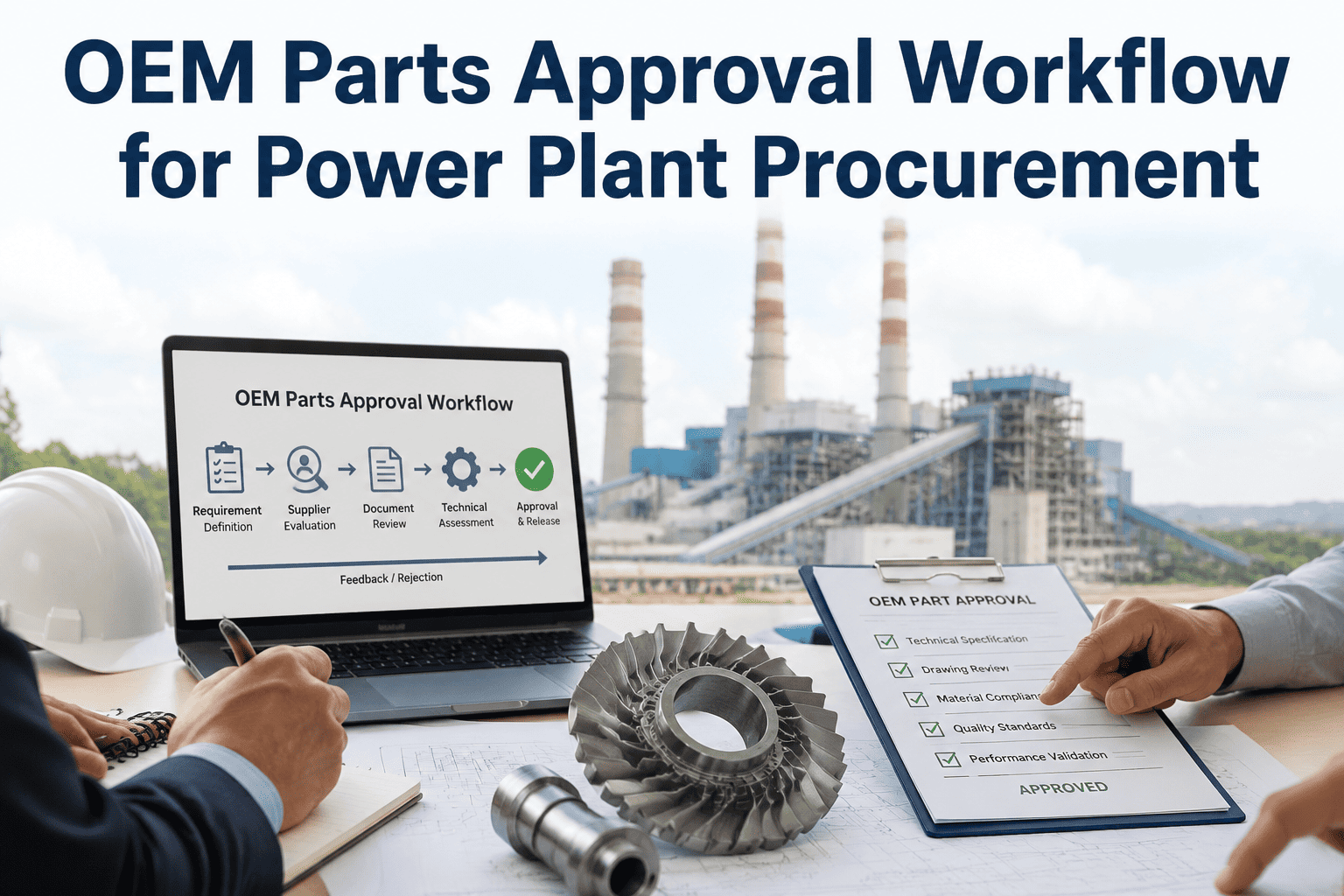
A controlled purchase is not one approval — it is a sequence of gates, each answering a different question and each able to stop a bad buy before it reaches a vendor. The point is not more bureaucracy; it is putting the right check in the right place, so the compliant path is also the fast one.
1
Requisition raised
Requester
Part number, specification, asset, and business justification are captured on one structured form.
Blocks if: the required spec or asset link is missing
2
Spec and equivalency review
Engineering
Confirms the exact OEM part, or signs off a qualified equivalent against the asset's requirements.
Blocks if: a non-OEM substitute has no equivalency approval
3
Vendor verification
Procurement
Source is on the approved vendor list and is the OEM or an authorized distributor.
Blocks if: the vendor is a broker or an unverified source
4
Spend authorization
Approver by threshold
Routed to the right authority level for the purchase value, per the approval matrix.
Blocks if: the value exceeds the approver's limit
5
PO and three-way match
Finance and Receiving
PO is issued, then receipt and invoice are reconciled with traceability documents attached.
Blocks if: the PO, receipt, and invoice do not match
Who Approves What
An Approval Authority Matrix by Spend
The spend-authorization gate runs on a matrix that routes each purchase to the right level of sign-off and the right depth of check. The thresholds below are illustrative — your own policy sets the exact bands — but the principle holds: the larger the spend, the more scrutiny and the higher the authority required.
| Purchase Value |
Approver |
Required Check |
| Up to $1,000 |
Supervisor |
Approved-vendor catalog item |
| $1,000 – $10,000 |
Maintenance Manager |
Engineering specification confirmed |
| $10,000 – $50,000 |
Plant Manager |
Equivalency review if non-OEM |
| $50,000 – $250,000 |
Procurement Director |
Competitive quotes and vendor audit |
| Over $250,000 |
Executive and Finance |
Full sourcing review and sign-off |
Route Every Purchase Through the Right Checks
Book a 30-minute walkthrough and we will build your approval matrix, load your approved vendor list, and show a requisition moving through spec, source, and spend gates inside OxMaint Purchase Management — with a full audit trail behind it.
Know Your Source
Six Red Flags of a Suspect Part
Most counterfeit and suspect parts share a handful of tells, and a workflow that surfaces them at the requisition stage catches the problem before the part is ever installed. When a source cannot be traced, the safe assumption is to treat the part as suspect until proven otherwise.
Broker, not the OEM
The source is an independent distributor rather than the manufacturer or an authorized channel.
Price too good to be true
A quote far below the OEM price is one of the most common counterfeit signals.
Paper, not provenance
A certificate of conformance with no traceable chain of custody back to the maker.
Remarked or refinished
Mismatched, polished, or re-stamped markings, lot numbers, or date codes.
Obsolete, suddenly available
A part the OEM no longer makes that a broker can somehow supply as new.
Documents that don't fit
Paperwork that arrives after the part or shows signs of alteration.
The Economics
The Numbers Behind Procurement Control
Up to 80%
Share of purchases that drift off-contract when approval controls are missing
10–20%
Negotiated savings lost to maverick, off-contract buying
Under 10%
Maverick-spend rate a controlled workflow is built to hold, with PO compliance above 95%
~67%
Suspect parts in one industry study sourced from outside China — counterfeiting is global
$1M+/day
NERC penalty exposure per violation that an unqualified part can put in play
Zero
Warranty or liability cover a counterfeit part carries the day it fails
From The Field
What 20 Years in Plant Procurement Teaches
The riskiest purchases in a plant are almost never the planned ones — they are the 2 a.m. "just get it here" buys during an outage. That is exactly when someone reaches for a broker and a credit card, and exactly when a remarked part with a pretty certificate gets installed in a critical system. The answer is not to slow buyers down. It is to build the approval path so the engineer signs the spec, procurement confirms the source, and the right manager approves the spend — all in the system, in minutes. When the compliant path is the fast path, the rogue buy stops being tempting.
FAQs
Frequently Asked Questions
What is an OEM parts approval workflow, and why does a power plant need one?
It is a defined sequence of checks every parts purchase passes through before money is committed — confirming the specification, the vendor, and the spending authority. Power plants need it because a single unqualified or counterfeit part in a critical system can cause a failure, void an OEM warranty, and create a compliance finding that carries serious penalties. The workflow makes the correct source the default and routes every requisition for review rather than leaving it to a rushed individual decision.
Book a demo to see the workflow on your own asset and vendor data.
How does OxMaint stop off-contract or maverick purchases?
Maverick spend usually happens because the proper process is slower than a workaround, so OxMaint makes the compliant path the quick one. Every requisition routes automatically to the right approver by value, draws from an approved vendor list, and cannot become a purchase order without the required sign-offs. Because every transaction is tied to an approved requisition and a three-way match, non-PO and off-contract spend has nowhere to hide.
Start a free trial to configure your approval matrix and vendor list.
Can the workflow handle qualified non-OEM equivalents, not just genuine OEM parts?
Yes. When a part is obsolete or the OEM lead time is unworkable, the workflow routes the requisition to engineering for an equivalency review against the asset's requirements, and only an approved alternative from a vetted vendor can proceed. The equivalency decision and its documentation are recorded against the part, so the substitution is traceable later. This lets you use legitimate alternatives without opening the door to unverified broker parts.
Book a demo to see equivalency approvals in the flow.
What does the workflow do to prevent counterfeit and suspect parts?
It enforces "know your source" at the vendor gate, allowing purchases only from the OEM or an authorized distributor and flagging brokers and unverified sources for extra scrutiny. It also requires traceability documentation to be attached, so a part that arrives with only a certificate of conformance and no chain of custody is caught and can be quarantined as suspect. Counterfeit parts most often enter through unauthorized channels, and the workflow is built to close that door.
Start a free trial to set your approved-source rules.
Does adding approvals create a full audit trail for compliance reviews?
Every step the workflow runs is recorded — who raised the requisition, who approved the spec and the spend, which vendor was used, and how the three-way match resolved. That digital trail turns an audit from a scramble through emails and paper into a single, searchable record of who approved what, when, and for how much. For a plant operating under reliability and safety obligations, that documentation is as valuable as the controls themselves.
Book a demo to see the audit trail OxMaint builds automatically.
Make the Right Source the Easy One
OxMaint's Purchase Management routes every parts requisition through specification, vendor, and spend checks, allows only approved OEM and authorized sources, and builds a complete audit trail — so a rushed buy never becomes a counterfeit failure, a voided warranty, or a compliance finding.