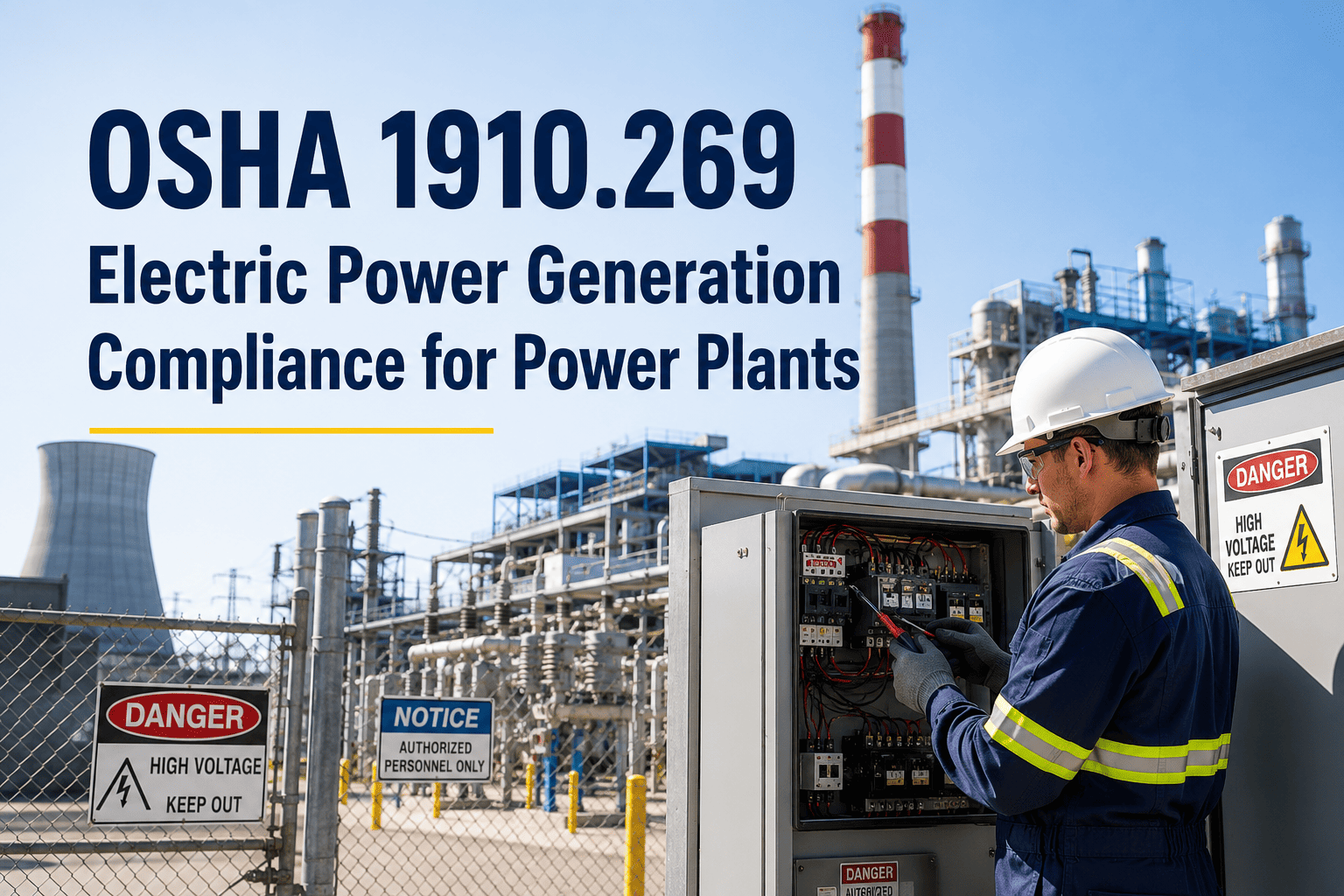
OSHA 1910.269 is the federal standard governing electrical safety in electric power generation, transmission, and distribution — and it reaches into every corner of your plant operations, from arc flash hazard assessments to lockout/tagout procedures and fall protection. For power plant safety and compliance teams, the challenge is not just understanding what 1910.269 requires — it is building an auditable, consistent program that holds up under OSHA inspection. Gaps in training records, missing arc flash assessments, and undocumented PPE programs are the three most common citation drivers. Sign up free on OxMaint to build a digital compliance program that keeps your 1910.269 records organized, current, and inspection-ready.
Who Does OSHA 1910.269 Apply To?
The standard applies to any employer whose workers operate, maintain, or repair electric power generation, transmission, or distribution systems. This includes utility-owned generating stations, industrial cogeneration facilities, independent power producers, and contractors performing maintenance on generation equipment. If your employees work in areas accessible only to qualified personnel — inside plant electrical rooms, on switchgear, near high-voltage equipment — 1910.269 governs that work.
The Five Pillars of 1910.269 Compliance
A defensible 1910.269 compliance program rests on five interconnected requirements. Weakness in any one pillar creates both injury risk and citation exposure. Each requires documentation that survives an OSHA inspection or post-incident investigation.
Only qualified employees — those with documented training and demonstrated skills for the specific voltages and equipment they encounter — may work on or near energized electrical systems. Training must cover hazard identification, minimum approach distances, PPE selection, and emergency response. Refresher training is required whenever new equipment, work practices, or procedures are introduced. CMMS-linked training records with expiration tracking prevent gaps that generate citations.
Before any work on or near exposed energized parts, employers must estimate the incident energy (cal/cm²) to which workers may be exposed. This assessment determines the arc flash boundary and the minimum arc rating of required PPE. Assessments must reflect actual system configuration — an assessment performed on original plant drawings that has never been updated for subsequent equipment changes is not compliant and will not protect workers.
1910.269 specifies minimum distances from energized conductors based on system voltage, transient overvoltage factors, and altitude above 900 meters. Qualified employees must know and observe MAD for every voltage level they encounter. For live-line work, insulated tools and rubber insulating equipment extend the effective MAD. MAD violations are among the most frequently cited 1910.269 deficiencies and are directly linked to electrocution and arc flash fatalities.
For generation equipment, the standard requires full lockout/tagout procedures to de-energize systems before maintenance. For transmission and distribution work, de-energization and equipotential zone grounding are the required protection method. The grounding establishes a zone where all conductors and equipment are at the same potential, protecting workers if the system is accidentally re-energized. LOTO procedures must be equipment-specific and documented in the CMMS as completed work orders.
The 2014 final rule introduced specific fall protection requirements for workers on poles, towers, and elevated platforms. It also established host employer responsibilities — when a utility or plant owner contracts work to outside contractors, the host must share information about electrical hazards at the site and coordinate safety responsibilities in writing. This contractor coordination requirement is frequently missing during OSHA inspections at plants that rely on contract maintenance crews.
Arc Flash Compliance: What the 2014 Rule Actually Requires
The 2014 revision to 1910.269 introduced the first-ever mandatory arc flash requirements in federal law. Before 2014, arc flash protection guidance existed in NFPA 70E as an industry standard but was not federally enforceable. The current rule created three specific, auditable requirements for arc flash protection.
| Requirement | What the Rule Requires | Common Compliance Gap |
|---|---|---|
| Incident Energy Estimation | Employer must estimate the incident energy to which each employee may be exposed before work begins on or near exposed energized parts | Outdated studies that do not reflect current protective device settings or system configuration changes made since last assessment |
| Arc Flash Boundary | Work within the arc flash boundary requires arc-rated PPE. The boundary is the distance at which a worker would receive a 1.2 cal/cm² exposure — the onset of a second-degree burn threshold | Boundaries posted on equipment labels that were calculated from an old study and no longer reflect actual incident energy at the equipment |
| Arc-Rated PPE Selection | PPE arc rating must be greater than or equal to the estimated incident energy at the working distance. Clothing system arc rating applies — the arc rating of the outermost layer is not automatically the system arc rating | Issuing PPE without verifying arc rating against site-specific incident energy values, or relying on PPE category tables not validated against the plant's actual system data |
| FR/AR Clothing Baseline | All employees exposed to arc flash hazards must wear flame-resistant or arc-rated clothing as their outer layer — even during tasks not requiring entry inside the arc flash boundary | Allowing workers to wear synthetic or non-FR clothing while performing switching or observation tasks near energized equipment |
Documentation That Survives an OSHA Inspection
OSHA inspections at power generation facilities typically request four categories of records. Plants that rely on paper-based maintenance and training systems routinely fail to produce these records in the timeframe OSHA allows — which itself becomes a citation item. A CMMS with digital work order history and training record linkage eliminates this exposure.
Dates, topics, instructor, and employee acknowledgment for initial qualification training and all refresher sessions — organized by employee and equipment/voltage level. Must demonstrate currency.
Current incident energy analysis, arc flash boundary calculations, and PPE requirement by equipment location — with revision date demonstrating the study reflects current system configuration.
Equipment-specific written procedures for de-energizing, locking out, and verifying zero-energy state — linked to work orders as completed records with employee signatures.
Written records of hazard information shared with contract employers, PPE verification for contractor personnel, and host employer coordination agreements as required by 1910.269(a)(3).
Confined Space Entry Under 1910.269
The 1910.269 standard allows routine entry into certain enclosed spaces — manholes, vaults, and similar locations — without full permit-required confined space (PRCS) procedures, provided specific precautions are applied. This exception only holds when the space does not contain life-threatening hazards after applying the 1910.269(e) precautions. When electrical hazards, oxygen deficiency, or flammable gases remain, full PRCS procedures under 1910.146 apply. Many plants incorrectly apply the 1910.269 enclosed-space exception to spaces that require full PRCS procedures — creating serious citation and injury exposure.
Test for oxygen content, flammable gases, and toxic air contaminants before entry. Results documented and available to entrants.
After applying 1910.269(e) precautions, does a life-threatening or escape-impairing hazard remain? If yes, PRCS procedures apply. If no, 1910.269 enclosed space procedures apply.
Continuous atmospheric monitoring during entry, emergency equipment staged at entry point, and communications maintained with above-ground attendant throughout.
Entry log, atmospheric test results, and any corrective actions documented in CMMS work order before closure. Entry records are inspection-ready evidence of compliance.
Expert Perspective
The arc flash assessment gap is the most dangerous compliance failure I encounter during facility reviews. Plants complete their first assessment at commissioning and never update it — but every time protective device settings change, a breaker is replaced, or a transformer is added, the incident energy values change. An outdated assessment does not protect workers and does not satisfy the rule. The assessment must reflect the system as it currently operates, not as it was built ten years ago.
Host employer coordination is the most overlooked section of 1910.269 in facilities that use contract maintenance crews. The rule is explicit — before contract employees begin work, the host must provide hazard information and coordinate protective measures. Most plants have no written record of this exchange. When an incident involves a contractor, the absence of these coordination records makes the host employer liable alongside the contractor. A one-page CMMS-linked coordination record for each contractor engagement eliminates this exposure entirely.