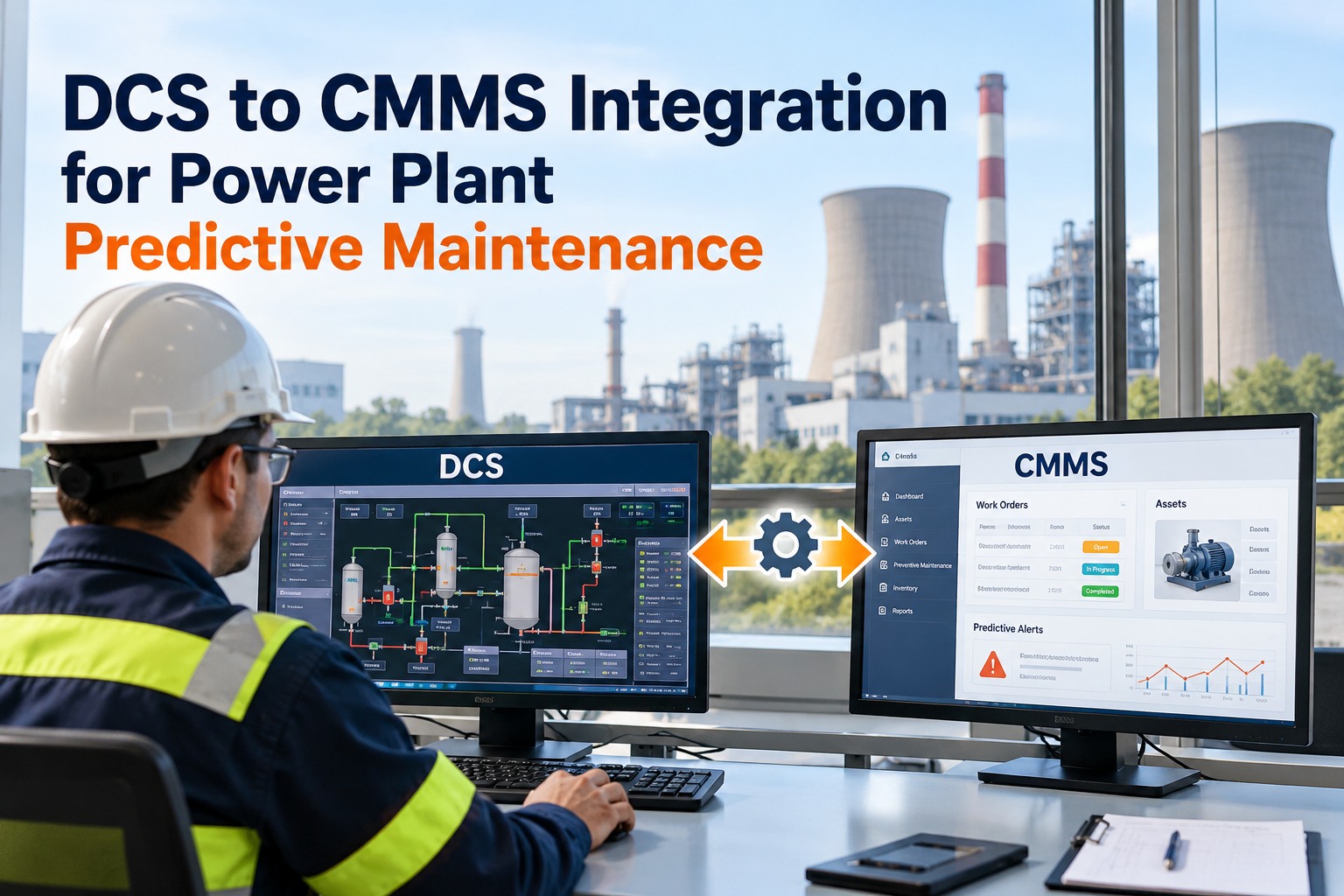
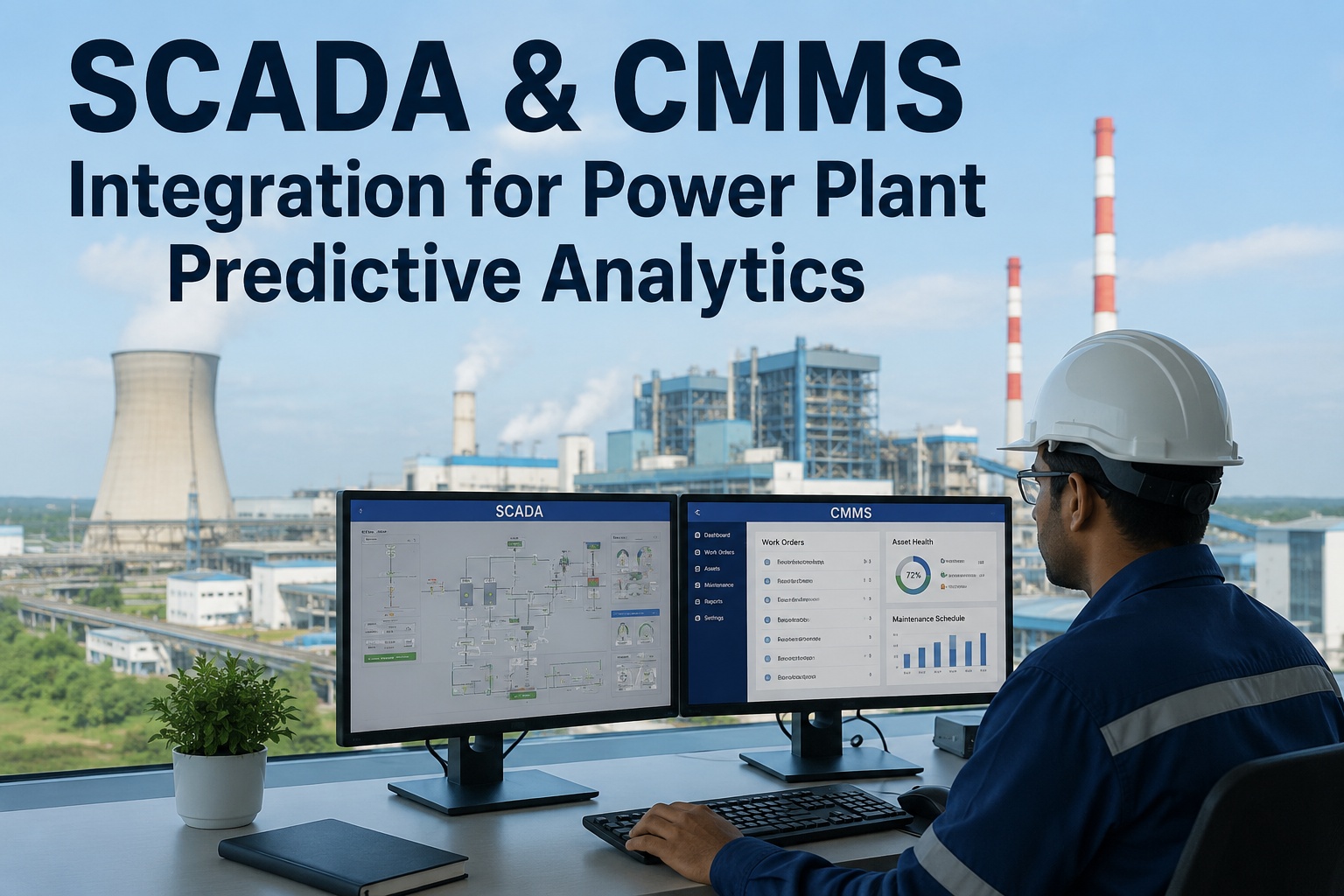
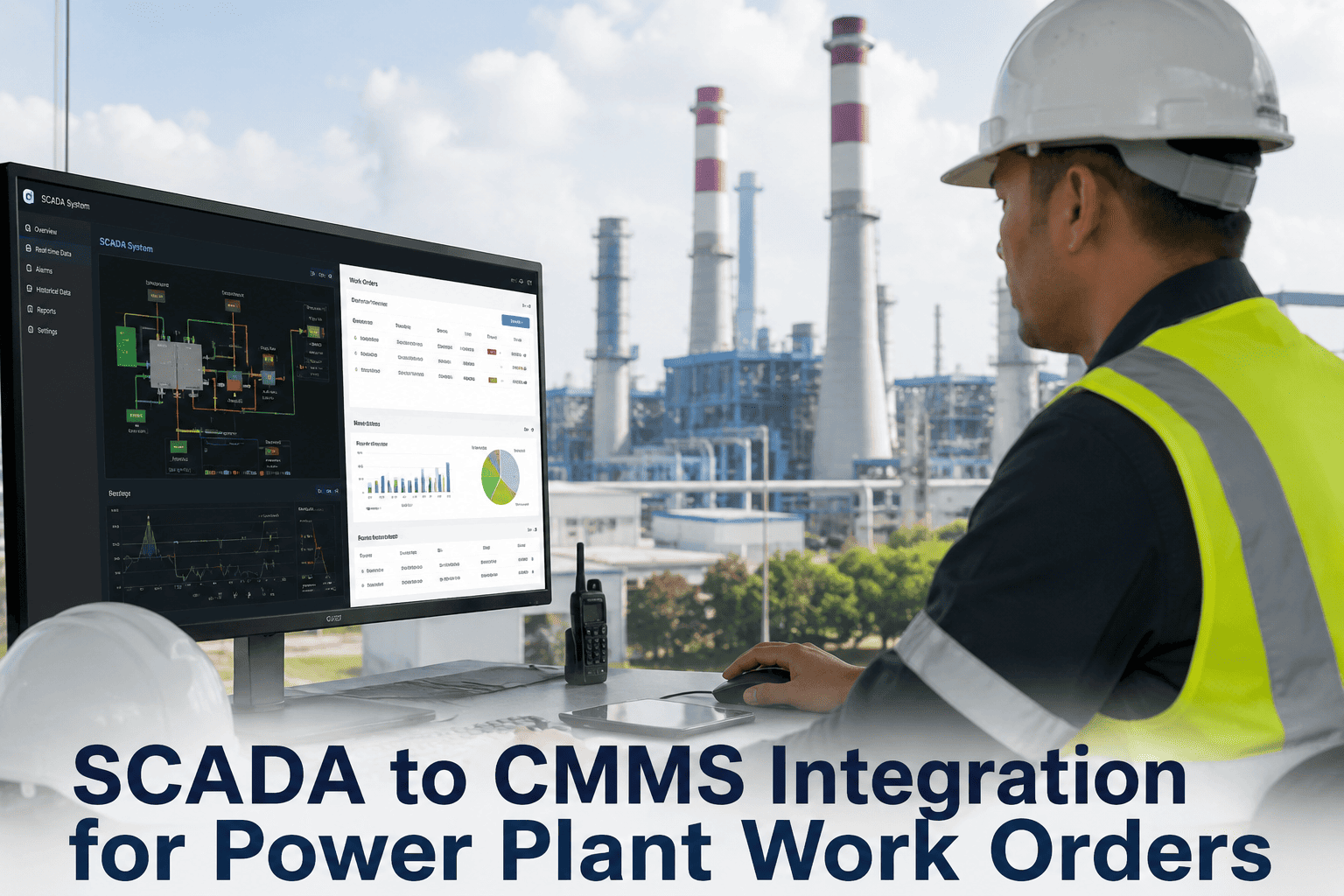
Most power plants already have their Distributed Control System collecting tens of thousands of data points every second — turbine speed, boiler pressure, vibration amplitude, transformer temperature — yet that process intelligence almost never reaches the maintenance team's CMMS, where it could be triggering work orders, forecasting failures, and scheduling inspections before the alarm sounds. The protocol gap between DCS platforms like Emerson Ovation, ABB 800xA, Siemens SPPA-T3000, and Honeywell Experion and a modern CMMS is exactly what this guide closes. If your plant's sensor data still sits siloed in the historian while your maintenance team works from gut feel and fixed-interval schedules, start a free Oxmaint trial and see what sensor-driven maintenance actually looks like in practice.
Power Plant OT-to-Maintenance Integration — 2026
DCS & OSIsoft PI Integration With CMMS: Turn Sensor Data Into Work Orders
Tag mapping, alarm routing, threshold-triggered work orders, and bidirectional historian sync — for Emerson Ovation, ABB 800xA, Siemens SPPA-T3000, and Honeywell Experion environments.
60%
Bandwidth reduction at edge gateway vs raw polling streams
20–35%
Fewer unplanned stoppages with sensor-triggered CMMS work orders
10,000+
Installed ABB 800xA systems across 100+ countries monitoring 50M+ tags
1.4M MW
Generating capacity managed by Emerson Ovation installations globally
Emerson Ovation
Power Generation Leader
ProtocolOPC-DA · OPC-UA · Modbus TCP
HistorianOvation Process Historian / OSIsoft PI
CMMS PathOPC-UA → Edge Gateway → REST API → CMMS
Key StrengthNative OPC-UA export; turbine & boiler tag libraries well-structured
ABB System 800xA
19.2% Global DCS Market Share
ProtocolOPC-UA · FOUNDATION Fieldbus · PROFIBUS
HistorianABB Asset Optimization / OSIsoft PI
CMMS PathAsset Optimization API → predefined CMMS interface → Oxmaint
Key StrengthBuilt-in CMMS connectivity layer; predefined IBM Maximo & SAP PM interfaces extensible to Oxmaint
Siemens SPPA-T3000
3,000+ Units Worldwide
ProtocolOPC-UA · IEC 61850 · PROFINET
HistorianSiemens Historian / OSIsoft PI via OPC connector
CMMS PathT3000 OPC server → PI connector → PI Web API → CMMS REST
Key StrengthStructured Workbench config; single-software commissioning reduces integration mapping time
Honeywell Experion PKS
Process & Power Specialist
ProtocolOPC-DA · OPC-UA · Modbus · HART
HistorianHoneywell PHD / OSIsoft PI
CMMS PathExperion OPC-UA → OSIsoft PI → PI Web API → CMMS
Key StrengthExperion Alarm Management module provides pre-filtered, prioritized alarm streams for CMMS routing
01
Field Sensors & DCS (OT Layer)
Thousands of sensors on turbines, boilers, pumps, transformers, and generators stream continuous process data into the DCS. Protocols: Modbus RTU, OPC-DA, OPC-UA, FOUNDATION Fieldbus, PROFIBUS, HART, IEC 61850. These devices have been in place for 10–20 years and cannot be replaced — only connected upward.
⮟
02
Edge Gateway (Protocol Translation)
The edge gateway polls DCS data, converts 20+ legacy protocols into OPC-UA or MQTT, applies engineering unit conversions, filters noise, and republishes only meaningful change-of-state events upward. This reduces bandwidth by up to 60% compared to raw polling streams — critical in air-gapped substation and switchyard environments.
⮟
03
OSIsoft PI / Data Historian (Time-Series Store)
OSIsoft PI (now AVEVA PI) receives translated tag data via PI OPC connector, PI Interface for OPC-DA/UA, or direct DCS adapters. The historian stores billions of timestamped data points per day, enabling trend analysis, pattern detection, and the condition-based maintenance threshold calculations that feed the CMMS trigger layer.
⮟
04
CMMS Integration Layer (Threshold Engine + Work Order Router)
Oxmaint queries the PI historian via PI Web API or REST connector at configurable intervals. When a monitored tag crosses a defined threshold — Warning, Alarm, or Critical — the CMMS automatically generates a work order, assigns it to the correct craft, attaches the relevant spare parts list and checklist, and sets priority. Zero human intervention required.
Sensor-Driven Maintenance Platform
Connect Your DCS and OSIsoft PI Historian to Oxmaint CMMS
Oxmaint connects to your existing OSIsoft PI, AVEVA PI, Honeywell PHD, or SCADA historian via standard APIs — mapping tags to assets, configuring thresholds, and auto-generating work orders without rebuilding your OT architecture.
Tag mapping is the process of linking a raw DCS tag name (e.g. GT1.BRG3.VIB.X) to a specific asset in the CMMS (Gas Turbine 1 → Bearing 3 → Vibration X-axis). Without it, sensor alarms have no asset context and cannot generate meaningful work orders. Without clean tag mapping, DCS-to-CMMS integration produces noise, not intelligence.
Step 1
Tag Inventory Export
Export the full DCS tag list from the historian. For a 500 MW plant, expect 15,000–80,000 active tags. Filter to maintenance-relevant signals: vibration, temperature, pressure, current draw, flow rate, speed. Typically 5–15% of total tags.
Step 2
Asset Hierarchy Alignment
Match filtered tags to the CMMS asset hierarchy. Each tag must link to a specific equipment ID — turbine, boiler, pump, motor, transformer — at the correct location level. Naming conventions rarely match between DCS and CMMS; a cross-reference table is the required deliverable.
Step 3
Threshold Configuration
For each mapped tag, define three threshold bands — Warning (early drift detection), Alarm (investigation required), Critical (immediate response). Thresholds are set per asset type, informed by OEM specs and historical failure data from the CMMS maintenance record.
Step 4
Work Order Routing Rules
Map each threshold breach to a CMMS response: work order priority, craft assignment (Mechanical, Electrical, Controls), required spare parts, and the pre-built inspection checklist. Warning thresholds create planned work orders; Critical thresholds create emergency dispatch notifications.
Step 5
Closed-Loop Validation
After integration, completion data from closed CMMS work orders writes back to the historian. The actual condition found by the technician is compared against the sensor trend — refining future thresholds and improving prediction accuracy over time.
Warning
Tag value exceeds baseline by 10–20%
Planned work order created · Low priority · Scheduled in next PM window
Gas turbine bearing vibration 12% above rolling baseline — inspection scheduled in 14 days
Alarm
Tag crosses manufacturer alarm setpoint
Corrective work order created · High priority · Technician notified within 1 hour
Boiler feed pump temperature at 94°C against 90°C alarm limit — investigation work order dispatched
Critical
Tag at or beyond trip setpoint
Emergency work order · Immediate dispatch · Supervisor escalation notification
Generator winding temperature at trip threshold — emergency isolation and inspection work order created simultaneously
Why Raw DCS Alarms Are Not Enough
DCS alarms tell operators what is happening at the control room screen. They do not create maintenance records, assign technicians, check parts availability, or generate audit trails. The CMMS integration layer translates alarms into structured maintenance actions — closing the gap between operations and reliability in a way that the DCS alone cannot.
20–35%
Fewer Unplanned Stoppages
Sensor-triggered work orders catch failure precursors 2–4 weeks before breakdown — converting unplanned shutdowns into scheduled maintenance windows at a fraction of the cost.
100%
Timestamped Audit Trail
Every sensor breach, work order, technician action, and parts used is recorded with timestamps cross-referenced between the historian and CMMS — NERC CIP and ISO 55001 evidence ready on demand.
Zero
Manual Alarm-to-Work Order Steps
The threshold engine converts DCS alarm events into CMMS work orders automatically — no control room to maintenance-desk phone calls, no manual work request entry, no time lost between detection and dispatch.
Continuous
Threshold Self-Refinement
Completed work order findings write back to the historian. Actual failure conditions calibrate future thresholds, improving prediction accuracy with every maintenance cycle rather than relying on static OEM setpoints alone.
Does the CMMS integration require changes to the DCS configuration or control logic?
No. The integration reads data from the historian layer — OSIsoft PI, AVEVA PI, or the DCS OPC server — without modifying any DCS control logic, setpoints, or safety systems. Your OT team does not need to be involved beyond granting read access to the OPC or PI endpoint. Book a demo to walk through the architecture for your specific DCS platform.
How many tags should we map to the CMMS to start?
Start with 50–200 high-criticality tags covering your top 10–20 assets by failure impact — main turbine bearings, boiler feed pumps, generator windings, cooling water pumps. Expand after the first 90 days once threshold calibration is validated. Mapping every tag from the start leads to alarm flooding and low-quality work orders.
Can Oxmaint connect to both OSIsoft PI and a DCS OPC server simultaneously?
Yes. Oxmaint supports concurrent connections to PI Web API, OPC-UA endpoints, and SCADA REST interfaces — routing data from multiple sources into a unified asset health layer within the CMMS. This is common in plants where the historian covers some assets but legacy DCS units expose only a direct OPC-DA feed. Explore this at app.oxmaint.ai.
What happens in areas where the plant network is air-gapped or has limited connectivity?
Edge gateways are deployed locally within the air-gapped network segment. They store and forward data during outages, queue work order events until connectivity is restored, and support offline CMMS mobile operation for technicians in the field. No live connection to the cloud is required for continuous operation.
How long does a DCS-to-CMMS integration project take?
Tag mapping and threshold configuration for an initial 100–200 asset scope typically takes 6–10 weeks. A full plant-wide rollout covering all DCS platforms, OSIsoft PI historian, and 500+ mapped tags runs 3–6 months depending on data quality and OT network access timelines.
CMMS Built for Power Plant OT Environments
Your Sensor Data Should Be Creating Work Orders, Not Sitting in the Historian
Oxmaint connects to OSIsoft PI, AVEVA PI, Honeywell PHD, and DCS OPC servers — mapping tags to assets, routing alarms to the right craft, and closing the loop between your control room and your maintenance team. Start with 50 tags. Scale to your entire fleet.
6–10 wks
Initial go-live scope
20+
Legacy protocols supported
Zero
DCS logic changes needed
3-tier
Alarm-to-work order routing