Most power plants know roughly where they want to end up — sensors feeding AI that intercepts failures weeks ahead — but the pilots that chase that vision first usually stall, because the data, the mobile habits and the trust aren't there yet. Digital transformation in maintenance isn't a technology purchase; it's a sequenced climb from paper to predictive, where each stage earns the next. This guide lays out the maturity ladder and a phased implementation roadmap for generation assets, and shows how OXMAINT AI, the AI-powered power-plant CMMS, carries each phase without the pilot that goes nowhere.
Power Generation · Maintenance & Reliability · Digital Transformation Roadmap · 2026
Power Plant Digital Transformation Roadmap for Maintenance & Reliability
A failed analytics pilot, crews still on paper, a stack of sensors with nowhere for their data to go — that's digital transformation attempted out of order. OXMAINT AI, the AI-powered CMMS and maintenance management software, runs it as a climb: a solid asset-and-PM foundation, mobile digital work orders, analytics on the data they produce, then IIoT condition triggers and predictive alerts — each phase built on the one before.
1Foundation
→
2Workflow
→
3Intelligence
→
4Integration
MAINTENANCE MATURITY
4Predictive
3Condition-based
2Preventive
1Reactive
4
maturity stages, reactive to predictive
4
implementation phases from foundation to integration
Mobile-first
adoption that ends post-shift paperwork
3–6 wk
warning predictive analytics can give before failure
Know Which Rung You’re On
Transformation starts with an honest read of where the plant actually is — not where the newest sensor suggests it could be. Maintenance maturity climbs four rungs, and each is defined by how decisions get made, not by what hardware is installed. OXMAINT AI meets a plant on its current rung and builds up. Book a demo to assess your maturity in OXMAINT AI.
STAGE 1
Reactive
Run-to-failure dominates and PM exists on paper but rarely gets done. Work is emergency response; the plant is managed by the last breakdown.
STAGE 2
Preventive
Time-based PMs are planned in advance and compliance is high, but some repeat failures continue because the calendar doesn't match real wear.
STAGE 3
Condition-based
Vibration, thermography and oil analysis inform decisions on critical assets, so maintenance follows condition rather than elapsed time.
STAGE 4
Predictive
SCADA and sensor data feed AI anomaly detection, so failure modes are intercepted weeks before they occur instead of after.
The Four-Phase Implementation Roadmap
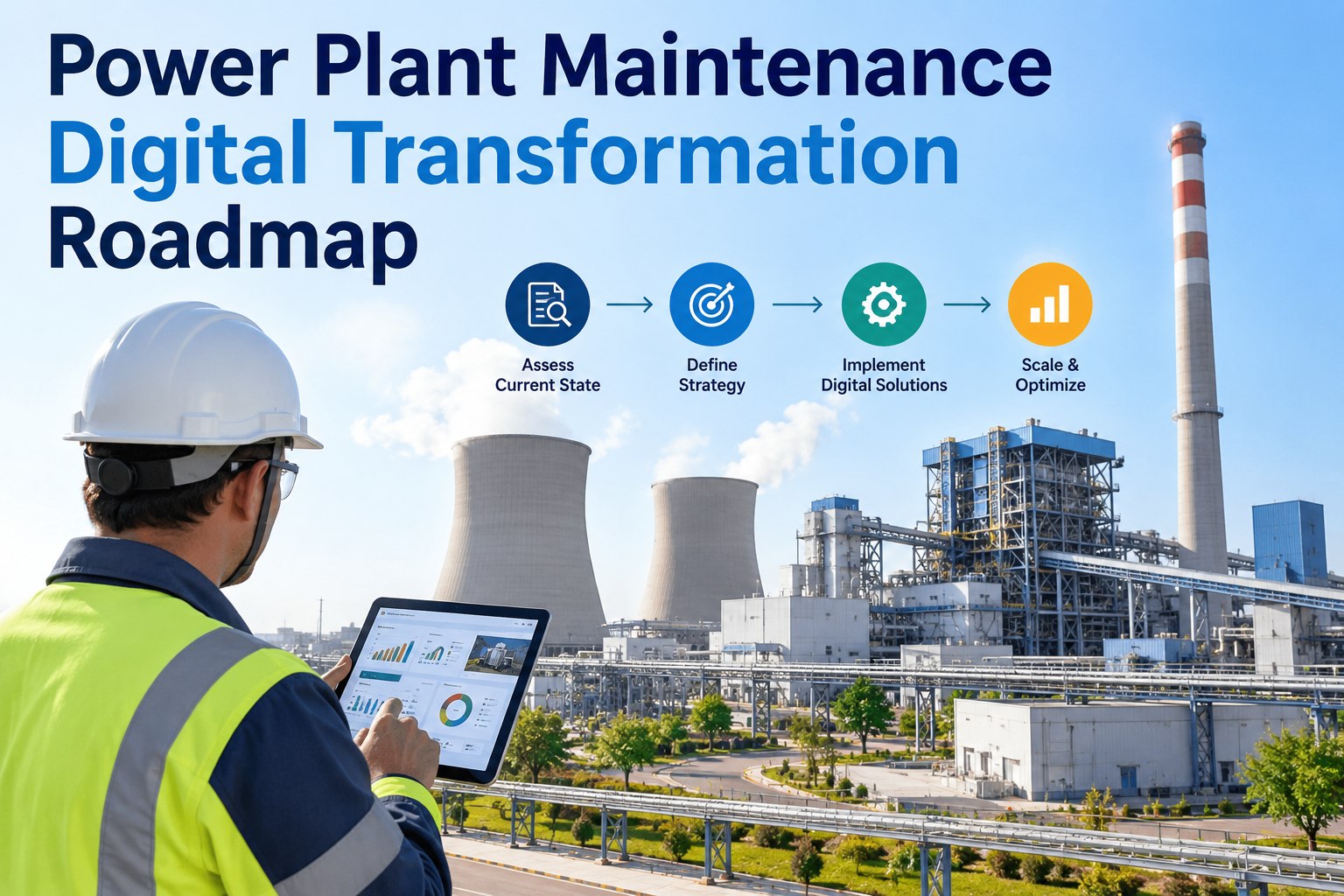
Climbing the ladder happens through a sequenced rollout, each phase delivering a usable win before the next begins — so momentum builds instead of a big-bang program stalling. OXMAINT AI structures the roadmap from the first asset record to predictive alerts. Start free and run the phased roadmap in OXMAINT AI.
Weeks 1–4
Phase 1 · Foundation
Build the asset registry and configure PM templates on the top critical assets, with OEM baseline intervals — the first automated PM work orders within days.
Weeks 5–10
Phase 2 · Workflow
Move reactive work to digital work orders, train crews on the mobile app, and track labor and parts per job — ending post-shift paperwork.
Weeks 11–20
Phase 3 · Intelligence
Turn on analytics for asset cost and PM compliance, trend mean-time-to-repair, and tune PM intervals on real data — plus regulatory reporting.
Month 6+
Phase 4 · Integration
Add IIoT condition triggers, connect ERP for purchasing, and enable offline mobile for remote areas — the first condition-triggered work order heads off an outage.
The sequencing matters as much as the phases: data scattered across spreadsheets is imported in phases rather than cleaned up first, and sensors are added in Phase 4 — onto a workflow crews already trust — not bolted onto paper in Phase 1, where their data would have nowhere to go.
The Predictive Pilot Fails When the Foundation Is Missing.
Sensors streaming into a plant that still runs on paper generate data nobody acts on. The climb works because each rung builds the thing the next one needs — clean asset data, trusted mobile workflows, then analytics, then prediction. OXMAINT AI carries all four on one platform so the foundation is always there.
The CMMS Is the Layer Everything Sits On
Every phase of the roadmap depends on one system holding the asset history, the work orders and the data. Without that foundation layer the analytics have nothing to analyze and the sensors have nowhere to report. OXMAINT AI is that layer from day one. Book a demo to see the foundation layer in OXMAINT AI.
Centralized asset history
Institutional knowledge captured against each asset instead of walking out the door with a retiring technician.
Live work-order visibility
Real-time status and backlog management, so the plant is managed by plan rather than by the last breakdown.
Automated compliance records
Audit-ready documentation for regulatory and ISO requirements, generated from the work itself.
Cost attribution
Spend broken out by asset, crew and work type, giving analytics something real to work on.
Digital shift handoff
Logbook integration so condition notes and open issues carry cleanly from one crew to the next.
Integration-ready
The hooks for IIoT sensors and ERP in later phases, so Phase 4 plugs in rather than starts over.
Transformation Is a People Problem Too
Technology rarely sinks a transformation — adoption does. Each group in the plant has its own stake in the change, and the roadmap succeeds when each sees what's in it for them. OXMAINT AI gives every role a reason to use it. Start free and bring every role on board in OXMAINT AI.
Plant manager
Availability and forced-outage risk, visible on one dashboard.
Maintenance superintendent
Planned-vs-reactive balance and backlog under control.
Finance controller
Maintenance spend attributed by asset and work type.
Compliance officer
Audit-ready records generated from the work itself.
Field technicians
A mobile app that ends the post-shift paperwork.
Operations team
Clean shift handoffs and fewer surprise trips.
“
We'd tried to jump straight to predictive once before — bought the sensors, ran a pilot, and it died because the data landed in a plant still keeping work orders on paper. The second attempt we did in order: asset registry and PM first, then got the crews onto mobile so the work was actually captured digitally, then switched on the analytics, and only then wired in the condition triggers. Doing it as a climb instead of a leap is the reason it stuck this time, and our planned-work ratio has been rising ever since.
Maintenance & Reliability Manager · Power Generation Plant
Frequently Asked Questions
What are the stages of maintenance maturity?
Four: reactive (run-to-failure, PM on paper), preventive (planned time-based PM with high compliance), condition-based (vibration, thermography and oil analysis guiding critical-asset work), and predictive (SCADA and sensor data feeding AI that intercepts failures weeks ahead). Each is defined by how decisions are made.
Book a demo to assess your stage in OXMAINT AI.
What are the implementation phases?
Four: Foundation (weeks 1–4, asset registry and PM templates on critical assets), Workflow (weeks 5–10, digital work orders and mobile crew adoption), Intelligence (weeks 11–20, analytics, MTTR trending and PM optimization), and Integration (month 6+, IIoT condition triggers and ERP connectivity).
Why not start with sensors and predictive analytics?
Because predictive analytics need clean asset data and trusted digital workflows to act on. Sensors added onto a paper-based plant produce data nobody works, which is why predictive pilots stall. The condition triggers go in last, onto a foundation the earlier phases built.
Do we have to clean up our data before we start?
No. Asset data scattered across spreadsheets and paper is imported in phases rather than perfected first — waiting for a pre-implementation cleanup is a common way transformations never begin. The registry is built and refined as the roadmap proceeds.
How do you get crews to actually adopt it?
With a mobile-first workflow that removes work rather than adding it — completing a job on a device in the field instead of filling out paperwork after the shift — and by giving every role, from plant manager to technician, a concrete reason the change helps them.
Start free and drive adoption in OXMAINT AI.
Climb to Predictive — One Phase at a Time.
Run your digital transformation on the OXMAINT AI maintenance management software — a four-stage maturity path, a sequenced four-phase roadmap from foundation to IIoT integration, a CMMS foundation layer under every phase, and adoption built for every role. Reach predictive by building the rungs, not leaping the gap.