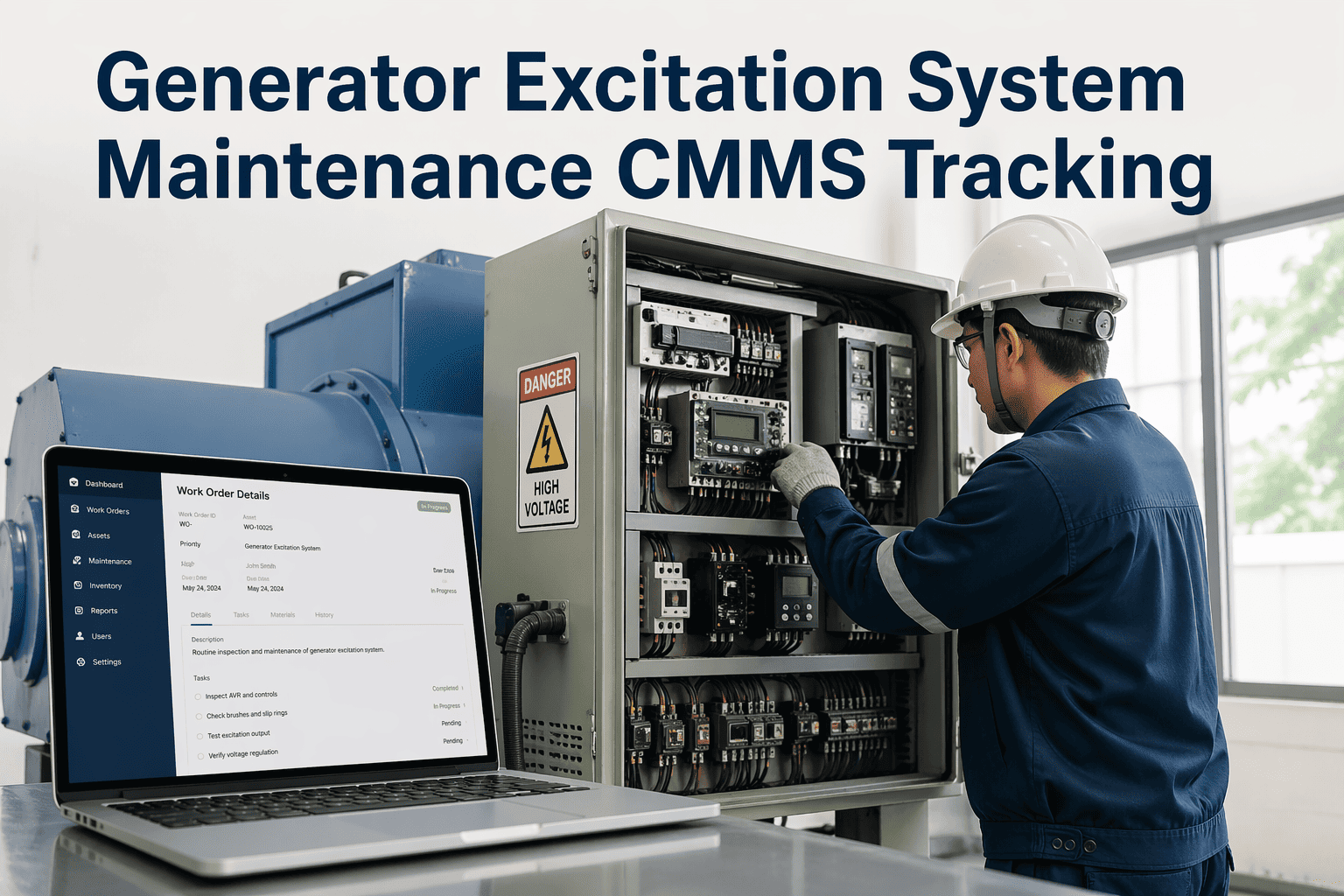
Generator Excitation System Maintenance CMMS Tracking

By Johnson on April 23, 2026

power-plant-excitation-system-maintenance-cmms

A generator excitation system failure is one of the few fault modes that can instantly separate a generating unit from the grid — and unlike mechanical failures, excitation degradation rarely announces itself before it causes a trip. AVR instability, brush gear wear beyond tolerance, slip ring surface deterioration, and excitation protection relay drift are all detectable in advance — but only if your maintenance team has a structured tracking system that captures inspection data, trending signals, and operating hour intervals in one place. Start a free trial with Oxmaint CMMS to build your excitation system maintenance program from a proven power generation framework, or book a 30-minute session with our generator reliability specialists to review your current excitation PM schedule.

System Overview

Why Excitation Systems Demand Dedicated CMMS Tracking

Excitation systems sit at the intersection of electrical protection, voltage regulation, and mechanical wear — three maintenance disciplines that are rarely managed by the same team or tracked in the same system. This fragmentation is the primary reason excitation-related forced outages are consistently underreported and under-maintained at thermal and hydro power plants.

12–18%
of generator-related forced outages are caused by excitation system faults
6,000 hrs
Typical brush gear inspection interval — often tracked only on paper
$180K+
Average cost of a generator trip caused by missed excitation maintenance
System Components

Four Excitation System Components That Require CMMS-Tracked Maintenance

Excitation maintenance is not a single task — it is a collection of interdependent component checks, each with different inspection intervals, different failure modes, and different consequences if missed. CMMS tracking treats each component class as an independent maintenance object within the generator asset hierarchy.

Automatic Voltage Regulator (AVR)
Digital control and regulation module
Inspection Interval
Annual or per OEM firmware release
Primary Failure Modes
Voltage instability, PID parameter drift, cooling fan failure
CMMS Tracking Points
Firmware version, last calibration date, setpoint verification log
Consequence of Miss
Voltage instability — potential unit trip
Brush Gear Assembly
Carbon brushes and brush holder mechanism
Inspection Interval
Every 2,000–4,000 operating hours
Primary Failure Modes
Brush wear beyond minimum length, excessive sparking, spring pressure loss
CMMS Tracking Points
Brush length measurement, replacement date, sparking severity rating
Consequence of Miss
Loss of field current — immediate unit trip
Slip Ring Assembly
Rotor current transfer surface
Inspection Interval
Every 4,000–8,000 hours; surface grind at major overhaul
Primary Failure Modes
Surface grooving, eccentricity, contamination-induced arcing
CMMS Tracking Points
Surface condition rating, runout measurement, cleaning and polish log
Consequence of Miss
Progressive wear — forced outage for slip ring regrind
Excitation Protection Relays
Loss-of-field, over-excitation, and under-excitation protection
Inspection Interval
Every 2 years or per protection relay testing schedule
Primary Failure Modes
Setting drift, relay failure to operate, CT/PT circuit degradation
CMMS Tracking Points
Test results, settings as-found vs as-left, secondary injection test dates
Consequence of Miss
Undetected over-excitation — generator winding damage
PM Schedule Framework

Excitation System PM Intervals: CMMS Work Order Structure

The table below shows the recommended CMMS work order structure for excitation system preventive maintenance — including trigger type, task scope, and the specific condition data points that should be recorded on every work order closure to build a valid trending baseline.

PM Task Trigger Type Interval Task Scope Data to Record in CMMS
Brush gear inspection Operating hours 2,000–4,000 hrs Measure brush length, inspect spring pressure, check for sparking or arcing marks Brush length (mm), spring load reading, sparking severity (1–5 scale)
Brush replacement Condition trigger When length < minimum Replace worn brushes, verify new brush bedding-in procedure, record batch number Replaced quantity, new brush supplier and batch, post-installation sparking check
Slip ring condition check Operating hours 4,000–8,000 hrs Inspect surface for grooving, measure runout, check for contamination or carbonization Surface condition rating, runout (mm), cleaning performed Y/N
AVR functional test and calibration Calendar Annual Verify AVR setpoints, test auto/manual transfer, check firmware version, inspect cooling Voltage setpoint as-found/as-left, firmware version, cooling fan condition
Excitation protection relay test Calendar Every 2 years Secondary injection test for LOF, OEL, and UEL protection; verify CT/PT circuits Test results pass/fail, settings as-found vs as-left, CT/PT ratio check
Rectifier diode inspection Calendar Annual or at major overhaul Inspect for overheating signs, test diode forward voltage drop, check connections Diode forward voltage readings, visual condition rating, torque check results
Insulation resistance test Calendar / condition Annual or after wetting event Megger test on excitation winding, field winding, and AVR isolation circuits IR values in MΩ, test voltage used, polarization index (PI) where applicable

Build Your Excitation Maintenance Program in Oxmaint

Oxmaint CMMS comes with a power generation asset template library that includes pre-built excitation system PM tasks, operating-hour triggers, and condition data fields — ready to deploy against your generator asset hierarchy from day one.

CMMS Trending

How CMMS Failure Trending Catches Excitation Problems Before They Trip the Unit

Brush wear is predictable. Slip ring grooving follows a measurable degradation curve. Relay setting drift happens over years, not overnight. All three patterns are detectable in CMMS data — if the data is being collected and the trending reports are being reviewed. Here is what a mature excitation maintenance program looks like in practice.

01
Brush Wear Rate Trending
When brush length measurements are recorded on every inspection work order, CMMS can calculate the wear rate (mm per 1,000 operating hours) for each brush position. A brush position showing 40% faster wear than the fleet average is a signal to investigate spring pressure, slip ring condition, or current distribution — before the brush reaches minimum length and causes an unexpected trip.
02
Slip Ring Surface Deterioration Tracking
A condition rating applied to slip ring surface at each inspection — even a simple 1–5 scale — creates a trend line over time. When the surface condition deteriorates across two or three consecutive inspections, CMMS triggers a maintenance alert before grooving depth reaches the threshold that requires an unplanned outage for regrinding. Planned slip ring regrind costs a fraction of an emergency outage.
03
Insulation Resistance Trend Analysis
Insulation resistance (IR) values recorded after every megger test build a multi-year trend line for the excitation winding. A declining IR trend — even if current values are still above minimum acceptable levels — gives the maintenance team 12–18 months of advance notice before insulation failure becomes imminent. This lead time is sufficient to plan winding inspection or refurbishment during a scheduled outage window.
04
Protection Relay As-Found Setting Drift
Recording protection relay settings as-found versus as-left on every test work order identifies relays that consistently require resetting at each 2-year interval — which is the signature of a relay approaching end of reliable service life. Without CMMS trending, these relays are simply reset each time and the drift pattern is invisible until the relay fails to operate when actually needed.
Frequently Asked Questions

Excitation System Maintenance and CMMS: Common Questions

Start with the OEM-recommended interval (typically 2,000–4,000 hours) as the baseline, then adjust based on your CMMS wear rate data after 3–4 inspection cycles. Generators operating at high load factors or in dusty environments typically require shorter intervals than OEM standards suggest. Oxmaint CMMS calculates wear rate trending from your inspection records and flags when interval adjustment is warranted.
No — they should be separate work orders with separate asset IDs, even though they occur in the same outage window. Combining them into one work order loses the individual trending data for each component. AVR calibration is annual; relay testing is biennial. Separate records allow independent compliance tracking and failure history per component. Talk to our team about excitation system CMMS hierarchy design.
The minimum viable data set is: inspection date, operating hours at inspection, condition rating per component, and any replacement or corrective action taken. With this data recorded consistently over 3 inspection cycles, CMMS can generate meaningful wear rate trends and interval optimization recommendations. Oxmaint provides pre-configured excitation work order templates that enforce this minimum data capture on every work order.
Brushless excitation eliminates brush gear and slip ring maintenance entirely — but introduces rotating rectifier diode inspection as a critical PM task. CMMS asset structure for brushless systems should include the exciter rotor, rotating rectifier assembly, and permanent magnet pilot exciter as separate maintainable items with their own inspection schedules. Book a session to configure the correct CMMS hierarchy for your excitation type.
Yes — and for excitation components like brush gear and slip rings, operating-hour triggers are significantly more accurate than calendar triggers because wear is driven by hours under current, not time elapsed. Oxmaint supports operating-hour, calendar, and condition-based triggers for the same asset — so brush gear triggers on hours while AVR calibration triggers on annual calendar schedule, all within the same asset hierarchy.

Track Every Excitation Inspection, Trend Every Reading, Prevent Every Avoidable Trip

Oxmaint CMMS gives your generator maintenance team operating-hour triggers, condition trend tracking, and pre-built excitation PM templates — so nothing is missed between outages and every inspection builds the data foundation for smarter maintenance decisions over time.

Share This Story, Choose Your Platform!